How to Balance a Tonearm and Set Tracking Force
Ten minutes, no tools, and it is the single adjustment that decides whether your records last decades or years. Here is the order, and the arithmetic behind it.
How this is funded: we earn a commission if you buy through our links, at no extra cost to you. It never changes which product we recommend, and we’ll tell you plainly when to skip one. Full disclosure.
If you own a turntable with a counterweight on the back of the arm, this is the most consequential ten minutes you will spend with it. Tracking force determines how hard a diamond presses into a groove wall, and getting it wrong in either direction wears records — permanently, and faster than most people expect.
It is also completely undramatic. No tools are required, nothing can be broken by getting it wrong on the first attempt, and the whole procedure is six steps.
What you are actually setting
A tonearm is a lever balanced on a pivot. At one end sits the cartridge; at the other, a movable counterweight. Slide the weight back and the stylus end rises; slide it forward and the stylus end presses down.
Tracking forceis how hard the stylus presses down, measured in grams. Cartridge makers publish a range and a recommended figure — Ortofon gives 1.6–2.0 g with 1.8 g recommended for the 2M Red, for example. That figure is not arbitrary. It is the force at which that particular stylus, with its particular suspension compliance, sits correctly in the groove.
The reason you zero-balancefirst is that the counterweight’s numbered ring is a relative scale, not an absolute one. It only means grams once you have established the point at which the arm is weightless. Skip that and the numbers on the ring are decorative.
Why both extremes are bad
This is the part that surprises people, so it is worth stating before the procedure.
Too heavy is the intuitive failure. More force, more friction, faster wear on both the groove and the stylus. It also raises the temperature at the contact point, which does the vinyl no favors.
Too light is worse.An under-weighted stylus cannot stay seated against the groove wall when the modulation gets violent. It loses contact, bounces, and slams back — hitting the groove wall edge-on at velocity rather than tracing it. That produces audible mistracking and does more physical damage than a slightly heavy setting.
Which is why the honest advice is: set it to the published figure. If you cannot, set it to the middle of the published range. If you must err, err towards the heavy end of that range, not below it.
The procedure
Work through the six steps in the box below in order. Two of them are the ones people get wrong.
Step 2, zero-balance. The arm should float level and stay there. Nudge it gently downward and it should return to level, not sink or spring up. If it drifts persistently in one direction, the counterweight needs moving, not the ring.
Step 3, zeroing the ring. On most arms the numbered ring rotates independently of the weight it sits on. You want to turn only the ring so that 0 aligns with the index mark, leaving the weight itself exactly where balance left it. Turning both together undoes step 2 and is the single most common mistake in this whole procedure.
Anti-skate: what it is compensating for
A pivoted tonearm sweeps an arc across a record while the groove is a spiral. That geometry means the friction between stylus and groove produces a net force pulling the arm inward, towards the spindle. It is a real force with a real magnitude, and it increases as the arm moves towards the center of the record.
Uncorrected, it means the stylus presses harder on the inner groove wall than the outer one. Consequences: uneven wear on both stylus and record, and channel imbalance, since the two groove walls carry the two stereo channels.
Anti-skateapplies a small outward force to cancel it — via a spring, a magnet or a hanging weight on a thread, depending on the deck. Setting it to the same number as the tracking force is the standard approximation and it is close enough for essentially all domestic use.
The diagnostic worth knowing: if a record mistracks or distorts consistently in one channel only, anti-skate is the first thing to adjust, before you suspect the cartridge.
Checking your work
Three levels of confidence, in increasing order of effort:
- By ear. Play a busy, loud, well-mastered side. Clean tracking on the loudest passages and through the inner grooves means you are in the right territory.
- By eye. Watch the arm as it plays. It should move smoothly inward with no visible hesitation or lateral twitching.
- By gauge. A digital stylus force gauge reads the actual force at the tip and takes the factory scale out of the equation. Worth it if you change cartridges regularly.
What to do if your deck has no counterweight
Then there is nothing to balance, and that is by design rather than an oversight. Fully automatic decks like the AT-LP60X use a fixed arm at a factory-set force matched to the fitted cartridge, because their cueing mechanism needs the arm to be a constant. The force is correct; it is simply not yours to change.
The trade-off that follows — no tracking force adjustment means no cartridge upgrades — is covered in automatic vs manual turntables, and the rare deck that offers both is the Denon DP-300F.
When to redo it
Re-balance whenever you change the cartridge (different mass, different specified force), whenever you change the stylus if the new one is a different profile with a different published range, after the deck has been moved or knocked, and as a routine annual check. Counterweights creep, particularly friction-fit ones.
Note the setting somewhere — a piece of tape under the plinth works — so you can tell at a glance whether it has moved. That is the same tape we suggest for stylus dates in how often to replace a stylus.
What this procedure assumes you have
An adjustable counterweight and a cartridge that publishes a tracking force. If your deck has neither, there is nothing to balance — and that is worth knowing before you go looking for a dial that does not exist.
A deck with a counterweight

Fluance RT81
First serious turntable that you won't outgrow in a year
Price as of October 14, 2026. #ad How we’re funded
A cartridge with a published force
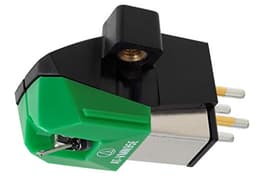
Audio-Technica AT-VM95E
The first cartridge upgrade for most decks
Frequently asked questions
How do you balance a tonearm?
Set anti-skate to zero, then rotate the counterweight until the arm floats level and parallel to the platter with the stylus guard off. That is zero balance. Then rotate only the numbered ring to 0 without moving the weight, and turn the whole assembly forward until the ring reads your cartridge's specified tracking force.
What tracking force should I use?
Whatever your cartridge publishes — never a general figure. Ortofon specifies 1.6-2.0 g for the 2M Red with 1.8 g recommended; Audio-Technica specifies 1.8-2.2 g for the AT-VM95E. If you cannot find your cartridge's specification, look it up before you guess: both extremes damage records.
Is it better to track too light or too heavy?
Neither, and too light is the more damaging mistake. A stylus that cannot stay seated in the groove rattles against the walls and skips, gouging as it goes. Too heavy wears the groove faster but at least traces it. If you must err, err slightly heavy within the published range.
What does anti-skate do?
It counteracts a real force. A pivoted tonearm traces an arc, and friction between stylus and groove pulls the arm inward towards the spindle. Anti-skate applies a small outward force to cancel that, so the stylus presses equally on both groove walls. Without it the inner wall takes more force than the outer one.
Should anti-skate equal tracking force?
As a starting point, yes — on most decks the two scales are printed to correspond, so set the anti-skate dial to the same number. It is a well-established approximation rather than a law of physics, and if a record consistently mistracks in one channel only, adjusting anti-skate slightly is the first thing to try.
Do I need a stylus force gauge?
Not to get a good result — counterweight scales are calibrated at the factory and are usually close. A gauge is worth owning if you swap cartridges often, if your arm is old enough that the scale may have drifted, or if you simply want to confirm rather than assume. It is a cheap accessory.
How often should I re-check the tracking force?
Whenever you change cartridge or stylus, if the deck has been moved or knocked, and as a routine check once or twice a year. Counterweights can creep, particularly on arms where the weight is a friction fit rather than threaded.
Sources
- Audio-Technica — Balancing the tonearm and setting tracking force — Manufacturer procedure for zero-balancing an arm, then dialing tracking force and anti-skate (accessed August 19, 2026)
- Elusive Disc — Turntable setup guide: tracking force & anti-skate — Step-by-step on balancing the tonearm, setting tracking force and anti-skate (accessed July 24, 2026)
- Ortofon — 2M Red — Manufacturer specs: 5.5 mV output, 1.6-2.0 g tracking (1.8 g recommended), 47 kOhm load (accessed July 24, 2026)
- Crutchfield — Phono cartridge guide — Reference on cartridge types, styli and mounting (accessed July 24, 2026)
Keep reading
Is 180 Gram Vinyl Better?
Why a heavier record slightly changes the arm height you just set.
Read the guideHow to Set Up a Turntable
The whole setup, of which this is the step that matters most.
Read the guideHow to Set Up a Cartridge
Mounting and alignment — do this before you balance.
Read the guideAutomatic vs Manual Turntables
Why some decks have a counterweight and others cannot.
Read the comparisonTurntable Troubleshooting
Skipping, distortion and channel imbalance, diagnosed.
Read the guideBest Stylus Force Gauges
Six gauges ranked on published accuracy and measuring height — and when the counterweight dial is already enough.
Choose a gauge