AT-LP60X vs AT-LP120XUSB
Audio-Technica's entry automatic against its direct-drive workhorse. They are not two rungs on one ladder, and the price gap is not what decides it.
How this is funded: we earn a commission if you buy through our links, at no extra cost to you. It never changes which product we recommend, and we’ll tell you plainly when to skip one. Full disclosure.
These are the two Audio-Technica decks people cross-shop more than any others, and the comparison is almost always framed as spend-less-versus-spend-more. That framing is wrong, and it is why so many AT-LP120XUSBs end up on shelves with the counterweight still in the box.
The AT-LP60X and the AT-LP120XUSB are not two rungs on one ladder. They are two different machines that happen to share a brand. One is built so that it cannot be operated incorrectly. The other is built so that it can be adjusted, upgraded and recorded from — which necessarily means it can also be set up badly.
The one question that decides it: are you going to touch the tonearm?
The short answer
- Buy the Audio-Technica AT-LP60X if you want to put a record on, press a button, and have the deck do the rest — including lifting the arm and stopping when the side ends. Nothing to balance, nothing to align, nothing to get wrong.
- Buy the Audio-Technica AT-LP120XUSB if you want an adjustable arm, a better cartridge you can keep upgrading, a third speed for 78s, and a USB output for digitizing. It asks for ten minutes of setup and it never cues or stops for you.
If both of those descriptions sound half right, skip to the section on what to buy when neither one fits — there is a genuine middle answer, and it is not either of these decks.
The tonearm is the whole comparison
Every other difference between these two turntables is downstream of one design decision, so it is worth being precise about it.
The AT-LP60X has a fixed tonearm. There is no counterweight and no anti-skate control. Tracking force is set at the factory and you cannot change it. That is not corner-cutting — it is what makes the automation dependable. A mechanism that cues, returns and shuts off has to know exactly what mass it is moving, and an arm the owner can rebalance would break that assumption.
The AT-LP120XUSB has a balanced S-shaped arm with a counterweight, adjustable dynamic anti-skate, a hydraulically damped lift and a lockable rest. You zero-balance it, dial in the force the cartridge specifies, then match anti-skate to it. Audio-Technica publishes that procedure for this exact deck, and our guide to balancing a tonearm and setting tracking force walks the same steps with the reasons attached.
This is the fork in the road. An adjustable arm can carry a better cartridge, because you can set the force that cartridge needs. A fixed arm cannot, because you cannot. Everything below follows from that.
The cartridge, and the ladder behind it
The AT-LP60X ships with the AT3600L, a conical-stylus cartridge with a replaceable stylus. A conical tip is rounded and forgiving of a slightly imperfect angle — exactly the right choice for an arm nobody can align.
The AT-LP120XUSB ships with the AT-VM95E, an elliptical cartridge from Audio-Technica’s VM95 family. The elliptical tip has a narrower contact radius, sits deeper in the groove wall and traces finer modulation. In practice that reads as more air around cymbals and strings, cleaner separation in dense mixes, and vocal texture that stays texture instead of flattening into a shape.
The upgrade ladder matters more than the starting point. The VM95 body accepts the whole VM95 stylus range as snap-on swaps — you can move up to a micro-linear or Shibata profile later without buying a new cartridge, and the VM95 stylus range is the cheapest genuine sound upgrade in budget vinyl. The AT-LP60X’s arm takes a proprietary fixed mount; a worn stylus is replaced with the same stylus, and that is where its ceiling is.
Over five years that difference is worth more than the price gap between the two decks. A cartridge upgrade on the AT-LP120XUSB costs a fraction of a new turntable and improves what you hear more than moving between budget decks would.
Direct drive, and what it is actually for
The AT-LP60X is belt drive: an elastic belt turns the platter, which isolates it from motor vibration. The AT-LP120XUSB is direct drive, with a DC servo motor under the platter and quartz speed lock on its pitch control.
Be honest about what that buys a listener. It is not, at this price, better sound in any straightforward sense — setup and cartridge dominate both decks. It buys two concrete things: speed that arrives instantly and holds across a long side, and torque, which is why the platter resists a hand and why DJs use decks like this. Speed stability is the one that matters to a listener, and it matters most on piano and sustained strings, where wavering pitch is audible, and when recording a side to a computer, where a drift is baked into the file forever.
There is also a maintenance angle nobody mentions in the spec table: a belt is a consumable. The AT-LP60X will need a new one eventually. The AT-LP120XUSB has nothing to stretch. Our belt drive vs direct drive guide covers the full trade, including the old objection about motor noise and why modern designs largely engineer it out.
Speeds, USB and the things only one deck does
The AT-LP60X plays 33 1/3 and 45 RPM. The AT-LP120XUSB adds 78 RPM and a USB output, and its listing includes the USB cable, a detachable RCA output cable, the 45 RPM adapter, a felt mat, the counterweight and a removable hinged dust cover.
Two honest caveats on those headline features. The USB output is class-compliant, so a computer sees it as an audio input with no drivers to install and free software such as Audacity records from it — but the capture is only ever as good as the cartridge, the tracking force and how clean the record is. The converter is not the bottleneck. And the 78 RPM setting is not the whole story either: a shellac 78 has a much wider groove than a microgroove LP, so playing 78s properly needs a 78-specific stylus. The stock elliptical is cut for modern records. That the VM95 family offers one is a genuine advantage, but it is a separate purchase.
What the AT-LP60X does better
It would be dishonest to write this as a one-sided comparison. Full automation is a real feature, not a consolation prize, and the cheaper deck wins on four counts.
- It cannot be set up wrong. The most common cause of poor sound and avoidable record wear on a manual deck is an arm that was never balanced. The AT-LP60X removes that failure mode completely.
- It lifts at the end of a side. The AT-LP120XUSB does not. A manual deck leaves the stylus in the run-out groove until someone notices, which on a fall-asleep evening is hours of pointless wear on a stylus you paid for.
- It cannot be dropped on a record. The mechanism lowers the stylus, not your hand. On a shared deck — or one a child can reach — that is worth more than a spec sheet suggests.
- It is far easier to place. Audio-Technica’s listings put the AT-LP60X at 14.7 by 14.1 by 3.8 inches, against 17.8 by 13.9 by 5.6 inches for the AT-LP120XUSB, which is also the substantially heavier machine. Measure your shelf before you assume the bigger deck fits, and remember the dust cover needs clearance to hinge open above it.
There is a spending argument too. The difference between these two decks buys a decent pair of powered speakers, and on a first system the speakers change what you hear more than the turntable does.
Where they are identical
Both have a switchable built-in phono preamp, which is the single most under-appreciated thing these two share. Either one plugs straight into powered speakers or any line input today, and either can be switched to phono output later when you add a separate phono stage or an amplifier with a phono input. Neither locks you in.
Both use a replaceable magnetic cartridge tracking at a sane force, so neither will grind down your records the way a sealed ceramic suitcase player does. Both run their AC/DC conversion outside the chassis on an external adapter. Both come with a dust cover. And neither has speakers — both need something to plug into, which is a cost people forget when they compare the two price tags.
If neither answer fits
A lot of people want the automatic convenience of the AT-LP60X and the adjustable arm of the AT-LP120XUSB, and assume they have to choose. They do not, quite.
- You want automation and an upgrade path: the Denon DP-300F is the rare fully automatic deck that still gives you a counterweight, anti-skate and a standard removable headshell. It costs more than the AT-LP60X and it is the honest answer to “can I have both?”. Audio-Technica’s own AT-LP70X is the cheaper half-step: still automatic, still no on-arm force adjustment, but it upgrades the cartridge to a VM95-series body, which reopens the stylus ladder. You will find it among the decks with a switchable built-in preamp.
- You want an adjustable arm but will never digitize or DJ: the Fluance RT81 gives you a counterweight, anti-skate and an elliptical cartridge for less than the AT-LP120XUSB, because none of its budget went into a USB converter, a pitch fader or a third speed. That is the comparison to read next if the tonearm is what you are actually buying.
What each one costs you after the box is open
Comparing two price tags is not the same as comparing two purchases, and on these decks the running costs point in opposite directions.
Neither one needs a phono preamp, which is genuinely money saved against decks that ship without a stage. Both need something to plug into, and that spend is the same either way. From there they diverge. The AT-LP60X will eventually want a new belt, and its stylus is a consumable like every stylus — worn tips are replaced on hours played, not on how they look, and on the AT-LP60X a replacement is strictly a like-for-like part.
On the AT-LP120XUSB the same recurring cost is optional spending instead. When the stylus wears out you can fit the identical one, or move a rung up the VM95 ladder for a real improvement, on the same cartridge body. Against that, its headline features are the ones that carry an extra invoice: a 78-specific stylus if you actually intend to play shellac, and, if you are archiving seriously, storage for the uncompressed files the USB output is worth using. Both decks are cheap to keep. Only one of them can be made better with the money.
The decision, in one paragraph
Buy the AT-LP60X if the turntable should make its own decisions: you have records you want to play, you are not interested in becoming an owner-operator, and you would rather the difference went into speakers. Buy the AT-LP120XUSB if you will balance the arm, if a USB output or a 78 speed is a real requirement rather than a nice idea, and if you expect to put a better stylus on it in a year or two. The one outcome to avoid is buying the AT-LP120XUSB, never balancing the arm, and leaving the stylus parked in the run-out groove every night — that is the case where the more expensive deck delivers less than the cheaper one, and it is more common than it should be.
Both decks, with live prices
Prices are pulled live and dated. Neither deck is a mistake — but one of them is the wrong machine for most of the people who buy it.
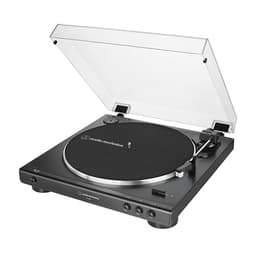
Audio-Technica AT-LP60X
A safe, genuinely automatic first deck under $200
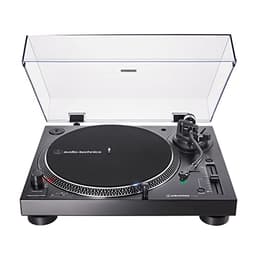
Audio-Technica AT-LP120XUSB
Digitizing records and learning proper setup
Frequently asked questions
Is the AT-LP120XUSB worth the extra money over the AT-LP60X?
It is if you will use the adjustable tonearm, the third speed or the USB output. The AT-LP120XUSB ships with an elliptical cartridge on an arm you can balance, so it sounds better and can be upgraded for years. If you only ever want to press a button and hear an album, the extra money buys hardware you will never touch — and a deck that no longer lifts its own arm.
Which is better for a beginner, the AT-LP60X or the AT-LP120X?
The AT-LP60X, if 'beginner' means you want nothing to set. It is fully automatic and its tracking force is fixed at the factory, so it cannot be set up wrong. The AT-LP120XUSB is a fine first deck for someone willing to balance a tonearm and set anti-skate — but left unbalanced it will perform worse than the cheaper machine.
Can I upgrade the cartridge on the AT-LP60X?
Not meaningfully. The arm carries a proprietary fixed mount with no counterweight, so you can replace a worn stylus with the same stylus and that is the end of the road. The AT-LP120XUSB takes a standard half-inch cartridge on a removable headshell, and its counterweight lets you dial in whatever tracking force the new cartridge specifies.
Does the AT-LP120XUSB stop at the end of a record?
No. It is fully manual: it has a damped cueing lever and a lockable arm rest, but nothing returns the arm for you. If you fall asleep with a record on, the stylus sits in the run-out groove until someone lifts it. The AT-LP60X returns the arm and stops on its own, which is a real advantage and not just a convenience.
Do either of them need a separate phono preamp?
No. Both have a switchable built-in phono stage, so both plug straight into powered speakers or any line input as they come. Both can also be switched to phono output later if you add a separate preamp or an amplifier with a phono input — you just never run two phono stages at once.
Which one should I buy for recording vinyl to a computer?
The AT-LP120XUSB, without hesitation. It has a USB output that records straight to a computer, plus direct-drive speed stability that keeps a long side from drifting — a drift becomes a permanent property of the file. The AT-LP60X has no digital output at all; digitizing from it means running its analog output into a separate audio interface.
What is the difference between the AT-LP120X, the AT-LP120XUSB and the AT-LP120XBT-USB?
AT-LP120XUSB is the full model name of the deck compared here — 'AT-LP120X' is how most people shorten it. The AT-LP120XBT-USB is the closely related model that adds Bluetooth output for streaming to a wireless speaker. If you only ever use wired outputs, the plain USB version costs less and sounds the same over RCA.
Sources
- Audio-Technica — AT-LP60X turntable — Manufacturer specs for the fully automatic belt-drive AT-LP60X (accessed August 11, 2026)
- Audio-Technica — Balancing the tonearm and setting tracking force — Manufacturer procedure for zero-balancing an arm, then dialing tracking force and anti-skate (accessed August 19, 2026)
- Audio-Technica — AT-VM95E cartridge — Manufacturer specs: 0.3 x 0.7 mil elliptical stylus on an aluminum cantilever, 4.0 mV output at 1 kHz / 5 cm/sec, 1.8-2.2 g tracking force (2.0 g standard), 20-22,000 Hz, 20 dB channel separation at 1 kHz, half-inch mount, AT-VMN95E replacement stylus, and the maker's own statement that "all VM95 Series share the same body" so the stylus "can be replaced with any of the six interchangeable AT-VMN95 replacement styli". Re-read on the access date below, which corrected a tracking-force range previously noted here as 1.8-2.3 g (accessed September 26, 2026)
- Audio-Technica — VM95 Series cartridges — The shared-body VM95 range and its interchangeable stylus upgrade path (accessed July 24, 2026)
- Crutchfield — How to choose the right turntable — Buying-guide reference on drive type, cartridges, preamps and setup (accessed July 24, 2026)
Keep reading
Audio-Technica AT-LP60X Review
The full case for the automatic deck, including exactly where its ceiling is.
Read the reviewAudio-Technica AT-LP120XUSB Review
The full case for the direct-drive deck, and its real limits.
Read the reviewAutomatic vs Manual Turntables
The trade-off underneath this whole comparison, generalized past these two.
Read the guideAT-LP60X vs AT-LP70X
The other step inside the range — the one that keeps the automation and reopens the stylus ladder.
Compare themBest Turntables Under $500
Everything else competing at the money the AT-LP120XUSB asks for.
See the picks