AT-LP60X vs Fluance RT81
Two decks about $120 apart that represent two different ideas of what a turntable is for. Here is the one question that decides between them.
How this is funded: we earn a commission if you buy through our links, at no extra cost to you. It never changes which product we recommend, and we’ll tell you plainly when to skip one. Full disclosure.
These two decks come up together constantly, and the comparison is usually framed as cheap-versus-better. That framing is wrong and it leads people to buy the wrong one. They are not two points on a quality ladder. They are two different products built on opposite design philosophies, and about $120 apart.
The one question that decides it: do you want the turntable to make its own decisions, or do you want to make them?
The short answer
- Buy the Audio-Technica AT-LP60X if you want to press a button and hear a record. Full automation, nothing to set, nothing to get wrong, and a factory tracking force that is correct out of the box.
- Buy the Fluance RT81if you expect vinyl to last. An adjustable counterweight, anti-skate, an elliptical stylus and a standard cartridge mount — in exchange for cueing the arm yourself and spending ten minutes on setup.
Where the $120 actually goes
The tonearm
This is the difference that produces every other difference. The AT-LP60X has a fixed arm: no counterweight, no anti-skate. That is not a cost saving — it is what makes the automation mechanism reliable. The RT81 has an adjustable arm: you balance it, dial in the tracking force the cartridge specifies, and set anti-skate to match.
Everything downstream follows from that. An adjustable arm can carry a better cartridge, because you can set the force it needs. A fixed arm cannot, because you cannot.
The stylus
The AT-LP60X uses a conical stylus — a simple rounded tip that is forgiving of a slightly wrong angle, which is exactly right for an arm you cannot adjust. The RT81 uses an elliptical stylus, whose narrower contact profile sits deeper in the groove and traces finer modulations.
What that sounds like: more air around cymbals and strings, better separation between instruments in a dense mix, and vocal texture that reads as texture rather than as a shape. It is the clearest audible difference between the two decks, and it is a consequence of the tonearm rather than a separate upgrade.
The upgrade path
The RT81’s cartridge sits on a standard half-inch mount in a removable H-4 bayonet headshell. An AT-VM95E, an AT-VM95ML or a Nagaoka MP-110 all bolt straight on, and the counterweight lets you set the tracking force each one needs. Check the mass of anything heavier first: Fluance publishes this arm’s supported cartridge weight as 3.5 to 6.5 g, which those three sit inside and an Ortofon 2M Red at 7.2 g does not — the RT81 vs RT82 comparison works through that ceiling. The AT-LP60X’s arm takes a proprietary fixed mount, so its ladder is one rung and then the end of the road.
Over five years, that difference is worth more than the $120. A cartridge upgrade on the RT81 costs less than a new turntable and improves the sound more than moving from one budget deck to another would.
What the AT-LP60X does better
It would be dishonest to frame this as a one-sided comparison. Full automation is a real advantage, not a consolation prize.
- It cannot be set up wrong. The single most common cause of poor sound and record wear on a manual deck is an arm that was never balanced. The AT-LP60X removes that possibility entirely.
- It cannot be dropped on a record. The mechanism lowers the stylus, not your hand. On a shared deck, or one children can reach, this matters.
- It lifts at the end of a side. A manual deck leaves the stylus in the run-out groove until someone notices, which on a fall-asleep evening means hours of unnecessary wear.
- It costs less. The difference funds a decent pair of powered speakers or a few dozen records, both of which affect your listening more than the deck upgrade would.
Where they are the same
Both are belt drive. Both have a switchable built-in phono preamp, so both plug straight into powered speakers today and into a separate phono stage later. Both use a replaceable magnetic cartridge that tracks at a safe force, so neither will wear your records the way a ceramic-cartridge suitcase player does. Both need something to plug into — neither has speakers.
The decision, in one paragraph
If you are buying a turntable because you inherited some records and want to play them, buy the AT-LP60X and spend the difference on speakers. If you are buying a turntable because you have started buying records deliberately, buy the RT81, spend ten minutes setting it up properly, and plan to put a better cartridge on it in a year or two. The mistake is buying the RT81 and never balancing the arm — that is the one outcome where the extra $120 buys you worse sound than the cheaper deck.
Both decks, with live prices
Prices are pulled live and dated. Neither deck is a bad buy — they answer different questions.
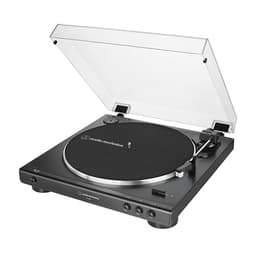
Audio-Technica AT-LP60X
A safe, genuinely automatic first deck under $200
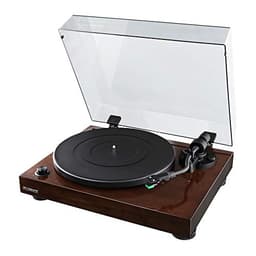
Fluance RT81
First serious turntable that you won't outgrow in a year
Price as of October 16, 2026. #ad How we’re funded
Frequently asked questions
Is the Fluance RT81 better than the AT-LP60X?
It sounds better and it can be upgraded, because it has an elliptical stylus, an adjustable counterweight and anti-skate, and a standard cartridge mount. The AT-LP60X is better at being effortless: it is fully automatic and cannot be set up wrong. Which one is 'better' depends entirely on which of those you want.
Is the Fluance RT81 worth the extra money?
If you expect to keep listening to records for years, yes — the adjustable arm and standard cartridge mount mean the deck can grow instead of being replaced. If you want to press a button and hear music with no learning curve, the extra money buys you something you will not use.
Does the AT-LP60X sound bad compared with the RT81?
No, it sounds good for what it is. The gap is real but it is a matter of degree: the RT81's elliptical stylus retrieves more high-frequency detail and separation than the AT-LP60X's conical one. Neither deck damages records or sounds broken.
Which is better for a beginner, the AT-LP60X or the RT81?
The AT-LP60X, if 'beginner' means you want zero setup. The RT81, if 'beginner' means you are new but willing to spend ten minutes balancing a tonearm. The RT81 rewards that time; left unadjusted, it performs worse than the factory-set AT-LP60X.
Can both decks connect to powered speakers?
Yes. Both have a switchable built-in phono preamp, so both can output line level directly into powered speakers, and both can be switched to phono output later if you add a separate preamp or a receiver with a phono input.
Can I upgrade the cartridge on either deck?
On the RT81, yes — it uses a standard half-inch mount and has a counterweight to rebalance for a new cartridge. On the AT-LP60X, effectively no: the arm carries a proprietary fixed mount with no counterweight, so you can replace the stylus but not move to a different cartridge.
Sources
- Audio-Technica — AT-LP60X turntable — Manufacturer specs for the fully automatic belt-drive AT-LP60X (accessed August 11, 2026)
- Crutchfield — How to choose the right turntable — Buying-guide reference on drive type, cartridges, preamps and setup (accessed July 24, 2026)
- Audio-Technica — VM95 Series cartridges — The shared-body VM95 range and its interchangeable stylus upgrade path (accessed July 24, 2026)
- Elusive Disc — Turntable setup guide: tracking force & anti-skate — Step-by-step on balancing the tonearm, setting tracking force and anti-skate (accessed July 24, 2026)
Keep reading
Audio-Technica AT-LP60X Review
The full case for the automatic deck, including where its ceiling is.
Read the reviewFluance RT81 Review
The full case for the adjustable deck, and the setup it demands.
Read the reviewAutomatic vs Manual Turntables
The same trade-off, generalized beyond these two decks.
Read the guideBest Turntables Under $300
Everything else in the tier these two bracket.
See the picks