PLATTER & PLINTH

The Best Automatic Turntables

Automatic means three different things, and only one of them puts the arm back on its rest. This is what each of these decks actually does when the side ends — and what the mechanism costs you at the tonearm.

By Stephen V.Last updated How we pick

An automatic turntable takes one job off you: it puts the stylus down at the start of a side and, more importantly, picks it up again at the end. That second half is the part people are really buying. A record finishes, the stylus sits in the run-out groove going round and round, and on a manual deck nothing stops it until somebody walks over.

The trouble is that “automatic” is printed on listings that mean three different things by it. Fully automatic decks start, play, lift and return the arm to its rest, then stop the platter. Semi-automatic decks make you cue the first groove yourself but lift the arm and stop playback at the end. Auto-lift is the narrowest version — the arm rises and the platter carries on turning. All three get sold with the same word, and the difference decides whether the deck solves your problem.

The second thing worth knowing before you spend anything: on most cheap automatics, the automation is paid for at the tonearm. The mechanism is simplest and most reliable when the arm is light and its tracking force is fixed at the factory, which is exactly why the sub-$200 automatics have no counterweight and no anti-skate. That is a real trade, not a conspiracy — and three of the six decks below refuse to make it.

Every pick here has a phono preamp built in, so each one drives powered speakers or a spare line input with no extra box. We own none of these decks and have listened to none of them; every figure below is read from the maker’s published data or the live retail listing, and each was confirmed as a buyable offer before it went on the page. If you are still deciding whether you want automation at all, start with automatic vs manual turntables.

How this is funded:we earn a commission if you buy through our links, at no extra cost to you. It never changes which product we recommend, and we’ll tell you plainly when to skip one. Full disclosure.

Quick picks

Ranked on published specs, drive/motor design and buyer fit. Select a row to jump to the full write-up. We have not heard most of these units — here is exactly what we do instead.

#ProductBest forPrice
1
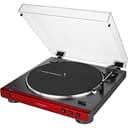
Audio-Technica AT-LP60X

Audio-Technica AT-LP60X

The default first turntable for a reason: it's fully automatic, so you press one button and it cues, plays and returns the arm on its own — nothing to set up wrong. The built-in switchable preamp lets it plug into anything, and it tracks safely enough to trust with your records.

Best overall
$179.00 · View on Amazon

$199.0010% off

Price as of September 2, 2026. #ad How we’re funded

2
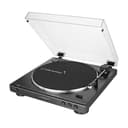
Audio-Technica AT-LP70X

Audio-Technica AT-LP70X

The automatic that grew up: it keeps the one-button convenience of the LP60X but adds a proper VM95-series cartridge and a die-cast platter, so it sounds a clear step better while still cueing itself. The natural pick if you want automation without the budget-deck ceiling.

Best upgrade path
$249.00 · View on Amazon

Price as of September 2, 2026. #ad How we’re funded

3
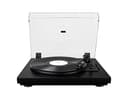
Pro-Ject Automat A1

Pro-Ject Automat A1

The automatic that answers the usual objection to automatics. Pro-Ject states that the mechanism is entirely mechanical: press start and the arm is carried to the lead-in groove, and once the record is playing the automatics are disengaged. Underneath the convenience is a real deck — an 8.3-inch aluminum tonearm, a pre-adjusted Ortofon OM 10 with an elliptical stylus, a damped aluminum platter in a wooden chassis, and a switchable moving-magnet phono stage.

Best for sound
$399.99 · View on Amazon

Price as of September 2, 2026. #ad How we’re funded

4
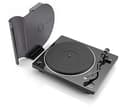
Denon DP-300F

Denon DP-300F

A fully automatic belt-drive deck with a built-in preamp and a die-cast aluminum platter — the convenient choice for someone who wants set-and-forget play but a more substantial build than the budget automatics. It has a proper counterweight, so it's automatic and adjustable.

Best adjustable arm
$449.00 · View on Amazon

$499.0010% off

Price as of September 2, 2026. #ad How we’re funded

5
Audio-Technica AT-LP60XBT

Audio-Technica AT-LP60XBT

The AT-LP60X with Bluetooth added: the same safe, fully automatic belt-drive deck, but able to stream straight to a wireless speaker or headphones. The easiest way to get records playing wirelessly without dropping to a novelty player.

Best wireless
$259.00 · View on Amazon

$299.0013% off

Price as of September 2, 2026. #ad How we’re funded

6
Denon DP-450USB

Denon DP-450USB

The most complete record-digitizing deck we can find: one-touch USB-A recording straight to a thumb drive with no computer involved, three speeds including 78 RPM, a weighted belt-driven platter and a curved tonearm with auto lift and stop at the end of a side. It is expensive for what it is, and it is also the only deck here that will archive a shellac 78 without a laptop.

Best semi-automatic
$719.00 · View on Amazon

$799.0010% off

Price as of September 2, 2026. #ad How we’re funded

The picks in full

#1Best overall

Audio-Technica AT-LP60X

The default first turntable for a reason: it's fully automatic, so you press one button and it cues, plays and returns the arm on its own — nothing to set up wrong. The built-in switchable preamp lets it plug into anything, and it tracks safely enough to trust with your records.

Strengths

  • Fully automatic — start and stop at the touch of a button, no manual cueing
  • Switchable built-in preamp connects to powered speakers or a receiver
  • Tracks at a sane force with a replaceable Audio-Technica stylus

Trade-offs

  • Fixed tonearm — no counterweight or anti-skate to adjust
  • Conical (spherical) stylus is a rung below the elliptical on step-up decks
DriveBelt drive
OperationFully automatic
CartridgeAudio-Technica AT3600L (conical, replaceable stylus)
Built-in preampYes — switchable
Speeds33 1/3 and 45 RPM
Bluetooth / USBNo

Note. The fixed tonearm is the trade for the automation: you can't adjust tracking force, but you also can't set it wrong. That's the right trade for a first deck.

Specifications read from the manufacturer / product listing, on July 24, 2026. “Not published” means the maker does not state that figure.

#2Best upgrade path

Audio-Technica AT-LP70X

The automatic that grew up: it keeps the one-button convenience of the LP60X but adds a proper VM95-series cartridge and a die-cast platter, so it sounds a clear step better while still cueing itself. The natural pick if you want automation without the budget-deck ceiling.

Strengths

  • Fully automatic operation, like the LP60X
  • Upgraded to the VM95C cartridge on a detachable headshell mount
  • Anti-resonance die-cast aluminum platter

Trade-offs

  • Costs more than the LP60X for a similar convenience level
  • Still no on-arm tracking-force adjustment
DriveBelt drive
OperationFully automatic
CartridgeAudio-Technica AT-VM95C (conical, VM95 series)
Built-in preampYes — switchable
Speeds33 1/3 and 45 RPM
PlatterDie-cast aluminum

Note. Because it uses the VM95 cartridge body, you can later drop in a VM95E elliptical or higher stylus without changing the whole cartridge — a real upgrade path the LP60X doesn't offer.

Specifications read from the manufacturer / product listing, on July 24, 2026. “Not published” means the maker does not state that figure.

#3Best for sound

Pro-Ject Automat A1

The automatic that answers the usual objection to automatics. Pro-Ject states that the mechanism is entirely mechanical: press start and the arm is carried to the lead-in groove, and once the record is playing the automatics are disengaged. Underneath the convenience is a real deck — an 8.3-inch aluminum tonearm, a pre-adjusted Ortofon OM 10 with an elliptical stylus, a damped aluminum platter in a wooden chassis, and a switchable moving-magnet phono stage.

Strengths

  • Pro-Ject publishes that the automatics are fully mechanical and are taken out of the equation once the record is playing
  • Ships with an Ortofon OM 10 elliptical cartridge on a carbon-reinforced headshell, with tracking force and anti-skate factory pre-adjusted
  • Switchable built-in MM phono stage with gold-plated RCA connectors — line input today, an external stage later

Trade-offs

  • Costs roughly twice what the entry automatics do, and much of that goes to the mechanism rather than to the cartridge
  • Two speeds only, and no USB or Bluetooth output is published — this is a wired listening deck
  • The published wow and flutter figure is ordinary for the money; the case for this deck is the arm, the cartridge and the mechanism, not a speed-stability number
DriveBelt drive, fully automatic
OperationMechanical auto start and stop, disengaged during play
CartridgeOrtofon OM 10 (elliptical), factory pre-adjusted
Tonearm8.3 in ultra-light-mass aluminum, carbon-reinforced headshell
Built-in preampYes — switchable moving magnet
Speeds33 1/3 and 45 RPM, electronic speed change
PlatterDamped aluminum
Wow & flutter33: +/-0.27%, 45: +/-0.25%
Signal to noise65 dB

Note. The OM 10 is the part that keeps paying off: Ortofon publishes 4 mV output, a 1.25-1.75 g tracking range with 1.5 g recommended, and an r/R 8/18 um elliptical tip, and it sells replacement styli for the OM bodies separately — so the cartridge is a starting point rather than a fixed fitting.

Specifications read from the manufacturer / product listing, on September 1, 2026. “Not published” means the maker does not state that figure.

#4Best adjustable arm

Denon DP-300F

A fully automatic belt-drive deck with a built-in preamp and a die-cast aluminum platter — the convenient choice for someone who wants set-and-forget play but a more substantial build than the budget automatics. It has a proper counterweight, so it's automatic and adjustable.

Strengths

  • Fully automatic start and stop with a real counterweight for tracking force
  • Built-in switchable phono preamp
  • Solid die-cast platter and a well-regarded, long-lived design

Trade-offs

  • Stock headshell/cartridge is basic; many owners upgrade it
  • Styling is dated next to newer decks
DriveBelt drive
OperationFully automatic
CartridgeDenon DSN-85 (included)
Built-in preampYes — switchable
Speeds33 1/3 and 45 RPM
PlatterDie-cast aluminum

Note. It's unusual in offering both full automation and an adjustable counterweight, which makes it a good fit for someone who wants convenience without the fixed-arm compromise of the cheapest automatics.

Specifications read from the manufacturer / product listing, on July 24, 2026. “Not published” means the maker does not state that figure.

#5Best wireless

Audio-Technica AT-LP60XBT

The AT-LP60X with Bluetooth added: the same safe, fully automatic belt-drive deck, but able to stream straight to a wireless speaker or headphones. The easiest way to get records playing wirelessly without dropping to a novelty player.

Strengths

  • Fully automatic and easy — same proven platform as the LP60X
  • Bluetooth output pairs directly with a wireless speaker or headphones
  • Switchable built-in preamp for wired use too

Trade-offs

  • Bluetooth trades a little fidelity versus the wired output
  • Fixed tonearm — no tracking-force adjustment
DriveBelt drive
OperationFully automatic
WirelessBluetooth output
CartridgeAudio-Technica AT3600L (conical, replaceable stylus)
Built-in preampYes — switchable
Speeds33 1/3 and 45 RPM

Note. It's the wireless version of our top beginner pick, so everything in that review applies — you're paying the small premium purely for Bluetooth out.

Specifications read from the manufacturer / product listing, on July 24, 2026. “Not published” means the maker does not state that figure.

#6Best semi-automatic

Denon DP-450USB

The most complete record-digitizing deck we can find: one-touch USB-A recording straight to a thumb drive with no computer involved, three speeds including 78 RPM, a weighted belt-driven platter and a curved tonearm with auto lift and stop at the end of a side. It is expensive for what it is, and it is also the only deck here that will archive a shellac 78 without a laptop.

Strengths

  • One-touch USB-A recording to a drive — no computer, no recording software
  • Semi-automatic: the arm lifts and playback stops at the end of a side
  • Supports both MM and MC cartridges, and plays 78 RPM shellac

Trade-offs

  • Costs roughly twice what a computer-based USB deck does
  • Semi-automatic only — you still cue the arm at the start of a side
DriveBelt drive, weighted platter
OperationSemi-automatic (auto lift and stop)
DigitalOne-touch USB-A recording
Cartridge supportMoving magnet and moving coil
Built-in preampYes — built-in phono equalizer
Speeds33 1/3, 45 and 78 RPM

Note. The USB-A recording writes to a drive you plug into the deck itself. That is the whole point of the price premium — if you are happy running a cable to a laptop, the AT-LP120XUSB does the same job for far less.

Specifications read from the manufacturer / product listing, on August 11, 2026. “Not published” means the maker does not state that figure.

How we chose these six

Five criteria, applied in this order. None of them is a listening claim, because we make none.

  1. The maker states what the mechanism does. Not the word “automatic” on its own, but which of the three behaviors above you get. This single rule removed most of the cheap suitcase players, whose listings use the word and then decline to say whether anything happens at the end of a side.
  2. The arm has to lift itself. Auto-start is a convenience; auto-lift is the safety feature. Every deck here lifts the arm without you.
  3. A phono preamp inside, ideally switchable. Automation is bought by people who want the record to play without a project attached, and a deck that still needs an external phono stage is a project. All six have one built in.
  4. A real brand with published specs. Audio-Technica, Denon and Pro-Ject each publish enough to argue with. Where a figure is not published, this site says so rather than filling the gap.
  5. Buyable today. Every ASIN here was checked against a live retail listing with a real price and a real availability line before publication.

Fully automatic, semi-automatic, auto-lift

The distinction is worth being precise about, because the failure people are actually trying to prevent — a stylus left riding the run-out groove for an hour while they cook dinner or fall asleep — is solved by the lift, not by the return.

  • Fully automatic. One button sends the arm to the lead-in groove; at the end of the side the arm lifts, travels back to its rest and the platter stops. Five of the six picks work this way: the AT-LP60X, the AT-LP60XBT, the AT-LP70X, the Denon DP-300F and the Pro-Ject Automat A1. Audio-Technica and Denon both describe the whole cycle in their own listing copy.
  • Semi-automatic. You cue the first groove; the deck handles the end. Denon specifies the DP-450USB’s curved tonearm as having “auto lift & playback stop” and its manual lists an automatic arm lifter that raises the arm when the record finishes. You still place the stylus, which is the part experienced listeners tend not to mind doing.
  • Auto-lift only. The arm rises and the platter keeps spinning. It exists as a feature on some manual decks and as an aftermarket lifter that clips to the plinth. Nothing in this roundup is auto-lift alone, but if your deck is otherwise fine and the run-out groove is your only complaint, an add-on lifter is a far cheaper answer than a new turntable.

One consequence worth planning for: a fully automatic deck decides for itself where the lead-in groove is, which is why every one of these plays 12-inch and 7-inch records at 33 1/3 and 45 RPM and nothing stranger. Odd-sized pressings and 10-inch records are where automation gets awkward, and where a manual arm is simply better.

Does the automation hurt the sound?

This is the objection that keeps people on manual decks, and it deserves a straight answer in two halves.

The first half is mechanical. Something has to sense where the arm is and act on it, and if that something stays connected to the arm while the record plays, it is one more path for vibration to travel. Pro-Ject gives the clearest published answer in this class: the Automat A1’s automatics are entirely mechanical, they are engaged when you press start, and once the record is playing they are, in the company’s own words, completely taken out of the equation — no additional electronics running alongside the cartridge. That is a design argument you can check against the maker’s own document rather than a claim about how it sounds.

The second half is the honest one. For the cheap automatics, the compromise is not a mysterious sonic penalty at all — it is a concrete design consequence, and it lives in the next section. The AT-LP60X does not sound entry-level because it cues itself. It sounds entry-level because it has a conical stylus on a fixed arm, and it has a fixed arm partly so the automation can be cheap and reliable.

What we will not tell you is which of these decks sounds better than which. We have not heard them, we have measured nothing, and every ranking here is argued from published specifications and buyer fit. Our methodology page sets out exactly what that does and does not entitle us to say.

The real cost of automation is at the tonearm

The cheapest way to build a reliable automatic is to make the arm light and set its tracking force at the factory with a spring. Nothing can be adjusted wrong because nothing can be adjusted. That describes the AT-LP60X, the AT-LP60XBT and, despite its better cartridge, the AT-LP70X.

What you give up is specific: you cannot dial tracking force to a cartridge’s published figure, you cannot set anti-skate, and on the LP60X-family decks the cartridge sits on a proprietary mount rather than a standard half-inch one. If none of that is ever going to interest you, it costs you nothing at all. If it might, the arm is where you should spend.

Three decks here refuse the trade. The Denon DP-300F is fully automatic and still gives you an adjustable counterweight, anti-skate and a standard-mount removable headshell — its listing specifies the standard mount headshell, an MM cartridge and a DC servo motor. The Denon DP-450USB goes further on paper: Denon specifies a static balanced tonearm with a 220 mm effective length, a stylus pressure range of 0 to 4.0 g and support for cartridges weighing 5.0 to 13.0 g, which is a fully adjustable arm that also lifts itself. The Pro-Ject Automat A1 takes the third route: an 8.3-inch ultra-light-mass aluminum arm with tracking force and anti-skate set correctly at the factory for the Ortofon OM 10 it ships with, so it is plug-and-play without being unadjustable in principle.

If you buy one of the adjustable ones, the setup is a ten-minute job and worth doing properly the first time — see how to balance a tonearm and set tracking force.

An automatic turntable with a preamp, and what that buys

A turntable’s output is thousandths of a volt and cut to a curve that has to be undone before it sounds like music. A phono preamp does both jobs. Every deck on this page has one inside, which is why every one of them will run straight into powered speakers, a soundbar with a line input, or the AUX, CD or TAPE socket on any amplifier — no extra box, no extra cable run.

The distinction that matters is whether the internal stage can be switched off. Audio-Technica publishes a switchable phono/line output on the AT-LP60X, AT-LP60XBT and AT-LP70X; Denon fits a switchable phono equalizer to the DP-300F; Pro-Ject specifies a switchable moving-magnet stage with gold-plated RCA connectors on the A1. A switchable stage means the deck works today with whatever you own and gets out of the way later when you add a better phono preamp. A permanently wired one caps the deck forever.

If you are not sure what you already have, the two pages that settle it are do I need a phono preamp? and turntables with a built-in preamp, which ranks the same question across manual decks too.

What you can upgrade later, deck by deck

Automation limits the cartridge more than it limits anything else, and the six decks sit at four different points on that ladder.

  • AT-LP60X and AT-LP60XBT. The AT3600L’s stylus is replaceable, and that is the whole upgrade path. The cartridge body is on a proprietary mount, so a different cartridge is not on the table.
  • AT-LP70X. The most useful step in the range: Audio-Technica states the integrated AT-VM95C is compatible with any VM95-series replacement stylus. That opens the entire VM95 ladder — conical to elliptical to micro-linear — without ever removing the cartridge body. Our replacement stylus roundup covers what each rung is worth.
  • Denon DP-300F. A standard-mount removable headshell means any common half-inch moving-magnet cartridge fits, and the counterweight rebalances for it. That is a genuine upgrade path, and it is the reason this deck is priced where it is.
  • Denon DP-450USB. Supports both moving-magnet and moving-coil cartridges within a 5.0 to 13.0 g weight window, with stylus pressure adjustable from 0 to 4.0 g. The widest compatibility here by a distance.
  • Pro-Ject Automat A1. The Ortofon OM 10 is a real branded moving-magnet cartridge rather than a fixed fitting. Ortofon publishes 4 mV output, a 1.25 to 1.75 g tracking range with 1.5 g recommended, and an elliptical tip, and it sells styli for the OM bodies separately — its own stated pitch is that you upgrade the performance by upgrading the stylus.

If a cartridge change is on your horizon at all, our cartridge picks are the next page to read, and it is worth reading before you buy the deck rather than after.

Bluetooth, USB and the third speed

Three of these do something beyond playing a record into a pair of speakers.

The AT-LP60XBT is the AT-LP60X with a Bluetooth transmitter bolted on: it pairs directly with a wireless speaker or headphones, its listing states aptX codec support, and it still ships with the RCA cable for wired use. It is the cheapest way here to get records playing wirelessly without dropping to a novelty player.

The DP-450USB is the archivist’s deck. It records to a USB drive plugged into the turntable itself — Denon specifies a type-A USB 2.0 recording port and one-touch operation, so no computer is in the chain — and it is the only deck here with a 78 RPM setting. Denon publishes 0.1% WRMS wow and flutter and a 62 dB signal-to-noise ratio for it. If you want that job done with a computer instead, it is done far more cheaply elsewhere; our guide to recording vinyl to a computer covers the whole chain.

One deck we have deliberately not ranked here: the Sony PS-LX310BT. It is fully automatic, it has Bluetooth out, a USB output and three gain settings on its switchable phono stage, and it is our pick on the Bluetooth roundup. It sits in the same slot as the AT-LP60XBT on this list and we give one slot per job, so the honest instruction is to compare the two on live price at the moment you buy: the Sony adds USB capture, the Audio-Technica is usually the cheaper way to the same wireless convenience.

Who should not buy an automatic

Four cases, and they cover a lot of people.

  • You want the most turntable per dollar. A manual belt-drive deck at the same money spends nothing on a mechanism, so it spends it on a better cartridge and an adjustable arm instead. That comparison is argued deck-by-deck in AT-LP60X vs Fluance RT81, and by price bracket in best turntables under $300.
  • You want to DJ or to digitize with pitch control. Automation and a direct-drive platter with variable pitch are different machines. Start at USB turntables instead.
  • You own pressings you care about. A fixed factory tracking force is fine for ordinary records and it is not what you want on a rare record. Buy an arm you can set to the cartridge’s published figure with a gauge — on this list, that is the DP-300F or the DP-450USB.
  • Your objection is only the run-out groove. Then you do not need a fully automatic deck at all. A semi-automatic, or an aftermarket arm lifter on the deck you already own, solves that exact problem for a fraction of the money.

Three things to check when it arrives

Automatic decks arrive closer to ready than manual ones, but they are not entirely hands-off.

  1. Get it level, on something solid. An automatic mechanism has to move an arm across a plinth reliably, and every deck — automatic or not — tracks better level than tilted. The full sequence is in how to set up a turntable.
  2. Put the preamp switch where it belongs. PHONO means the internal stage is bypassed and the deck expects a phono input; LINE means the internal stage is doing the work. Getting this backwards produces either a nearly silent, thin sound or a distorted, overloaded one, and it is the most common complaint we see on decks that are working perfectly. If something still sounds wrong, work through turntable troubleshooting.
  3. Let the mechanism finish. Do not push the arm against an automatic cycle that is already running, and do not lift it off the rest mid-return. The linkage is doing something specific, and forcing it is the one way to break a part that is otherwise good for decades.

After that, the ordinary care applies and it matters more than the deck you picked: clean records, a stylus replaced on schedule, and a dust cover down when the deck is idle. Our maintenance guide sets the intervals.
Frequently asked questions

What is the best automatic turntable?

For most buyers, the Audio-Technica AT-LP60X — it is fully automatic, it has a switchable built-in phono preamp so it plugs into anything, and nothing on it can be set up wrong. Pay more only for a specific reason: the AT-LP70X if you want the VM95 stylus upgrade ladder, the Denon DP-300F if you want automation and an adjustable counterweight with a standard headshell, the Pro-Ject Automat A1 if you want an Ortofon cartridge and a mechanism the maker states is disengaged during play, and the Denon DP-450USB if you need 78 RPM or USB recording without a computer.

What is the difference between a fully automatic and a semi-automatic turntable?

A fully automatic deck starts the record for you as well as ending it: press one button and the arm moves to the lead-in groove, plays the side, lifts, returns to its rest and stops the platter. A semi-automatic deck makes you cue the first groove by hand, then lifts the arm and stops playback at the end of the side. The safety benefit — nothing left riding the run-out groove — is identical. Only the convenience at the start of the record differs.

Is there an automatic turntable with a built-in preamp?

Yes, and it is the normal configuration rather than the exception. All six decks on this page have a phono preamp inside, so each one connects straight to powered speakers or to any line-level input without a separate box. Audio-Technica publishes a switchable phono/line output on the AT-LP60X, AT-LP60XBT and AT-LP70X, Denon fits a switchable phono equalizer to the DP-300F, and Pro-Ject specifies a switchable moving-magnet stage on the Automat A1. Prefer a switchable one: it lets you bypass the internal stage later if you buy a better phono preamp.

Do automatic turntables damage records?

A working automatic mechanism is gentler than a human hand — it lowers the stylus at a controlled speed and lifts it at the end of every side, which is the single most common way records and styli get damaged when nobody is in the room. The real risk on cheap automatics is elsewhere: a factory-fixed tracking force cannot be checked against the cartridge's published figure, and a worn stylus does damage on any deck. Replace the stylus on schedule and an automatic is a safe place for ordinary records.

Do automatic turntables sound worse than manual ones?

Not because of the automation itself, but often because of what a maker had to do to fit it cheaply. The mechanism is easiest to build reliably around a light arm with fixed tracking force, which is why the sub-$200 automatics have no counterweight and use conical styli — and that is what you hear, not the mechanism. Pro-Ject addresses the mechanical objection directly on the Automat A1: its automatics are entirely mechanical and, in Pro-Ject's words, completely taken out of the equation once the record is playing. We own none of these decks and have not compared them by ear.

Can you upgrade the cartridge on an automatic turntable?

It depends entirely on the mount. The AT-LP60X and AT-LP60XBT take a replacement stylus but not a different cartridge — the body sits on a proprietary mount. The AT-LP70X's integrated AT-VM95C accepts any VM95-series replacement stylus, which is a real upgrade ladder. The Denon DP-300F uses a standard-mount removable headshell, so any common half-inch moving-magnet cartridge fits. The DP-450USB supports moving-magnet and moving-coil cartridges from 5.0 to 13.0 g. The Pro-Ject A1 ships with an Ortofon OM 10, and Ortofon sells styli for the OM bodies separately.

Is there a fully automatic turntable that plays 78 RPM records?

Not among the fully automatic decks here — all five play 33 1/3 and 45 RPM only. The one 78-capable deck on this page is the semi-automatic Denon DP-450USB, which Denon specifies at 33 1/3, 45 and 78 RPM with one-touch USB recording. Bear in mind that a 78 needs a wider stylus than a modern microgroove record, so the third speed on any deck is only half the job.

Sources

  • Pro-Ject Audio Systems — Automat A1 product information (PDF)Manufacturer data: "belt drive, fully automatic", damped aluminum platter, wow and flutter 33: +/-0,27% / 45: +/-0,25%, S/N 65dB, 8.3 in ultra-light-mass aluminum tonearm, and the statement that the fully mechanical automatics are "completely taken out of the equation" once the record is playing (accessed September 1, 2026)
  • Ortofon — OM SeriesManufacturer specs for the OM 10: 4 mV output, 1,25-1,75 g tracking force (1,5 g recommended), elliptical stylus r/R 8/18, 20-22.000 Hz — and the stated upgrade path, "upgrade the performance of an entire music system very easily by upgrading the stylus" (accessed September 1, 2026)
  • Denon — DP-300F fully automatic turntableManufacturer page: fully automatic tonearm, switchable built-in phono equalizer, 33 1/3 and 45 RPM (accessed August 19, 2026)
  • Denon — DP-450USB specificationsManufacturer specs: belt drive, DC servo motor, 33 1/3 / 45 / 78 RPM, wow and flutter 0.1% WRMS, S/N 62 dB, static balanced tonearm, 220 mm effective length, 0-4.0 g stylus pressure range, MM cartridge, USB type A version 2.0 recording (accessed September 1, 2026)
  • Audio-Technica — AT-LP60X turntableManufacturer specs for the fully automatic belt-drive AT-LP60X (accessed August 11, 2026)
  • Crutchfield — How to choose the right turntableBuying-guide reference on drive type, cartridges, preamps and setup (accessed July 24, 2026)

Keep reading