Audio-Technica AT-LP60X Review
The most-recommended first turntable in the world, and a clear account of the two things it gives up to earn that position.
How this is funded: we earn a commission if you buy through our links, at no extra cost to you. It never changes which product we recommend, and we’ll tell you plainly when to skip one. Full disclosure.
The short version
Audio-Technica AT-LP60X
The safest possible first turntable: fully automatic, so nothing can be set up wrong, with a replaceable magnetic cartridge that tracks at a sane force and a switchable preamp that connects to almost anything. Buy it if you want to play records this week. Skip it if you already know you will want to adjust tracking force or upgrade the cartridge.
Strengths
- Fully automatic — start and stop at the touch of a button, no manual cueing
- Switchable built-in preamp connects to powered speakers or a receiver
- Tracks at a sane force with a replaceable Audio-Technica stylus
Trade-offs
- Fixed tonearm — no counterweight or anti-skate to adjust
- Conical (spherical) stylus is a rung below the elliptical on step-up decks
| Drive | Belt drive |
|---|---|
| Operation | Fully automatic |
| Cartridge | Audio-Technica AT3600L (conical, replaceable stylus) |
| Built-in preamp | Yes — switchable |
| Speeds | 33 1/3 and 45 RPM |
| Bluetooth / USB | No |
Specifications read from the manufacturer / product listing, accessed 2026-07-24. We have not measured this unit — what we do instead.
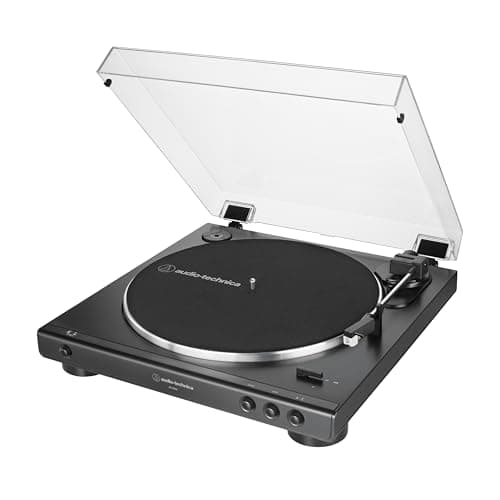
The AT-LP60X is the turntable that gets recommended when someone says “I just want to play my records.” It has held that position for years, through several revisions, and the reason is not marketing. It is that Audio-Technica made a specific and unusual set of choices: they removed every adjustment a beginner could get wrong, kept a real magnetic cartridge, and priced it where the suitcase players live.
This review is about whether those choices are the right ones for you. There are two of them that cost you something, and both are worth understanding before you buy — not because the deck is bad, but because the same two facts are why some people should spend $120 more instead.
What full automation actually means here
Press start and the arm lifts, swings across, lowers onto the lead-in groove, plays the side, then lifts and returns to its rest when the side ends. You never touch the arm. There is no cueing lever to fumble, no chance of dropping the stylus onto the label, and no chance of leaving the arm running in the run-out groove overnight.
That matters more than it sounds. The most common way people damage records is not a bad turntable — it is a hand slipping while cueing a manual arm. A fully automatic deck removes that failure mode entirely, which is why it is the right recommendation for a first turntable, a shared household deck, or one that lives somewhere children can reach it.
Automation also handles the end of the side. Leaving a stylus circling in the run-out groove for hours wears both the stylus and that section of the record. On a manual deck that is a habit you have to build. Here the machine does it.
The cost: a fixed tonearm
Automation on a deck at this price is mechanical — a system of cams and levers driven off the platter. To make that work reliably, the tonearm has to be a known quantity: fixed mass, fixed cartridge, fixed tracking force set at the factory. So the AT-LP60X has no counterweight and no anti-skate adjustment.
In practice this means two things. First, you cannot correct the tracking force if it drifts or if the arm is disturbed — but you also cannot set it wrong, and the factory setting is appropriate for the fitted cartridge. Second, and more consequentially, you cannot fit a different cartridge. A better cartridge needs a different tracking force and usually a different mass, neither of which this arm can accommodate.
That is the real ceiling on this deck. It is not that it sounds bad — it is that it is nearly finished. The upgrade path is one rung: Audio-Technica sells an elliptical ATN3600LE stylus that snaps on in place of the conical, and that is the end of it. If you suspect you are the kind of person who will want to change something in two years, the Fluance RT81is the deck that answer points to — or, if you want to keep the automation, the AT-LP70X, whose cartridge takes the whole VM95 stylus range.
The cartridge and what a conical stylus does
The AT-LP60X ships with a conical — spherical — stylus. A conical tip is a simple rounded point. It rides in the groove and traces its walls adequately, and it is forgiving of a slightly wrong tracking angle, which is exactly what you want on an arm with no adjustments.
An ellipticalstylus, of the kind fitted to decks a tier up, has a narrower contact profile that sits deeper in the groove and follows finer modulations — which is to say, high-frequency detail. The difference is audible on well-recorded material: more air around cymbals, more separation between instruments, more legible vocal texture. It is not subtle once you have heard both.
This is the second thing you give up, and it is inherent to the design rather than a corner cut. A more demanding stylus needs a more precisely set arm, and this arm cannot be set. The two facts are the same fact.
Connecting it: the preamp switch on the back
The AT-LP60X has a switchable built-in phono preamp, and this is the feature that makes it as flexible as it is. Set to LINE, it outputs a normal line-level signal that plugs into powered speakers, an amplifier’s aux input, or a soundbar with an analog input. Set to PHONO, it bypasses the internal stage and outputs a raw phono signal for a receiver with a proper phono input or a separate phono preamp.
The one thing to avoid is running two phono stages in series — the internal one switched to PHONO position mismatched against an external one, or the LINE output into a phono input. That produces sound that is distorted, harsh and far too loud. If something sounds wrong on first setup, check this switch first; our troubleshooting guide covers the symptom in detail.
What to pair it with
With the preamp switched to LINE, a pair of powered speakers is the complete system: two cables, no third box, done. That is the combination we would recommend to anyone buying this deck, and it keeps the whole setup under roughly $350 including speakers.
Passive speakers work too, but they need an amplifier between the deck and the speakers — see amplifiers for a turntable. And keep the deck away from the speakers. A light plastic-plinth turntable sitting between two speakers picks up their output through the chassis and feeds it back into the cartridge, which sounds like boom and mud rather than obvious feedback.
Who should buy it — and who should not
Buy it if: this is your first turntable and you want to play records without a learning curve; you want a deck that other people in the house can use without instruction; you are replacing a suitcase player and want something that will not wear your records; or you simply want the lowest-hassle route from a stack of LPs to sound in a room.
Don’t buy it if:you already know the words “tracking force” and expect to use them; you want to fit a better cartridge later; you plan to digitize a collection seriously (a USB deck with an adjustable arm will capture better); or you have the extra $120 and the patience to cue an arm yourself, in which case the extra adjustability is the better buy.
The AT-LP60X is not the best-sounding turntable at any price and does not try to be. It is the one that makes the fewest demands and takes the fewest risks with your records, and for a very large number of people that is the correct set of priorities.
The deck it is most often cross-shopped against is not another component turntable at all — it is an all-in-one with speakers in the plinth. Our Audio-Technica vs Victrola comparison settles that one on the published rows, starting with whether the cartridge can be replaced.
Frequently asked questions
Is the Audio-Technica AT-LP60X good for beginners?
It is the standard recommendation, and deservedly. Full automation removes every setup mistake a beginner can make: the arm cues, plays and returns on its own, and the factory-set tracking force is correct out of the box. A magnetic, replaceable cartridge means it will not damage records.
Will the AT-LP60X damage my records?
No. It uses a replaceable magnetic cartridge tracking at a normal force, not the sealed ceramic pickup found in cheap suitcase players. The concern about cheap decks wearing records applies to ceramic cartridges, which press on the groove several times harder.
Can I upgrade the cartridge on an AT-LP60X?
Not meaningfully. The tonearm carries a proprietary fixed mount rather than a standard half-inch one, and there is no counterweight to rebalance for a different cartridge. You can replace the stylus when it wears, but the upgrade path effectively stops there.
Does the AT-LP60X need a phono preamp?
No. It has a switchable built-in phono preamp, so it can plug directly into powered speakers, a soundbar with a line input, or any amplifier's aux input. Switch it to PHONO instead if you later connect it to a receiver with a dedicated phono input.
What is the difference between the AT-LP60X and the AT-LP60XBT?
The BT adds a Bluetooth transmitter, so it can stream to a wireless speaker or headphones. Mechanically the two are the same deck. If you will use wired speakers, the plain AT-LP60X costs less and sounds the same over the wired output.
How long does the AT-LP60X stylus last?
Audio-Technica's general guidance for conical and elliptical styli in this range is a few hundred hours of playing time. Replace it when detail dulls, sibilance hardens or you can see visible wear under magnification — a worn stylus damages records, so this is the one maintenance item you should not defer.
Sources
- Audio-Technica — AT-LP60X turntable — Manufacturer specs for the fully automatic belt-drive AT-LP60X (accessed August 11, 2026)
- Crutchfield — How to choose the right turntable — Buying-guide reference on drive type, cartridges, preamps and setup (accessed July 24, 2026)
- Elusive Disc — Turntable setup guide: tracking force & anti-skate — Step-by-step on balancing the tonearm, setting tracking force and anti-skate (accessed July 24, 2026)
- Crutchfield — How to choose a phono preamp — On why a phono signal needs a preamp and never running two at once (accessed July 24, 2026)
Keep reading
The First 10 Records to Buy
What to spin first, once the deck is set up and the shelf is empty.
See the picksSony PS-LX310BT Review
The step-up automatic that adds Bluetooth, USB and gain switching.
Read the reviewAT-LP60X vs Fluance RT81
The $120 decision this review keeps pointing at, settled properly.
Read the comparisonAT-LP60X vs AT-LP120XUSB
The step up inside Audio-Technica's own range, and who should not take it.
Read the comparisonAT-LP60X vs AT-LP70X
The automatic step up — same button, a cartridge built for 2 g, and a five-rung stylus ladder.
Read the comparisonBest Turntables for Beginners
Where the AT-LP60X sits among the other safe first decks.
See the picksBest Powered Speakers for Turntables
The simplest thing to plug this deck into.
See the speakersAutomatic vs Manual Turntables
What automation actually costs you, in detail.
Read the guide