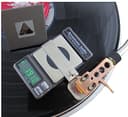
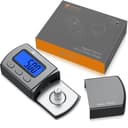
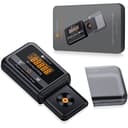
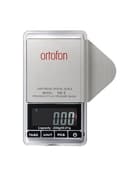
The two figures this page is ranked on
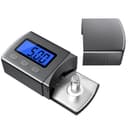
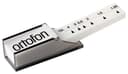
Stated accuracy. A resolution of 0.01 g means the last digit changes in hundredths. It says nothing about whether the reading is right. The figure that does is accuracy or tolerance, and on this page only four of the six gauges have one: Riverstone states a measurement error within ±0.005 g after a multi-point calibration, Ortofon states a factory tolerance of ±0.01 g for the DS-3, and Neoteck states ±0.02 g for its 0.01 g gauge and ±0.015 g for its 0.005 g gauge. DIGITNOW publishes resolution only, and the mechanical Ortofon publishes neither, because a beam balance has no digit to be accurate to. Where a figure is missing the spec table says “Not published” rather than guessing.
Measuring height. A stylus on a record sits roughly 2 to 3 mm above the mat, because that is how thick a record is. A stylus on a flat-plate gauge sits on top of the gauge’s housing — Riverstone puts the typical figure at 6 to 8 mm — which tilts the arm up by a small amount and, on some arms, changes the downward force by a small amount too. Riverstone’s gauge is the only one here that moves the measuring pad to record level on a cantilevered arm, and that is why it is first. Whether the difference is audible on your deck is a fair question. That the other five cannot answer it is the finding.
Two tiebreakers follow. A calibration mass in the box lets you check the gauge against a known weight before you trust it; Riverstone (5 g and 20 g), the 0.005 g Neoteck (20 g), the 0.01 g Neoteck (5 g) and DIGITNOW (unstated mass) include one, the DS-3 does not mention one, and the balance cannot be checked. And non-magnetic construction matters more than it used to: the magnets in modern moving-coil and moving-iron cartridges can pull on a steel platform and pull the reading with it. Every digital gauge here describes itself as non-magnetic; only Riverstone names the alloy.
When a gauge is worth owning, and when the dial is enough
The honest answer this site has given in its setup guides is that a counterweight dial is usually close, and it still is. A gauge earns its place in four situations:
- After a cartridge swap. The new cartridge weighs a different amount, the arm was rebalanced by hand, and the dial’s zero was set by eye. The cartridge setup guide walks through the balance; the gauge confirms it.
- An advanced stylus profile. A MicroLine or Shibata tip has a narrower window than a conical, and sits wrong in the groove faster when the force is off. If you have upgraded to the AT-VM95ML or a 2M Blue, the gauge is part of the upgrade.
- An older or secondhand arm whose counterweight scale you have no reason to trust, or a counterweight that has been replaced.
- A deck with no dial at all. Some arms set force by sliding the counterweight against no scale. A gauge is the only instrument there is.
And one situation where it cannot help: a fully automatic deck with a fixed arm. The Audio-Technica AT-LP60X has no counterweight, so a gauge can report the factory force but you cannot change it. The automatic roundup names the automatics that do have a counterweight, which is where a gauge becomes useful again.
What the numbers you are checking against actually are
A gauge is only useful against a target, and the target is published by the cartridge maker, not the turntable maker. Audio-Technica specifies 1.8 to 2.3 g for the AT-VM95E, with 2.0 g as the standard setting; Ortofon specifies 1.6 to 2.0 g for the 2M Red and recommends 1.8 g. Those windows are the reason a 0.01 g gauge is not overkill and a kitchen scale is: a scale that reads to 0.1 g cannot tell you whether a 2M Red is at 1.75 g or 1.85 g, and the whole window is only 0.4 g wide. Every cartridge the site recommends publishes its window on its own page; the cartridge roundup links each one.
How to use one
- Level the deck first. Every gauge here, digital or mechanical, assumes a level surface, and the setup guide puts leveling at step one for the same reason.
- Place the gauge where the record would be — on the platter, over the mat — and tare it with nothing on the pad. On a flat-plate gauge, note that the pad is a few millimeters above record level; on the Riverstone, fit the arm so the pad is at record level.
- Lower the stylus with the cueing lever, onto the center of the pad, and let go of the arm. Never lower a stylus onto a scale by hand: a slip bends the cantilever, and no gauge on earth protects against that.
- Read it, then adjust the counterweight by the difference and read again. Two or three passes is normal. The tonearm guide covers the counterweight itself.
- Set anti-skate to match the force you measured, not the force the dial claimed.
What is deliberately not on this page
Unbranded clones. The search for this class returns the same gauge under a dozen storefront names, most with no maker page, no accuracy figure and no one to warrant it. Riverstone warns on its own site that its patented design has been counterfeited with steel arms that attract a cartridge’s magnet toward the stylus. Every pick here has a maker that puts its name on the product and publishes at least a resolution figure.
Jewelry and kitchen scales. A pocket scale that reads to 0.1 g is not fine enough for a 0.4 g window, and a scale with a steel platform is the magnet problem in a different box.
A Clearaudio gauge came back in the search with a single unit in stock. A listing that will be dead next week is not a recommendation.
What no maker in this class publishes
Only Riverstone publishes a measuring height, and no flat-plate gauge does — not one of the four states how far above the platter its pad sits. Only Riverstone and Ortofon describe a calibration procedure; the rest ship a weight and leave the method to you. And no maker here publishes the drift of its sensor with temperature, which is why Ortofon’s 10 to 30 °C operating range is the closest thing on this page to a statement about it. That is not a reason to skip a gauge. It is a reason to check yours against the calibration mass before you check your arm against it.