How Often Should You Replace a Turntable Stylus?
The honest answer is a range, not a number — and the reason it is a range is that tip profile, tracking force and how clean your records are all change the arithmetic.
How this is funded: we earn a commission if you buy through our links, at no extra cost to you. It never changes which product we recommend, and we’ll tell you plainly when to skip one. Full disclosure.
Stylus replacement is the one piece of turntable maintenance with a real deadline attached, because a worn stylus does not just sound worse — it damages the records it plays, permanently. So the question is worth answering properly rather than with a shrug.
The honest answer has three parts: a published hour figure that depends on the tip profile, a way to convert that into your own calendar, and a set of symptoms that override the count entirely.
Part 1: the published hour figures
Manufacturers quote lifetimes in playing hours, not months, and the figure varies by tip profile because the profiles wear at different rates.
Two published data points we can cite directly. Audio-Technica states approximately 300–500 hoursfor the ATN3600LC, the conical stylus fitted to a very large number of budget decks. Elusive Disc’s guidance for elliptical and Shibata profiles is to replace the stylus every 800–1000 hours, dependent on usage and model.
The pattern behind those numbers is worth understanding. A conical tip touches the groove wall over a small, roughly circular area, so the tracking force is concentrated. An elliptical contacts along a narrower vertical line but a taller one, spreading the load. A micro-linear or Shibataprofile mimics the shape of the cutting stylus, contacting a much larger area of groove wall — which is why they both retrieve more detail and last longer.
So the profile that costs more up front also tends to cost less per hour. That is the arithmetic that makes an advanced-profile stylus less extravagant than it looks.
Part 2: turning hours into your calendar
Nobody logs stylus hours. Convert instead using album sides, which you can estimate:
- One 12-inch LP side is roughly 20 minutes. Three sides is about an hour.
- An album a day, both sides— about 40 minutes — is roughly 240 hours a year. A conical stylus at 300–500 hours is therefore somewhere between 15 months and two years.
- Two albums a week is about 70 hours a year. The same conical lasts four to seven years; an advanced profile effectively lasts as long as you will own the cartridge.
- A record on most evenings, plus weekends— call it 400 hours a year — means a conical annually and an elliptical every two years or so.
The common advice to “replace it once a year” is a reasonable default for a heavy listener with a conical stylus and much too aggressive for a casual one with an elliptical. Do the arithmetic once for your own habits and you will have a date rather than a rule of thumb.
A practical trick: write the month on a piece of tape on the underside of the plinth when you fit a stylus. It costs nothing and removes the guesswork entirely.
Part 3: the four symptoms that override the count
Hours are an estimate. These are evidence, and any one of them means replace it now.
- Dull highs. Cymbals lose their shimmer, strings lose air. This is the most common symptom and the hardest to notice, because it arrives gradually. If a record you know well sounds flat, suspect the stylus before you suspect the record.
- Hard or splashy sibilance.The “s” sounds in vocals turn harsh or spitty. A worn tip cannot follow the fast modulation that sibilants produce.
- Distortion that worsens towards the center. The inner grooves have the lowest linear velocity, so the same music is packed into less groove length. It is the hardest tracking on the record and the first place a worn tip fails.
- Visible mistracking.The stylus skips, buzzes on loud passages or visibly bounces. Check tracking force first — see how to balance a tonearm — and if the force is correct, the tip is the problem.
One caution: all four symptoms are also produced by a dirtystylus. Brush it first, from back to front, and listen again. A surprising number of “worn” styli are simply carrying a compacted collar of dust around the tip.
What actually shortens stylus life
Three things, in order of how much difference they make:
Dirty records.Every particle in a groove is an abrasive being dragged under a diamond at pressure. Clean records extend stylus life more than anything else you can do — which is the practical argument behind our cleaning fluid roundup and how to clean vinyl records.
Wrong tracking force.Too heavy is obvious: more force, more wear. Too light is worse and less obvious — a stylus that cannot stay in the groove rattles against the walls instead of tracing them, damaging both. Set it to the cartridge maker’s published figure, not by feel.
A dirty stylus.Debris on the tip acts as a rigid extension, changing the contact geometry and grinding accumulated grit into the groove. Brush it every few sides — how to clean a turntable stylus covers the routine and, more importantly, the direction to brush in, which is the one way people damage a cartridge while looking after it.
All three of those are also the answer to the bigger question people arrive at from here, which is how long the records themselves last. The short version: the stylus is the part with a published service life, and it is the part that consumes the collection — we work through that in how long do vinyl records last.
Replacing versus upgrading
The good news about replacement time is that on the two dominant cartridge families it is also an upgrade opportunity, because the styli are interchangeable within a range.
On Audio-Technica’s VM95 series, one body accepts conical, elliptical, micro-linear and Shibata styli. Fit an AT-VMN95ML to a VM95E body and you now have a VM95ML. On Ortofon’s 2M series, a 2M Blue stylus on a 2M Red body gives you a 2M Blue — the swap covered in 2M Red vs 2M Blue.
In both cases the swap takes seconds, needs no alignment and no tools, and gives you a longer-lasting tip as well as a better one. If you are buying a stylus anyway, look one rung up the ladder before you buy the same one again. The full set of options is in best replacement styli, and the physical procedure is in how to replace a turntable stylus.
Replacement styli, and the brush that delays the need
Buy the stylus that matches your cartridge family — they are not interchangeable across brands. The brush is the cheapest thing on this page and does the most for stylus life.
For AT-LP60X and similar
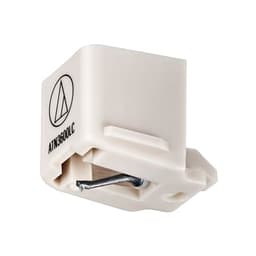
Audio-Technica ATN3600LC Replacement Stylus
For the VM95 series
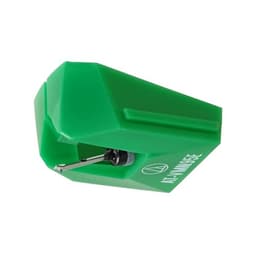
Audio-Technica AT-VMN95E Replacement Stylus
For the Ortofon 2M Red
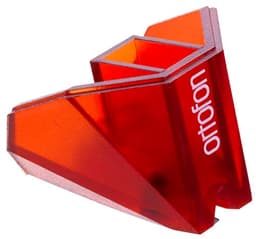
Ortofon 2M Red Replacement Stylus
To make it last longer
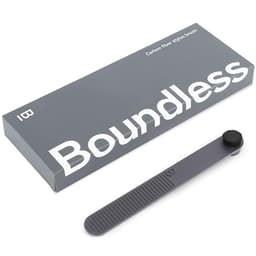
Boundless Audio Carbon Fiber Stylus Brush
Frequently asked questions
How often should you replace a turntable stylus?
Manufacturers and specialist retailers quote playing-hour figures rather than calendar time. Audio-Technica states approximately 300-500 hours for its ATN3600LC conical stylus; Elusive Disc's guidance for elliptical and Shibata profiles is to replace every 800-1000 hours depending on usage and model. An hour of listening a day is roughly a year to eighteen months on a conical, longer on an advanced profile.
How do I know if my stylus is worn out?
Four symptoms, any one of which means replace it: highs that have gone dull, sibilance on vocals that has turned hard or splashy, distortion that gets worse towards the center of a side, and the stylus visibly skating or mistracking on loud passages. A worn stylus does not announce itself gradually enough to notice — it is usually a comparison with a new one that reveals it.
Does a worn stylus damage records?
Yes, and this is the reason the question matters. A worn tip has developed flat facets where it contacts the groove wall, concentrating the same tracking force onto sharp edges. Those edges scrape rather than trace. The damage is permanent and no cleaning fixes it.
Do stylus hours mean playing time or elapsed time?
Playing time — hours with the stylus actually in a groove. A record left on a paused deck accumulates nothing. The easiest way to keep count is to think in album sides: a 12-inch LP side is roughly 20 minutes, so three sides is about an hour.
Does a more expensive stylus last longer?
Generally yes, because advanced profiles spread the contact patch over a larger area of the groove wall. A conical is typically rated for a few hundred hours; a micro-linear or Shibata for around a thousand. Cost per hour can favor the expensive stylus even before you count the better sound.
Can I clean a stylus instead of replacing it?
Cleaning removes accumulated debris, which restores the sound a dirty stylus loses — and a lot of 'worn' styli are simply filthy. It does not restore a diamond that has physically worn. Clean before every few sides with a soft brush from back to front; that delays wear but does not reverse it.
Should I replace the stylus or the whole cartridge?
The stylus, if your cartridge has a replaceable one — which most moving-magnet designs do. It is cheaper, it needs no alignment, and on the VM95 and 2M families you can fit a better stylus than the one you had, upgrading the cartridge in the process. Moving-coil cartridges usually need factory retipping or full replacement.
Sources
- Elusive Disc — Elliptical or Shibata stylus, and when to replace one — Retailer reference: "Replace the stylus every 800-1000 hours (dependent on usage and model)" (accessed August 19, 2026)
- Audio-Technica — AT-VMN95E replacement stylus — Manufacturer page for the elliptical VM95-series replacement stylus and its fitment list (accessed August 11, 2026)
- Audio-Technica — VM95 Series cartridges — The shared-body VM95 range and its interchangeable stylus upgrade path (accessed July 24, 2026)
- Crutchfield — Phono cartridge guide — Reference on cartridge types, styli and mounting (accessed July 24, 2026)
Keep reading
The First 10 Records to Buy
The collection a fresh stylus is protecting.
See the picksHow to Replace a Turntable Stylus
The two-minute procedure, once you have decided it is time.
Read the guideBest Replacement Styli
Which stylus fits which cartridge, with live prices.
See the picksCartridge vs Stylus
Which part is which, and which one you are actually buying.
Read the explainerTurntable Maintenance
Everything else on the deck that wears out, and how often.
Read the guide