How to Level a Turntable
Level is not a nicety. A deck that leans puts a sideways force on the stylus that anti-skate was never set to cancel — and it is the cheapest fault on this site to correct.
How this is funded: we earn a commission if you buy through our links, at no extra cost to you. It never changes which product we recommend, and we’ll tell you plainly when to skip one. Full disclosure.
The short answer: put a small spirit level on the platter, read it left-to-right and front-to-back, and correct the low side — with the deck’s own feet if it has adjustable ones, with thin firm shims if it does not, and by leveling the furniture if the surface itself slopes. It takes about five minutes, it costs nothing, and it removes a fault that no cartridge, mat or isolator will compensate for.
Why level matters more on a turntable than on anything else
A stylus is held in the groove by a tracking force measured in grams — 1.8 to 2.2 g for an Audio-Technica AT-VM95E, 1.6 to 2.0 g for an Ortofon 2M Red. That force is gravity acting straight down on a very small, very compliant suspension. Tilt the whole assembly and you split that force into a smaller downward component and a new sideways one, pulling the stylus toward the low side of the deck for the entire side of the record.
Two things follow. The first is that the stylus is now bearing harder on one groove wall than the other, which is a channel imbalance and an uneven wear pattern at the same time. The second is that your anti-skate setting is wrong, because anti-skate exists to cancel one specific inward force — the one produced by a pivoted arm tracking an arc — and it was set with no knowledge of your furniture. Adding a second, constant sideways force means the compensation no longer matches the problem.
On a suspended-subchassis deck there is a third consequence: the suspension is designed to sit at a particular attitude, and a leaning plinth loads the springs unevenly. That is a less common design at the prices this site covers, but if you own one, level is not optional.
Measuring it properly
Three rules make the measurement trustworthy. Measure on the platter, near the spindle, because the record sits on the platter rather than on the plinth — and because plenty of plinths have a rim, a texture or a slope that will not take a level flat. Measure twice, ninety degrees apart, because a deck can be level left-to-right and leaning front-to-back; those are two independent corrections. Stop the platter and take the record off first.
A cheap bubble level is the better tool here, and we do not rank one — there is no product on this site for it, because a two-dollar spirit level from a hardware store has nothing to calibrate and nothing to go wrong. A phone app works too, with one sanity check: read it, rotate the phone 180 degrees, and read again. If the sign flips instead of staying the same, the phone has an offset and you are chasing its error rather than your deck’s.
Correcting it: three cases
Case one, the deck has adjustable feet. Most decks above entry level do: the feet screw in and out. Turn the low foot out or the high foot in, in small increments, re-measuring after each one. Work one foot at a time — on a three-foot deck every adjustment changes both axes, so iterate rather than trying to solve it in one pass. Fluance publishes adjustable feet on the RT81+, for example; many decks at the same price do not.
Case two, the feet are fixed. Shim under the low feet with something thin, firm and non-compressible: index cards, thin cork sheet, plastic washers, or the shims sold for furniture. Do not use foam, folded paper or sticky pads — they compress at different rates under different loads, so the deck is level on the day and leaning a week later. Keep the shim smaller than the foot so the foot still carries the load through its own contact patch.
Case three, the surface slopes. This is the one people try to solve at the deck and should solve at the furniture. An old sideboard, a flexing shelf or a floor that runs downhill is not a problem a turntable foot has enough travel to fix. Level the furniture, add a rigid platform, or move the deck to a wall shelf you mount level.
What isolation products do and do not do
This is worth being blunt about, because the two jobs get confused constantly. Isolation decouples a deck from vibration. It does not level anything. IsoAcoustics publishes no adjustable feet for the zaZen I platform — it is a 17 by 15 inch dense-fiber slab rated to 25 lb, and it sits at whatever angle the shelf under it sits at. Compliant isolators are worse for this purpose, not better: a Vibrapod Model 2 is rated 4 to 8 lb per pod with a 6 lb optimum, so it compresses in proportion to the load it carries, and an unevenly loaded deck will settle unevenly.
Where isolation genuinely earns its money is the dynamic problem: footfall on a suspended floor, speaker energy coming back through the furniture, or a deck sharing a shelf with a subwoofer. A wall shelf is the strongest answer to the first of those — Pangea publishes a 40 lb rating for the Premier SE MKII with stud slots at 16 in on center and a 1 in cable gap — because it takes the turntable off the floor entirely. Our isolation picks rank that class properly, by published load rating and footprint.
After you level it
Re-check the tracking force. A gauge reads a weight, weight is gravity, and you have just changed the geometry that gravity acts through — so confirm the figure your cartridge maker publishes, with the gauge sitting on the platter rather than the plinth. Our force gauge picks explain why measurement height matters for exactly this reason, and balancing the tonearm is the full version of the job.
Then, if the symptom that brought you here has not gone away, it was not level. Skipping has four other common causes, which the skipping guide works through in order; a hum has three, in hum and grounding; and a wavering pitch is usually a belt or a speed setting rather than a surface, which troubleshooting covers symptom by symptom.
When the furniture is the problem, with live prices
Three ways to give a deck a level, solid surface. The wall shelf is the one that also solves footfall; the platform publishes a load rating but no adjustable feet, which is exactly the limitation to know about before you buy it as a leveling fix.
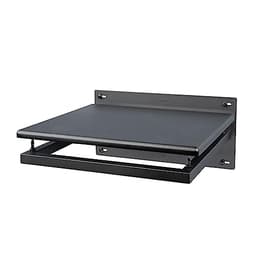
Pangea Audio Premier SE MKII Turntable Wall Shelf
Footfall: a suspended wooden floor where walking past makes the stylus skip
Price as of October 10, 2026. #ad How we’re funded
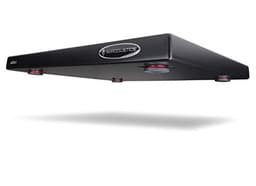
IsoAcoustics zaZen I Isolation Platform
A deck up to 25 lb where you want the isolators engineered into the platform
Price as of October 10, 2026. #ad How we’re funded
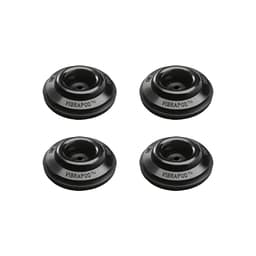
Vibrapod Isolator Model 2 (set of four)
Buying to a published weight band instead of a published maximum
Price as of October 10, 2026. #ad How we’re funded
Frequently asked questions
Does a turntable really need to be level?
Yes, and it is the cheapest correction available. An out-of-level deck adds a constant sideways pull on the stylus toward the low side, which anti-skate was not set to cancel, and it changes how the cartridge sits in the groove. The symptoms are one channel sounding different from the other, mistracking on loud passages, a tendency to skate inward or outward, and in bad cases skipping. None of those is fixed by anything you can buy.
How do I level a turntable without adjustable feet?
Shim it. Measure both axes with a spirit level on the platter, then put thin, firm, non-compressible material under the low feet - index cards, thin cork sheet or plastic washers work well. Avoid foam and folded paper, which compress unevenly and settle over a few days. If the whole surface slopes, level the furniture rather than the deck: it is easier and it stays fixed.
Can I use a phone app to level a turntable?
Yes, with one caution: measure on the platter rather than the plinth, and check the app against a known flat surface first by rotating the phone 180 degrees - if the reading flips sign, the app or the phone has an offset. A cheap bubble level is more reliable because it has nothing to calibrate, and either is accurate enough for this job.
Where should I put the level - on the platter or the plinth?
On the platter, near the spindle. The record sits on the platter, so that is the plane the stylus has to track. A plinth can be level while the platter is not, if the bearing or the sub-platter sits slightly off, and some plinths have a sloped or textured top that will not take a level flat in the first place.
Will an isolation platform level my turntable?
No, and this is the most common misunderstanding about these products. A platform or a set of isolators decouples the deck from vibration; it does not correct a slope. IsoAcoustics publishes no adjustable feet for the zaZen I platform, and compliant isolators sit at whatever height the load on them dictates. If your shelf slopes, you need to level the shelf - then isolate on top of it.
Does being out of level damage records?
It accelerates wear rather than causing sudden damage. A sideways force the arm is not balanced for means the stylus bears unevenly on one groove wall, which wears that wall and the stylus itself faster. It also makes mistracking more likely on heavily modulated passages, and mistracking is the thing that actually scuffs a groove.
How level does a turntable need to be?
Level enough that a small spirit level reads centered in both axes - that is the practical standard, and no maker publishes a tolerance in degrees. Trust the bubble rather than chasing a number: if the bubble sits between the lines left-to-right and front-to-back with the level sitting on the platter, you are done, and the remaining error is smaller than the other variables in your setup.
My floor bounces when I walk past. Will leveling fix the skipping?
No. Leveling fixes a static slope; a bouncing floor is a dynamic problem and needs the deck taken off the floor's path. The standard answer is a wall shelf mounted into studs - Pangea publishes a 40 lb load rating for its Premier SE MKII, with slots for studs 16 in on center - because a wall carries footfall far less than a suspended floor does. Compliant isolators under the deck help, but on a genuinely springy floor they do not help enough.
Sources
- IsoAcoustics — zaZen isolation platforms — A platform range split purely by load: "zaZen I with a weight capacity of 25lbs (11.3kg) and the zaZen II with a weight capacity of 40lbs (18.1kg)", described as "a stable isolation platform designed for turntables, tube amps and other sensitive audio equipment" whose effect comes from "the combination of the platform mass and the integrated IsoAcoustics isolation technology" (accessed September 11, 2026)
- Pangea Audio — Turntable Wall Mounted Premier SE Shelf MKII — Manufacturer specification: "Weight capacity: 40 lbs.", a shelf "18\" wide, 15.5\" deep, and 19mm thick", a backplate "18\" wide and 8.5\" tall", a "one-piece welded steel frame" in black powder coat, backplate slots for "studs spaced 16\" on center with left/right adjustability" and a "1\" gap between shelf and backplate for cable management". The rating is published WITH its assumption: for drywall it holds "installed with a minimum of two supplied screws into wood studs plus at least two additional drywall anchors" (accessed September 11, 2026)
- Vibrapod — Isolator specifications — The only maker in this class that publishes a weight RANGE per unit rather than a maximum, which is the whole fitment rule: per isolator, Model 1 is 2 to 3 lb (optimum 2.5 lb), Model 2 is 4 to 8 lb (optimum 6 lb), Model 3 is 8 to 12 lb (optimum 10 lb), Model 4 is 14 to 18 lb (optimum 16 lb) and Model 5 is 22 to 28 lb (optimum 25 lb). "All Models of VIBRAPOD Isolators are 9/16\" Tall and have a Diameter of 2 7/16\"." Turntables are named in the suggested uses for every model (accessed September 11, 2026)
- IsoAcoustics — OREA Series isolation feet — The published load ladder for the class: Graphite 4 lb (1.8 kg), Bronze 8 lb (3.6 kg), Indigo 16 lb (7.2 kg) and Bordeaux 32 lb (14.5 kg) PER UNIT, with diameters from 1.6 to 2.6 in and heights from 1.1 to 1.4 in, "made of machined stainless steel". The quantity rule is published too — the pucks are "packaged individually to allow greater flexibility when determining the number of units to use" and "We recommend a minimum of 3 units under each component, depending on weight" — and IsoAcoustics names turntables as one of the components "particularly sensitive to vibration" (accessed September 11, 2026)
- Audio-Technica — Balancing the tonearm and setting tracking force — Manufacturer procedure for zero-balancing an arm, then dialing tracking force and anti-skate (accessed August 19, 2026)
- Elusive Disc — Turntable setup guide: tracking force & anti-skate — Step-by-step on balancing the tonearm, setting tracking force and anti-skate (accessed July 24, 2026)
- Audio-Technica — AT-VM95E cartridge — Manufacturer specs: 0.3 x 0.7 mil elliptical stylus on an aluminum cantilever, 4.0 mV output at 1 kHz / 5 cm/sec, 1.8-2.2 g tracking force (2.0 g standard), 20-22,000 Hz, 20 dB channel separation at 1 kHz, half-inch mount, AT-VMN95E replacement stylus, and the maker's own statement that "all VM95 Series share the same body" so the stylus "can be replaced with any of the six interchangeable AT-VMN95 replacement styli". Re-read on the access date below, which corrected a tracking-force range previously noted here as 1.8-2.3 g (accessed September 26, 2026)
- Crutchfield — How to choose the right turntable — Buying-guide reference on drive type, cartridges, preamps and setup (accessed July 24, 2026)
Keep reading
How to Set Up a Turntable
The whole first-day sequence, of which leveling is step one.
Read the guideBest Turntable Isolation
Load-rated platforms, feet and shelves, ranked on the figure that decides whether they work.
See the picksWhy Is My Record Skipping?
If leveling did not fix it, this is the diagnostic order to work through next.
Read the guideHow to Balance a Tonearm
The step that has to be redone after any change to how the deck sits.
Read the guide