Why Is My Record Skipping?
Start with one question: does it skip in the same place every time, or in different places? The answer splits five possible causes into two short lists — and the most common one is free to fix.
How this is funded: we earn a commission if you buy through our links, at no extra cost to you. It never changes which product we recommend, and we’ll tell you plainly when to skip one. Full disclosure.
The short answer: in most cases the tracking force is too light, and setting it to the figure your cartridge maker publishes fixes it for nothing. But before you touch anything, answer one question, because it halves the work: does it skip in the same place every time? A repeatable skip at one groove is a problem with that copy or with debris in it. A skip that moves around, or that happens on several records, is a problem with the deck, the setup or the room.
The split, and why it matters
| What you observe | What it points at | Where to start |
|---|---|---|
| Same groove, every play, one record | Debris in that groove, a scratch, or a pressing fault | Clean the record properly, then try a different copy |
| Different places, same record | Tracking force, stylus condition or anti-skate | Check the force against the published range |
| Several records, anywhere | Setup: force, level, anti-skate, worn stylus | Work through the five checks below in order |
| Only when someone walks past | Footfall reaching the deck through the floor | Isolate or wall-mount the deck |
| Only at high volume | Acoustic feedback from the speakers | Separate the speakers from the deck |
| Only on loud passages, at normal volume | Mistracking: force too light, or a worn tip | Force first, then the stylus |
Check 1: tracking force (free, and usually the answer)
A stylus stays in a groove because a small, precisely specified downward force holds it there. Too little and it rides up the groove wall and jumps out, especially where the groove is heavily modulated — which is why skipping so often happens on the loudest part of a side.
Every cartridge maker publishes the range. Audio-Technica publishes 1.8 to 2.2 g with 2.0 g standard for the AT-VM95E; Ortofon publishes 1.6 to 2.0 g for the 2M Red and the 2M Blue; Nagaoka publishes 1.5 to 2.0 g for the MP-110. Set the figure with the counterweight, in the middle of the range rather than at the bottom of it, and confirm it with a gauge sitting on the platter. Riverstone’s gauge publishes 0.005 g resolution and measures 2 to 3 mm above the mat, which is record level — the reason that matters is geometric: a stylus measured 6 to 8 mm up sits at a different vertical angle than one on a record.
What not to do: tape a coin to the headshell. It is the most-repeated bad advice in the hobby. Overloading the arm past the published range increases wear on the record and the stylus, and it hides whatever was actually wrong. Our tonearm balancing guide covers doing it properly in about ten minutes.
Check 2: the record and the stylus, cleaned
Dust is not cosmetic. A stylus tip is a few tens of microns across; a compacted lump of dust at the tip, or a wad of debris in a groove, is a physical obstacle big enough to lift the diamond out of the wall. Two cleans are involved, and they are different jobs: the record, dry-brushed before every play and wet-cleaned when it has never been cleaned or has come out of storage, and the stylus, which collects a grey collar at the tip that you can see with a phone camera and a light.
If the skip is in the same place every time, do this before concluding the record is damaged. Compacted debris in one groove looks exactly like a defect and comes out completely. Our record cleaning guide covers the method and stylus cleaning covers the part most people never touch; the picks above are the starter kit we rank for both.
Check 3: level
An out-of-level deck adds a constant sideways force on the stylus toward the low side, for the whole side of the record. It is the second free check: put a small spirit level on the platter, read it left-to-right, then turn it ninety degrees and read it front-to-back. Correct with the deck’s feet if it has adjustable ones, with thin firm shims if it does not, or by leveling the furniture when the surface itself slopes. Our leveling guide is the five-minute version.
Check 4: anti-skate
A pivoted tonearm tracking an arc across a record generates an inward pull. Anti- skate — a dial, a weight on a thread, or a magnet, depending on the deck — cancels it. Most manuals direct you to set the anti-skate value to match the tracking force, so if you have just changed the force, change this too.
The diagnostic signature is directional: if the stylus consistently skates inward across the record, there is too little anti-skate; if it consistently pushes outward, too much. Decks with no anti-skate control at all — most fixed-arm automatics — take this decision out of your hands, which is one of the things you are buying when you buy an adjustable deck. Our cartridge setup guide covers both controls together.
Check 5: the stylus itself, and the room
If force, cleanliness, level and anti-skate are all right and a record still mistracks on loud passages, suspect the tip. Published stylus lives are in the hundreds of hours — roughly 300 to 500 for a conical, about 300 for an elliptical, in Audio-Technica’s figures for its own replacement styli — and a worn or chipped diamond cannot track properly at any force. A damaged cantilever is visible: sight along the arm and check the stylus is perpendicular rather than leaning. Our stylus replacement guide covers the hour figures, and the replacement stylus picks cover the part.
Two room-shaped causes remain, and both are easy to confirm. If it only skips when someone walks past, that is footfall: the fix is to decouple the deck or to get it off the floor entirely with a wall shelf — Pangea publishes a 40 lb load rating for its Premier SE MKII, mounted into studs 16 in on center. If it only skips when the volume is up, that is acoustic feedback: sound from the speakers is driving the plinth, so move the speakers off the same furniture, and if that is impossible, isolate the deck — Hudson publishes 37.5 lb per pad for the Firm IsoBlock, which is the version it assigns to turntables. Our isolation picks rank the class on published load ratings, and troubleshooting covers the rest of the symptom list.
The three things worth owning, with live prices
A gauge confirms the number the cartridge maker publishes, a cleaning kit removes the debris that lifts a stylus out of a groove, and isolation feet are for the case where the floor rather than the record is the problem.
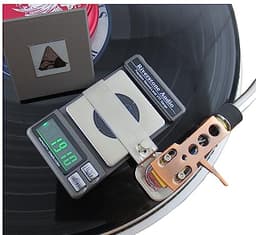
Riverstone Audio Record-Level Stylus VTF Gauge
Anyone who has set tracking force once and wants to know it was right
Price as of October 10, 2026. #ad How we’re funded

Boundless Audio Record Cleaning Kit
A complete starter record-cleaning routine
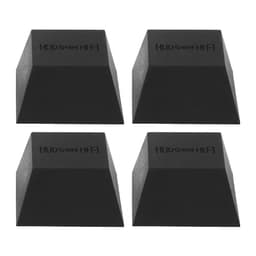
Hudson Hi-Fi IsoBlock Firm Silicone Isolation Feet
A first, cheap experiment in decoupling before spending on a platform
Price as of October 10, 2026. #ad How we’re funded
Frequently asked questions
Why does my record skip in the same spot every time?
Because something repeatable is interfering with the stylus at that point: debris sitting in that groove, a scratch or a pressing fault in that copy, or a deformation in the disc. Play a different record - if that one is fine, the fault is in the first copy rather than in the deck. Clean the record properly first; compacted dust in a groove is far more common than real damage, and it is free to remove.
Why is my brand new record skipping?
Three causes, in order of likelihood. First, tracking force set too light - a new record is no different from an old one here, and insufficient force is the leading cause of skipping. Second, mould release and packing debris still in the grooves, which a proper wet clean removes. Third, a genuine pressing fault, which happens and is grounds for a replacement. Check your tracking force with a gauge before you blame the pressing.
Does a record skip because the needle is worn?
It can, and it tends to show up on loud passages first, because that is where a worn or chipped tip loses contact with the groove wall. Published stylus lives run in the hundreds of hours - Audio-Technica publishes roughly 300 to 500 hours for a conical tip and about 300 for an elliptical one - and a stylus does not announce its age. If you do not know how many hours yours has done, and everything else checks out, replace it.
Will adding weight to the tonearm stop the skipping?
Taping a coin to a headshell is the internet's favorite fix and it is the wrong one. The right move is to set the tracking force to the figure the cartridge maker publishes using the counterweight, then verify it with a gauge. Deliberately overloading the arm beyond the published range increases wear on both the record and the stylus, and it masks whatever the real cause was.
Why does my record skip when I walk past the turntable?
That is footfall, and it means the vibration path from the floor to the stylus is too direct. It is most common on suspended wooden floors and on furniture that flexes. The strongest fix is to take the deck off the floor's path with a wall shelf mounted into studs; isolation feet under the deck help and are the cheaper first experiment. Neither is a substitute for the deck being level and the tracking force being right.
Can static make a record skip?
Static does not usually cause a skip on its own, but it causes the condition that does: a charged record attracts and holds dust, and dust in a groove is one of the things that lifts a stylus out of it. If your records crackle and attract fluff visibly, treat the static as well as the dust - our static guide covers the distinction, which matters because the two problems need different responses.
What should the anti-skate be set to?
Whatever your deck's manual specifies, which on most pivoted arms means matching the anti-skate value to the tracking force you have set. Anti-skate exists to cancel the inward pull a pivoted arm generates as it tracks an arc. Too little and the stylus bears on the inner groove wall; too much and it bears on the outer one. If the skipping is always outward or always inward, anti-skate is the first suspect after force.
Is a skipping record ruined?
Usually not. Most skipping is a setup or cleanliness problem and the record is unharmed - which is why the diagnosis order matters, because playing a record repeatedly with too little force or a worn stylus is what actually damages it. A deep scratch or a crack is permanent, but a groove full of compacted debris looks like damage and cleans out completely.
Sources
- Audio-Technica — AT-VM95E cartridge — Manufacturer specs: 0.3 x 0.7 mil elliptical stylus on an aluminum cantilever, 4.0 mV output at 1 kHz / 5 cm/sec, 1.8-2.2 g tracking force (2.0 g standard), 20-22,000 Hz, 20 dB channel separation at 1 kHz, half-inch mount, AT-VMN95E replacement stylus, and the maker's own statement that "all VM95 Series share the same body" so the stylus "can be replaced with any of the six interchangeable AT-VMN95 replacement styli". Re-read on the access date below, which corrected a tracking-force range previously noted here as 1.8-2.3 g (accessed September 26, 2026)
- Ortofon — 2M Red, published specifications — The other half of the comparison, read live the same day and cited for the three rows that actually move between the two cartridges — and the four that do not. Published: output voltage at 1 kHz, 5 cm/sec "5.5 mV", channel balance at 1 kHz "1.5 dB", channel separation at 1 kHz "22 dB", frequency response 20 Hz - 20 kHz "+ 3 / - 1 dB", tracking ability at 315 Hz "70 um", compliance (dynamic, lateral) "20 um/mN", stylus type "Elliptical diamond", stylus tip radius "r/R 8/18 um", cantilever "Aluminium", tracking force range "1.6-2.0 g (16-20 mN)" with "1.8 g" recommended, internal impedance "1.3 kOhm", internal inductance "700 mH", recommended load "47 kOhm" and "150-300 pF", cartridge weight "7.2" g. Listed at 99,00 EUR and "Unavailable" in Ortofon's own store on the access date. The identical rows are the point: same tip radius, same compliance, same weight, same tracking force, same output, same load (accessed October 5, 2026)
- Audio-Technica — Balancing the tonearm and setting tracking force — Manufacturer procedure for zero-balancing an arm, then dialing tracking force and anti-skate (accessed August 19, 2026)
- Elusive Disc — Elliptical or Shibata stylus, and when to replace one — Retailer reference: "Replace the stylus every 800-1000 hours (dependent on usage and model)" (accessed August 19, 2026)
- Elusive Disc — Turntable setup guide: tracking force & anti-skate — Step-by-step on balancing the tonearm, setting tracking force and anti-skate (accessed July 24, 2026)
- Riverstone Audio — Record-Level Stylus VTF Pressure Gauge (Graphite) — The maker's own page, and the argument the whole page is ranked on: "For accurate VTF measurement, the stylus tip should be at the same vertical position as the record surface - that is, at \"record level\"." With the patented arm (US Patent D878232) "vertical tracking force is measured approx. 2 mm to 3 mm from the surface of a turntable mat or platter - which is the height of a stylus tip resting on an LP record (LP's have a thickness range of 1.9 mm to 2.9 mm)", while "less expensive gauges typically have a stylus tip measurement distance between 6 and 8 mm". Published figures: 0.005 g resolution; "All gauges we ship will have a measurement error within +/-0.005 g" after "a rigorous multi-point calibration procedure"; two calibration masses (5 g and 20 g) supplied; re-calibratable "for use up to 100 g" with additional masses; housing "durable plastic", arm "316 stainless steel, a premium non-ferromagnetic grade", locking screw "machined from brass"; 52 mm x 91 mm x 12 mm; one AAA alkaline, not included; a warning about counterfeit copies of the design on marketplaces; and the honest line that fitting the arm "requires a good pair of glasses, a bit of technical savvy, and a good dose of patience" (accessed September 15, 2026)
- Library of Congress — Caring for and cleaning grooved discs — Preservation guidance on cleaning and storing records to prevent damage (accessed July 24, 2026)
- Hudson Hi-Fi — IsoBlock silicone isolation feet — Published spec block: "Material: Platinum-Cured Silicone", "Weight Capacity: Soft Block - 15 lbs/pad | Firm Block - 37.5 lbs/pad", temperature resistance -40 to 240 C, and a set of four feet plus four isolation dots. Hudson assigns the variants by component type — Soft for "preamps, DACs, or streaming devices", Firm for "heavier components like turntables, amplifiers, and receivers". The same page also prints a 150 lb capacity and a "Durometer 60 (Shore A)" figure in reused body copy, and an "absorb up to 95.32% of vibration and resonance" claim with no test method, which is why our spec rows read as they do (accessed September 11, 2026)
- Pangea Audio — Turntable Wall Mounted Premier SE Shelf MKII — Manufacturer specification: "Weight capacity: 40 lbs.", a shelf "18\" wide, 15.5\" deep, and 19mm thick", a backplate "18\" wide and 8.5\" tall", a "one-piece welded steel frame" in black powder coat, backplate slots for "studs spaced 16\" on center with left/right adjustability" and a "1\" gap between shelf and backplate for cable management". The rating is published WITH its assumption: for drywall it holds "installed with a minimum of two supplied screws into wood studs plus at least two additional drywall anchors" (accessed September 11, 2026)
Keep reading
Turntable Troubleshooting
Every other symptom, from hum to a wavering pitch, in the same diagnostic style.
Read the guideBest Stylus Force Gauges
How to confirm the figure your cartridge maker publishes instead of trusting a dial.
See the picksHow to Level a Turntable
Check number four in full, including what to do when the furniture slopes.
Read the guideHow Often to Replace a Stylus
The published hour figures behind the last check on this page.
Read the guide