Turntable Hum: Grounding, Ground Loops and the Fixes
A hum that changes when you touch the tonearm is a different fault from one that changes when you move the deck. Diagnose which you have before you buy anything — two of the three fixes are free.
How this is funded: we earn a commission if you buy through our links, at no extra cost to you. It never changes which product we recommend, and we’ll tell you plainly when to skip one. Full disclosure.
The short answer: if the hum drops when you touch the tonearm, the deck is not earthed properly — land its ground wire on the ground terminal of whichever box holds the phono input. If the hum is there with everything earthed, suspect a ground loop and try removing that wire instead. If it only appears at volume while a record plays, it is not a grounding fault at all; it is feedback. Two of those three fixes cost nothing, which is why the diagnosis comes before any purchase.
Why a turntable is the one source that hums
A phono cartridge puts out a few millivolts — Audio-Technica publishes 4 mV nominal for the AT-VM95E against 240 mV from the same deck’s line output. That tiny signal then gets amplified by around 36 dB in a phono stage before anything else touches it. Anything that leaks into the cable before that amplification is amplified along with the music, which is why a CD player sitting in the same rack is silent while the turntable hums. It is not a flaw in your deck; it is the consequence of the smallest signal in domestic audio.
That is also why the earth matters. A cartridge sits inside a metal arm and a metal chassis which, if left floating, act as an aerial for the mains field in your walls and your equipment. Earthing the chassis gives that interference a path that is not through your phono input.
The three hums, told apart
| What changes the noise | What it is | The fix |
|---|---|---|
| Touching the tonearm or chassis makes it quieter | Missing or badly landed earth | Connect the ground wire to the phono input’s ground terminal |
| Everything is earthed and it is still humming, or got worse | Ground loop | Remove the signal ground wire and listen; keep whichever state is quiet |
| Moving a power brick or re-routing a cable changes it | Induced hum from a nearby transformer | Separate power supplies from phono cables; cross at right angles |
| Only present at volume, only while playing | Acoustic feedback (mechanical, not electrical) | Separate the speakers from the deck, then isolate the deck |
| Still there with the turntable unplugged | Not the turntable at all | Work back through the amplifier, speakers and other sources |
Case one: the ground wire
Most turntables with RCA outputs have a thin separate lead, usually ending in a spade or a bare tail, whose only job is to earth the chassis. It goes on the box that contains the phono input, which is the part people get wrong. With an outboard phono stage, that is the stage’s GND post. With a receiver or integrated amp, it is the ground terminal beside the PHONO input. With powered speakers that have a phono input, it is their ground screw — Klipsch publishes a switchable phono/line input “with switch and ground screw terminal” on the R-50PM and R-40PM, and prints a connections page for a turntable in the manual.
Three practical details. Land it on bare metal, not paint or anodizing. Make sure it is tight — a spade resting against a post is not a connection. And if your deck’s built-in preamp is switched to LINE, you are bypassing the phono input entirely, so the ground wire has no useful destination on that path; switch to PHONO or use the line output consistently, not half of each.
Case two: the ground loop
A ground loop is the opposite problem: too many earth paths rather than none. Two pieces of equipment earthed to the mains and also joined by a signal ground form a loop, and a small circulating current in that loop appears as a steady hum. The signature is counterintuitive — everything is wired correctly and it still hums, or adding the ground wire made it worse.
The test is free and reversible: disconnect the turntable’s ground lead and listen. Some decks, particularly those whose power supply already earths the chassis, are quieter without it. If that is your system, leave it off and label it so nobody “fixes” it later. What we would not do is start cutting earth pins off mains plugs, which is how a hum fix becomes a safety problem — that is the one line in this whole topic worth refusing to cross.
Case three: induced hum from a power supply
This one is physical housekeeping and it is remarkably common in small systems. Wall-wart power supplies, the transformer inside an amplifier, and mains cables all produce a field. A phono cable carrying 4 mV that runs parallel to one of those for half a meter will pick it up. Audio-Technica’s own manual for the AT-LP120XUSB is published with the deck’s own supply and cabling in mind, and the same rule applies to any deck: keep the phono cables away from the power leads, cross them at right angles rather than running them side by side, and if a phono stage runs off a plug-top supply, put the supply at the amplifier end rather than beside the cartridge.
If you have an unshielded or damaged phono cable, the same hum appears for the same reason. A captive lead that has been bent sharply at the plug for years is a candidate; so is a cheap extension on the phono side. On decks with detachable output cables this is a five-dollar test.
The fourth noise: feedback, which is not hum
If the noise only appears when a record is playing and the volume is up — a low boom, a muddy bass, or a howl that climbs — that is acoustic feedback. Sound from the speakers is driving the plinth and the stylus is reading it, which produces more sound, which drives the plinth harder. No ground wire anywhere will touch it.
The fixes are mechanical: get the speakers off the same furniture as the turntable, put them on stands, and if the deck is on a flexing shelf or a suspended floor, decouple it — isolation products are ranked on published load rating for exactly this job. Starting from a deck that is level and on something rigid removes most of the problem before you buy anything. If the noise is a skip rather than a hum, the skipping guide has its own diagnostic order, and troubleshooting covers every other symptom.
What to look for if you are buying to fix it
If the conclusion is that you need a box with somewhere to land an earth wire, the published row to look for is simply whether the maker states one. Fosi publishes a dedicated ground post on the Box X5, which also offers switchable gain at 38, 48, 56 or 66 dB for moving-coil cartridges. Klipsch publishes a ground screw terminal on both of its powered monitors with phono inputs — and notably does not publish one for The Three Plus, which is the kind of omission worth catching before you buy. The Fluance PA10 we rank on our under $100 page is an excellent moving-magnet stage that does not publish a ground terminal, so it suits a deck that has no ground wire rather than one that does. That is the whole shopping rule: match the terminal to the deck you own.
Where the ground wire can actually land, with live prices
The row that matters is whether the box publishes a grounding provision. Fosi publishes a dedicated ground post; Klipsch publishes a switchable phono/line input with a ground screw terminal; the Fluance PA10 does not publish a ground terminal, which is worth knowing before you buy it for a deck that has a ground wire.
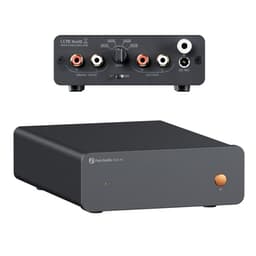
Fosi Audio Box X5
The cheapest honest route into moving-coil cartridges
Price as of October 10, 2026. #ad How we’re funded
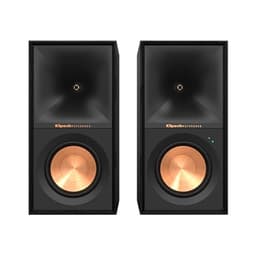
Klipsch R-50PM
A complete vinyl system in two boxes, with the phono stage already inside
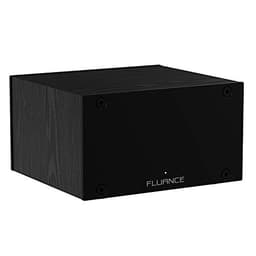
Fluance PA10
A solid mid-priced MM upgrade
Price as of October 10, 2026. #ad How we’re funded
Frequently asked questions
Why does my turntable hum?
Three common causes. Most often the deck is not properly earthed - its ground wire is missing, unconnected, or landed on paint rather than metal - and the giveaway is that the hum drops when you touch the tonearm. Second, a ground loop, where the deck is earthed twice and the hum gets worse rather than better. Third, induced hum, where a mains transformer or power supply is sitting too close to the phono cables. Acoustic feedback is a fourth noise that is often called hum, and it only appears at volume while a record plays.
Where does the turntable ground wire go?
On the box that contains the phono input. If you use an outboard phono stage, it goes to that unit's GND post. If your amplifier has a phono input, it goes to the amplifier's ground terminal next to it. If your powered speakers have a phono input, it goes to their ground screw - Klipsch publishes one on the R-50PM and R-40PM. Tighten it onto bare metal, and if the lead ends in a spade, make sure the spade is gripped rather than just resting.
What if my turntable has no ground wire?
Plenty do not, and it is not a defect. A deck with a captive RCA lead and no separate earth - Sony's PS-LX3BT publishes exactly that, a fixed lead with no ground terminal - is designed to work without one, usually because the chassis is earthed through its own power supply or the cartridge circuit is arranged differently. If such a deck hums, the cause is elsewhere: induced hum from a nearby power supply, a ground loop in the rest of the system, or a fault in the cable.
What is a ground loop, and how do I know I have one?
It is a loop of earth paths between two or more pieces of equipment, in which a small current circulates and appears as a steady hum. The diagnostic signature is backwards from the usual one: everything is properly earthed and the hum is still there, or got worse when you added the ground wire. The cheapest test is to disconnect the turntable's ground lead and listen. If the hum disappears, you had a loop rather than a missing earth.
Why does the hum stop when I touch the tonearm?
Because your body is completing the earth path that the equipment should be providing. It is the clearest single indicator that the deck's ground is not connected properly - either the wire is not landed, it is landed on a painted surface, or the terminal is loose. Fix the connection and the hum goes with it; do not treat the touch test as a solution, because it tells you the fault is still there.
Can a phono preamp cause hum?
It can contribute in two ways, neither of them mysterious. If it has no ground terminal, a deck with a ground wire has nowhere to land it. And if its power supply is a wall-wart sitting next to the phono cables, it can induce hum into them - moving the supply away is free and often enough. When shopping, the published row to look for is a dedicated ground post: Fosi publishes one on the Box X5.
Is a humming turntable damaging my records or speakers?
Not the records. A hum is an electrical artifact in the signal path and the stylus is unaffected by it. Sustained high-level hum into a speaker is not good for the driver, particularly a tweeter being fed distortion from a clipping amplifier, but at normal listening levels the practical risk is low. The real cost is that it is masking the quiet detail you bought a turntable for.
My hum only happens when the volume is up. Is that grounding?
No - that is almost certainly acoustic feedback, and it is a mechanical problem rather than an electrical one. Sound from the speakers is reaching the plinth and the stylus is reading it, which builds into a low boom or howl as the volume rises. Move the speakers off the same furniture as the deck, put them on stands, and if that is not possible, isolate the turntable. An electrical hum does not care what the volume control is doing.
Sources
- Elliott Sound Products — Phono preamp / RIAA equalization — Technical reference on RIAA pre-emphasis and the inverse playback curve (accessed July 24, 2026)
- Crutchfield — How to choose a phono preamp — On why a phono signal needs a preamp and never running two at once (accessed July 24, 2026)
- Crutchfield — Intro to home audio power amplifiers and preamps — On the preamp/power-amp split, integrated amplifiers and impedance stability (accessed August 11, 2026)
- Klipsch — R-50PM powered monitors spec sheet (PDF) — Manufacturer specification table, read live. System description "Powered Monitor (pair)", frequency response 55 Hz - 20 kHz, "DYNAMIC BASS EXTENSION 44Hz", maximum output 104 dB, "120W Total System Power (240W Peak)" and "60W per channel cont. @ <%1 THD", 1" (2.5 cm) aluminum LTS tweeter on a 90 x 90 square Tractrix horn, "Single 5.25" (13.3cm) spun-copper TCP woofer", crossover "1663 Hz (Passive)", MDF, "Bass-reflex via rear-firing port", 14" (35.6 cm) H x 7" (17.8 cm) W x 10.8" (27.4 cm) D, 24.8 lbs (11.2 kg). The input list is the reason this model is on the page: "Bluetooth wireless technology / Phono/Line analog (with switch and ground screw terminal) / 3.5mm analog mini jack / USB digital / Optical digital", with a "Single RCA line level output for connection to subwoofer". The header badges read TURNTABLE READY, PC READY, TV READY and NO RECEIVER NEEDED. NO sensitivity and NO nominal impedance row is printed — which is why this site records both as not published for the powered models (accessed September 29, 2026)
- Klipsch — R-40PM powered monitors spec sheet (PDF) — Manufacturer specification table, read live, printed in the same format as the R-50PM's. System description "Powered Monitor (pair)", frequency response 60 Hz - 20 kHz, "DYNAMIC BASS EXTENSION 52Hz", maximum output 100 dB, "70W Total System Power (240W Peak)" and "35W per channel cont. @ <%1 THD", 1" (2.5 cm) aluminum LTS tweeter on a 90 x 90 square Tractrix horn, "Single 4" (10.2cm) spun-copper TCP woofer", crossover "1730 Hz (Passive)", MDF, bass-reflex via rear-firing port, the same input list including "Phono/Line analog (with switch and ground screw terminal)", the same single RCA subwoofer output, 11.8" (30 cm) H x 5.7" (14.5 cm) W x 10.1" (25.65 cm) D and "18.3 lbs (8.3 kg) (pair)". In the box: remote, "4M speaker wire with soldered tips", a 2 m power cord and a 2 m USB A-to-B cable. No sensitivity or impedance row, as above (accessed September 29, 2026)
- Klipsch — R-40PM and R-50PM owner's manual (PDF) — The manual both powered models share. Cited for three things the spec sheet only implies: the contents page carries a section headed "CONNECTIONS - TURNTABLE" (page 9), the rear-panel legend labels a "Phono/Line Switch", "Phono Inputs" and a "Ground Screw Terminal" as separate numbered items, and the diagram labels the pair as "RIGHT SPEAKER (ACTIVE)" — so the powered cabinet is the right one, the left is passive, and the supplied 4 m speaker wire has to span the gap (accessed September 29, 2026)
- ecoustics — Sony PS-LX3BT and PS-LX5BT announcement, with a PS-LX3BT / PS-LX5BT / PS-LX310BT specification table — A trade write-up of the launch whose value is the three-column table built from Sony's own specification sheets, which is where several PS-LX3BT figures Sony's 403-walled product page would otherwise hold are readable. For the PS-LX3BT: "Gain Select — Low (-4 dB) / Mid (0 dB) / High (+6 dB)"; "USB connector — Output port Type-B"; "Platter — 11.65" dia. aluminum die-cast"; "ARM Pipe Material — Aluminum Component Alloy"; "Exchangeable Head Shell — No"; "Earth Terminal — No"; "RCA Terminal or Cables — Standard Jacks, RCA cable" (the PS-LX5BT's row reads "Gold-Plated Jacks"); "Phono/Line Selector Switch — Yes"; "Auto Return / Auto Start / Auto Stop — Yes"; "Power Requirement — AC 100-240 V 50 / 60 Hz"; "Power Consumption — 1.8 W"; dimensions 430 x 117 x 366 mm (17 x 4-5/8 x 14-1/2 in); weight 7 lb 11.5 oz / approx. 3.5 kg; list price $399.99. The table carries NO wow-and-flutter and NO signal-to-noise row for any of the three decks, which is the basis for this site recording both as not published rather than as unknown (accessed September 22, 2026)
- Audio-Technica — AT-LP120XUSB user manual — The published dimensions and weight of the deck that decides the footprint question on this page: 452.0 mm (17.80 in) wide x 352.0 mm (13.86 in) deep x 141.6 mm (5.57 in) high, 8 kg (17.6 lb) without the dust cover. At 17.80 in across it is wider than the Fluance IB40's published 17.13 in footprint limit and wider than the 17 in zaZen I platform (accessed September 11, 2026)
- IsoAcoustics — OREA Series isolation feet — The published load ladder for the class: Graphite 4 lb (1.8 kg), Bronze 8 lb (3.6 kg), Indigo 16 lb (7.2 kg) and Bordeaux 32 lb (14.5 kg) PER UNIT, with diameters from 1.6 to 2.6 in and heights from 1.1 to 1.4 in, "made of machined stainless steel". The quantity rule is published too — the pucks are "packaged individually to allow greater flexibility when determining the number of units to use" and "We recommend a minimum of 3 units under each component, depending on weight" — and IsoAcoustics names turntables as one of the components "particularly sensitive to vibration" (accessed September 11, 2026)
Keep reading
Turntable Troubleshooting
The full symptom list, from skipping to a wavering pitch, in the same order.
Read the guideBest Phono Preamps
Including which of them publish a dedicated ground post.
See the picksBest Speakers With a Phono Preamp
Where the ground screw terminal matters most: a system with no separate amplifier.
See the picksBest Turntable Isolation
For the noise that is not electrical at all: feedback through the furniture.
See the picks