Record Player Playing Too Fast or Too Slow
Four causes, in the order they actually occur: the wrong speed selected, a tired belt, a dragging platter, a failing motor. Three of the four are free to fix.
How this is funded: we earn a commission if you buy through our links, at no extra cost to you. It never changes which product we recommend, and we’ll tell you plainly when to skip one. Full disclosure.
The short answer: if a record plays obviously fast, check the speed selector against what is pressed on the label; if it plays slightly slow or the pitch wanders, replace the drive belt. Those two account for the overwhelming majority of wrong-speed complaints, and neither is expensive — one is free and the other is usually a few dollars. What follows is the full order to work through, from the checks that cost nothing to the point where a repair stops being worth it.
First: is it the deck, or the record?
A 12-inch album at 45 RPM sounds comically sharp, and a 7-inch single at 33 1/3 sounds like a dirge. Both are switches rather than faults, and both are more common than any mechanical problem. The rule of thumb — 12-inch is 33 1/3, 7-inch is 45 — has real exceptions: 12-inch singles, most dance pressings and a great many audiophile reissues are cut at 45 precisely because more groove travels under the stylus per second. Our 33 vs 45 guide covers why, and what to do with an unlabeled record.
If one record is wrong and the rest are fine, the record is the variable. If everything is wrong, keep reading.
The free checks, in order
The pitch control. If the deck has a slider or a fine-speed dial, return it to center or zero. Pitch controls get nudged in transit, during cleaning and by anyone who has ever used the deck for anything other than listening.
Anything touching the platter. Clean the spindle, check the mat is flat and not trapped under the platter rim, and watch a full revolution for a cable, a dust-cover hinge or a stray sleeve brushing the edge. A constant drag reads as slow; an intermittent one reads as wavering.
Which step the belt is on. On most belt-drive decks the motor pulley has two diameters, and those two steps arethe two speeds. A belt that was re-seated on the wrong step after cleaning will run the platter at the other speed — obviously wrong, and fixed in thirty seconds.
Whether the deck is level. A deck sitting badly out of level puts uneven load on the bearing and the platter, which can show up as speed wander alongside the more usual skipping. Leveling it costs nothing and rules it out.
The belt, which is the usual answer
Lift the platter — on nearly every belt-drive deck it comes off by hand once the mat is removed — and look at the rubber loop around the inner rim. A healthy belt is matte, supple and under visible tension. A tired one is shiny where it has polished itself against the pulley, slack enough to hang, flattened from sitting still for years, or cracked.
A stretched belt slips. The platter is driven a fraction slower than the motor intends, and because the slip varies with load, the pitch wanders as well as sagging. This is the single most common mechanical cause of a slow deck, and the cheapest to fix: order the belt specified for your exact model, wipe the pulley and the platter’s inner rim with a dry cloth, and fit the new one on the correct step.
Direct-drive decks have no belt at all — the platter sits on the motor, which is why a deck like the AT-LP120XUSB reaches speed in a fraction of a turn and has nothing to stretch. The trade is that when a direct-drive deck does go wrong, the fault is in the motor or its control board. Our belt vs direct drive guide sets out both failure modes.
Putting a number on it
“Sounds slow” is hard to act on. A free strobe or speed-measurement app — with the phone resting on the platter, or its strobe light played across a printed strobe disc — turns it into a percentage, and a percentage can be compared with what the maker published.
That comparison is the point. Fluance publishes ±1.00% speed variation and 0.2% wow and flutter for the RT81, and 0.13% speed variation with 0.07% wow and flutterfor the RT82 — so a deck measuring two or three percent off is genuinely faulty rather than merely cheap, while a deck half a percent out on an RT81 is behaving exactly as advertised. Decks that publish no figure at all, which includes most all-in-one players, give you nothing to hold them to; that absence is itself worth knowing before you spend money chasing it.
When to stop fixing and start replacing
Try the belt. It is cheap, it is the likeliest cause, and fitting it takes five minutes. Beyond that, a motor, a bearing or a servo board on a deck worth under a few hundred dollars is usually more than the deck is worth — and on a suitcase or all-in-one player with worn gearing there is often no part to buy at all.
If you land there, buy forward rather than sideways: a deck whose maker publishes its speed accuracy, so the same conversation cannot happen again without a figure to point at. The best-for-the-money picks and our direct-drive roundup are the two places to look, and if the deck you are replacing was a secondhand buy, our guide on buying a used turntable lists the checks that would have caught it.
Decks that publish what their speed accuracy is, with live prices
If the diagnosis comes out as a worn motor rather than a belt, these are the replacements whose makers print a speed figure you can hold them to - the Fluance RT82 at 0.13 percent speed variation and 0.07 percent wow and flutter, the RT85 at 0.07 percent with an isolated speed-control motor, and the direct-drive AT-LP120XUSB, which has no belt to stretch at all.
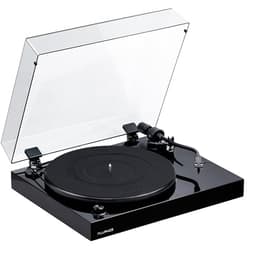
Fluance RT82
A step-up deck when you already have a phono preamp
Price as of October 16, 2026. #ad How we’re funded
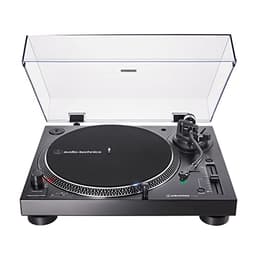
Audio-Technica AT-LP120XUSB
Digitizing records and learning proper setup
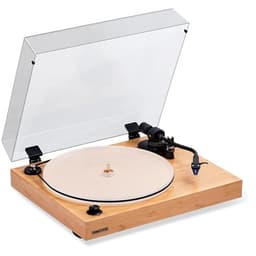
Fluance RT85
The most cartridge and platter per dollar under $600
Price as of October 16, 2026. #ad How we’re funded
Frequently asked questions
Why is my record player playing too slow?
On a belt-drive deck, nine times out of ten it is the belt. A belt that has stretched or gone shiny slips on the motor pulley, and the platter never quite reaches speed. The other causes, in order of likelihood: the belt sitting on the wrong step of the pulley, something dragging on the platter or spindle, a pitch control that has been knocked off center, and finally a failing motor or a dry bearing.
Why is my record player playing too fast?
Usually because 45 RPM is selected for a 33 1/3 record - that reads as obviously fast and sharp, and is a switch rather than a fault. If the speed is correct, check a pitch slider or fine-speed dial has not been nudged. A deck that is only slightly fast with everything set right points at the belt sitting on the wrong pulley step, or at a motor running out of specification.
How do I know what speed a record should play at?
It is nearly always printed on the label or the jacket. As a rule of thumb, a 12-inch album plays at 33 1/3 RPM and a 7-inch single at 45 RPM - but 12-inch singles, many audiophile reissues and most dance pressings are cut at 45, and shellac records from before the 1950s need 78. If the record is unlabeled, play it at 33 1/3 and listen: vocals an octave too high are unmistakable.
How do I fix a stretched turntable belt?
You replace it rather than fix it. Lift the platter off, note how the belt loops around the inner rim and the motor pulley, and order the belt specified for your exact model - they are usually a few dollars and the single cheapest repair in vinyl. Fit it on the correct pulley step for the speed you want, and wipe the pulley and rim clean with a dry cloth before you do.
Can I adjust the speed on my turntable?
Only if the maker provided a control for it. Some decks have a pitch slider or a pair of fine-speed trim pots, often behind a small cover on the underside or inside the plinth; those can be set against a strobe app. Most modern budget decks have no adjustment at all, by design - their speed is set by the motor controller, and a deck that is out of specification needs a new belt or a repair rather than a tweak.
Is 'wow and flutter' the same as playing at the wrong speed?
No, and the difference is useful. Speed accuracy is whether the platter averages 33 1/3 RPM; wow and flutter is how much it wobbles around whatever average it achieves. A deck can be accurate and wobbly, or steady but consistently sharp. Fluance publishes both for its decks - 0.2 percent wow and flutter with plus or minus 1 percent speed variation on the RT81 against 0.07 percent and 0.13 percent on the RT82 - which is why those two figures are quoted separately on this site.
Do direct-drive turntables have speed problems?
They have no belt to stretch, which removes the commonest cause, and they typically reach speed in a fraction of a turn. When a direct-drive deck does go wrong it tends to be the motor or its control board rather than a consumable, which is a repair rather than a part swap. That trade - fewer faults, pricier ones - is covered in our belt drive versus direct drive guide.
Could the record itself be the problem?
If only one record sounds wrong, yes - either it is cut at a speed you are not using, or it is a bad pressing. If everything sounds wrong, the deck is the problem. One more possibility worth ruling out on an all-in-one or a suitcase player: badly worn gears or a slipping idler can make speed wander in a way no setting fixes, and on that class of player it is usually the end of the road.
Sources
- Fluance — RT81 Elite turntable, published specifications — Manufacturer specification table, read live: belt drive, DC motor on three-point rubber isolation, 33 1/3 and 45 RPM (78 RPM "No"), speed variation +/- 1.00%, wow and flutter 0.2%, signal-to-noise "67 dB or higher (A-weighted, 20 kHz LPF)" and "60 dB or higher (unweighted, 20 kHz LPF)", aluminum platter 12 in / 1.22 lb (553 g) / 0.62 in (16 mm) with a rubber mat, static-balanced S-type aluminum tonearm 8.82 in (224 mm) effective length and 0.99 oz (28.2 g) effective mass, adjustable 100 g counterweight, anti-skating, cueing lever, pivot bearing, H-4 bayonet headshell 0.38 oz (10.7 g), "Audio Technica: AT95E" dual moving magnet cartridge with a 0.4 x 0.7 mil bonded elliptical diamond on an aluminum cantilever at 2.0 g tracking force, 20-20,000 Hz, 20 dB channel separation at 1 kHz, 3.5 mV phono output and 140 mV (-17 dBV) line output, switchable PHONO/LINE preamp with full bypass and a ground terminal, MDF plinth in real wood veneer, tinted dust cover, defeatable auto-stop, suspension isolation feet, 14.1 lb (6.4 kg), 1.5 W. Listed at 299.99 USD on the access date with no discontinuation notice. Re-read live on 2026-10-05 for the RT81 vs AT-LP120XUSB head-to-head and the 2M Blue review, every figure above unchanged and still listed at 299.99 USD; two rows quoted on those pages are confirmed verbatim from the same table — "Supported Cartridge Weight: 0.12 to 0.23 oz (3.5 to 6.5 g)", which EXCLUDES the 7.2 g Ortofon 2M Blue, and "Cartridge Weight: 5.7 g (+/- 0.5 g)" (accessed September 26, 2026)
- Fluance — RT82 Reference turntable, published specifications — Manufacturer specification table: belt drive, servo-controlled DC motor, 0.07% wow and flutter, 68.5 dB weighted S/N, aluminum platter 553 g / 16 mm, static balanced S-type aluminum arm 224 mm / 21.78 g, H-4 bayonet headshell, Ortofon OM 10, no built-in preamp, 6.8 kg. Re-checked live on 2026-10-05 for the 2M Blue review, which quotes one further row from the same table verbatim: "Supported Cartridge Weight: 0.18 - 0.25 oz (5.0 - 7.5 g)", the range that DOES accommodate a 7.2 g Ortofon 2M Blue where the RT81's does not. Still listed at 349.99 USD (accessed September 3, 2026)
- Fluance — RT85 Reference turntable, published specifications — Manufacturer specification table: 0.07% wow and flutter, 69 dB weighted S/N, acrylic platter 1.56 kg / 16 mm, static balanced S-type aluminum arm 224 mm / 27.5 g, H-4 bayonet headshell, Ortofon 2M Blue 0.3 x 0.7 mil nude elliptical, no built-in preamp, 7.6 kg (accessed September 3, 2026)
- Audio-Technica — AT-LP120XUSB user manual, full published specification — The complete published table, re-read in full on this date (this manual was previously cited on this site only for the deck's dimensions). Turntable: type "Direct drive", motor "DC servo motor", "3-speed, fully manual operation" at 33-1/3, 45 and 78 RPM, die-cast aluminum platter, starting torque "> 1.0 kgf.cm", braking system "Electronic brake", wow and flutter "< 0.2% WRMS (33 RPM) at 3 kHz", signal-to-noise "> 50 dB", output PHONO "4 mV nominal at 1 kHz, 5 cm/sec" and LINE (MM) "240 mV nominal at 1 kHz, 5 cm/sec", phono pre-amp gain "36 dB nominal, RIAA equalized". Tonearm: "Static balanced S-shaped tonearm", effective length 230.5 mm, overhang 16 mm, maximum tracking error angle "Less than 3", stylus pressure adjustment range "0 to 4 g", applicable cartridge weight range "3.5 to 8.5 g". Cartridge and headshell: AT-VM95E, VM type, 47,000 ohms recommended load, 4.0 mV output, "0.3 x 0.7 mil bonded elliptical stylus", aluminum pipe cantilever, tracking force range "1.8 to 2.2 g (2.0 g standard)", cartridge weight 6.1 g, headshell AT-HS6 at 9 g including lead wire, headshell overhang adjustment "+/- 5 mm". USB function "16 bit 44.1 kHz or 48 kHz USB A/D, D/A selectable", computer interface "USB 1.1 Compliant". General: 452.0 mm (17.80") x 352.0 mm (13.86") x 141.6 mm (5.57"), 8 kg (17.6 lbs) without dust cover, 2.75 W, replacement stylus AT-VMN95E, replacement headshell AT-HS6, with a stylus target light, USB cable and RCA audio cable in the box (accessed October 5, 2026)
- Audio-Technica — AT-LP120XUSB user manual — The published dimensions and weight of the deck that decides the footprint question on this page: 452.0 mm (17.80 in) wide x 352.0 mm (13.86 in) deep x 141.6 mm (5.57 in) high, 8 kg (17.6 lb) without the dust cover. At 17.80 in across it is wider than the Fluance IB40's published 17.13 in footprint limit and wider than the 17 in zaZen I platform (accessed September 11, 2026)
- Crutchfield — How to choose the right turntable — Buying-guide reference on drive type, cartridges, preamps and setup (accessed July 24, 2026)
Keep reading
33 vs 45 RPM
Which speed a record is cut at, why 45 exists, and how to tell without a label.
Read the guideBelt Drive vs Direct Drive
The design decision behind most speed faults, and which one fails how.
Read the guideTurntable Troubleshooting
The full fault list, from no sound at all to one channel dropping out.
Read the guideBuying a Used Turntable
Where speed problems are most likely to arrive from - and how to check before you pay.
Read the guide