Buying a Used Turntable: What to Check First
A secondhand deck is the cheapest route into good vinyl and the easiest way to buy a problem. Seven checks separate the two, and most of them take under a minute.
How this is funded: we earn a commission if you buy through our links, at no extra cost to you. It never changes which product we recommend, and we’ll tell you plainly when to skip one. Full disclosure.
The short answer: a used turntable is worth buying when a replacement stylus and drive belt for that exact model are still sold, and the counterweight moves. Those two checks eliminate most bad buys in under a minute. Everything else on this page is about what the deck will cost once you own it — because the real price of a secondhand deck is the asking price plus a stylus, and often plus a belt and a phono preamp as well.
Why a used deck can beat a new one
At any price, a turntable is mostly platter, bearing and arm. Those are machining-and-materials costs that have not got cheaper, while the electronics around them have. So a well-made deck from the 1970s or 1980s often carries a heavier platter and a better tonearm than a new deck at the same money — and the parts that wear out on it are consumables rather than the expensive bits.
The catch is that nothing on a used deck is guaranteed and one part is almost certainly worn: the stylus. That is not a reason to avoid the used market. It is a reason to go into it with a figure in your head.
The checks, and what each one is really testing
1. Parts availability, before price. Get the full model number and search for a stylus and a belt for it. This is the only check that can rule a deck out completely, because a turntable you cannot re-tip is a turntable with a fixed remaining lifespan. Audio-Technica, Ortofon and Nagaoka all still sell replacement styli for their current cartridge families, which is why a used deck carrying one of those cartridges is a safer buy than one carrying a house-brand pickup nobody supports.
2. The stylus, under a phone camera.Zoom all the way in. A clean point or narrow blade is fine; blunt, hooked or fluffy is not. There is no way to date a diamond by eye, and the hour figures dealers quote for stylus life — several hundred to around a thousand hours, depending on the tip — are useless when nobody knows how many have been used. Assume you are buying one.
3. The counterweight.Spin it. It should move smoothly on its thread and stay put. A seized or missing counterweight means you cannot set tracking force, and a deck that cannot be set to its cartridge’s published force is a deck that will wear your records. This is the fault to walk away from, because unlike a stylus it is not a part you can order.
4. The belt, on a belt-drive deck.Lift the platter — most come off by hand — and look at the rubber loop around the inner rim. Shiny, cracked, slack or flattened means replace it, which is usually a few dollars. Direct-drive decks have no belt; there, check that the platter reaches speed promptly and stops without coasting, since a motor that freewheels is a repair rather than a consumable. Our belt vs direct drive guide covers which is which if the deck is unfamiliar.
5. Speed, judged against a record you know.Do not evaluate tone on someone else’s speakers. Evaluate pitch. Music that drags or runs sharp against your memory of it is the clearest sign of a tired belt or a failing motor, and it is the one fault a seller cannot talk you out of hearing. Listen too for rumble that rises and falls in time with the platter, which points at the bearing.
6. Vibration through the plinth. Rest a hand on the base while a record plays. Motor vibration that reaches the plinth reaches the groove. A faint hum is normal on an older deck; a buzz you can feel clearly is a motor or suspension issue and rarely economic to fix at the bottom of the market.
7. The total, against new. Add the stylus, the belt, a tracking-force gauge and, if you have no receiver with a PHONO socket, a phono preamp. Then compare that number with a new deck that arrives with a current cartridge, a switchable phono stage and a warranty.
Where the crossover sits
Below about $200 all-in, new tends to win. A new automatic at under $180 arrives with a replaceable Audio-Technica cartridge, a switchable built-in preamp and nothing to set up wrong, and a used deck at $120 plus a $40 stylus plus a belt is not far off the same money with none of those assurances.
Above roughly $250, used starts winning clearly, because that is where the secondhand market offers a heavier platter, a better bearing and an arm with proper adjustment — the things new budget decks spend least on. The honest version of this page’s advice is therefore: buy used when you are buying up, and buy new when you are buying cheap. Our beginner picks and picks under $300 are the new-deck benchmarks to measure against.
The first hour after you get it home
Fit the new stylus, then set the deck up from scratch rather than trusting how it arrived. Level it, reset the counterweight and tracking force to the cartridge’s published figure, and clean the stylus before the first record. If the sound is dull rather than wrong, why vinyl sounds muffledworks through the causes in order — on a used deck the answer is usually the one part you have just replaced, or the force you have just set.
What a used deck usually needs on day one, with live prices
Budget for these before you agree a price, not afterwards. A replacement stylus for the cartridge the deck actually carries, and a gauge to confirm the tracking force once the counterweight is reset - those two are what turn a secondhand deck into one that is safe for your records.
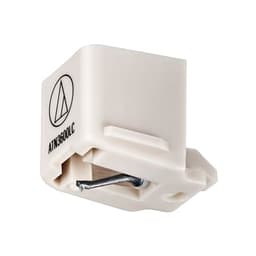
Audio-Technica ATN3600LC Replacement Stylus
Keeping an AT-LP60X or AT-LP60XBT from wearing your records
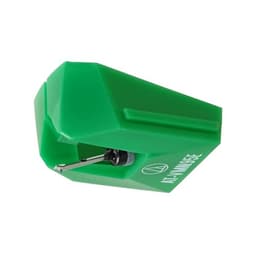
Audio-Technica AT-VMN95E Replacement Stylus
Replacing a worn stylus without touching the alignment
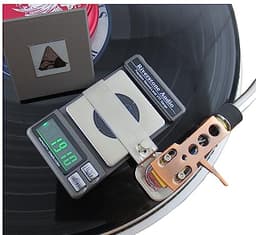
Riverstone Audio Record-Level Stylus VTF Gauge
Anyone who has set tracking force once and wants to know it was right
Price as of October 16, 2026. #ad How we’re funded
The new decks a used purchase has to beat
These are the prices a secondhand deck plus its repairs is competing with. All three ship with a current, replaceable cartridge and a switchable phono stage, which between them remove most of the risk this page is about.
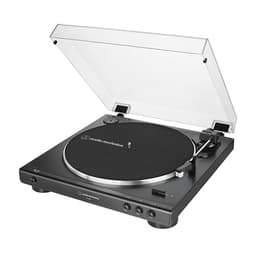
Audio-Technica AT-LP60X
A safe, genuinely automatic first deck under $200
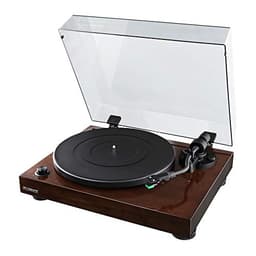
Fluance RT81
First serious turntable that you won't outgrow in a year
Price as of October 16, 2026. #ad How we’re funded
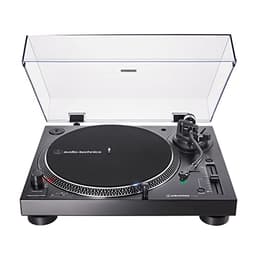
Audio-Technica AT-LP120XUSB
Digitizing records and learning proper setup
Frequently asked questions
Is it worth buying a used turntable?
Yes, if the model still has parts available and you budget for a new stylus. A well-made deck from the 1970s or 1980s can outperform a new budget turntable, because the money went into the platter, the bearing and the arm. It stops being worth it when the stylus is discontinued, the counterweight is missing, or the asking price plus repairs exceeds a new deck with a warranty.
What should I check when buying a used turntable?
Seven things: the exact model and whether parts are still sold, the state of the stylus under a phone camera, whether the counterweight moves and holds, the condition of the drive belt, whether the speed sounds right on a record you know, how much motor vibration reaches the plinth, and whether the repair total still beats a new deck.
How can I tell if a used stylus is worn out?
Zoom in with a phone camera. A usable diamond reads as a clean point or a narrow blade; a worn one looks blunt, hooked to one side, or buried in grey fluff. There is no reliable way to date a stylus by looking, so assume a used deck needs one unless the seller can say when it was changed. A worn stylus does not just sound dull - it cuts the groove rather than tracing it.
How long does a turntable stylus last?
Manufacturers and specialist dealers generally quote several hundred to around a thousand hours for a conical or elliptical diamond, depending on the tip and how clean the records are. The number matters less than the habit: nobody buying a used deck knows how many of those hours have been used, which is why a replacement stylus belongs in the purchase price rather than in a later plan.
What is a good used turntable to buy?
One whose stylus and belt you can still order today. That rules more models in than out: Audio-Technica, Technics, Dual, Pioneer and Denon decks of various ages are generally serviceable, and Audio-Technica still sells replacement styli for its own current cartridge families. If a search for the exact stylus part number returns nothing from a dealer, treat the deck as a decoration rather than a turntable.
Should I buy a used turntable or a new budget one?
Do the arithmetic rather than the romance. A used deck at $120 that needs a $40 stylus and a $5 belt costs $165 with no warranty, no current cartridge and no built-in phono stage. A new automatic at $178 arrives with all three. Above about $250 the used market starts winning clearly, because that is where secondhand buys a heavier platter and a better arm than new money can.
Do used turntables need a phono preamp?
Almost always, yes. Most older decks pre-date the built-in phono stage entirely, so they output a raw phono-level signal and need either a receiver with a PHONO input or an external preamp. Add that to the purchase total too: it is the third item people forget after the stylus and the belt.
Is a suitcase record player worth buying used?
No. The usual faults of that class - a sealed ceramic cartridge, a fixed arm with no counterweight, and a high tracking force - are design features rather than wear, so a used one is a new one with more hours on the stylus. Our guide on suitcase players explains what those three things do to a record.
Sources
- Elusive Disc — Elliptical or Shibata stylus, and when to replace one — Retailer reference: "Replace the stylus every 800-1000 hours (dependent on usage and model)" (accessed August 19, 2026)
- Library of Congress — Caring for and cleaning grooved discs — Preservation guidance on cleaning and storing records to prevent damage (accessed July 24, 2026)
- Crutchfield — How to choose the right turntable — Buying-guide reference on drive type, cartridges, preamps and setup (accessed July 24, 2026)
- Audio-Technica — ATN3600LC replacement stylus — The replacement conical stylus for the AT3600L cartridge fitted to the AT-LP60X, and the only place Audio-Technica publishes that cartridge's tracking-force range: "Vertical Tracking Force 3.0 to 4.0 g (3.5 g standard)"; "Conical bonded", 0.6 mil; stylus life "Approx. 300-500 hours"; compatible with the AT-LP60X series, AT-LP60 series, AT-LP2D series, AT-PL300 series, AT-SB727, AT-SB2022, AT-LPGO-BT and AT-PL50 (accessed September 18, 2026)
- Audio-Technica — AT-VMN95E replacement stylus — Manufacturer page for the elliptical VM95-series replacement stylus and its fitment list (accessed August 11, 2026)
- Audio-Technica — AT-LP120XUSB user manual — The published dimensions and weight of the deck that decides the footprint question on this page: 452.0 mm (17.80 in) wide x 352.0 mm (13.86 in) deep x 141.6 mm (5.57 in) high, 8 kg (17.6 lb) without the dust cover. At 17.80 in across it is wider than the Fluance IB40's published 17.13 in footprint limit and wider than the 17 in zaZen I platform (accessed September 11, 2026)
- Fluance — RT81 Elite turntable, published specifications — Manufacturer specification table, read live: belt drive, DC motor on three-point rubber isolation, 33 1/3 and 45 RPM (78 RPM "No"), speed variation +/- 1.00%, wow and flutter 0.2%, signal-to-noise "67 dB or higher (A-weighted, 20 kHz LPF)" and "60 dB or higher (unweighted, 20 kHz LPF)", aluminum platter 12 in / 1.22 lb (553 g) / 0.62 in (16 mm) with a rubber mat, static-balanced S-type aluminum tonearm 8.82 in (224 mm) effective length and 0.99 oz (28.2 g) effective mass, adjustable 100 g counterweight, anti-skating, cueing lever, pivot bearing, H-4 bayonet headshell 0.38 oz (10.7 g), "Audio Technica: AT95E" dual moving magnet cartridge with a 0.4 x 0.7 mil bonded elliptical diamond on an aluminum cantilever at 2.0 g tracking force, 20-20,000 Hz, 20 dB channel separation at 1 kHz, 3.5 mV phono output and 140 mV (-17 dBV) line output, switchable PHONO/LINE preamp with full bypass and a ground terminal, MDF plinth in real wood veneer, tinted dust cover, defeatable auto-stop, suspension isolation feet, 14.1 lb (6.4 kg), 1.5 W. Listed at 299.99 USD on the access date with no discontinuation notice. Re-read live on 2026-10-05 for the RT81 vs AT-LP120XUSB head-to-head and the 2M Blue review, every figure above unchanged and still listed at 299.99 USD; two rows quoted on those pages are confirmed verbatim from the same table — "Supported Cartridge Weight: 0.12 to 0.23 oz (3.5 to 6.5 g)", which EXCLUDES the 7.2 g Ortofon 2M Blue, and "Cartridge Weight: 5.7 g (+/- 0.5 g)" (accessed September 26, 2026)
Keep reading
How to Replace a Turntable Stylus
The first job on almost every used deck, done in about five minutes without tools.
Read the guideHow to Balance a Tonearm
The second job: setting tracking force properly once you have reset the counterweight.
Read the guideWhy Is My Record Player Playing at the Wrong Speed?
The fault a used belt-drive deck is most likely to arrive with, and what fixes it.
Read the guideBest Turntables for the Money
What new money buys at each price, so you can tell whether the used deck is a bargain.
See the picks