How we judged value here
Four tests, applied to every deck on the site. A pick had to pass at least two of them clearly.
- Does it include a component worth buying separately?A factory-fitted Ortofon 2M Blue is not a line on a spec sheet — it is a cartridge with its own retail price, and it transfers to your next deck.
- Does it have an adjustment decks twice the price omit? A counterweight and anti-skate cost the manufacturer money and are the gateway to every future upgrade.
- Does it remove a second purchase? A switchable built-in preamp saves a box. A USB output saves an audio interface.
- Will it still be worth owning after an upgrade? A deck with a standard half-inch cartridge mount survives two or three cartridge changes. A fixed-arm deck is finished the day you buy it.
Where the value curve actually bends
Plotting what you get against what you pay across this site’s whole registry, the curve has three distinct sections.
Below about $150: value is negative
This is the only part of the market where spending less can cost you money. The sub-$100 suitcase players use sealed ceramic cartridges that track heavy and cannot be replaced, so the “saving” is paid for in permanent groove wear on your records. The cheapest genuinely safe deck is the floor, not the bargain.
$150 to $350: the steepest value in the hobby
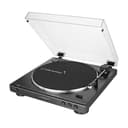
Every dollar here buys something structural. Around $180 you get a real magnetic cartridge and full automation. Around $300 you add a counterweight, anti-skate, an aluminum platter and an elliptical stylus. That is the single biggest jump in sound quality per dollar anywhere on this site, and it is why the Fluance RT81 is our overall value pick.
$350 to $600: value depends on what is included
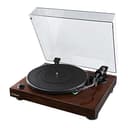
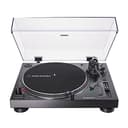
The curve flattens, but two decks bend it back up. The Fluance RT85ships with an Ortofon 2M Blue and an acrylic platter — buy that cartridge separately and you have spent a large share of the deck’s price on its own. The AT-LP120XUSB includes a USB output that replaces a separate audio interface if you plan to digitize. Both are cases where the price includes something with its own market value.
Above $600: you are buying refinement, not value
Real improvements, but the ratio stops being remarkable. That is not a criticism — it is what the top of any market looks like. See are expensive turntables worth it? for where exactly the returns flatten.
The value trap: buying a deck that needs more money
The most common way people overpay is by buying a deck whose price excludes something they then have to buy. Three to watch for:
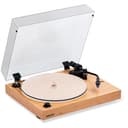
- No built-in preamp.The Fluance RT82 and RT85 both omit it by design. That is a fidelity decision, not a cost cut — but if you do not already own a phono stage, add that to the price before comparing.
- No speakers. Every deck here except the Victrola needs something to plug into. A $300 deck plus $150 speakers is a $450 system.
- A cartridge you will replace immediately. If a deck ships with a conical stylus you intend to upgrade, the real price includes the cartridge you would rather have had.
The genuinely cheapest route to good sound is usually a deck with a switchable preamp plus powered speakers — two boxes, two cables, no hidden third purchase. Our beginner setup guide costs three complete systems out that way.
The best value upgrade is not a turntable
Worth saying on a page about value: if you already own a competent deck with an adjustable arm, the highest return per dollar available to you is not a new turntable. It is, in order:
- Setting up the deck you own correctly.Free. Frequently the largest single improvement available — see the setup guide.
- A better stylus on the cartridge body you already have. Tens of dollars, snaps on in seconds, no realignment — see needles and replacement styli.
- Speakers. They change what you hear more than any other component.
- A separate phono stage, especially if you are currently using one built into a budget receiver.
A new deck comes fifth. That ordering is unglamorous and it is the honest answer to “what should I spend my money on?”