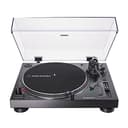
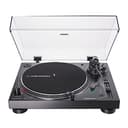
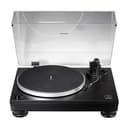
The three decks on the published figures
| Row | AT-LP120XUSB | AT-LP120XBT-USB | AT-LP5X |
|---|
| Drive | Direct drive, DC servo motor | Direct drive, DC servo motor | Direct drive, low-noise motor |
| Starting torque | > 1.0 kgf.cm | Not published | Not published |
| Braking | Electronic brake | Not published | Not published |
| Wow and flutter | < 0.2% WRMS (33 RPM) at 3 kHz | Not published | Not published |
| Speeds | 33 1/3, 45, 78 RPM | 33 1/3, 45, 78 RPM | 33 1/3, 45, 78 RPM |
| Tonearm | Static balanced S-shape, 230.5 mm | Static balanced S-shape, adjustable dynamic anti-skate | J-shaped, AT-HS6 removable headshell |
| Applicable cartridge weight | 3.5 to 8.5 g | Not published | Not published |
| Outputs beyond RCA | USB | USB and Bluetooth with aptX Adaptive | None |
| Built-in phono preamp | Yes, switchable | Yes, switchable | Yes, switchable phono/line |
The “Not published” cells are the point of showing the table. Audio-Technica publishes a full engineering table for the AT-LP120XUSB and far less for the other two, so the deck with the most detail available is also the one we can argue for most confidently. That is not an estimate of ours in either direction — it is what the maker does and does not state.
How we ranked them
- Published drive and torque detail. Starting torque and a braking system are the two rows that describe a direct drive as a direct drive. Only one of these three publishes them, and it leads the page.
- What you can fit later. The AT-LP120XUSB publishes an applicable cartridge weight range of 3.5 to 8.5 g and a stylus pressure adjustment range of 0 to 4 g, which admits everything from a 6.1 g AT-VM95E to a 7.2 g Ortofon 2M. That is a wider window than any belt deck we rank. The AT-LP5X answers the same question differently, with a removable AT-HS6 headshell that turns a cartridge change into a two-minute swap.
- The third speed, used honestly. All three select 78 RPM. None of them ships with a stylus cut for it: a true shellac 78 needs a 3.0 mil conical tip, which our 78 RPM page covers in full, including the tracking force a fixed arm cannot set.
- Whether the extra output is worth the premium. Bluetooth on the BT model is a convenience path rather than the good-sounding one, and it costs meaningfully more than the wired deck for that alone. We rank it third-way-up rather than top for exactly that reason.
What direct drive is genuinely better at
Three things, all of them checkable. There is no belt to perish — a belt is a consumable, and a stretched one is the most common cause of a slow or wavering deck. Speed selection is electronic, which is how a third speed and a pitch slider exist at this price at all. And the platter reaches speed almost immediately and stops when told, which is the whole reason DJs standardized on the layout. If you cue by hand, slip-cue, or record one side at a time to a computer, those three add up to a materially nicer deck to operate.
There is a fourth, quieter advantage: the manual controls that tend to travel with the layout. All three decks here are fully manual with an adjustable counterweight, anti-skate and a switchable phono stage, which is the specification that lets you balance the arm properly and set the tracking force your cartridge actually asks for.
When a belt drive is the better buy
If you will never play a 78, never digitize a record and never touch the platter while it spins, the direct-drive advantages stop applying and the belt-drive ones start. A belt isolates motor vibration mechanically rather than electronically, which is why the better-measuring decks at this money are belt-driven: 0.07% published wow and flutter on a Fluance RT82 against under 0.2% on the AT-LP120XUSB. Belt decks are also lighter, smaller and usually cheaper — the AT-LP120XUSB publishes 8 kg and 17.80 inches of width, which rules it out of several isolation platforms and more than one shelf.
The comparison most people actually face is the Fluance RT81 against the AT-LP120XUSB, which we have put side by side row for row, and the broader field is on our best turntables page. If you want automatic operation, note that none of the three decks here has it: that list is our automatic turntable picks, and every one of them is belt-driven.
What to buy with it
All three decks have a switchable phono preamp inside, so they will drive powered speakers on day one with nothing else in the chain. The upgrade that matters first is usually the cartridge or its stylus — the AT-VM95E fitted to the AT-LP120XUSB and AT-LP5X accepts any VMN95 stylus, which is the cheapest real improvement available, and our cartridges for Audio-Technica decks page covers what fits. After that, the deck’s own mass makes isolation a question of what it is standing on rather than of damping the deck itself.