33 vs 45 RPM: Which Speed, and Why It Matters
Two numbers, one physical trade: 45 moves more vinyl past the stylus per second, and buys that with playing time. Here is how to tell which speed a record wants, and what to do when the sleeve does not say.
How this is funded: we earn a commission if you buy through our links, at no extra cost to you. It never changes which product we recommend, and we’ll tell you plainly when to skip one. Full disclosure.
The short answer: a 12-inch album is 33 1/3 RPM, a 7-inch single is 45 RPM, and the exceptions are audiophile reissues that cut an album at 45 across two discs for a real technical reason. The number is a rotation speed, and the only thing it changes mechanically is how much vinyl passes under the stylus per second. Everything else — sound quality, playing time, why some reissues cost twice as much — follows from that one fact.
What the two numbers actually describe
RPM is revolutions per minute: the platter turns 33 and a third times a minute, or 45. Because a record’s groove is a spiral of fixed length, speed decides how much groove is consumed per second of music — and therefore how much space each waveform gets to be cut into.
At 45 RPM the groove moves faster under the stylus, so a given passage of music is spread over more vinyl. High frequencies, which are the shortest wavelengths cut into a groove, get more physical room; the cutting head and the playback stylus both have an easier job. At 33 1/3 RPM the same music occupies less groove, which is how a whole album side fits on one disc in the first place. That is the entire trade, and it has not changed since the formats were introduced.
| Row | 33 1/3 RPM | 45 RPM | 78 RPM |
|---|---|---|---|
| Usual format | 12-inch album (LP) | 7-inch single; also audiophile 12-inch reissues | 10-inch shellac disc, pre-1960s |
| Typical playing time per 12-inch side | About 20 to 22 minutes | About 12 to 15 minutes | Around 3 to 5 minutes (10-inch) |
| Groove speed under the stylus | Lower | Higher — about 35% more than 33 1/3 | Highest |
| Needs a different stylus | No | No | Yes — a 3.0 mil conical tip |
| Supported by the decks we rank | All of them | All of them | A minority |
| Centre hole | Small | Small or large, depending on the market | Small |
How to tell which speed a record wants
In order of reliability: the label in the middle of the disc, which usually prints it; the jacket or spine, where audiophile reissues advertise “45 RPM” as a feature; and failing both, format and size. A 12-inch album with no speed printed anywhere is almost certainly 33 1/3. A 7-inch is almost certainly 45. A 10-inch could be either, and if it is thick, heavy and sounds like sandpaper when you drop the needle, it is a shellac 78 and you should take it off.
If you genuinely cannot tell, play it at 33 1/3 first. A 45 played slow is immediately obvious — sluggish, flat, wrong — and nothing is harmed by the attempt. The reverse is equally obvious and equally harmless. The only speed where guessing costs you something is 78, because of the stylus rather than the speed.
Switching speeds on your deck
Every modern turntable publishes 33 1/3 and 45 — the Fluance RT81 publishes exactly those two, the AT-LP120XUSB and the Denon DP-450USB publish three with 78 included. What varies is the mechanism.
Direct-drive decks select the speed electronically, usually with a button, because the motor that drives the platter is the platter’s own motor. Belt-drive decks do it either with a switch that changes motor speed, or on simpler designs by moving the belt between two steps on the motor pulley — a thirty-second job with the platter lifted off, not a defect. Whether your deck needs that is in its manual rather than guessable from its badge, which is why our belt drive vs direct drive guide treats speed selection as one of the real differences between the layouts, and why the direct-drive picks all publish a third speed.
The 7-inch problem: adapters and big center holes
American 45s were commonly pressed with a large center hole — the result of jukebox mechanisms — and they will not sit on a normal spindle without a 45 RPM adapter: a puck that fills the hole and centers the record. Some decks include one; Audio-Technica lists a 45 RPM adapter in the box for the AT-LP70X, for instance. Elsewhere in the world, 7-inch singles were usually pressed with a small hole and a removable “dinked” center, so plenty of singles need nothing at all.
We do not rank an adapter, and that is deliberate: it is a commodity part, usually a few dollars, with nothing published about it worth comparing. If your deck did not come with one and your singles have big holes, buy any of them — what matters is that it is flat and sits level, because a wobbling adapter puts the record off-center, which is audible as a slow wavering pitch on every revolution.
Why some albums come as two 45 RPM discs
When a reissue label splits an album across two discs at 45 RPM, it is making the trade deliberately: shorter sides, more vinyl per second, easier high-frequency cutting. It is the same engineering logic as the speed difference itself, applied to a format that did not originally need it.
It is worth knowing what that does and does not promise. The speed is a real technical choice. It is also one choice among several that a premium reissue is selling you — mastering source, cutting engineer, plating, pressing plant and packaging. Blue Note’s Tone Poet series, for example, publishes all-analog mastering from the original tapes by one named engineer and 180g pressing at a named plant, which is the kind of disclosure worth more than the weight on the sticker. On weight specifically, the pressing company Disc Makers is blunt in its own words: the stampers used for 180g records are the same as for standard weight, and the groove depths are the same. Our audiophile pressings guide and 180 gram vinyl go through the rest of that list, and which pressing to buy ranks the factors by how much they actually affect what you hear.
78 RPM is a different thing entirely
The one speed that is not just a selector position. A 78 is usually shellac, not vinyl, and its groove is far wider than a modern microgroove record’s — so a modern stylus sits in it badly and wears it. Audio-Technica publishes a 3.0 mil conical tip and a 4.5 to 5.5 g tracking force for the AT-VM95SP, the cartridge it makes for the format, against 0.3 x 0.7 mil and 1.8 to 2.2 g for the elliptical on a normal deck. That 5 g figure is the real constraint: an arm with no counterweight cannot be set to it, whatever its speed selector offers. If a box of 78s is why you are reading this, start at our 78 RPM page rather than with the speed switch.
And whatever speed your records are, the things that actually determine how they sound are elsewhere: a clean disc, a stylus inside its published life, correct tracking force, and a deck that is level. Our cleaning guide and upgrade order are both worth more than the number printed on the label.
Decks and their published speeds, with live prices
Every modern deck plays 33 and 45; the third speed is the one that varies. The Fluance RT81 publishes two speeds, the AT-LP120XUSB and the Denon DP-450USB publish three including 78 RPM.
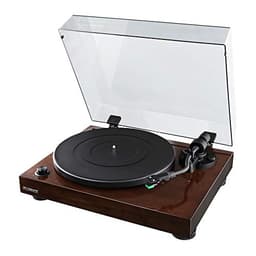
Fluance RT81
First serious turntable that you won't outgrow in a year
Price as of October 10, 2026. #ad How we’re funded
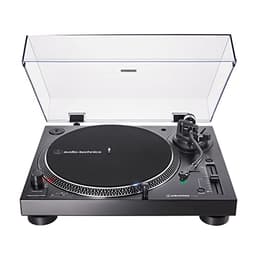
Audio-Technica AT-LP120XUSB
Digitizing records and learning proper setup
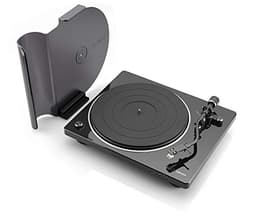
Denon DP-450USB
Archiving a record collection without a computer in the chain
Price as of October 10, 2026. #ad How we’re funded
Frequently asked questions
What is the difference between 33 and 45 RPM?
They are rotation speeds: 33 1/3 and 45 revolutions per minute. At 45 RPM more vinyl passes under the stylus each second, so a given stretch of music occupies more groove - which makes high frequencies easier to cut accurately and lowers the demands on the stylus. The cost is playing time: a 12-inch side holds roughly 20 to 22 minutes at 33 1/3 and only about 12 to 15 at 45, which is why albums cut at 45 arrive as two discs.
How do I know if a record is 33 or 45 RPM?
Check the label first - the speed is printed on most of them - then the jacket or the spine. If neither says, use size and format: a 12-inch album is 33 1/3 unless it is badged as a 45 RPM audiophile pressing, a 7-inch single is 45, and a 10-inch could be either. If you are still unsure, play it at 33: a record played too slowly sounds obviously sluggish and flat, and you have lost nothing by trying.
Does 45 RPM sound better than 33?
It can, for a reason that is physical rather than mystical: higher linear velocity under the stylus means less information packed into each millimeter of groove, which eases high-frequency cutting and tracking. Whether you hear it depends on the mastering, the pressing and your system, and we have run no listening tests. What is not in dispute is the trade - you are buying that advantage with playing time, extra discs and a side change every fifteen minutes.
Can all turntables play 45 RPM?
Effectively all modern ones, yes - 33 1/3 and 45 is the standard pair, and every deck we rank publishes both. What varies is 78 RPM, which appears on a minority of decks, and how the speed is changed: some decks have a button or a switch, some have a two-step pulley that needs the belt moved by hand. Check your manual before concluding a deck cannot do it.
Do I need an adapter to play 7-inch singles?
If the single has a large center hole, yes - that is the dinked 45 format, and you need a plastic or metal puck that sits in the hole and centers the record on the spindle. Some decks include one: Audio-Technica lists a 45 RPM adapter in the box for the AT-LP70X. Singles with a small center hole, which are common outside the United States, need nothing at all.
What happens if I play a record at the wrong speed?
Nothing is damaged - the pitch is simply wrong. A 45 played at 33 1/3 sounds slow, flat and dragging; a 33 played at 45 sounds fast and thin. The one real risk is unrelated to speed: if you have a 78 and play it with a modern microgroove stylus, the tip is too small for the groove, and that does cause wear. Speed itself is harmless to get wrong once.
Why are some albums pressed at 45 RPM across two discs?
Because the label has chosen fidelity over convenience. Splitting an album across two 45 RPM discs keeps each side short enough to cut at the higher speed, which eases the high-frequency demands of cutting and playback. It is a real technical decision rather than packaging - and it is also why those releases cost more: twice the vinyl, twice the pressing, twice the jacket.
Is 78 RPM the same kind of record?
No, and this is the one speed that needs more than a selector switch. A 78 is usually shellac rather than vinyl and its groove is much wider, so it needs a stylus cut for it - Audio-Technica publishes a 3.0 mil conical tip and a 4.5 to 5.5 g tracking force for its AT-VM95SP, against 0.3 x 0.7 mil and 1.8 to 2.2 g for a modern elliptical. A deck that selects 78 is only half the requirement.
Sources
- Audio-Technica — AT-LP120XUSB user manual, full published specification — The complete published table, re-read in full on this date (this manual was previously cited on this site only for the deck's dimensions). Turntable: type "Direct drive", motor "DC servo motor", "3-speed, fully manual operation" at 33-1/3, 45 and 78 RPM, die-cast aluminum platter, starting torque "> 1.0 kgf.cm", braking system "Electronic brake", wow and flutter "< 0.2% WRMS (33 RPM) at 3 kHz", signal-to-noise "> 50 dB", output PHONO "4 mV nominal at 1 kHz, 5 cm/sec" and LINE (MM) "240 mV nominal at 1 kHz, 5 cm/sec", phono pre-amp gain "36 dB nominal, RIAA equalized". Tonearm: "Static balanced S-shaped tonearm", effective length 230.5 mm, overhang 16 mm, maximum tracking error angle "Less than 3", stylus pressure adjustment range "0 to 4 g", applicable cartridge weight range "3.5 to 8.5 g". Cartridge and headshell: AT-VM95E, VM type, 47,000 ohms recommended load, 4.0 mV output, "0.3 x 0.7 mil bonded elliptical stylus", aluminum pipe cantilever, tracking force range "1.8 to 2.2 g (2.0 g standard)", cartridge weight 6.1 g, headshell AT-HS6 at 9 g including lead wire, headshell overhang adjustment "+/- 5 mm". USB function "16 bit 44.1 kHz or 48 kHz USB A/D, D/A selectable", computer interface "USB 1.1 Compliant". General: 452.0 mm (17.80") x 352.0 mm (13.86") x 141.6 mm (5.57"), 8 kg (17.6 lbs) without dust cover, 2.75 W, replacement stylus AT-VMN95E, replacement headshell AT-HS6, with a stylus target light, USB cable and RCA audio cable in the box (accessed October 5, 2026)
- Fluance — RT81 Elite turntable, published specifications — Manufacturer specification table, read live: belt drive, DC motor on three-point rubber isolation, 33 1/3 and 45 RPM (78 RPM "No"), speed variation +/- 1.00%, wow and flutter 0.2%, signal-to-noise "67 dB or higher (A-weighted, 20 kHz LPF)" and "60 dB or higher (unweighted, 20 kHz LPF)", aluminum platter 12 in / 1.22 lb (553 g) / 0.62 in (16 mm) with a rubber mat, static-balanced S-type aluminum tonearm 8.82 in (224 mm) effective length and 0.99 oz (28.2 g) effective mass, adjustable 100 g counterweight, anti-skating, cueing lever, pivot bearing, H-4 bayonet headshell 0.38 oz (10.7 g), "Audio Technica: AT95E" dual moving magnet cartridge with a 0.4 x 0.7 mil bonded elliptical diamond on an aluminum cantilever at 2.0 g tracking force, 20-20,000 Hz, 20 dB channel separation at 1 kHz, 3.5 mV phono output and 140 mV (-17 dBV) line output, switchable PHONO/LINE preamp with full bypass and a ground terminal, MDF plinth in real wood veneer, tinted dust cover, defeatable auto-stop, suspension isolation feet, 14.1 lb (6.4 kg), 1.5 W. Listed at 299.99 USD on the access date with no discontinuation notice. Re-read live on 2026-10-05 for the RT81 vs AT-LP120XUSB head-to-head and the 2M Blue review, every figure above unchanged and still listed at 299.99 USD; two rows quoted on those pages are confirmed verbatim from the same table — "Supported Cartridge Weight: 0.12 to 0.23 oz (3.5 to 6.5 g)", which EXCLUDES the 7.2 g Ortofon 2M Blue, and "Cartridge Weight: 5.7 g (+/- 0.5 g)" (accessed September 26, 2026)
- Denon — DP-450USB specifications — Manufacturer specs: belt drive, DC servo motor, 33 1/3 / 45 / 78 RPM, wow and flutter 0.1% WRMS, S/N 62 dB, static balanced tonearm, 220 mm effective length, 0-4.0 g stylus pressure range, MM cartridge, USB type A version 2.0 recording (accessed September 1, 2026)
- Audio-Technica — AT-LP70X fully automatic belt-drive turntable — The maker's own product page and specification table. Features as published: "Fully automatic belt-drive turntable operation with two speeds: 33-1/3, 45 RPM"; "A fixed-body AT-VM95C Integral Dual Moving Magnet phono cartridge is compatible with any VM95 Series replacement stylus"; "Stylish three-piece chassis construction dampens resonance for improved sound quality*" with the footnote "*Compared to AT-LP60X"; "J-shaped tonearm is engineered to minimize tracking errors"; "Tonearm lock reduces risk of stylus damage"; "Built-in switchable phono/line pre-amplifier"; "Anti-resonance, die-cast aluminum platter with felt mat"; "Includes detachable RCA output cable (dual RCA male to dual RCA male with ground), 45 RPM adapter, and removable hinged dust cover"; "Available in Black/Gray, Black/Bronze, and White/Silver". Spec table: DC motor; belt drive; die-cast aluminum platter; signal-to-noise > 55 dB; "This product is equipped with an AT-VM95C Dual Moving Magnet Stereo Cartridge. The cartridge cannot be removed."; output PHONO 4.0 mV and LINE 252 mV nominal at 1 kHz, 5 cm/sec; phono pre-amp gain 36 dB nominal, RIAA equalized; power consumption 1.5 W; 400 mm (16 in) W x 330 mm (13 in) D x 110 mm (4.3 in) H; approx. 2.9 kg (6.4 lb); effective arm length 220 mm (8.7 in); overhang 18 mm (0.71 in); tracking error angle less than 2.0 degrees; replacement stylus AT-VMN95C; AC adapter 12 V DC, 0.5 A. The upgrade-path block on the same page lists the AT-VMN95C, AT-VMN95E, AT-VMN95EN, AT-VMN95ML and AT-VMN95SH as compatible styli, and the description states the stylus "can also be easily upgraded with any other styli (elliptical, micro linear, or Shibata) in our VM95 Series". The wow-and-flutter cell on the web table was empty on the access date; the figure is taken from the manual instead (accessed September 18, 2026)
- Audio-Technica — AT-VM95SP, the VM95-series 78 RPM cartridge — The part that makes a 78 playable rather than merely spinnable, with the maker's complete table read live on this date. Published: stylus shape "3.0 mil conical" against the AT-VM95E's 0.3 x 0.7 mil elliptical; vertical tracking force "4.5-5.5 g (5.0 g standard)", which is more than double the VM95E's 1.8-2.2 g and the reason a fixed-force tonearm cannot run one; output voltage "2.7 mV (1 kHz, 5 cm/sec.)"; mounting "Half-inch"; cartridge weight "6.1g"; stylus construction "Bonded round shank"; cantilever "Aluminum pipe"; channel separation "NA"; replacement stylus "AT-VMN95SP". Audio-Technica's own description: "This VM95 Series cartridge with 3.0 mil conical stylus fits half-inch mount turntables. While this cartridge is designed to play 78 RPM mono records, it is, nevertheless, a stereo cartridge". NOT ranked on this site: we hold no verified retail listing for it, so it is named and cited rather than sold (accessed October 6, 2026)
- Audio-Technica — cartridges for 78 / shellac / SP records — The maker's own product category for the format, confirming that 78 playback is treated as a distinct cartridge requirement rather than a speed setting. Used to support the central claim of the 78 RPM roundup: the third speed is the easy half of that purchase (accessed October 6, 2026)
- Disc Makers — vinyl record weights: what is 180 gram, and is it important? — A record-pressing company on its own product: standard weight for a 12-inch record "averages around 140 grams"; on whether 180g sounds better, "The short answer is, no they don't sound any better"; and decisively, "The stampers/plates used for 180g records are the same as Standard weight records. The groove depths are the same." It allows that extra mass may damp micro-movements on high-end systems, and says the heavier disc mainly creates "an impression of higher quality" (accessed September 7, 2026)
- Blue Note — Tone Poet Audiophile Vinyl Reissue Series — Label's own series description: "produced by the 'Tone Poet' Joe Harley", "mastered all-analog directly from the original master tapes by Kevin Gray of Cohearent Audio", "pressed on 180g vinyl at Record Technology Inc. (RTI), and packaged in deluxe tip-on jackets" (accessed September 7, 2026)
- Library of Congress — Caring for and cleaning grooved discs — Preservation guidance on cleaning and storing records to prevent damage (accessed July 24, 2026)
Keep reading
Audiophile Pressings Explained
Where 45 RPM sits among the other things a premium reissue is actually selling.
Read the guideIs 180 Gram Vinyl Better?
The other number on the sticker, answered with the pressing plant's own words.
Read the guideBest Turntables for 78 RPM
The third speed, and the stylus that selecting it does not give you.
See the picksWhich Pressing Should You Buy?
Speed, weight, plant and mastering, in the order that actually affects the sound.
Read the guide