PLATTER & PLINTH

The Best Speaker Stands for Bookshelf Speakers

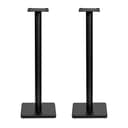
Height is the specification, and it is personal to your sofa. Five stands from 22 to 31 inches, compared on published dimensions and load ratings rather than on a sound claim we cannot make.

By Stephen V.Last updated How we pick

Our bookshelf speaker roundup has told readers for months that stands are “one of the cheapest genuine improvements available to any system.” It has never told them which stand to buy. This page fixes that.

Stands do three concrete things. They put the tweeter at the height of your ears, which changes what you hear more than any cable ever will. They stop the speaker sharing a piece of furniture with everything else in the room. And for a vinyl system specifically, they get the speaker off the same surface as the turntable — a record player is the only source component in the house that can literally hear your speakers, and a cabinet resonating through a shared shelf into a stylus is the classic cause of the low howl that builds when you turn the volume up.

So the ranking below is built on published figures, not adjectives. Height first, because it is the only spec that is personal to your room and the only one you can get wrong. Load rating, top plate size and whether the column takes fill after that. We own none of these stands and have listened to none of them; every dimension here comes from the maker’s own published data or, where a maker blocks scripted access to its site, from the live retail listing — and we say which.

All five are currently purchasable. Four are sold as a pair and one is sold individually, which is the single most expensive detail on this page if you miss it.

How this is funded:we earn a commission if you buy through our links, at no extra cost to you. It never changes which product we recommend, and we’ll tell you plainly when to skip one. Full disclosure.

Quick picks

Ranked on published specs, drive/motor design and buyer fit. Select a row to jump to the full write-up. We have not heard most of these units — here is exactly what we do instead.

#ProductBest forPrice
1
Dayton Audio SSMB24

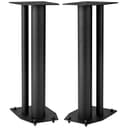
Dayton Audio SSMB24

The stand that lands closest to the arithmetic for the most people: 24-3/4 inches puts a typical bookshelf tweeter right at a seated ear. Dayton publishes every dimension that decides fitment — 6-5/8 x 8-1/4 in top plate, 8-1/4 x 11 in base, 75 lb load — and the 3 in rear tube both hides the speaker cable and takes fill for added mass. It is the cheapest pair here and the only one under $120 you can add mass to.

Best overall
$109.98 · View on Amazon

Price as of September 5, 2026. #ad How we’re funded

2
Kanto ST28

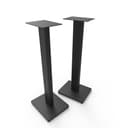
Kanto ST28

The one to buy if the formula puts you above 26 inches. A steel column on an MDF base, 30 lb per stand, the largest standard top plate in this roundup at 5.9 x 7.9 in, and both foot types in the box — domed rubber for hardwood, spikes for carpet. Kanto sizes the column for full-size POWER cables as well as speaker wire, which matters on a site where half the recommended speakers are powered.

Best for a taller seat
$149.99 · View on Amazon

Price as of September 5, 2026. #ad How we’re funded

3
Kanto SX22

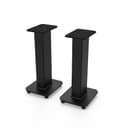
Kanto SX22

The stand that solves the two problems money can actually solve: mass and fit. A fillable column with the substrate bags in the box, two top plates (5.25 x 6.5 in and 6.5 x 9.3 in) so a deep cabinet is not left overhanging, a 9.5 x 11.2 in base, spiked isolation feet with silicone floor discs, and leveling you adjust from the TOP of the base rather than lying on the floor. 22 inches is the short one in a 22/26/30 line.

Best premium
$339.99 · View on Amazon

Price as of September 5, 2026. #ad How we’re funded

4
Monoprice Monolith 28in Speaker Stand

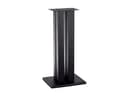
Monoprice Monolith 28in Speaker Stand

The heavy one. Four steel columns, ALL of them fillable with sand or steel shot, a 100 lb published load and adjustable spikes — the stand to buy when the speaker is genuinely heavy or you want as much mass under it as this price allows. The catch is on the price tag, not in the engineering: it is sold individually, so a pair costs twice what the listing says.

Best for heavy speakers
$94.99 · View on Amazon

$99.995% off

Price as of September 5, 2026. #ad How we’re funded

5
Fluance SS05S

Fluance SS05S

The tall one, and the only stand here from a brand that also makes the turntable. At 31.1 in it is built for surround duty, which makes it the right answer for a high seat or a short cabinet and the wrong one for a low sofa. Fluance publishes the whole set: 6 x 6 in top plate, 10.43 in base, 25 lb per stand, a 1.18 x 1.77 in cable opening, spikes and rubber feet, and an optional wall-anchor hole.

Best for a high seat or a short cabinet
$119.99 · View on Amazon

Price as of September 5, 2026. #ad How we’re funded

The picks in full

#1Best overall

Dayton Audio SSMB24

The stand that lands closest to the arithmetic for the most people: 24-3/4 inches puts a typical bookshelf tweeter right at a seated ear. Dayton publishes every dimension that decides fitment — 6-5/8 x 8-1/4 in top plate, 8-1/4 x 11 in base, 75 lb load — and the 3 in rear tube both hides the speaker cable and takes fill for added mass. It is the cheapest pair here and the only one under $120 you can add mass to.

Strengths

  • 24-3/4 in is the height the ear-height formula returns for most bookshelf cabinets
  • Rear tube hides the speaker cable AND can be filled with sand for mass
  • 75 lb load and a full published dimension set — top plate, base plate, height
  • Sold as a pair, so the listed price is the price of the job

Trade-offs

  • Only the rear tube is fillable; the two front tubes are not, so you add less mass than a fully fillable column
  • Adjustable spikes on the base and neoprene pads on top — Dayton publishes no rubber feet, so bare hardwood needs pads you supply
  • The 6-5/8 x 8-1/4 in top plate is shallower than some cabinets are deep, so a little overhang is normal
  • Black crinkle finish is workshop, not furniture
  • One height in this model: if the formula says 28 in, this is the wrong stand
Height24-3/4"
Top plate6-5/8" x 8-1/4", 3/8" thick, neoprene pads
Base plate8-1/4" x 11", tapering to 5" at the back
Load rating75 lb
ColumnsThree tubes: two 1.5" front, one 3" rear
FillableRear tube only (sand)
Cable routingThrough the rear tube
FeetAdjustable spikes for leveling and isolation
FinishBlack crinkle
Sold asPair

Note. Every figure here is from Dayton Audio's own product page, not the retail listing. Dayton does not publish a stand weight, so that row is absent rather than guessed.

Specifications read from the manufacturer / product listing, on September 4, 2026. “Not published” means the maker does not state that figure.

#2Best for a taller seat

Kanto ST28

The one to buy if the formula puts you above 26 inches. A steel column on an MDF base, 30 lb per stand, the largest standard top plate in this roundup at 5.9 x 7.9 in, and both foot types in the box — domed rubber for hardwood, spikes for carpet. Kanto sizes the column for full-size POWER cables as well as speaker wire, which matters on a site where half the recommended speakers are powered.

Strengths

  • 28 in suits a seated ear height at the 36-38 in end of the range
  • Ships domed rubber feet AND carpet spikes — you are not buying feet separately
  • Largest standard top plate here: 5.9" x 7.9"
  • Column is sized for a full-size power cable, not just speaker wire
  • Sold as a pair, 30 lb published load per stand

Trade-offs

  • Not fillable — Kanto reserves the fill column for the SX series, so this gets its mass from steel and MDF alone
  • 30 lb per stand is the lowest published load of the steel stands here
  • The ST line is 28 in and 34 in only; there is no shorter ST if the formula says 24 in
  • Costs about 40% more than the Dayton pair for a stand you cannot add mass to
Height28" (a 34" ST34 is also sold)
Top plate5.9" x 7.9" (15 x 20 cm)
Load rating30 lb per stand
ColumnSteel, sized for speaker wire and full-size power cables
BaseMDF
FillableNo
Feet8x domed rubber feet + 8x spiked feet included
Cable routingInternal, through the column
Sold asPair

Note. Kanto's ST-series page publishes the 30 lb load and the box contents; the top plate size comes from Kanto's own 2025 floor-stand comparison chart. Kanto does not publish a per-stand weight for the ST, so that row is absent.

Specifications read from the manufacturer / product listing, on September 4, 2026. “Not published” means the maker does not state that figure.

#3Best premium

Kanto SX22

The stand that solves the two problems money can actually solve: mass and fit. A fillable column with the substrate bags in the box, two top plates (5.25 x 6.5 in and 6.5 x 9.3 in) so a deep cabinet is not left overhanging, a 9.5 x 11.2 in base, spiked isolation feet with silicone floor discs, and leveling you adjust from the TOP of the base rather than lying on the floor. 22 inches is the short one in a 22/26/30 line.

Strengths

  • Fillable column with substrate bags and zip ties included — real added mass, not just a heavier tube
  • Two top plates in the box (5.25" x 6.5" and 6.5" x 9.3") for narrow and deep cabinets
  • Leveling adjusted from the top of the base, with a bullseye level included
  • Spiked isolation feet AND silicone floor protectors, so hardwood is covered
  • 40 lb published load, and the line runs 22 / 26 / 30 in so the formula has somewhere to land

Trade-offs

  • $300-plus a pair is more than several of the speaker pairs this site recommends
  • 22 in is the shortest here — right only for a low seat or a tall cabinet, so run the arithmetic first
  • Filled, each stand is heavy and genuinely awkward to move or re-site
  • The fill substrate is not included — the bags are, what goes in them is your sand or shot
Height22" (SX26 at 26" and SX30 at 30" are the same design)
Top plates5.25" x 6.5" and 6.5" x 9.3", both included
Base plate9.5" x 11.2"
Load rating40 lb per stand
FillableYes — column fill bags and zip ties included
Feet8x spiked isolation feet + 8x silicone floor protectors
LevelingAdjusted from the top of the base; bullseye level included
Cable routingDedicated cable channel separate from the fill
Sold asPair

Note. Heights, load rating and both top-plate sizes come from Kanto's own 2025 floor-stand comparison chart and SX-series page. Kanto does not publish the fill volume on either, so we have not stated one.

Specifications read from the manufacturer / product listing, on September 4, 2026. “Not published” means the maker does not state that figure.

#4Best for heavy speakers

Monoprice Monolith 28in Speaker Stand

The heavy one. Four steel columns, ALL of them fillable with sand or steel shot, a 100 lb published load and adjustable spikes — the stand to buy when the speaker is genuinely heavy or you want as much mass under it as this price allows. The catch is on the price tag, not in the engineering: it is sold individually, so a pair costs twice what the listing says.

Strengths

  • All four columns take sand or steel shot — the most fill capacity in this roundup
  • 100 lb published load, comfortably the highest here
  • Adjustable spikes on every stand for leveling and carpet
  • Cheapest per stand of anything here with a three-figure load rating

Trade-offs

  • SOLD EACH — you need two, so budget roughly double the listing price
  • Monoprice reuses its bullet copy across the range: the 28-inch listing states "Each stand is 24 inches tall" in its own features. Buy on the title and the stated dimensions
  • Spikes only — no rubber feet are published, so a hardwood floor needs pads you supply
  • The listing does not publish a top-plate size, so cabinet fit is the one thing you cannot check before it arrives
Height28" (per the listing title and dimensions)
Top plateNot published
Load rating100 lb
ColumnsFour rectangular steel piers, powder-coated
FillableYes — all four columns, sand or steel shot
FeetAdjustable spikes
Sold asEach (buy two)

Note. Monoprice serves 403 to scripted agents, so every figure here is the one its live Amazon listing publishes rather than a maker's spec sheet. That is also why the top-plate row reads Not published.

Specifications read from the manufacturer / product listing, on September 4, 2026. “Not published” means the maker does not state that figure.

#5Best for a high seat or a short cabinet

Fluance SS05S

The tall one, and the only stand here from a brand that also makes the turntable. At 31.1 in it is built for surround duty, which makes it the right answer for a high seat or a short cabinet and the wrong one for a low sofa. Fluance publishes the whole set: 6 x 6 in top plate, 10.43 in base, 25 lb per stand, a 1.18 x 1.77 in cable opening, spikes and rubber feet, and an optional wall-anchor hole.

Strengths

  • 31.1 in is the height to buy when your seat is high or your cabinet is short
  • Both foot types published — adjustable floor spikes and rubber feet — plus rubber pads on the top plate
  • Internal wiring tunnel with a published 1.18 x 1.77 in opening, so you can check your plug fits first
  • Optional safety anchor hole for securing the stand to a wall
  • Matte black or matte white, sold as a pair

Trade-offs

  • The tallest here by three inches: with a typical 9-10 in tweeter offset it puts the tweeter around 40 in, above the 34-36 in seated ear height the standard formula assumes
  • Fluance markets it for "surround sound and bookshelf speakers" — the height claim is written for surround, not near-field stereo
  • 6" x 6" top plate is the smallest here; a cabinet deeper than 6 in overhangs it (a Klipsch R-40M is 8.5 in deep)
  • 25 lb per stand is the lowest published load in this roundup
  • Not fillable — MDF and metal, with a wiring tunnel rather than a fill column
Height31.1" (79 cm)
Top plate6" x 6" (15.24 cm), rubber pads
Base width10.43" (26.5 cm), square
Load rating25 lb (11.34 kg) per stand
MaterialsMDF and metal
FillableNo
Cable routingInternal tunnel, 1.18" x 1.77" opening
FeetAdjustable floor spikes and rubber feet
Wall anchorOptional anchor hole (hardware not included)
Sold asPair (matte black SS05S; matte white SS05SWH)

Note. A round-base SS05R exists with the same published figures. Fluance does not state a per-stand weight, so that row is absent rather than estimated.

Specifications read from the manufacturer / product listing, on September 4, 2026. “Not published” means the maker does not state that figure.

Work out your height before you read anything else

Everything else on this page is secondary. A beautifully made stand at the wrong height is worse than a cheap one at the right height, because the thing you are buying is the position of the tweeter.

The calculation is one line, and Audio Advisor publishes it in exactly this form: ear height minus tweeter height equals stand height. Three measurements, five minutes, a tape measure.

  1. Measure your seated ear height. Sit where you actually sit, in the posture you actually sit in, and measure from the floor to your ear canal. Audio Advisor puts most listeners between 34 and 36 inches; other references quote 36 to 38. The spread is exactly why you measure rather than assume — a firm dining chair and a deep sofa can be six inches apart.
  2. Measure your tweeter offset. From the bottom of the speaker cabinet up to the center of the tweeter. On most two-way bookshelf speakers this lands somewhere around 9 to 11 inches, but it is not a constant and the difference matters.
  3. Subtract. Audio Advisor works the example as 34 inches of ear height minus a 10-inch tweeter offset, which returns a 24-inch stand. That is the number that put the Dayton Audio SSMB24 at the top of this page: at 24-3/4 inches it is the closest match to the most common answer.

Two things the arithmetic does not need to be exact about. Being an inch or two low is generally more forgiving than being high, because most speakers are voiced to be listened to slightly off-axis vertically rather than from underneath. And if your seat and your speakers cannot be reconciled by any stand in this list, the answer is a stand you can adjust rather than a compromise — but adjustable stands overwhelmingly aim at the 33-to-45-inch surround market, which is the wrong end of the range for seated stereo listening. That is covered below.

How we chose these five

Five criteria, applied in this order. None of them depends on a listening claim, because we make none.

  1. The maker publishes a height and a load rating. Those two figures decide whether a stand is right for your seat and safe under your speaker. A stand sold without them is a stand you are buying on faith, and that rule removed most of the search results by itself.
  2. It is a real, identifiable brand. Speaker stands are a category swamped by unbranded steel-and-glass columns sold under rotating storefront names, with nobody to publish a spec sheet and nobody to stand behind the weld. All five picks come from a company that also makes speakers, turntables or hi-fi accessories under its own name.
  3. The heights had to differ. There is no point ranking five 24-inch stands when height is the whole decision. The set below covers 22, 24-3/4, 28, 28 and 31.1 inches, which brackets essentially every combination of sofa and cabinet a home listener will have.
  4. Mass and decoupling are handled deliberately. A stand either has a fillable column or it does not, and it either ships both foot types or leaves you buying pads. Both are published facts, so both are in the tables.
  5. It has to be buyable today. Every ASIN here was checked against a live retail listing carrying a real price and a real availability line before it went on the page.

What a stand actually does, and the part that is specific to vinyl

Three jobs. All real, none of them magic.

  • It sets the height. Covered above, and it is most of the value. This is a positional change, not a tonal claim — you are moving the speaker relative to your head, which is the same reason people rearrange furniture to fix a room.
  • It gets the cabinet off shared furniture. A bookshelf speaker on a sideboard turns the sideboard into part of the speaker. A stand replaces a large, thin, resonant panel with a narrow column and a small plate, which is a far less enthusiastic radiator.
  • It breaks the loop back to the stylus. This is the vinyl part, and it is the reason this page exists on a turntable site rather than a home cinema one. Your cartridge is a device for converting tiny mechanical vibrations into a voltage. It cannot tell the difference between a vibration coming from the groove and one arriving through the shelf from the speaker sitting two feet away. Move the speaker onto its own stand, off the deck’s furniture, and that path is gone. If you already have the howl, the full diagnostic sequence is in turntable troubleshooting.

And what a stand does not do: it will not add bass, it will not fix a bright speaker, and it will not rescue a cartridge that has never been aligned. If your system sounds wrong and you have not yet balanced the arm, start with how to balance a tonearm instead — it costs nothing and it changes more.

Mass and fill: the difference between a table and a stand

The reason serious stands are hollow is so you can make them heavy after they arrive. Sand or steel shot poured into a column does two things at once: it raises the mass sitting under the speaker, and it damps the column so it rings less when the cabinet drives it. Shipping a stand pre-filled would make it absurd to post, which is why the good ones ship empty and tell you to fill them.

The three approaches on this page:

  • Fully fillable. The Monolith 28-inch has four rectangular steel piers and Monoprice states all four take sand or steel shot. That is the most fill capacity here, and it pairs with the highest published load rating on the page at 100 lb.
  • Partly fillable. Dayton’s SSMB24 uses a three-tube layout — two 1.5-inch tubes at the front, one 3-inch tube at the rear — and only the rear tube is described as fillable. You get some of the benefit and the cable path in the same tube.
  • Fillable by design, with the bags in the box. Kanto’s SX22 ships column fill bags and zip ties, and keeps the fill in a separate chamber from the cable channel so a thick power cable does not have to fight through the substrate. It is the most considered execution here and it is also, by a distance, the most expensive.

The Kanto ST28 and the Fluance SS05S are not fillable at all. That is not disqualifying — both get their mass from steel and a weighted base, and both publish load ratings that cover any bookshelf speaker in our roundup — but if adding mass is the point of the exercise for you, those two are the wrong pair.

Top plate versus cabinet: the fit check most people skip

A top plate smaller than the base of your speaker is normal and usually fine; a top plate dramatically smaller is a stability problem and looks like a mistake. Measure the footprint of your cabinet — width and depth, not height — and compare.

A worked example from our own registry: the Klipsch R-40M measures 11.7 x 5.8 x 8.5 inches and weighs 7 lb each. On the Kanto ST28 (5.9 x 7.9 in) it sits with the plate essentially matching its width and about half an inch of overhang front to back. On the Fluance SS05S (6 x 6 in) the width is fine and the 8.5-inch depth overhangs by two and a half inches. Neither is dangerous with a 7 lb speaker. Both would look and feel different under something deeper and heavier.

The Kanto SX22 is the pick that removes this question entirely, because it ships two plates — 5.25 x 6.5 in and 6.5 x 9.3 in — and you fit whichever matches your cabinet. The Monolith is the pick that leaves the question open, because its listing publishes no top-plate dimension at all. We have recorded that as “Not published” rather than repeat a figure from a reseller.

Spikes, rubber, and what your floor decides

Every stand here ships feet of some kind, but not the same kind, and your floor picks for you.

  • Carpet wants spikes. A spike goes through the pile and reaches the floor beneath, so the stand stops rocking on a springy layer. Every pick here has spikes.
  • Hardwood, tile and laminate want a pad or a disc. Spikes on a finished floor mark it. The Kanto ST28 ships eight domed rubber feet alongside its eight spikes, the Kanto SX22 ships silicone floor protectors, and the Fluance SS05S publishes both spikes and rubber feet. The Dayton and the Monolith publish spikes only, so on a bare floor you supply the pads.
  • Level it afterwards. A stand with one foot off the floor is a stand that rocks. The Kanto SX22 is the only pick here that puts the leveling adjustment on the top of the base and includes a bubble level, which is a genuinely nice touch when the stand is filled and weighs more than you want to tip over.

Sold as a pair, or sold each

Read this row before you read the price. Four of the five picks here are sold as a pair; the Monolith 28-inch is sold individually. Its listing price looks like the cheapest thing on this page and the real cost of two stands is roughly double it, which moves it from “cheapest” to “mid-priced” in one step. It is still the right buy for a heavy cabinet — nothing else here publishes a 100 lb rating — but buy it knowing the arithmetic.

One more listing quirk on the same product, stated because it is confusing and verifiable: Monoprice reuses its bullet copy across the Monolith range, so the 28-inch listing contains a feature line reading “Each stand is 24 inches tall.” The title and the stated dimensions say 28. Buy on the title and the dimensions.

What we did not pick, and why

Three whole categories were considered and left off, and the reasons are more useful than another pick would have been.

  • Height-adjustable “surround sound” stands. They are cheap, widely sold, and almost always wrong for this job. The typical range is around 33 to 45 inches, which is the height for a small satellite firing across a room at a seated head from a distance — not for a bookshelf speaker six feet away. They also tend to publish very low load ratings, sometimes as little as 11 lb, which several of the passive speakers we recommend exceed. If a genuinely adjustable stand in the 22-to-28 inch band from a brand that publishes its figures appears, we will add one.
  • Desktop wedges and isolation pads. Useful, cheap, and a different product solving a different problem. If your speakers live on a desk rather than on the floor, a wedge that tilts them toward your ears is the right buy and a floor stand is not.
  • Wall brackets. They solve the resonance problem in the cheapest possible way and they are terrible at the height problem, because the bracket goes where the stud is. They are also a poor fit for rear-ported cabinets, which most bookshelf speakers under $500 are.

One brand-specific note for readers running powered speakers with a phono stage built in: Kanto also makes an SP-series stand with a rotating top plate and a quarter-inch mounting screw sized for its own YU4 and YU6. When we checked, the black version was not showing a live in-stock offer, so it is named here rather than ranked. If you own those speakers, it is worth looking up.

Setting them up

Assembly is thirty minutes. Getting the result is a few more steps after that.

  1. Fill before you place, if the stand fills. Dry play sand from a hardware store is the standard choice; steel shot is heavier and more expensive. Fill to just below the top so the column is not packed solid against the plate, and cap it. Neither the Dayton, the Monolith nor the Kanto includes the substrate itself — Kanto includes the bags it goes in.
  2. Set the feet for your floor. Spikes on carpet, pads or discs on anything finished. Then level each stand so no foot is proud.
  3. Place the pair before you place the turntable. Speakers first, listening seat second, deck last — and the deck should not share furniture with either speaker if you can avoid it. The full placement logic for a vinyl system is in how to build a hi-fi system.
  4. Route the cable through the column, not around it. This is half the reason to buy a stand with a channel. If you are running powered speakers you also have a mains cable to hide, and only some columns are sized for a full-size plug — Kanto states the ST column is, and Fluance publishes its opening as 1.18 x 1.77 inches so you can check.
  5. Re-check the deck afterwards. Moving speakers changes the vibration path into the turntable, for better or worse. Play something with real bass at your usual volume and listen for the low rumble building; if it does, move the deck rather than the speakers.

None of this is difficult and all of it is reversible, which is the honest case for stands as an upgrade: unlike a cartridge or an amplifier, you can hear the difference the same afternoon and undo it if you disagree.

Frequently asked questions

What height speaker stands do I need for bookshelf speakers?

Measure, do not guess. Audio Advisor publishes the calculation as ear height minus tweeter height equals stand height: measure from the floor to your ear canal while sitting where you actually listen, measure from the bottom of the speaker cabinet to the center of the tweeter, and subtract. Most listeners land between 34 and 36 inches of seated ear height, and most two-way bookshelf tweeters sit around 9 to 11 inches up the cabinet, which is why 22 to 28 inch stands cover most rooms and why the 33-to-45-inch adjustable stands sold for surround duty usually do not.

Do speaker stands actually make a difference?

They change three things you can verify without a listening test: the tweeter is at the height of your ears rather than below them, the cabinet is no longer coupled to a large piece of shared furniture, and the speaker is no longer on the same surface as your turntable. The first is a positional change and it is the biggest of the three. We have not measured any of these stands and make no claim about a tonal improvement.

Should I fill my speaker stands with sand?

If the column is designed for it, yes — it adds mass under the speaker and damps the column so it rings less. Dry play sand is the usual choice and steel shot is the heavier, pricier one. Fill to just below the top rather than packing it solid. On this page the Monolith takes fill in all four columns, the Dayton takes it in the rear tube only, and the Kanto SX22 ships the fill bags but not the substrate. The Kanto ST28 and the Fluance SS05S are not fillable at all.

Do speaker stands help with turntable feedback?

They remove one of the common paths. A cartridge cannot distinguish vibration arriving through furniture from vibration in the groove, so a speaker sharing a sideboard or shelf with your turntable can feed its own output back into the stylus — the low howl that builds as you raise the volume. Putting the speakers on their own stands, away from the deck's furniture, breaks that path. It does not address airborne feedback or a bouncy floor, which need the deck moved or isolated instead.

How much weight can speaker stands hold?

It varies more than people expect, and it is published. Among these five: 25 lb per stand for the Fluance SS05S, 30 lb for the Kanto ST28, 40 lb for the Kanto SX22, 75 lb for the Dayton SSMB24 and 100 lb for the Monolith. Most bookshelf speakers weigh well under 25 lb — the Klipsch R-40M is 7 lb each — so capacity is rarely the binding constraint, but check it before putting a large passive cabinet on a stand rated for a satellite.

Are speaker stands sold in pairs?

Usually, but not always, and it is the most expensive assumption on this page. The Dayton SSMB24, Kanto ST28, Kanto SX22 and Fluance SS05S are all sold as pairs. The Monolith 28-inch is sold individually, so two stands cost roughly twice its listed price. Always read the title before comparing prices between stands.

Do I need spikes or rubber feet on speaker stands?

Your floor decides. Spikes go through carpet pile to reach the solid floor underneath, so the stand stops rocking on a springy layer. On hardwood, tile or laminate, spikes mark the finish and you want rubber feet or silicone discs instead. The Kanto ST28 ships both types, the Kanto SX22 ships spiked isolation feet and silicone protectors, and Fluance publishes both for the SS05S. The Dayton and the Monolith publish spikes only, so on a bare floor you supply the pads.

Sources

  • Dayton Audio — SSMB24 24-inch universal steel speaker stand pairManufacturer specs: "The stand is 24-3/4″ tall", "weight capacity of 75 lbs", platform "6-5/8″ x 8-1/4″ and measures 3/8″ thick", bottom plate "8-1/4″ x 11″", "two 1.5″ tubes in front and one 3″ tube in the rear", and the rear tube "hides the speaker cable from sight and can be filled for added mass" (accessed September 4, 2026)
  • Kanto — ST Series speaker floor standsManufacturer page: "Weight capacity: 30 lb", "sturdy steel columns and an MDF base", "Route speaker wire and full-size power cables through the spacious steel column", "Leveling rubber feet are included for hard floors along with carpet spikes", 28" and 34" heights, box contents 2x stands / 8x rubber dome feet / 8x spiked feet (accessed September 4, 2026)
  • Kanto — floor stand comparison chart, March 2025 (PDF)Manufacturer chart: ST28 top plate 5.9" x 7.9" (15 x 20 cm); SX22 / SX26 / SX30 at 22" (55.9 cm) / 26" (66 cm) / 30" (76.2 cm), 40 lbs each, steel base, fillable, bespoke isolation feet, top plates 5.25" x 6.5" (13.3 x 16.5 cm) and 6.5" x 9.3" (16.5 x 23.5 cm), bottom plate 9.5" x 11.2" (24.1 x 28.5 cm) (accessed September 4, 2026)
  • Kanto — SX Series bespoke fillable speaker floor standsManufacturer page: box contents "2x Speaker Floor Stands | 2x 5.2″ Wide Top Plates | 2x 6.5″ Wide Top Plates | 4x Adhesive Foam Padding | 2x Column Fill Bags & Zip Ties | 8x Spiked Isolation Feet | 8x Silicone Floor Protectors | 1x Levelling Bubble", fillable column, leveling accessible from the top of the base (accessed September 4, 2026)
  • Fluance — SS05S floor speaker stands (square base, matte black)Manufacturer specs: height "31.1 inches (79 cm)", top plate "6 x 6 inches / 15.24 x 15.24 cm", base width "10.43 inches (26.5 cm)", "25 lb (11.34 kg) per stand", MDF and metal, adjustable floor spikes and rubber feet, cable opening "1.18 x 1.77 inches", optional wall safety anchor hole (hardware not included), sold as a pair (accessed September 4, 2026)
  • Audio Advisor Learning Center — how to choose speaker stand heightRetailer guide for the height calculation used on this page: "Ear Height – Tweeter Height = Ideal Stand Height", with seated ear height for most listeners falling "between 34 and 36 inches", worked as 34 in ear height minus a 10 in tweeter offset = a 24 in stand (accessed September 4, 2026)
  • Crutchfield — Home speakers buying guideReference on choosing passive vs powered speakers, room size and amplifier pairing (accessed August 11, 2026)

Keep reading