The stylus problem, in full
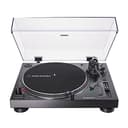
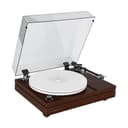
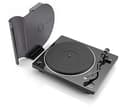
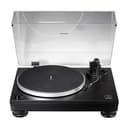
Every deck on this page ships with a stylus intended for modern records. The AT-LP120XUSB and AT-LP5X ship an Audio-Technica AT-VM95E elliptical; the Fluance RT87 ships an Ortofon 2M Blue; the Denon takes a moving-magnet or moving-coil cartridge of your choosing; the Numark ships a portable cartridge built for scratching. None of those is a 78 stylus, and no amount of speed selection changes that.
How much wider is not a guess, because Audio-Technica publishes both figures. Its AT-VM95E — the cartridge fitted to the AT-LP120XUSB and the AT-LP5X — carries a 0.3 x 0.7 mil elliptical stylus. The AT-VM95SP, the 78 RPM member of the same VM95 series, carries a 3.0 mil conical one. That is an order of magnitude of tip width, and it is why a 78 played with a microgroove tip sounds noisier than the record actually is: the stylus is riding where the dirt and the wear live rather than on the groove walls that carry the signal.
The second published figure is the one that decides which turntables can do this at all. Audio-Technica states 4.5 to 5.5 g, 5.0 g standard vertical tracking force for the AT-VM95SP, against 1.8 to 2.2 g for the VM95E. More than double. A deck whose tonearm has no counterweight cannot be set to 5 grams, which rules out every fixed-arm automatic no matter what its speed selector says, and a 6.1 g cartridge has to be inside the arm’s supported cartridge-weight window — for the AT-LP120XUSB, Audio-Technica publishes 3.5 to 8.5 g, so it fits. This is the whole reason the ranking above is what it is.
Two honest notes on that part. We do not rank it, and we are not going to pretend otherwise: we hold no verified retail listing for the AT-VM95SP or its AT-VMN95SP stylus, so it is named and cited here from Audio-Technica’s own published table rather than sold. And read the fitment line carefully — Audio-Technica describes the AT-VMN95SP as the replacement stylus for the AT-VM95SP cartridge, not for the VM95 family in general, so this is a whole second cartridge rather than a stylus you snap into the body you already own. Which brings us straight to the headshell.
Why a removable headshell matters more here than anywhere else
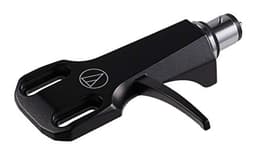
On most turntables a removable headshell is a convenience. On a deck that plays two incompatible formats it is close to a requirement, because the alternative is unscrewing, rewiring and realigning a cartridge every time the record changes format. The AT-LP120XUSB and AT-LP5X both use the universal half-inch AT-HS6 pattern; the Fluance RT87 uses an H-4 bayonet shell that also comes off as an assembly. Buy a second shell, mount a 78 pickup on it once, and switching formats becomes a ten-second job. Our headshell guide covers what fits what, and our cartridge setup guide covers doing the mounting once, properly.
Archiving is usually the real reason
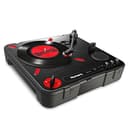
Most 78s are not reissued, and a lot of them are not streamable anywhere. That makes digitizing the point of the exercise far more often than it is with LPs, and it is why three of these five decks have a digital output. The AT-LP120XUSB and AT-LP120XBT-USB send audio to a computer over USB; the Denon DP-450USB writes to a USB-A drive plugged into the deck itself, with no computer and no recording software involved; the Numark PT01 Scratch is a class-compliant USB interface in a portable chassis, which is the only one of the five you can take to someone else’s attic. The workflow for all of them is the same, and it is in our guide to recording vinyl to a computer. If the collection is the whole project, our USB turntable picks rank these decks on capture rather than on speed.
Clean first, and clean differently
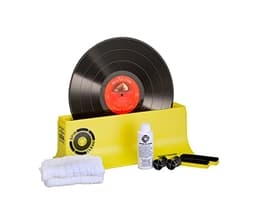
A 78 that has been in a loft since the 1950s is carrying half a century of dust in a groove wide enough to hold it. Cleaning before the first play does more for the result than any deck on this page — our record cleaning kit picks and cleaning routine cover the method. Two things are worth checking on any product before it touches shellac: whether the maker lists 78 among the record sizes it fits, and what the fluid actually contains. Those are both published facts rather than folklore, and they are the reason the Spin-Clean appears below rather than one of the machines.
Who should not buy a 78-capable deck
Anyone who does not own 78s. The third speed is free on the decks here because of how their motors are built, but it is not free as a buying criterion: it rules out the entire Fluance Reference range except the flagship, every Audio-Technica automatic, and most of our beginner picks. If the shellac is a maybe rather than a shelf, buy the deck that suits the records you actually play — our main turntable picks are organized that way.