Almost everybody searching for this is picturing the same thing: records playing, no wires crossing the room. It is worth saying plainly that Bluetooth does not work that way by default. A Bluetooth speaker receives. For a wireless record, the turntable has to transmit, and only a minority do — a listing that says “Bluetooth turntable” sometimes means the deck receives Bluetooth so you can play a phone through it, which is the opposite of what you need. Our Bluetooth turntable picks sort out which direction each deck runs.
So there are two honest buying cases. In the first, you already own or plan to buy a transmitting deck, Bluetooth carries the record, and the speaker’s wireless side is what you are shopping for. In the second — far more common — the turntable is wired to the speaker and Bluetooth is for your phone, a laptop or a TV. In that second case the wired input decides everything: a phono input with a ground terminal means your deck plugs in directly; a line-only input means you need a phono preamp in between.
That is how this page is ranked. Three of the five publish a phono stage inside the speaker, two do not, and the difference is a separate purchase rather than an opinion. Everything else — drivers, power, how low each one goes — is in the table below from the makers’ own figures.
Quick picks
The “Phono preamp” column is the one to read first: a Yes means a turntable without its own preamp connects directly, and a No means one more box. Every figure comes from the maker’s published specification or the listing cited under each product, read on the date shown there. Prices are live and dated on each button. We have not measured these speakers; here is exactly what we do instead.
| # | Product | Type | Phono preamp | Best for | Price |
|---|
| 1 | 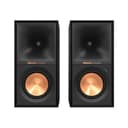 Klipsch R-50PM The shortest complete Klipsch system for a record player. Klipsch's own spec sheet lists the analog input as "Phono/Line analog (with switch and ground screw terminal)", so a deck with no preamp plugs straight in and its earth wire has a post to land on - and the manual carries a page headed CONNECTIONS - TURNTABLE. 120 W total, a 5.25" TCP woofer and a published 55 Hz limit. | Powered (active) bookshelf pair, bass-reflex (rear port) | Yes - switchable phono/line with ground screw terminal | Best overallA complete vinyl system in two boxes, with the phono stage already inside | |
| 2 | 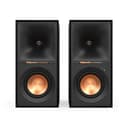 Klipsch R-40PM The R-50PM's smaller sibling with the same input panel - switchable phono/line with a ground screw terminal - in a cabinet 2.2 inches shorter and 1.3 inches narrower. 70 W total against 120 W, and a published 60 Hz limit against 55 Hz. Klipsch badges it PC READY as well as TURNTABLE READY, which is exactly the overlap it serves. | Powered (active) bookshelf pair, bass-reflex (rear port) | Yes - switchable phono/line with ground screw terminal | Best for a desk or small roomA desk or a small room where the R-50PM would be too big | |
| 3 | 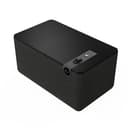 Klipsch The Three Plus One cabinet, 14 inches wide, with a phono preamp inside it. Klipsch calls it a 2.1 stereo system: two 2.25" full-range drivers, a 5.25" long-throw woofer and two 5.25" opposing passive radiators, 120 W, 45 Hz - 20 kHz published. It is the smallest honest way to put a turntable on a sideboard and be finished. | Single-cabinet powered 2.1 system, bass reflex | Yes - RCA input with phono pre-amp | Best single-cabinet systemA turntable on one shelf, with nothing else in the room | |
| 4 | 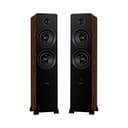 Fluance Ai81 Elite The tower that deletes the amplifier. Fluance builds 150 W of Class D (2 x 75 W RMS) into the active cabinet and publishes 30 Hz - 20 kHz with DSP, so a deck with a switchable phono stage plugs straight into one of the two RCA inputs and the system is finished. Read one row before you buy, though: Fluance's own table prints Phono Preamp as No. | Powered (active) 2-way floorstander | No | Best for a big roomTower sound with no amplifier to buy or house | |
| 5 | 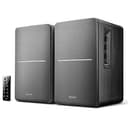 Edifier R1280DB The R1280T's more connected sibling: the same value formula plus Bluetooth, optical and coaxial inputs, so it handles a turntable and a TV and a phone. Still no phono preamp, so a deck needs its own stage — but as a do-everything desktop pair it's hard to beat. | Powered (active) bookshelf | No | Best on a budgetPowered speakers that also serve a TV and phone | |
The five on the published figures
| Row | Klipsch R-50PM | Klipsch R-40PM | Klipsch The Three Plus | Fluance Ai81 | Edifier R1280DB |
|---|
| Phono input | Yes, switchable phono/line with ground screw | Yes, switchable phono/line with ground screw | Yes, RCA with phono preamp | No | No |
| Ground terminal | Yes | Yes | Not published | Not applicable | Not applicable |
| Frequency response | 55 Hz - 20 kHz (44 Hz with dynamic bass extension) | 60 Hz - 20 kHz (52 Hz with dynamic bass extension) | 45 Hz - 20 kHz | 30 Hz - 20 kHz (DSP enhanced) | Not published |
| Power | 120 W total, 60 W per channel continuous | 70 W total, 35 W per channel continuous | 120 W | 150 W continuous average | 42 W RMS total |
| Woofer | 5.25 in spun copper | 4 in spun copper | 5.25 in long-throw plus two passive radiators | Dual 6.5 in woven glass fiber | Not published |
| Bluetooth | Yes | Yes | Bluetooth 5.3 | Bluetooth 5.0 | Yes |
| Subwoofer output | Yes, single RCA line level | Yes, single RCA line level | Not published | Yes, 80 Hz low pass | Not published |
| Form | Bookshelf pair | Bookshelf pair | One cabinet | Floorstanding pair | Bookshelf pair |
Two of the empty cells are worth naming rather than skipping. Klipsch does not publish a ground terminal for The Three Plus even though it does publish the phono preamp, which matters because a grounding screw is how you kill the hum some turntables produce; if your deck has a ground wire, that is a question to put to Klipsch before you buy. And Edifier publishes no frequency response for the R1280DB at all, so we print nothing. A maker that does not state a figure is a finding, not a gap we fill in.
How we ranked them
- Can a turntable plug in with no extra box? A phono input with a ground terminal removes a purchase, a shelf position and two cables. That is why the two Klipsch powered monitors lead, and it is the same logic as our speakers with a phono preamp page, which ranks the wider field of that feature.
- Published low-frequency limit, read honestly. Records have a lot of information in the lower midrange and the bass, and a small sealed box runs out. The spread here is real: 30 Hz published for the Fluance tower against 55 and 60 Hz for the Klipsch bookshelf pair. A dynamic-bass-extension figure is a processing claim rather than the same measurement, so we quote both numbers Klipsch gives and do not merge them.
- Whether the Bluetooth is the main event or the backup. For a record player it is almost always the backup, so we weight the wired path heavier. Where a maker publishes a Bluetooth version — 5.3 on The Three Plus, 5.0 on the Ai81 — we state it; where it does not, we do not guess at codecs.
- What it costs to finish the system. The Ai81 and R1280DB are both strong speakers, and both need a phono preamp added if your deck has no built-in stage. We say so in each card rather than letting the price look like the whole price.
How to actually get a record to a Bluetooth speaker
There are only three routes, and it is worth knowing which one you are on before you spend.
- A transmitting turntable. The deck sends Bluetooth, the speaker receives it, and nothing else is needed. This is the only genuinely wireless route. The trade is that the signal is compressed on the way across, so the same deck sounds better out of its RCA sockets.
- A wired turntable with a built-in phono stage. Switch the deck’s output to LINE and run RCA cables to any input on the speaker. Bluetooth stays available for your phone. This is what most people end up doing, and it is the better-sounding arrangement.
- A wired turntable with no phono stage. You need either a speaker with a phono input (three of the five here) or a separate phono preamp in between. Without one, records play quiet, thin and bass-light — the single most common complaint we see, and never a fault in the speaker.
What there is no route for is a Bluetooth transmitter plugged into a turntable’s phono output. A phono signal needs RIAA equalization before anything else touches it; feeding it to a generic transmitter gives you a thin, quiet stream. If you want to add Bluetooth to a wired deck, the phono stage has to come first. Our do I need a phono preamp page is the two-sentence version of that rule.
Where to put them
One practical note that applies to every powered speaker on this page: keep them away from the turntable. A speaker sitting on the same shelf as a deck feeds vibration straight back into the stylus, which at volume becomes the boomy howl known as acoustic feedback. Stands or a separate shelf fix it, and our speaker stand picks and isolation picks cover both halves. The powered-against-passive question — whether to buy speakers with amplification inside at all — is laid out in powered vs passive speakers.