Speaker Placement for Vinyl
Six moves, all free, in the order that pays. And one rule that applies to records and to nothing else: the speakers do not share a shelf with the turntable.
How this is funded: we earn a commission if you buy through our links, at no extra cost to you. It never changes which product we recommend, and we’ll tell you plainly when to skip one. Full disclosure.
The short answer: get the tweeters to your seated ear height, set the speakers as far apart as each one is from your head, pull them 8 to 12 inches off the wall if they are rear ported, angle them toward you, and keep them off the turntable’s shelf. All of that is free except the stands, and on a budget system it changes more than the difference between one pair of $300 speakers and another. The last item is the one that only matters with records, and it is the one most people get wrong.
Height first, because it is the error you hear immediately
Treble is directional in a way bass is not. Point a tweeter at your knees and the top end arrives dulled and off-axis; point it over your head and the same thing happens in the other direction. Everything else on this page is a refinement; this one is either right or audibly wrong.
Measure from the floor to your ear in the chair you actually use. On a sofa that is usually 36 to 42 inches; on a dining chair or an office chair it is higher. Then put the tweeter within a few inches of it. A TV cabinet is almost always too low and a bookshelf is usually too high, which is why stands are the one purchase this page recommends — and why the stand makers’ published height charts are worth reading rather than guessing from a photograph. Our stand roundup ranks them on exactly that figure.
The triangle, and why wider is not better
Set the distance between the two speakers to roughly the distance from each speaker to your head. In an ordinary room that lands around six to eight feet on each side.
Push them much wider than that and the image develops a hole in the middle — instruments appear at the left speaker, at the right speaker, and nowhere in between, which is the opposite of what a well-recorded album is trying to do. Bring them much closer and the whole stage collapses into a single point between them. The triangle is not a superstition; it is the geometry that keeps a center image where the recording put it.
Distance from the wall, decided by the port
This is where published specifications help. A rear-portedspeaker — the Klipsch R-40M and R-50M, and most powered pairs including the R-40PM and R-50PM — vents its low frequencies backwards. With a wall right behind the cabinet, that output arrives late and reinforced, and the result is what everyone calls boom: a thickened, slow low end that smears the midrange above it. Start at 8 to 12 inches of clearance and move from there.
A front-ported or sealed design does not care nearly as much. The ELAC Debut 2.0 B5.2 is front ported for exactly this reason, and if your speakers must sit on a real bookshelf against a real wall, that single spec row should decide your purchase. It is on the card of every speaker we cover in the bookshelf roundup.
Toe-in and symmetry
Angle each speaker so it points approximately at your head. Mild toe-in tightens the center of the image and reduces the amount of sound bouncing off the side walls before it reaches you; too much makes the sound narrow and beamy. Move one speaker at a time, with a record you know intimately rather than whatever is on the platter.
Then make the two sides match as closely as the room allows: equal distance to the side walls, and equal surroundings. One speaker in a bookcase alcove and the other in open space will never image properly, because the two channels are being filtered differently before they arrive. Where the room forbids symmetry — and most rooms do — match the side-wall distance first and let the rest go.
The rule that only applies to records
A turntable is a microphone that does not know it is one. The stylus reads vibration; it cannot tell the difference between vibration carved into a groove and vibration arriving through the furniture. So a speaker sitting on the same shelf, cabinet or sideboard as the deck is feeding its own output back into the cartridge.
At low volume that reads as thickened, indistinct bass. Turn it up and the loop becomes obvious: a rising howl that builds on itself, which is acoustic feedback and is the reason DJ booths are built the way they are. It is also why putting a speaker on top of the dust cover — which people do, because it is a flat surface at a convenient height — is the worst placement available in the room.
Separate the two surfaces. Speakers on stands, deck on its own shelf. If the room genuinely forbids that, reduce the coupling instead: isolation feet or a platform under the turntable, which our isolation roundup ranks on published load rating, and a level deck on a rigid surface rather than a springy one. A wall shelf is the honest answer for a suspended wooden floor, where footfall alone can make the stylus skip.
Before you blame the placement, check the wiring
Both speakers must be connected positive to positive and negative to negative. A pair wired out of phase sounds vague and distant with a thin, disembodied bass, and it survives every placement change you throw at it. With bare wire and spring clips it is an easy mistake to make and a thirty-second one to rule out.
On powered pairs, check the inter-speaker cable is fully seated at both ends, and note that on most of them — including both Klipsch PM models — the mains lead and every input land on one cabinet, so that cable decides which side can go where. Our R-40PM vs R-50PM comparison covers the panel both share, and connecting a turntable to a receiver covers the rest of the chain, including where the ground wire belongs.
Stands that get the tweeter to ear height, with live prices
The first step on this page is also the only one that usually needs a purchase. These three publish a height for every model in the range, which is what lets you buy to a measurement instead of guessing: the Dayton SSMB24 at a sofa-friendly height, the Kanto ST28 when the seat is higher or the speaker's power cable has to be routed, and the Fluance SS05S for a dining chair, a desk or a short speaker.
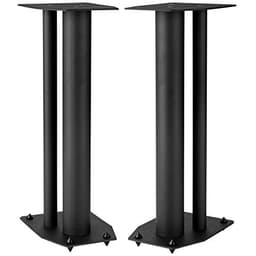
Dayton Audio SSMB24
The default height for a sofa, with fill and a published spec for every dimension
Price as of October 16, 2026. #ad How we’re funded
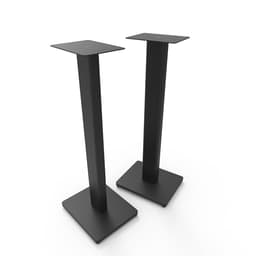
Kanto ST28
A firmer or taller seat, and powered speakers whose power cable has to go somewhere
Price as of October 16, 2026. #ad How we’re funded
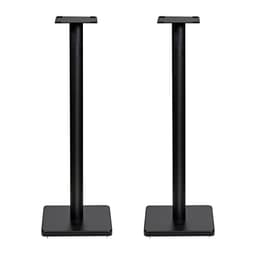
Fluance SS05S
A dining chair, an office chair or a short speaker — anywhere the ear sits high
Price as of October 16, 2026. #ad How we’re funded
Frequently asked questions
Where should I put my speakers for a record player?
Tweeters at ear height when you are seated, the two speakers about as far apart as each one is from your head, pulled 8 to 12 inches off the wall if they are rear ported, angled in toward your listening position, and - the rule specific to vinyl - on a different surface from the turntable. That last one prevents vibration from the speakers reaching the stylus.
How high should speakers be for vinyl?
High enough that the tweeter is within a few inches of your seated ear height, which on a typical sofa is 36 to 42 inches from the floor. That is well above most TV cabinets and well below most bookshelves, which is why stands exist. Stand makers publish the height of every model in their ranges, so you can measure your ear height once and buy to the figure.
How far should speakers be from the wall?
It depends on the port. A rear-ported speaker - the Klipsch R-40M and R-50M and most powered pairs - wants 8 to 12 inches of clearance to start with, because wall reinforcement of a late port output is what boom actually is. A front-ported or sealed design like the ELAC Debut 2.0 B5.2 can sit much closer, which is the practical reason to choose one if the speakers must live on a shelf.
Can I put my speakers on the same shelf as my turntable?
It is the one placement mistake that can damage the sound of every record you play. Vibration from the speaker cabinet travels through the shelf into the plinth and then into the cartridge, which reads as thickened bass, and at higher volumes as a rising howl - acoustic feedback. Put the speakers on stands or a separate piece of furniture. If there is genuinely no alternative, isolation feet or a platform under the deck reduce the coupling without eliminating it.
Should speakers be toed in?
Usually a little. Pointing each speaker roughly at your head tightens the center of the stereo image and reduces the first reflection off the side walls. Too much toe-in narrows the sound and makes it feel beamy, too little leaves a vague middle. Start mild, move one speaker at a time, and listen to something you know well rather than something that happens to be on.
Does speaker placement matter more than upgrading my speakers?
At the budget end, often yes, and it is free. Getting the tweeter to ear height, pulling a rear-ported pair off the wall and matching the two sides changes what you hear more than moving from one $200 pair to another does. Fix placement first, and judge an upgrade against the properly placed version of what you already own.
Do powered speakers need different placement from passive ones?
The acoustic rules are identical. Two practical differences: powered pairs need a mains socket near one cabinet, and on most of them - including both Klipsch PM models - the mains lead and every input land on one cabinet, so the supplied inter-speaker cable has to reach the other. Measure that cable before deciding which side goes where.
What about a subwoofer with a turntable?
Place it near a wall or in a corner for reinforcement, then adjust the level down from where you first think it should be. One vinyl-specific caution: a warped record produces energy below 20 Hz that you cannot hear and a subwoofer will happily reproduce as pumping. A phono stage with a subsonic filter - the iFi Zen Air Phono 2 publishes one - is the fix for that rather than turning the subwoofer down.
Sources
- Dayton Audio — SSMB24 24-inch universal steel speaker stand pair — Manufacturer specs: "The stand is 24-3/4″ tall", "weight capacity of 75 lbs", platform "6-5/8″ x 8-1/4″ and measures 3/8″ thick", bottom plate "8-1/4″ x 11″", "two 1.5″ tubes in front and one 3″ tube in the rear", and the rear tube "hides the speaker cable from sight and can be filled for added mass" (accessed September 4, 2026)
- Kanto — ST Series speaker floor stands — Manufacturer page: "Weight capacity: 30 lb", "sturdy steel columns and an MDF base", "Route speaker wire and full-size power cables through the spacious steel column", "Leveling rubber feet are included for hard floors along with carpet spikes", 28" and 34" heights, box contents 2x stands / 8x rubber dome feet / 8x spiked feet (accessed September 4, 2026)
- Kanto — floor stand comparison chart, March 2025 (PDF) — Manufacturer chart: ST28 top plate 5.9" x 7.9" (15 x 20 cm); SX22 / SX26 / SX30 at 22" (55.9 cm) / 26" (66 cm) / 30" (76.2 cm), 40 lbs each, steel base, fillable, bespoke isolation feet, top plates 5.25" x 6.5" (13.3 x 16.5 cm) and 6.5" x 9.3" (16.5 x 23.5 cm), bottom plate 9.5" x 11.2" (24.1 x 28.5 cm) (accessed September 4, 2026)
- Fluance — SS05S floor speaker stands (square base, matte black) — Manufacturer specs: height "31.1 inches (79 cm)", top plate "6 x 6 inches / 15.24 x 15.24 cm", base width "10.43 inches (26.5 cm)", "25 lb (11.34 kg) per stand", MDF and metal, adjustable floor spikes and rubber feet, cable opening "1.18 x 1.77 inches", optional wall safety anchor hole (hardware not included), sold as a pair (accessed September 4, 2026)
- Audio Advisor Learning Center — how to choose speaker stand height — Retailer guide for the height calculation used on this page: "Ear Height – Tweeter Height = Ideal Stand Height", with seated ear height for most listeners falling "between 34 and 36 inches", worked as 34 in ear height minus a 10 in tweeter offset = a 24 in stand (accessed September 4, 2026)
- Crutchfield — Home speakers buying guide — Reference on choosing passive vs powered speakers, room size and amplifier pairing (accessed August 11, 2026)
Keep reading
Best Speaker Stands
Ranked on published height, top-plate size and load rating - the three figures that decide fit.
See the picksBest Turntable Isolation
What goes under the deck when the speakers and the turntable have to share a room.
See the picksWhy Does My Vinyl Sound Muffled?
If placement was not the problem, this is the order to work through next.
Read the guideBest Speakers Under $500
Once placement is right, this is what the next step up actually buys.
See the picks