PLATTER & PLINTH

The Best Speakers for a Turntable Under $200

The tier where a wrong choice costs you more than money — six pairs that hold up, and the arithmetic that decides whether powered or passive is cheaper for you.

By Stephen V.Last updated How we pick

Speakers change what you hear more than any other component in a vinyl system. That is true at every price, and it is most true here: a $250 turntable through good $180 speakers sounds better than a $600 turntable through poor ones, and it is not close.

Under $200 you have a real choice to make first. Poweredspeakers have the amplifier built in — two cables and you are done. Passive speakers sound better per dollar but need an amplifier, which for a total under $200 means a very cheap one. Both routes work; they just spend the money differently, and the arithmetic below shows which is cheaper for your situation.

One thing to check before anything else: does your turntable have a built-in phono preamp? Most decks under $400 do. If yours does not, that is a third purchase and it changes the sums — see do I need a phono preamp?

How this is funded:we earn a commission if you buy through our links, at no extra cost to you. It never changes which product we recommend, and we’ll tell you plainly when to skip one. Full disclosure.

Quick picks

Ranked on published specs, drive/motor design and buyer fit. Select a row to jump to the full write-up. We have not heard most of these units — here is exactly what we do instead.

#ProductBest forPrice
1
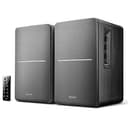
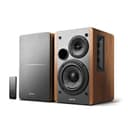
Edifier R1280T

Edifier R1280T

The default powered-speaker recommendation for a turntable: active speakers with the amplifier built in, dual RCA inputs and a remote, at a price that undercuts almost everything. Feed them from a deck with a built-in preamp and you have a complete system for the cost of a cartridge.

Best overall under $200
$129.99 · View on Amazon

$149.9913% off

Price as of August 31, 2026. #ad How we’re funded

2
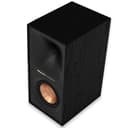
Klipsch R-40M

Klipsch R-40M

Klipsch publishes the numbers that matter: 91 dB sensitivity, 71 Hz-21 kHz +/-3 dB, 8 ohms compatible, 50 W continuous. That sensitivity is the point — these go loud on very little power, which makes them the natural partner for a small, cheap amplifier. This is the Reference Next-Generation replacement for the discontinued R-41M.

Best passive pair
$199.99 · View on Amazon

Price as of August 31, 2026. #ad How we’re funded

3
Edifier R1280DB

Edifier R1280DB

The R1280T's more connected sibling: the same value formula plus Bluetooth, optical and coaxial inputs, so it handles a turntable and a TV and a phone. Still no phono preamp, so a deck needs its own stage — but as a do-everything desktop pair it's hard to beat.

Best with Bluetooth
$189.99 · View on Amazon

Price as of August 31, 2026. #ad How we’re funded

4
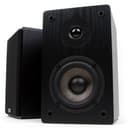
Micca MB42X

Micca MB42X

The passive pick for people who want to choose their own amp: a well-reviewed two-way bookshelf speaker that punches above its price, but with no amplifier of its own. Buy these only if you have (or want) a separate amplifier or receiver — they will not work plugged straight into a turntable.

Best compact passive
$119.99 · View on Amazon

Price as of August 31, 2026. #ad How we’re funded

5
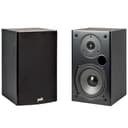
Polk Audio T15

Polk Audio T15

A 5.25-inch Dynamic Balance driver and a 0.75-inch tweeter from a brand with fifty years of speaker-building behind it, at a price that undercuts most of the field. Polk sells it into home theater, but as a stereo pair on the end of a turntable it is one of the safest sub-$150 buys there is.

Best brand-name passive
$125.00 · View on Amazon

$149.0016% off

Price as of August 31, 2026. #ad How we’re funded

6
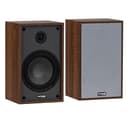
Dayton Audio Classic B65

Dayton Audio Classic B65

A 6.5-inch woofer and a one-inch soft dome in a wood-veneer cabinet, rated 60 W RMS, for less than a decent cartridge costs. It is the cheapest passive pair we would put in front of a real turntable — the size of the woofer is doing the work that a small budget speaker's port usually fakes.

Best budget passive
$79.98 · View on Amazon

Price as of August 31, 2026. #ad How we’re funded

The picks in full

#1Best overall under $200

Edifier R1280T

The default powered-speaker recommendation for a turntable: active speakers with the amplifier built in, dual RCA inputs and a remote, at a price that undercuts almost everything. Feed them from a deck with a built-in preamp and you have a complete system for the cost of a cartridge.

Strengths

  • Amplifier built in — no separate amp needed
  • Two RCA inputs, so a turntable and a second source can both stay connected
  • Remote control and tone controls; famously good value

Trade-offs

  • No built-in phono preamp — your turntable or an external box must provide one
  • No Bluetooth on this model (the R1280DB adds it)
TypePowered (active) bookshelf
Power42W RMS total
Inputs2 x RCA (line level)
Phono preampNo
BluetoothNo

Note. These take a LINE-level signal, so your turntable needs a preamp somewhere — either its own switchable built-in stage set to ON, or a separate box. Our 'do I need a phono preamp' guide walks through it.

Specifications read from the manufacturer / product listing, on July 24, 2026. “Not published” means the maker does not state that figure.

#2Best passive pair

Klipsch R-40M

Klipsch publishes the numbers that matter: 91 dB sensitivity, 71 Hz-21 kHz +/-3 dB, 8 ohms compatible, 50 W continuous. That sensitivity is the point — these go loud on very little power, which makes them the natural partner for a small, cheap amplifier. This is the Reference Next-Generation replacement for the discontinued R-41M.

Strengths

  • 91 dB sensitivity — a 20 W amp drives these to genuinely loud levels
  • Horn-loaded 1" aluminum LTS tweeter gives the presence Klipsch is known for
  • Full published response, impedance and crossover figures, unusual at the price

Trade-offs

  • The 4" woofer runs out of bass at 71 Hz — no low end without a subwoofer
  • The horn's forward treble is a taste; bright pressings can sound brighter still
  • Rear-firing ports, so it turns boomy pushed hard against a wall
TypePassive 2-way bookshelf, bass-reflex (rear ports)
Woofer4" spun-copper TCP
Tweeter1" aluminum LTS on a 90x90 square Tractrix horn
Frequency response71 Hz - 21 kHz +/-3 dB
Sensitivity91 dB in-room (2.83 V / 1 m, half-space anechoic)
Impedance8 ohms compatible
Crossover1,770 Hz
Power handling50 W continuous / 200 W peak
CabinetMDF, 11.7 x 5.8 x 8.5", 7 lbs each

Note. Sensitivity is the spec most people ignore and shouldn't. At 91 dB these play about twice as loud as an 85 dB speaker on the same amplifier, which changes which amp you need to buy. Klipsch qualifies the figure as in-room, measured at 2.83 V into half-space — read it as a comparison against other Klipsch numbers rather than as an anechoic figure.

Specifications read from the manufacturer / product listing, on August 28, 2026. “Not published” means the maker does not state that figure.

#3Best with Bluetooth

Edifier R1280DB

The R1280T's more connected sibling: the same value formula plus Bluetooth, optical and coaxial inputs, so it handles a turntable and a TV and a phone. Still no phono preamp, so a deck needs its own stage — but as a do-everything desktop pair it's hard to beat.

Strengths

  • Bluetooth, optical and coaxial inputs on top of dual RCA
  • Same well-regarded value as the R1280T
  • Remote and tone controls

Trade-offs

  • No built-in phono preamp
  • Bluetooth codec is basic (SBC)
TypePowered (active) bookshelf
Power42W RMS total
InputsRCA x2, optical, coaxial, Bluetooth
Phono preampNo
ExtrasRemote, tone controls

Note. Pick this over the R1280T only if you want Bluetooth and digital inputs; for a pure turntable setup the cheaper R1280T is the same speaker.

Specifications read from the manufacturer / product listing, on July 24, 2026. “Not published” means the maker does not state that figure.

#4Best compact passive

Micca MB42X

The passive pick for people who want to choose their own amp: a well-reviewed two-way bookshelf speaker that punches above its price, but with no amplifier of its own. Buy these only if you have (or want) a separate amplifier or receiver — they will not work plugged straight into a turntable.

Strengths

  • Excellent sound-per-dollar for a passive bookshelf
  • A real two-way design with a crossover, unlike single-driver budget boxes
  • Lets you pick the amp and grow the system your way

Trade-offs

  • Passive — needs a separate amplifier or receiver AND a phono preamp
  • Not a plug-and-play choice for a first-time buyer
TypePassive (needs an amp)
Configuration2-way with crossover
AmplifierNone (external required)
Phono preampNone (external required)
Sold asPair

Note. These are the odd one out in a powered-speaker roundup on purpose: they show what the passive route costs in extra boxes. If the word 'amplifier' is new to you, buy powered speakers instead.

Specifications read from the manufacturer / product listing, on July 24, 2026. “Not published” means the maker does not state that figure.

#5Best brand-name passive

Polk Audio T15

A 5.25-inch Dynamic Balance driver and a 0.75-inch tweeter from a brand with fifty years of speaker-building behind it, at a price that undercuts most of the field. Polk sells it into home theater, but as a stereo pair on the end of a turntable it is one of the safest sub-$150 buys there is.

Strengths

  • Established speaker maker rather than a marketplace brand at this price
  • 5.25" Dynamic Balance driver gives more low-end body than the 4" competition
  • Wall-mountable, and easy for any amplifier to drive

Trade-offs

  • 0.75" tweeter is smaller than the 1" domes on the step-up pairs, and the top end is less airy for it
  • Voiced and marketed for home theater — competent rather than refined on music
TypePassive 2-way bookshelf
Woofer5.25" Dynamic Balance
Tweeter0.75"
Power handling100 W
MountingWall-mountable
Built-in preampNo — passive

Note. Polk's marketing talks about 5.1 systems and surround expansion. Ignore it — bought as a stereo pair for a turntable, this is simply a well-made budget bookshelf speaker from a maker with a long track record.

Specifications read from the manufacturer / product listing, on August 12, 2026. “Not published” means the maker does not state that figure.

#6Best budget passive

Dayton Audio Classic B65

A 6.5-inch woofer and a one-inch soft dome in a wood-veneer cabinet, rated 60 W RMS, for less than a decent cartridge costs. It is the cheapest passive pair we would put in front of a real turntable — the size of the woofer is doing the work that a small budget speaker's port usually fakes.

Strengths

  • 6.5-inch woofer moves real air — most speakers at this price use a 4-inch driver
  • Passive design, so you choose the amplifier and can upgrade it later
  • Keyhole mounts for wall placement, and a five-year warranty

Trade-offs

  • Needs an amplifier — budget for one, which erases part of the price advantage
  • Wood-veneer finish and basic crossover; this is value engineering, not refinement
TypePassive 2-way bookshelf
Woofer6.5"
Tweeter1" soft dome
Power handling60 W RMS
MountingKeyhole wall mounts
Built-in preampNo — passive

Note. Passive means the amplifier is a separate purchase. Pair these with a sub-$100 class-D amp and you have a complete, genuinely listenable system for around the price of one powered pair.

Specifications read from the manufacturer / product listing, on August 11, 2026. “Not published” means the maker does not state that figure.

Powered or passive: the arithmetic

This is the decision, so let us do it properly rather than in the abstract.

The powered route

One purchase. The Edifier R1280T contains its own amplification, has two RCA inputs, and includes tone controls. Connect a turntable with a built-in preamp and you have a complete system with two cables and nothing else to buy.

Total cost: the speakers. Total boxes: two, including the turntable.

The passive route

Two purchases. The Klipsch R-40M, Micca MB42X, Polk T15 and Dayton B65 are all passive — they make no sound without an amplifier. A budget class-D amplifier from our amplifier roundup adds roughly $90 to the total.

Total cost: speakers plus amplifier. Total boxes: three.

Which wins

At a hard $200 ceiling for everything, powered wins— the passive route would leave you about $110 for speakers, and the powered pair at $150 beats anything you can buy for $110.

If $200 is the speaker budget and you can add an amplifier separately, passive wins on sound quality and on upgrade path: you can replace either half later without discarding the other.

And if you already own an amplifier or receiver, passive wins outright. Do not buy powered speakers to sit next to an amplifier you already have.

What to look for at this price

  • Woofer size. The single most reliable predictor of low-end weight. A 5- or 6.5-inch woofer moves meaningfully more air than a 4-inch one, which is why the Polk T15 and Dayton B65 sound larger than their price suggests.
  • Sensitivity, on passive pairs. The Klipsch R-40M publishes 91 dB, which means it plays as loud on a 20 W amplifier as an 86 dB pair does on 60 W. On a tight total budget, a sensitive speaker effectively subsidizes the amplifier.
  • Where the port faces. A rear-firing port pushed against a wall gets boomy. If the speakers must go on a shelf against a wall, a front port or a sealed design is the safer choice.
  • Inputs, on powered pairs. Two RCA inputs let a turntable and a phone stay connected at once. That is more useful day-to-day than any spec on this list.
  • Whether a phono stage is included. Most powered speakers at this price do not have one, including the Edifiers here. That is fine if your turntable has one, and a problem if it does not.

What $200 does not buy

Being honest about the ceiling is more useful than overselling the floor.

  • Deep bass. Physics: small cabinets with 4- to 6.5-inch woofers roll off in the 50-70 Hz region. On most records that is fine, because a groove rarely carries much energy below 40 Hz. On bass-heavy electronic music you will hear the limit.
  • Room-filling volume in a large space. These suit a bedroom, a study or a modest living room. A big open-plan room wants more.
  • Refinement. The step to the $250-500 tieris real — better cabinets, better crossovers, more even response. It is the clearest upgrade available once the deck is sorted.

Placement is free and worth more than the upgrade

At this price, positioning changes more than switching between any two pairs on this page.

  1. Get them to ear height. Stands, or a shelf at seated ear level. Speakers firing at your knees lose all their treble.
  2. Form a triangle. Speakers and listening position roughly equidistant, toed slightly inward.
  3. Keep them away from the turntable.A light deck between two speakers picks up their output through its plinth and feeds it back into the cartridge — heard as boom and mud, not obvious howling. See troubleshooting.
  4. Pull them out of corners. Corner placement adds bass that is impressive for a week and muddy afterwards.

The complete system, costed

For a first setup, the combination we would actually recommend at this level is a turntable with a switchable built-in preamp plus one of the powered pairs here. Two boxes, two cables, no hidden third purchase, and both halves upgradeable later — the deck first, then the speakers. Our beginner setup guide costs three complete systems out that way, and best turntables for the money covers the deck half of the decision.
Frequently asked questions

What are the best speakers for a turntable under $200?

The Edifier R1280T for most people — it is a powered pair, so it needs no separate amplifier, and it has two RCA inputs and tone controls. If you already own an amplifier, a passive pair like the Klipsch R-40M sounds better within the same budget.

Do I need an amplifier for speakers under $200?

Only for passive speakers. Powered (active) pairs like the Edifiers have the amplifier built in. Passive pairs like the Klipsch, Micca, Polk and Dayton need one, which adds roughly $90 to the total using a budget class-D amplifier.

Can I plug a turntable straight into powered speakers?

Only if the turntable has a built-in phono preamp — most decks under $400 do, usually with a PHONO/LINE switch. Powered speakers expect line level, so a raw phono signal into them sounds very quiet and thin.

Are powered or passive speakers better for vinyl?

Passive pairs generally sound better per dollar and let you upgrade each half separately. Powered pairs are cheaper as a complete system and simpler to set up. At a hard $200 total, powered wins; if $200 is just the speaker budget, passive wins.

Do I need a subwoofer with speakers this size?

Usually not for records. These pairs roll off somewhere in the 50-70 Hz region and vinyl rarely carries much energy below 40 Hz. Add one if you also watch films on the same system or listen to a lot of bass-heavy electronic music.

Will $200 speakers be a bottleneck for a good turntable?

Eventually, yes — speakers are usually the limiting factor in any system. But they will not embarrass a deck up to about $400, and upgrading speakers later while keeping the turntable is a perfectly sensible order to do things in.

Sources

Keep reading