How to Connect a Turntable Without a Receiver
You do not need a receiver. You do need the three jobs a receiver was doing — and there are four tidy ways to cover them.
How this is funded: we earn a commission if you buy through our links, at no extra cost to you. It never changes which product we recommend, and we’ll tell you plainly when to skip one. Full disclosure.
“Do I need a receiver?” is one of the most common questions in vinyl, and the answer is no. A receiver is a convenient bundle of jobs, not a requirement. Once you know which jobs it was doing, you can cover them in whatever combination suits your room and budget.
The three jobs a receiver was doing
- Phono preamplification.Boosting the cartridge’s tiny signal and reversing the RIAA equalization curve. Without this, everything is faint and tinny.
- Power amplification. Driving the speakers.
- Input switching and volume. Convenience, not physics.
Every route below covers the first two. That is all that actually matters.
Route 1 — Powered speakers (the simple answer)
What you need: a turntable with a built-in phono preamp, plus powered speakers.
Powered speakers contain their own amplifier, so job two is handled inside the cabinet. If your turntable has a built-in preamp — most decks under $400 do — job one is handled inside the deck. Connect the RCA cables, set the turntable to LINE, done.
Boxes: two. Cables: two. This is what we recommend to most people building a first system, and the pairs in best speakers under $200 all work this way.
Route 2 — Powered speakers with a phono input
What you need: powered speakers that include a phono stage.
Some powered speakers — the Kanto YU6 and Klipsch The Fives, for instance — have a PHONO input and a ground post. They do both jobs, so even a deck with no preamp at all connects directly.
The catch is that most powered speakers do not have this, including the very popular Edifier R1280T. Look for a switch or an input labeled PHONO and a small ground screw. Our powered speaker roundup flags which do.
Route 3 — Add a separate phono preamp
What you need: a turntable with no preamp, a separate phono stage, and powered speakers.
Turntable into the phono stage, phono stage into the powered speakers’ line input. Three boxes, and it is the route to take if you own a deck like the Fluance RT82 or a Pro-Ject Debut that deliberately omits the circuit.
A capable stage costs well under $100 — see phono preamps under $100.
Route 4 — A small integrated amplifier and passive speakers
What you need: a compact integrated amplifier plus passive speakers.
This is a receiver in everything but name, minus the radio tuner. A class-D amplifier the size of a paperback drives passive speakers happily, and some integrated amplifiers include a phono input, which covers both jobs in one box.
It is the best-sounding route per dollar at a given total budget, and the most upgradeable, because every component is separate. See amplifiers for a turntable and bookshelf speakers.
The mistake that makes all four fail
Two phono preamps in series. The signal gets amplified and equalized twice, and the result is distorted, harsh and painfully loud.
It happens when a turntable’s built-in preamp is left switched on and fed into a phono input on a preamp or powered speaker. The rule is simple: exactly one phono stage anywhere in the chain. If your turntable has a PHONO/LINE switch and something downstream also has a phono input, set the turntable to PHONO and let the downstream box do the work — or set it to LINE and use a line input instead.
The opposite error — none anywhere — gives the faint, tinny sound this page keeps returning to. Both symptoms are covered in turntable troubleshooting.
Two things people try that do not work
- Turntable straight into passive speakers. There is nothing in the chain providing power. Passive speakers need an amplifier, always.
- Turntable straight into a Bluetooth speaker.Not possible unless the deck has a Bluetooth transmitter built in, like the AT-LP60XBT. A phono output cannot pair with anything — see Bluetooth turntables.
- Turntable straight into a soundbar.Possible, but only through an analog input or Bluetooth, and only at line level — a soundbar has no phono input and no grounding terminal. Plenty of current bars accept nothing analog at all. The three routes, by what your bar actually has, are in connecting a turntable to a soundbar.
- Headphones straight into the turntable. Almost never works: a line-level output has no power behind it. The three routes that do are in listening to vinyl with headphones.
Which route should you take?
If you are starting from nothing: Route 1. A turntable with a built-in preamp plus powered speakers is the fewest boxes, the fewest decisions and the least that can go wrong.
If you already own a preamp-less deck: Route 3, or Route 2 if you have not bought speakers yet. If you want the best sound for the money and do not mind three boxes: Route 4. All four are legitimate; none of them needs a receiver.
And if you do own a receiver already, none of this applies — wiring a deck to it is a different job with its own rules about which socket and where the ground wire goes. Our guide to connecting a turntable to a receiver has the matching table for every combination of deck and receiver, including the common case where the receiver has no PHONO socket at all.
The two boxes most people end up buying
Powered speakers replace the receiver entirely. Add the phono stage alongside them only if your turntable does not have one. Prices are live and dated.
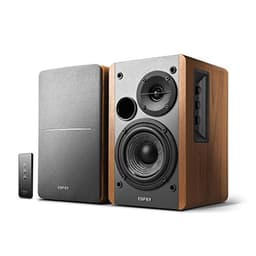
Edifier R1280T
The best-value complete-system speakers
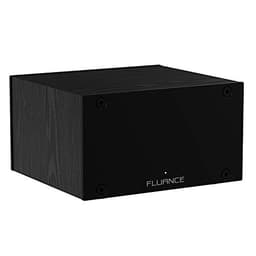
Fluance PA10
A solid mid-priced MM upgrade
Price as of October 14, 2026. #ad How we’re funded
Frequently asked questions
Can you connect a record player to speakers without a receiver?
Yes. The simplest route is powered speakers, which contain their own amplifier — a turntable with a built-in phono preamp connects to them with two RCA cables and nothing else. A receiver is one way to supply amplification, not the only way.
Do you need a receiver for a record player?
No. A receiver supplies amplification and often a phono input, but powered speakers supply amplification themselves and a separate phono preamp supplies the phono stage. You only need a receiver or amplifier if your speakers are passive.
What do I need to connect a turntable to powered speakers?
Two RCA cables, and a phono preamp somewhere in the chain. If your turntable has a built-in preamp set to LINE, that is all — connect and play. If it does not, you need either a separate phono preamp or powered speakers with a phono input built in.
Can I connect a turntable directly to a Bluetooth speaker?
Only if the turntable has a Bluetooth transmitter built in, like the Audio-Technica AT-LP60XBT. A standard turntable outputs an analog phono signal and cannot pair with anything. Bluetooth also compresses the signal, so a wired connection sounds better where you have the option.
Can I plug a turntable into a soundbar or a TV?
Sometimes. It needs an analog line input — a 3.5 mm or RCA aux socket — and your turntable needs a built-in phono preamp set to LINE. Many modern soundbars are HDMI and optical only, in which case there is no analog input to use.
Why is my turntable so quiet through my powered speakers?
There is no phono preamp in the chain. Powered speakers expect line level and a turntable outputs a signal roughly a hundred times smaller with the RIAA curve still applied. Switch on your turntable's built-in preamp, or add a separate one.
Sources
- Crutchfield — How to choose a phono preamp — On why a phono signal needs a preamp and never running two at once (accessed July 24, 2026)
- Crutchfield — Home speakers buying guide — Reference on choosing passive vs powered speakers, room size and amplifier pairing (accessed August 11, 2026)
- Crutchfield — Intro to home audio power amplifiers and preamps — On the preamp/power-amp split, integrated amplifiers and impedance stability (accessed August 11, 2026)
Keep reading
Turntable Setup Diagram
All five valid signal chains, drawn out.
Read the guideDo You Need an Amp for a Turntable?
The three jobs a receiver was doing, and where else they can live.
Read the explainerPowered vs Passive Speakers
Why powered speakers are the answer to this question so often.
Read the comparisonWhat Is a Built-in Phono Preamp?
How to check whether your deck already covers the missing piece.
Check yoursBest Speakers for a Turntable Under $200
The powered pairs that replace a receiver outright.
See the picks