Q Acoustics 3020c Review
A sealed, baffle-isolated tweeter and a new cone profile in a cabinet small enough for a real shelf — sold at a sensitivity that tells you to take the amplifier seriously.
How this is funded: we earn a commission if you buy through our links, at no extra cost to you. It never changes which product we recommend, and we’ll tell you plainly when to skip one. Full disclosure.
The short version
Q Acoustics 3020c
For a record system with a competent amplifier and limited shelf depth. Not for anyone hoping a 20 W class-D board will do.
Strengths
- Published 60 Hz - 30 kHz (-6 dB) from a 4.75" driver, with a 2.6 kHz crossover
- Hermetically sealed tweeter mechanically isolated from the baffle, in a P2P-braced cabinet
- An 11.0 x 6.9 x 11.1" cabinet that fits shelves the 5.5-inch 3030c will not
Trade-offs
- 87.0 dB sensitivity and a 3.7-ohm minimum impedance - Q Acoustics asks for 25-90 W, and the bottom of that range is the honest floor, not the target
- The frequency response is published at -6 dB, not the +/-3 dB most American rivals print, so 60 Hz here is not the same measurement as 44 Hz there
- Passive: an amplifier and a phono stage are both still to buy
| Type | Passive 2-way reflex standmount |
|---|---|
| Bass unit | 1 x 120 mm (4.75") C3 Continuous Curved Cone |
| Treble unit | 1 x 22 mm (0.9"), hermetically sealed, isolated from the baffle |
| Frequency response | 60 Hz - 30 kHz (-6 dB) |
| Sensitivity | 87.0 dB (1 m, 2.83 Vrms @ 1 kHz) |
| Impedance | 6 ohms nominal, 3.7 ohms minimum |
| Crossover | 2.6 kHz |
| Recommended amplifier power | 25 - 90 W |
| Cabinet | 279 x 175 x 281 mm (11.0 x 6.9 x 11.1"), 6.9 L effective volume |
| Weight | 5.5 kg (12.1 lbs) each |
| Built-in preamp | No - passive |
Specifications read from the manufacturer / product listing, accessed 2026-10-19. We have not measured this unit — what we do instead.
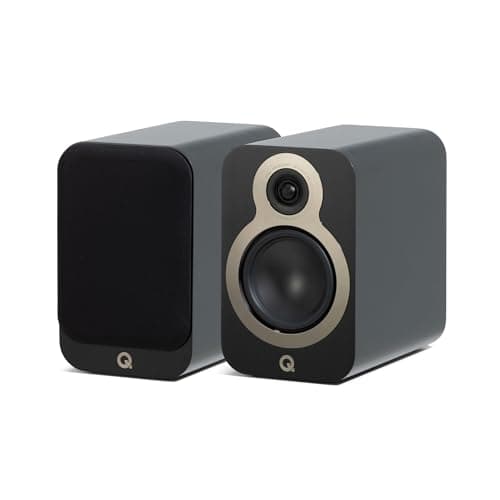
Price as of October 21, 2026. #ad How we’re funded
What it is, in one paragraph
The 3020c is a passive two-way standmount speaker: a single 120 mm (4.75 in) mid/bass driver and a 22 mm (0.9 in) tweeter in a reflex cabinet with 6.9 liters of effective internal volume, crossed over at 2.6 kHz. It replaces the 3020i, which this site used to rank and retired in October 2026 when its listings went dead: Q Acoustics has moved the whole 3000-series on to the “c” generation. We have not heard this pair. Every figure on this page is from Q Acoustics’ own published specification table, cited in Sources, and the numbers the maker does not publish are not invented here.
The sensitivity number is the review
Q Acoustics publishes 87.0 dB at 1 m with 2.83 Vrms at 1 kHz, a 6-ohm nominal impedance that falls to a 3.7-ohm minimum, and a recommended amplifier power of 25 to 90 W. Those three figures belong together, and they are the reason this is a review rather than a recommendation with no strings.
Sensitivity is how much sound you get for a given electrical input, and the scale is brutal because it is logarithmic: every 3 dB of sensitivity lost roughly doubles the amplifier power needed for the same loudness. Our bookshelf rounduphas pairs at 92 and 94.5 dB. Against a 94.5 dB speaker, the 3020c needs something close to four times the power to reach the same level in the same room. That is not a defect — low-sensitivity designs often trade efficiency for a smoother response or a better-controlled cabinet — but it is a purchase decision, and it is the one most people get wrong when they buy a $100 class-D board to go with a well-reviewed speaker.
The 3.7-ohm minimum matters for the same reason. A nominal 6-ohm speaker that dips below 4 ohms somewhere in its range asks the amplifier for current at exactly the frequency where it dips. A cheap amplifier with a modest power supply will either run out of headroom or protect itself. Anything in our amplifier picksrated for 4-ohm loads will be fine; so will a 25 W amplifier in a small room, which is why Q Acoustics’ own floor is 25 W rather than 50.
Reading the frequency response honestly
The published figure is 60 Hz – 30 kHz, measured at -6 dB. That condition is doing a lot of work, and comparing it across brands without it is how speaker shopping goes wrong. A -6 dB limit is a more generous test than the ±3 dBwindow Klipsch and ELAC print: it allows the output to have fallen twice as far, in decibel terms, before the number is quoted. So the 3020c’s 60 Hz and the Klipsch RP-600M II’s 44 Hz ±3 dB are not two points on one scale.
Within Q Acoustics’ own range the figure is useful, because the test is consistent. The larger 3030c publishes 48 Hz on the same -6 dB basis from a 142 mm driver and 12.5 liters of cabinet — so inside this range, 12 Hz is what the bigger box buys you.
For records, 60 Hz is lower than the format usually demands. Bass below about 40 Hz is cut carefully on vinyl, if at all, because large low-frequency excursions are what make a stylus lose the groove — one reason 45 RPM pressings exist. A pair that is honest down to the low 60s with a controlled cabinet is a better match for an LP than a bigger number achieved with a boomy port.
What Q Acoustics changed, and what it means
Three design claims are published for the 3000c range, and all three are about the same thing: stopping the cabinet and the drivers from adding anything of their own.
- The C3 Continuous Curved Cone.A new mid/bass profile, which Q Acoustics says is intended to improve bass dynamics and the blend with the tweeter. A continuously curved cone resists the bending modes a straight-sided cone develops as frequency rises, which is what turns a driver’s own breakup into audible hardness.
- A hermetically sealed tweeter, mechanically isolated from the baffle. Sealing it keeps the mid/bass driver’s pressure inside the cabinet out of the tweeter’s rear chamber; isolating it from the baffle stops the cabinet’s vibration from shaking the tweeter while it is working. Both are real engineering, and both are the kind of thing you notice as an absence rather than a feature.
- P2P (Point to Point) bracing. Internal bracing placed to stiffen the panels that need it, which Q Acoustics ties to reduced low-end reverberation and a cleaner stereo image. The 3030i used the same idea; it is a Q Acoustics house technique rather than a new one.
What the maker does not publish is equally worth recording. There is no stated port location and no power-handling figure in the table, and no THD number. We will not infer any of them. The cabinet is described as reflex; plan placement as you would for any ported box, with air behind it.
What it needs around it
The 3020c is passive, so the shopping list is longer than the speaker. It needs an amplifier, and the signal needs exactly one phono stagesomewhere between the cartridge and that amplifier — in the deck, in the amplifier, or in a separate box. Two in series is the commonest wiring mistake in vinyl and it sounds like distorted, uncontrollably loud mud.
It also needs stands, in practice. At 279 mm tall the tweeter lands well below ear height on a sideboard, and Q Acoustics’ own range includes dedicated stands for the series. A pair of stands is the cheapest meaningful improvement available once the speakers are chosen, ahead of any cable.
Source-wise, this is a speaker that will show you what the deck in front of it is. At this price the sensible pairing is a deck with an adjustable counterweight and a decent elliptical cartridge — our picks under $500 are the band that matches. A $120 automatic with a fixed arm will play perfectly well through it and will also make the compromise audible, which is the whole point of a revealing speaker.
Who should buy it, and who should not
Buy it if there is an amplifier on the rack already, or one in the plan, and the shelf or stand top is around 7 inches wide and 11 inches deep. You get a current-generation design from an established British speaker maker, with a sealed and isolated tweeter, a braced cabinet and a published response that is honest about its own test condition.
Do not buy itif the budget has to cover the whole chain. The 3020c’s price buys drivers and a cabinet; a powered pair with a phono input built in — see speakers with a phono preamp — buys a working system for similar money, and for a first vinyl setup that is usually the better purchase. Do not buy it either if the amplifier is already chosen and it is a small, cheap class-D board: at 87 dB and 3.7 ohms minimum, that combination is how a good speaker gets a bad reputation.
Frequently asked questions
Is the Q Acoustics 3020c good for a turntable?
Yes, with one condition: the amplifier has to be real. Q Acoustics publishes 87.0 dB sensitivity at 1 m / 2.83 Vrms and a 3.7-ohm minimum impedance, and asks for 25 to 90 W. Into a competent 40 to 60 W integrated amplifier with a phono input - or a 25 W amp in a small room - it is an excellent pair for records. It is passive, so a phono stage has to exist somewhere in the chain.
What is the difference between the 3020c and the old 3020i?
The 3020c is a ground-up redesign rather than a refresh, and the headline change is the driver: Q Acoustics calls it the C3 Continuous Curved Cone, a new mid/bass profile intended to improve bass dynamics and integration with the tweeter. The tweeter is now hermetically sealed and mechanically isolated from the baffle, and the cabinet uses P2P bracing. The 3000i range, including the 3020i and 3030i, is gone from the US catalog.
Do I need an amplifier for the Q Acoustics 3020c?
Yes. It is a passive speaker: there is no amplification and no phono stage inside, so a turntable cannot connect to it directly. You need an amplifier or receiver, and either that amplifier has a phono input or the turntable has a built-in preamp or a separate phono box sits between them. Exactly one phono stage in the chain, no more.
Is 87 dB sensitivity low?
It is below average for a modern bookshelf speaker, and it is the single most important number on the spec sheet for a buyer on a budget. Klipsch publishes 92 dB for the R-50M and 94.5 dB for the RP-600M II; every 3 dB roughly halves the amplifier power needed for the same level, so the 3020c wants meaningfully more power than either to play as loud. Q Acoustics' own 25-90 W recommendation reflects that.
How deep does the 3020c go?
Q Acoustics publishes 60 Hz to 30 kHz at -6 dB. Read the condition: -6 dB is a more generous measurement than the plus or minus 3 dB figure most American makers print, so the 60 Hz figure is not directly comparable with, say, the RP-600M II's 44 Hz plus or minus 3 dB. Within Q Acoustics' own range the comparison is valid, and the larger 3030c publishes 48 Hz on the same test.
Can I put the 3020c on an actual bookshelf?
Physically, yes - at 11.0 x 6.9 x 11.1 inches it fits shelves the 3030c will not. Acoustically, a reflex cabinet wants air behind it, and a shelf traps the output and exaggerates the low end. If the pair has to live on a shelf, pull it as far forward as the shelf allows and expect to lose some of the bass precision the cabinet bracing is there to protect.
3020c or a powered speaker with a phono input?
If the budget has to cover the whole system, a powered pair with a phono input - the Klipsch R-40PM or R-50PM - will beat the 3020c, because the 3020c's price buys drivers and cabinet only. The 3020c is the better speaker and the worse system. Buy it when an amplifier is already on the rack or is a planned purchase, not as a way to get a turntable playing this weekend.
Sources
- Q Acoustics — 3020c, published specifications — The maker's own table, read live on this date (Q Acoustics' US storefront publishes no specification table at all): bass unit "1 x 120 mm (4.75 in)", treble unit "1 x 22 mm (0.9 in)", frequency response "60 Hz - 30 kHz" at -6 dB, nominal impedance "6 Ohm", minimum impedance "3.7 Ohm", sensitivity "87.0 dB" at 1 m / 2.83 Vrms / 1 kHz, crossover frequency "2.6 kHz", recommended amplifier power "25-90 W", effective volume "6.9 L", dimensions "279 x 175 x 281 mm (11.0 x 6.9 x 11.1 in)", weight "5.5 Kg (12.1 lbs)". Key features as published: a new C3 Continuous Curved Cone mid/bass profile, a hermetically sealed high-frequency unit mechanically isolated from the baffle, P2P (Point to Point) cabinet bracing, and four finishes (Pin Oak, Claro Walnut, Satin White, Satin Black). The -6 dB condition on the response is NOT the +/-3 dB figure Klipsch and ELAC print - do not compare the two as like for like (accessed October 19, 2026)
- Q Acoustics — 3030c, published specifications — The larger standmount from the same range and the same page family, read the same day: bass unit "1 x 142 mm (5.5 in)", treble unit "1 x 22 mm (0.9 in)", frequency response "48 Hz - 30 kHz" at -6 dB, nominal impedance "6 Ohm", minimum impedance "3.9 Ohm", sensitivity "86.5 dB" at 1 m / 2.83 Vrms / 1 kHz, crossover frequency "2.5 kHz", recommended amplifier power "25-90 W", effective volume "12.5 L", dimensions "324 x 205 x 329 mm (12.8 x 8.1 x 13.0 in)", weight "7.5 Kg (16.5 lbs)". The counter-intuitive row is the sensitivity: the bigger speaker is half a dB LOWER than the 3020c and its minimum impedance is 0.2 ohms lower, so it is marginally the harder load of the two (accessed October 19, 2026)
- Crutchfield — Home speakers buying guide — Reference on choosing passive vs powered speakers, room size and amplifier pairing (accessed August 11, 2026)
- Crutchfield — Understanding speaker and amplifier wattage ratings — On RMS versus peak power, and matching an amplifier's output to a speaker's rating (accessed August 11, 2026)
Keep reading
Q Acoustics 3020c vs 3030c
The two standmounts in the range settled on the four published figures that differ - including the one that runs backwards.
Compare themBest Bookshelf Speakers for Vinyl
Passive pairs compared on the two specs that decide which amplifier you need.
See the picksBest Amplifiers for a Turntable
What to put behind a passive pair at 87 dB, with and without a phono input.
See the picksBest Speakers Under $500
The tier below this one, priced as systems rather than as speakers.
See the picks