Q Acoustics 3020c vs 3030c
Same tweeter, same bracing, same 6-ohm rating, same 25-90 W recommendation. Four published figures differ — and one of them runs in the direction nobody expects.
How this is funded: we earn a commission if you buy through our links, at no extra cost to you. It never changes which product we recommend, and we’ll tell you plainly when to skip one. Full disclosure.
The short answer
Buy the 3030c if it will sit on a stand or a surface at least 13 inches deep, and buy the 3020cif it will not. That is genuinely most of the decision, because Q Acoustics has not used this pair of models to separate a good speaker from a lesser one — the tweeter, the cone technology, the cabinet bracing, the nominal impedance and the power recommendation are the same on both spec sheets. What differs is how much air the cabinet encloses and how big the cone pushing it is.
The four rows that differ, in order of how much they matter
1. Cabinet volume: 6.9 L against 12.5 L
This is the root cause of everything else. The 3030c encloses 81% more air than the 3020c, and for a reflex design that is what buys low-frequency output. It is also why the published response moves from 60 Hz to 48 Hz. Nothing about the driver material or the crossover does that work; the box does.
2. Low-frequency limit: 60 Hz against 48 Hz, both at -6 dB
Twelve hertz, on the same test condition, from the same maker — which is exactly the circumstance in which a frequency-response comparison is worth something. For records this is a smaller difference than it sounds: most vinyl carries little energy below 40 Hz by design, because large low-frequency excursions are what push a stylus out of the groove. The 3030c’s advantage is audible on organ, synth bass and well-cut 45 RPM pressings, and close to inaudible on a 1970s rock LP.
3. Crossover: 2.6 kHz against 2.5 kHz
A hundred hertz lower on the 3030c, which hands a fraction less of the upper midrange to the 22 mm tweeter and a fraction more to the larger cone. On vocals — which is most of what is on a record — a lower crossover generally means the transition sits further from the region your ear is most sensitive to. This is a detail, not a headline, and it points the same way as the driver size.
4. Sensitivity and impedance: the row that runs backwards
Here is the counter-intuitive one. The bigger speaker is less sensitive: Q Acoustics publishes 86.5 dB for the 3030c against 87.0 dB for the 3020c, on the same 1 m / 2.83 Vrms / 1 kHz condition. Half a decibel is not audible on its own, but it is the opposite of what most people assume a larger cabinet buys, and it means the 3030c needs marginally more amplifier power than its little brother to play equally loud.
The minimum impedance moves the other way: 3.9 ohms on the 3030c against 3.7 ohmson the 3020c, so the bigger pair is a fractionally kinder load where the dip happens. Both are nominally 6 ohms, both dip below 4, and both therefore want an amplifier that is comfortable with a 4-ohm load — see our amplifier roundup, and note that this is one of the few cases where the cheapest class-D board is a false economy.
What is identical, and why that is the real story
Six rows in the table above are the same on both sheets: the two-way reflex topology, the 22 mm hermetically sealed tweeter mechanically isolated from the baffle, the C3 Continuous Curved Cone profile, the P2P cabinet bracing, the 6-ohm nominal rating and the 25 to 90 W recommendation. Neither pair has a phono input, because neither is powered.
That matters when you are deciding how much to spend. You are not buying a better tweeter or a better cabinet technique by moving up — you are buying displaced air. If the budget is tight and the choice is between the 3030c alone and the 3020c plus a pair of stands, the second option will usually sound better in a normal room, because getting the tweeter to ear height and the cabinet off a resonant surface fixes more than 12 Hz of extension.
Which one for which record setup
- A deck on a sideboard in a living room, speakers on stands:the 3030c. The room is big enough to use the extension and the stands solve the cabinet’s size.
- A deck and speakers sharing one shelf unit:the 3020c, and move the speakers off that shelf if you possibly can. Speakers and a turntable on the same surface is the one placement rule in vinyl that is not negotiable — a stylus cannot tell furniture-borne vibration from groove modulation, as our placement guide explains.
- A desk or a small room: the 3020c. At close range the 3030c has no room to develop its bass advantage and its cabinet is simply in the way.
- A first vinyl system with one budget for everything:neither. Both are passive, so the price buys drivers and a cabinet only. A powered pair with a phono stage inside — see speakers with a phono preamp — gets a turntable playing for similar money.
The generation note, because it changes the comparison
These replaced the 3000i range, and the swap is not like for like. The discontinued 3030iused a 165 mm driver and published a 46 Hz bass extension — a bigger cone and a slightly lower figure than the 3030c that now carries the name. If you are weighing a used 3030i against a new 3030c, the newer speaker is the current design with the sealed and isolated tweeter and the C3 cone, and the older one is the larger driver. Our 3020c review covers what the c generation actually changed, and our bookshelf roundup records why the 3030i was retired from this site when its listings went dead.
The spec matrix
Six of the fourteen rows are identical, including the tweeter, the cabinet technology, the nominal impedance and the power recommendation. The decision lives in the driver size, the low-frequency limit, the cabinet volume - and the sensitivity, which goes the wrong way.
| Specification | 3020cQ Acoustics | 3030cQ Acoustics |
|---|---|---|
| Typesame | Passive 2-way reflex standmount | Passive 2-way reflex standmount |
| Bass unit | 1 x 120 mm (4.75") | 1 x 142 mm (5.5") |
| Treble unitsame | 1 x 22 mm (0.9"), sealed and baffle-isolated | 1 x 22 mm (0.9"), sealed and baffle-isolated |
| Frequency response (-6 dB) | 60 Hz - 30 kHz | 48 Hz - 30 kHz |
| Sensitivity (1 m, 2.83 Vrms @ 1 kHz) | 87.0 dB | 86.5 dB |
| Nominal impedancesame | 6 ohms | 6 ohms |
| Minimum impedance | 3.7 ohms | 3.9 ohms |
| Crossover frequency | 2.6 kHz | 2.5 kHz |
| Recommended amplifier powersame | 25 - 90 W | 25 - 90 W |
| Effective volume | 6.9 L | 12.5 L |
| Dimensions (H x W x D) | 279 x 175 x 281 mm (11.0 x 6.9 x 11.1") | 324 x 205 x 329 mm (12.8 x 8.1 x 13.0") |
| Weight (each) | 5.5 kg (12.1 lbs) | 7.5 kg (16.5 lbs) |
| Cabinet technologysame | C3 cone, P2P bracing | C3 cone, P2P bracing |
| Phono inputsame | No - passive | No - passive |
Every figure is from Q Acoustics’ own published specification table for each model, read on the date in Sources. We have not measured either pair. Both tables quote frequency response at -6 dB, which is a more generous condition than the ±3 dB window most American makers print — so these two numbers can be compared with each other and should not be compared with a Klipsch or ELAC figure as though the test were the same. “Not published” means the figure is not stated in the sources cited below — it is never a value we estimated. Rows marked same are the ones where these decks do not differ.
Both pairs, with live prices
Both are passive: these prices buy speakers, not a system. An amplifier is still required, and a phono stage has to exist somewhere between the cartridge and that amplifier.
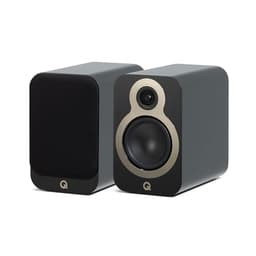
Q Acoustics 3020c
A small shelf, a decent amplifier, and a deck worth feeding it
Price as of October 22, 2026. #ad How we’re funded
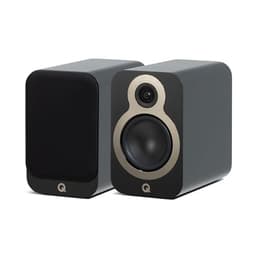
Q Acoustics 3030c
The deepest published bass extension in Q Acoustics' standmount range
Price as of October 22, 2026. #ad How we’re funded
What either pair needs behind it
At 86.5 to 87 dB with a sub-4-ohm dip, neither of these is the pair to pinch pennies on amplification for. The Fosi V3 is the cheapest honest option and needs a phono stage in front of it; the Sony STR-DH190 publishes a phono input, so one box covers both jobs.
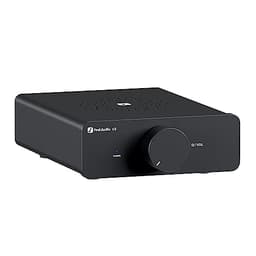
Fosi Audio V3
The cheapest amplifier worth putting behind passive speakers
Price as of October 22, 2026. #ad How we’re funded
Sony STR-DH190
One box that replaces both the phono preamp and the amplifier
Price as of October 22, 2026. #ad How we’re funded
Frequently asked questions
What is the difference between the Q Acoustics 3020c and the 3030c?
Driver size and cabinet volume, and the figures that follow from them. Q Acoustics publishes a 120 mm (4.75 inch) bass unit, 60 Hz to 30 kHz at -6 dB, 6.9 liters of effective volume and a 2.6 kHz crossover for the 3020c, against a 142 mm (5.5 inch) bass unit, 48 Hz to 30 kHz, 12.5 liters and a 2.5 kHz crossover for the 3030c. The tweeter, the cabinet technology, the 6-ohm nominal rating and the 25 to 90 W power recommendation are identical.
Which is better for a record player?
The 3030c, if the stand or shelf can take a 12.8 x 8.1 x 13.0 inch cabinet. The extra 12 Hz of published low-frequency reach and nearly twice the internal volume are real, and its crossover sits 100 Hz lower, which hands slightly less of the upper midrange to the tweeter. If the space is tight, the 3020c is not a compromise so much as a smaller speaker with the same engineering - and in a small room, less cabinet output can be the better outcome.
Is the bigger 3030c easier to drive?
No, and this is the row most buyers get backwards. Q Acoustics publishes 86.5 dB sensitivity for the 3030c against 87.0 dB for the 3020c, and a 3.9-ohm minimum impedance against 3.7 ohms. So the larger speaker is marginally LESS sensitive - it needs slightly more power for the same level - while being a fractionally kinder load at its impedance dip. Both get the same 25 to 90 W recommendation from the maker.
Is the 3030c worth the extra money over the 3020c?
If the room is more than a desk and the speakers are going on stands, yes: you are buying 12 Hz of published extension and 5.6 liters of cabinet for roughly the price of a decent phono preamp. If the pair has to fit a bookshelf, the answer flips, because a 13-inch-deep cabinet crammed into a shelf loses more to its placement than it gains in specification.
Do these replace the 3020i and 3030i?
They are the current generation, but they are not drop-in equivalents. The discontinued 3030i used a 165 mm driver and published 46 Hz; the new 3030c uses a 142 mm driver and publishes 48 Hz. So the model that replaced the 3030i is a smaller-driver design that gives up 2 Hz on paper - which is why this site retired its 3030i card in October 2026 rather than repointing it at a 3030c.
Do I need an amplifier for either of these?
Yes. Both are passive, neither has a phono input, and neither makes a sound on its own. A turntable needs an amplifier, with a phono stage either inside that amplifier, inside the deck, or in a separate box - exactly one, never two. Q Acoustics recommends 25 to 90 W for both pairs, and given 87 dB sensitivity with a sub-4-ohm dip, the middle of that range is the comfortable place to be.
Which one should go on a stand?
Both, ideally, but the 3030c effectively requires one: it is 12.8 inches tall and 16.5 lbs per cabinet, which is a stand speaker that happens to be called a bookshelf. The 3020c at 11.0 inches and 12.1 lbs will sit on a sideboard or a wide shelf, though its tweeter will then be below ear height, which is the first thing stands fix.
Sources
- Q Acoustics — 3020c, published specifications — The maker's own table, read live on this date (Q Acoustics' US storefront publishes no specification table at all): bass unit "1 x 120 mm (4.75 in)", treble unit "1 x 22 mm (0.9 in)", frequency response "60 Hz - 30 kHz" at -6 dB, nominal impedance "6 Ohm", minimum impedance "3.7 Ohm", sensitivity "87.0 dB" at 1 m / 2.83 Vrms / 1 kHz, crossover frequency "2.6 kHz", recommended amplifier power "25-90 W", effective volume "6.9 L", dimensions "279 x 175 x 281 mm (11.0 x 6.9 x 11.1 in)", weight "5.5 Kg (12.1 lbs)". Key features as published: a new C3 Continuous Curved Cone mid/bass profile, a hermetically sealed high-frequency unit mechanically isolated from the baffle, P2P (Point to Point) cabinet bracing, and four finishes (Pin Oak, Claro Walnut, Satin White, Satin Black). The -6 dB condition on the response is NOT the +/-3 dB figure Klipsch and ELAC print - do not compare the two as like for like (accessed October 19, 2026)
- Q Acoustics — 3030c, published specifications — The larger standmount from the same range and the same page family, read the same day: bass unit "1 x 142 mm (5.5 in)", treble unit "1 x 22 mm (0.9 in)", frequency response "48 Hz - 30 kHz" at -6 dB, nominal impedance "6 Ohm", minimum impedance "3.9 Ohm", sensitivity "86.5 dB" at 1 m / 2.83 Vrms / 1 kHz, crossover frequency "2.5 kHz", recommended amplifier power "25-90 W", effective volume "12.5 L", dimensions "324 x 205 x 329 mm (12.8 x 8.1 x 13.0 in)", weight "7.5 Kg (16.5 lbs)". The counter-intuitive row is the sensitivity: the bigger speaker is half a dB LOWER than the 3020c and its minimum impedance is 0.2 ohms lower, so it is marginally the harder load of the two (accessed October 19, 2026)
- Crutchfield — Home speakers buying guide — Reference on choosing passive vs powered speakers, room size and amplifier pairing (accessed August 11, 2026)
- Crutchfield — Understanding speaker and amplifier wattage ratings — On RMS versus peak power, and matching an amplifier's output to a speaker's rating (accessed August 11, 2026)
Keep reading
Q Acoustics 3020c Review
The smaller pair in full, including why its 87 dB sensitivity is the most important number on the sheet.
Read the reviewBest Bookshelf Speakers for Vinyl
Where these two sit against the Klipsch and ELAC pairs - and why the response figures are not comparable.
See the picksBest Speaker Stands
What the 3030c effectively requires and the 3020c quietly wants.
See the picksBest Amplifiers for a Turntable
What to put behind a 6-ohm passive pair that dips below 4 ohms.
See the picks