PLATTER & PLINTH

The Best Speakers Under $500 for a Turntable

The band where you stop compromising — and where the real question stops being “which pair?” and becomes “how many boxes am I buying?”

By Stephen V.Last updated How we pick

The verdict

The Klipsch RP-600M II is the pick for most people spending up to $500 on speakers for a record player — it publishes the highest sensitivity here (94.5 dB) and the lowest bass limit of any bookshelf pair on this page (44 Hz ±3 dB), so it goes loud on a cheap amplifier and still reaches the bottom of a bass guitar. It is passive, though, so an amplifier and a phono stage are still to buy. If $500 has to cover the whole system, the Klipsch R-40PM is the answer instead: it is the only pick here with a switchable phono input and a ground screw terminal built in, so a turntable with no preamp of its own plugs straight into it and nothing else is needed.

Every price in this list is the price for a stereo pair on the date shown on the buttons. That matters more than it sounds: half the floorstanding speakers sold on Amazon are listed one speaker at a time, which is how a $500 budget quietly becomes a $1,000 one. Nothing on this page is a single-speaker listing.

Under $500 the money can go three different ways, and they are not interchangeable. Passive pairs spend all of it on drivers and cabinet and leave the amplification to you. Powered pairs put an amplifier inside one cabinet, so a line-level signal is all they want. Powered with a phono input goes one step further and swallows the phono preamp too, which is the only configuration here that turns a preamp-less turntable into a working system with nothing else bought.

So the first question is not which pair sounds best. It is what you already own. If an amplifier or receiver is already on the shelf, buy passive and spend the whole budget on speakers. If nothing is, read the arithmetic below before you pick.

How this is funded: we earn a commission if you buy through our links, at no extra cost to you. It never changes which product we recommend, and we’ll tell you plainly when to skip one. Full disclosure.

Quick picks

Ranked on published specs, drive/motor design and buyer fit. Select a row to jump to the full write-up. We have not heard most of these units — here is exactly what we do instead.

#ProductBest forPrice
1
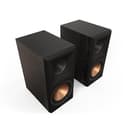
Klipsch RP-600M II

Klipsch RP-600M II

The most sensitive speaker on this page and the only one with a Cerametallic woofer. Klipsch publishes 94.5 dB at 2.83 V / 1 m, 44 Hz - 25 kHz +/-3 dB and 100 W continuous power handling, in an internally braced cabinet with bi-wire binding posts and a rear Tractrix port. If you are running a low-power tube or class-A amplifier, this is the Klipsch built for it.

Best overall
$449.99 · View on Amazon

Price as of October 16, 2026. #ad How we’re funded

2
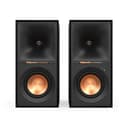
Klipsch R-40PM

Klipsch R-40PM

The R-50PM's smaller sibling with the same input panel - switchable phono/line with a ground screw terminal - in a cabinet 2.2 inches shorter and 1.3 inches narrower. 70 W total against 120 W, and a published 60 Hz limit against 55 Hz. Klipsch badges it PC READY as well as TURNTABLE READY, which is exactly the overlap it serves.

Best complete system
$349.99 · View on Amazon

$549.0036% off

Price as of October 16, 2026. #ad How we’re funded

3
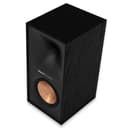
Klipsch R-50M

Klipsch R-50M

The R-40M with a bigger woofer and a full extra decibel of sensitivity, and the published numbers say it is the better buy for records. Klipsch prints 92 dB, 58 Hz - 21 kHz +/-3 dB and a 1,560 Hz crossover against the R-40M's 91 dB, 71 Hz and 1,770 Hz - so it goes lower, hands less of the vocal range to the horn, and still runs on a small amplifier.

Best value passive
$299.99 · View on Amazon

Price as of October 16, 2026. #ad How we’re funded

4
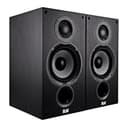
ELAC Debut 2.0 B5.2

ELAC Debut 2.0 B5.2

The Debut series is the default recommendation in this price band for a reason: a woven aramid-fiber woofer, a wide-roll cloth dome reaching 35 kHz, braced MDF cabinets and front-firing ports so you can actually put them on a shelf. Balanced rather than exciting, which is what you want for long album listening.

Best for a shelf
$269.00 · View on Amazon

$379.0029% off

Price as of October 16, 2026. #ad How we’re funded

5
Fluance Ai41

Fluance Ai41

A step up in size and output from the entry powered speakers: 5-inch drivers, a 90-watt amp, Bluetooth, optical and a subwoofer output, in a properly finished cabinet. The pick when you want fuller sound and room to grow without moving to separates.

Best powered without a phono input
$299.99 · View on Amazon

Price as of October 16, 2026. #ad How we’re funded

The picks in full

#1Best overall

Klipsch RP-600M II

The most sensitive speaker on this page and the only one with a Cerametallic woofer. Klipsch publishes 94.5 dB at 2.83 V / 1 m, 44 Hz - 25 kHz +/-3 dB and 100 W continuous power handling, in an internally braced cabinet with bi-wire binding posts and a rear Tractrix port. If you are running a low-power tube or class-A amplifier, this is the Klipsch built for it.

Strengths

  • 94.5 dB published sensitivity - the highest here, and the reason low-watt amplifiers get paired with Klipsch
  • A 6.5" Cerametallic woofer takes the published low end to 44 Hz, deep enough to skip a subwoofer for most records
  • Dual binding posts for bi-wiring or bi-amping, and cork pads rather than rubber bumpers for stand use

Trade-offs

  • Still passive: an amplifier and a phono stage are separate purchases on top of it
  • Published at 15.75" tall and 13" deep - this is a big "bookshelf" speaker and it will not fit a shallow shelf
  • The titanium tweeter on an expanded horn is the most forward treble in the lineup; it rewards good pressings and exposes bad ones
TypePassive 2-way bookshelf, bass-reflex (rear Tractrix port)
Woofer6.5" Cerametallic cone with Faraday rings
Tweeter1" titanium LTS vented, hybrid cross-section expanded Tractrix horn
Frequency response44 Hz - 25 kHz +/-3 dB
Sensitivity94.5 dB (2.83 V / 1 m, half-space anechoic, in-room)
Impedance8 ohms compatible
Crossover1,500 Hz
Power handling100 W continuous / 400 W peak
InputsDual aluminum binding posts (bi-wire / bi-amp)
CabinetInternally braced MDF, 15.75 x 7.95 x 13", 18.1 lb

Note. Sensitivity is the whole argument for this speaker. At a published 94.5 dB it needs roughly a quarter of the amplifier power an 88 dB speaker does to reach the same level, which is why Reference Premiere turns up so often on the end of small tube amplifiers. Klipsch qualifies the figure the way it does the rest of the range - 2.83 V into half-space - so read it against other Klipsch numbers first.

Specifications read from the manufacturer / product listing, on September 29, 2026. “Not published” means the maker does not state that figure.

#2Best complete system

Klipsch R-40PM

The R-50PM's smaller sibling with the same input panel - switchable phono/line with a ground screw terminal - in a cabinet 2.2 inches shorter and 1.3 inches narrower. 70 W total against 120 W, and a published 60 Hz limit against 55 Hz. Klipsch badges it PC READY as well as TURNTABLE READY, which is exactly the overlap it serves.

Strengths

  • The same switchable phono/line input with a ground screw terminal as the R-50PM
  • Small footprint: 11.8 x 5.7 x 10.1 inches, and 18.3 lbs for the pair
  • USB digital, optical and 3.5 mm alongside the phono input, so it doubles as a computer speaker honestly

Trade-offs

  • The 4" woofer and a published 60 Hz limit mean no deep bass without using the subwoofer output
  • Klipsch publishes no sensitivity or nominal impedance, so it cannot be compared with the passive pairs on that figure
  • Costs more than the passive R-50M while giving up the bigger driver; you are paying for the electronics
TypePowered (active) bookshelf pair, bass-reflex (rear port)
Phono preampYes - switchable phono/line with ground screw terminal
Woofer4" spun-copper TCP
Tweeter1" aluminum LTS on a 90x90 square Tractrix horn
Frequency response60 Hz - 20 kHz (dynamic bass extension 52 Hz)
Total system power70 W (240 W peak), 35 W per channel continuous at under 1% THD
Maximum output100 dB
Crossover1,730 Hz (passive)
SensitivityNot published
InputsBluetooth, phono/line RCA, 3.5 mm, USB digital, optical digital
OutputsSingle RCA line-level subwoofer output
CabinetMDF, 11.8 x 5.7 x 10.1", 18.3 lbs (pair)

Note. If you searched for Klipsch computer speakers and you also own a turntable, this is the answer rather than the ProMedia 2.1 - Klipsch publishes only a miniplug input and a headphone jack for that one, so a record player would need a separate phono preamp and an adapter to reach it. The R-40PM takes the deck directly.

Specifications read from the manufacturer / product listing, on September 29, 2026. “Not published” means the maker does not state that figure.

#3Best value passive

Klipsch R-50M

The R-40M with a bigger woofer and a full extra decibel of sensitivity, and the published numbers say it is the better buy for records. Klipsch prints 92 dB, 58 Hz - 21 kHz +/-3 dB and a 1,560 Hz crossover against the R-40M's 91 dB, 71 Hz and 1,770 Hz - so it goes lower, hands less of the vocal range to the horn, and still runs on a small amplifier.

Strengths

  • 92 dB published sensitivity - a 20-30 W amplifier is genuinely enough
  • The 5.25" woofer takes the published low end to 58 Hz, 13 Hz lower than the R-40M
  • Crossover drops to 1,560 Hz, so less of the vocal range is handed to the horn

Trade-offs

  • Passive: the price on the tile is not the price of a system - an amplifier and a phono stage are still to buy
  • Rear-firing ports, so it wants breathing room behind it and turns boomy against a wall
  • The horn's forward treble is a taste, and a bright pressing will not be softened by it
TypePassive 2-way bookshelf, bass-reflex (rear ports)
Woofer5.25" spun-copper TCP
Tweeter1" aluminum LTS on a 90x90 square Tractrix horn
Frequency response58 Hz - 21 kHz +/-3 dB
Sensitivity92 dB in-room (2.83 V / 1 m, half-space anechoic)
Impedance8 ohms compatible
Crossover1,560 Hz
Power handling75 W continuous / 300 W peak
InputsSingle gold-plated binding posts
CabinetMDF, 13.9 x 7 x 9", 11 lbs each

Note. This is the one step in the Reference Next-Generation range you can read straight off a spec sheet rather than infer. Klipsch prints both tables in the same format, and the R-50M wins the sensitivity, the low-frequency limit, the crossover point and the power handling. It is also 4 lbs heavier per cabinet, which matters when you buy stands.

Specifications read from the manufacturer / product listing, on September 29, 2026. “Not published” means the maker does not state that figure.

#4Best for a shelf

ELAC Debut 2.0 B5.2

The Debut series is the default recommendation in this price band for a reason: a woven aramid-fiber woofer, a wide-roll cloth dome reaching 35 kHz, braced MDF cabinets and front-firing ports so you can actually put them on a shelf. Balanced rather than exciting, which is what you want for long album listening.

Strengths

  • Front-firing port means shelf and near-wall placement doesn't wreck the bass
  • Woven aramid-fiber woofer is stiffer and better damped than paper or polypropylene
  • Thick braced MDF cabinets — the enclosure is where budget speakers usually cut corners

Trade-offs

  • Needs an amplifier, and rewards a decent one
  • Deliberately neutral voicing — no built-in excitement if that is what you want
TypePassive 2-way bass reflex bookshelf
Woofer5.25" woven aramid fiber
Tweeter1" cloth dome with waveguide
High-frequency responseUp to 35,000 Hz
CabinetBraced MDF, front-firing port
Built-in preampNo — passive

Note. The front port is the practical detail. Rear-ported speakers pushed against a wall get boomy; these were designed for the bookshelf people actually put them on. ELAC has since followed this generation with the Debut 3.0 DB53 (aluminum-dome tweeter, 48 Hz to 38 kHz); the B5.2 stays the pick here because it is still sold, and at run-out pricing it is the better buy for the money until stock is gone.

Specifications read from the manufacturer / product listing, on August 11, 2026. “Not published” means the maker does not state that figure.

#5Best powered without a phono input

Fluance Ai41

A step up in size and output from the entry powered speakers: 5-inch drivers, a 90-watt amp, Bluetooth, optical and a subwoofer output, in a properly finished cabinet. The pick when you want fuller sound and room to grow without moving to separates.

Strengths

  • 5-inch woven drivers and 90W of power fill a real room
  • Bluetooth, optical and RCA inputs, plus a subwoofer output
  • Handsome cabinet and included remote

Trade-offs

  • No built-in phono preamp — the turntable still needs a stage
  • Bigger footprint than the compact entry speakers
TypePowered (active) bookshelf
Power90W total
Drivers5-inch woven
InputsRCA, optical, Bluetooth 5
Phono preampNo
ExtrasSubwoofer output

Note. The subwoofer output is the standout here — it gives you an easy path to add low end later without changing speakers.

Specifications read from the manufacturer / product listing, on July 24, 2026. “Not published” means the maker does not state that figure.

What $500 actually buys, three ways

Take the numbers from the buttons above and add the missing boxes. These are the three routes, priced as systems rather than as speakers.

Route one: a passive pair plus an amplifier

The RP-600M II, R-50M and Debut 2.0 B5.2 make no sound on their own. Add a class-D amplifier from our amplifier roundup and, if the turntable has no built-in stage, a phono preamp under $100. That is three boxes and three purchases, and it is still the route that buys the most speaker per dollar — a $450 passive pair competes with the drivers and cabinet of a $450 powered pair that also had to pay for an amplifier, a DAC and a remote.

The sensitivity figure is what makes this route cheap. Klipsch publishes 94.5 dB for the RP-600M II and 92 dB for the R-50M, both at 2.83 V / 1 m, half-space anechoic, which is the condition printed on their own sheets. Every 3 dB halves the amplifier power needed for the same level, so a 20 to 30 W amplifier is genuinely enough for either — you are not obliged to spend amplifier money to hear what the speaker does.

Route two: a powered pair, phono stage elsewhere

The Fluance Ai41 has 90 W of its own amplification, RCA, optical and Bluetooth inputs and a subwoofer output. Two boxes, two cables — but Fluance publishes “Phono preamp: No”, so the turntable still has to provide one. On a Fluance RT81 or an Audio-Technica AT-LP120XUSB, which both have a switchable stage inside, that costs nothing. On an RT82or an RT85 it is another purchase, because Fluance publishes “Built-in preamp: No” for both of those decks too.

Route three: a powered pair with the phono input inside

The Klipsch R-40PM is the only pick here whose spec sheet prints the analog input as a switchable phono/line input with a ground screw terminal. That second half is the detail people miss: it means the turntable’s earth wire has somewhere to land, which is the usual cure for hum. Two boxes, two cables, no preamp to buy, and a USB and an optical input left over for a computer or a TV. It costs more than the passive R-50M while using a smaller woofer, and that is the honest trade — the premium buys electronics, not cone area.

How these were ranked

  • The published bass limit, with its tolerance.The RP-600M II’s 44 Hz ±3 dB and the R-50M’s 58 Hz ±3 dB are stated with a tolerance, so they can be compared with each other. The R-40PM’s 60 Hz figure carries a separate “dynamic bass extension” claim of 52 Hz, which is a different kind of number and is not treated here as though it were the same one.
  • Sensitivity, where the maker publishes it.Klipsch does, for the passive pairs, and it decides how much amplifier you have to buy. For the powered pairs Klipsch publishes no sensitivity and no nominal impedance, which is noted on the cards rather than filled in — the amplifier is already matched inside the cabinet.
  • Where the port faces. The RP-600M II and R-50M are rear ported and want breathing room behind them. The ELAC B5.2 is front ported, which is why it is the pick for an actual bookshelf rather than a stand.
  • What is still to buy. A $300 passive pair and a $300 powered pair are not the same purchase, and ranking them as if they were is how people end up with speakers they cannot play.

Where this sits next to the tier below

If $500 is more than you want to spend, our picks under $200 cover the band beneath this one, and the step up is real without being magical: the R-50M goes about 13 Hz lower than the R-40M and moves its crossover down to 1,560 Hz, which hands less of the vocal range to the horn. If you want towers rather than bookshelf speakers, no pair of floorstanders on this site comes in under $500 for two — see floorstanding speakers for vinyl and read the “sold as one speaker” row before you order.

Two things are worth budgeting for separately, because they change what you hear more than a $50 move within this list would: stands, which get the tweeter to ear height, and placement, which is free.

Frequently asked questions

What are the best speakers under $500 for a record player?

The Klipsch RP-600M II publishes the best figures of any bookshelf pair in this band: 94.5 dB sensitivity and 44 Hz to 25 kHz plus or minus 3 dB. It is passive, so an amplifier and a phono stage are extra. If $500 has to cover everything, the Klipsch R-40PM is the better answer, because its switchable phono/line input with a ground screw terminal means a turntable with no preamp of its own connects directly.

Do I need an amplifier for speakers under $500?

Only for the passive ones. The RP-600M II, R-50M and ELAC Debut 2.0 B5.2 all need an amplifier. The Fluance Ai41 and Klipsch R-40PM have amplification built in. Sensitivity decides how much amplifier a passive pair needs, and the Klipsch figures here are high enough that a 20 to 30 W integrated amplifier reaches loud levels in a normal room.

Are these prices for one speaker or for a pair?

A pair. Every price on this page is for a stereo pair on the date shown beside the buttons. We check that deliberately, because many floorstanding speakers - and a few bookshelf models - are listed one speaker at a time, which doubles the real cost of a system without changing the number on the listing.

Is it better to spend $500 on speakers or on the turntable?

On the speakers, if you are choosing between the two. Speakers change what you hear more than any other component, and a $250 deck through $450 speakers beats a $500 deck through $200 speakers. The exception is a deck that cannot track safely: a sealed ceramic cartridge wearing your records is not a problem better speakers can fix.

Can I connect a turntable straight to any of these?

Only to the Klipsch R-40PM, and only because it has a phono stage inside with a ground screw terminal. The Fluance Ai41 wants a line-level signal, so the turntable needs its own switchable preamp or an external box. The three passive pairs cannot take a turntable under any circumstances - they need an amplifier first, with a phono stage somewhere in the chain.

Do I need speaker stands as well?

They are the cheapest genuine improvement left once the speakers are chosen. All five picks are designed to sit with the tweeter near ear height, which a cabinet or a desk rarely achieves, and Klipsch supplies cork pads rather than rubber bumpers with the RP-600M II for exactly that use. Budget $90 to $150 for a pair of stands and expect it to matter more than the difference between the R-50M and the RP-600M II.

What about the Klipsch R-50PM instead of the R-40PM?

Same input panel - switchable phono/line with a ground screw terminal - in a bigger cabinet, with 120 W total against 70 W and a published 55 Hz limit against 60 Hz. It sits at the very top of this band or just above it depending on the day, which is why the R-40PM carries the system pick here. Our R-50PM review covers the larger pair in full.

Sources

  • Klipsch — Reference Premiere RP-600M II spec sheet (PDF) — Manufacturer specification table, read live: frequency response 44 Hz - 25 kHz +/-3 dB, sensitivity "94.5dB @ 2.83V / 1m", power handling 100 W / 400 W, nominal impedance "8 Ohms Compatible", crossover 1,500 Hz, high-frequency driver "1" Titanium LTS Vented Tweeter with Hybrid Cross-Section Expanded Tractrix Horn", low-frequency driver "6.5" Cerametallic Cone Woofer with Faraday rings", enclosure "MDF (Internally Braced)", "Bass Reflex via rear-firing Tractrix Port", inputs "Dual aluminum binding posts/bi-wire/bi-amp", 15.75" (40.0 cm) H x 7.95" (20.2 cm) W x 13.00" (33.0 cm) D, 18.1 lb (8.20 kg), finishes Ebony and Walnut, and "Cork pads replace rubber bumpers for security on a stand or table". Same sensitivity footnote as the Reference sheets (accessed September 29, 2026)
  • Klipsch — Reference R-50M spec sheet (PDF) — Manufacturer specification table, read live: frequency response 58 Hz - 21 kHz +/-3 dB, sensitivity 92 dB (In-Room), power handling 75 W / 300 W, nominal impedance "8 ohms Compatible", crossover 1,560 Hz, high-frequency driver "1" Aluminum LTS tweeter mated to a 90 x 90 square Tractrix Horn", low-frequency driver "Single 5.25" spun-copper TCP woofer", enclosure MDF, "Bass-Reflex via rear-firing ports", inputs "Single Gold Plated Binding Posts", 13.9" (354 mm) H x 7" (178 mm) W x 9" (229 mm) D, 11 lbs (5 kg), Black Textured Wood Grain Vinyl. The sensitivity asterisk reads "SPL at 1M, half-space anechoic with 2.83V input". Read alongside the R-40M sheet, which is printed in the identical format — the two are directly comparable line for line (accessed September 29, 2026)
  • Klipsch — R-40PM powered monitors spec sheet (PDF) — Manufacturer specification table, read live, printed in the same format as the R-50PM's. System description "Powered Monitor (pair)", frequency response 60 Hz - 20 kHz, "DYNAMIC BASS EXTENSION 52Hz", maximum output 100 dB, "70W Total System Power (240W Peak)" and "35W per channel cont. @ <%1 THD", 1" (2.5 cm) aluminum LTS tweeter on a 90 x 90 square Tractrix horn, "Single 4" (10.2cm) spun-copper TCP woofer", crossover "1730 Hz (Passive)", MDF, bass-reflex via rear-firing port, the same input list including "Phono/Line analog (with switch and ground screw terminal)", the same single RCA subwoofer output, 11.8" (30 cm) H x 5.7" (14.5 cm) W x 10.1" (25.65 cm) D and "18.3 lbs (8.3 kg) (pair)". In the box: remote, "4M speaker wire with soldered tips", a 2 m power cord and a 2 m USB A-to-B cable. No sensitivity or impedance row, as above (accessed September 29, 2026)
  • Klipsch — R-40PM and R-50PM owner's manual (PDF) — The manual both powered models share. Cited for three things the spec sheet only implies: the contents page carries a section headed "CONNECTIONS - TURNTABLE" (page 9), the rear-panel legend labels a "Phono/Line Switch", "Phono Inputs" and a "Ground Screw Terminal" as separate numbered items, and the diagram labels the pair as "RIGHT SPEAKER (ACTIVE)" — so the powered cabinet is the right one, the left is passive, and the supplied 4 m speaker wire has to span the gap (accessed September 29, 2026)
  • ELAC — Debut 3.0 DB53 bookshelf speaker — The maker's own page for the generation after the B5.2: "Building on the success of the acclaimed DB52, the Debut 3.0 DB53 delivers greater clarity, refinement, and balance in an even more compact bookshelf design." Published specification: 1-inch aluminum dome tweeter, 5.25-inch aramid-fiber woofer, frequency response 48 Hz to 38 kHz (-6 dB), sensitivity 86.5 dB at 2.83 V / 1 m, nominal impedance 6 ohms. ELAC's DB52 (B5.2) page was still live on the access date with no discontinuation wording, and the B5.2 remained in stock on Amazon below its list price (accessed September 21, 2026)
  • Crutchfield — Home speakers buying guide — Reference on choosing passive vs powered speakers, room size and amplifier pairing (accessed August 11, 2026)
  • Crutchfield — Understanding speaker and amplifier wattage ratings — On RMS versus peak power, and matching an amplifier's output to a speaker's rating (accessed August 11, 2026)

Keep reading