Vinyl vs CD: What Actually Differs
Most of this argument is conducted with claims nobody can check. Here are the parts that can be: what wears out, what it costs to keep playing, where the noise comes from, and whether the record was cut from analog tape at all.
How this is funded: we earn a commission if you buy through our links, at no extra cost to you. It never changes which product we recommend, and we’ll tell you plainly when to skip one. Full disclosure.
The short answer: CDs are cheaper to buy, cheaper to keep and completely consistent from play to play; records cost more in both directions and their sound depends on the condition of that individual copy and the setup of your deck. Which of those is “better” is a question about what you want from listening, not a measurement — and we have not run listening tests on either format, so this page sticks to the parts that can be checked. If you own both shelves and want one cabinet, the turntable and CD combo players we rank are the direct answer; if sound is the priority, a proper deck plus a separate disc player beats any combo and costs more.
What this page refuses to claim
You will find pages that tell you vinyl has more dynamic range than CD, or that CD is objectively transparent and vinyl is distortion. Both claims collapse when you ask which record, which pressing, which cartridge and which player — the format sets an envelope, and almost everything audible happens inside it. We own none of the equipment on this site and we have run no listening comparisons, so no sentence here will tell you which one sounds better. What follows is the set of differences that are either published, documented or structural.
Difference one: one of them wears, and the thing that wears it is replaceable
A record is played by dragging a diamond through a groove under a few grams of force. That means two consumables, not one. The groove degrades over many plays, and the stylus degrades much faster — one retailer reference puts a typical elliptical or Shibata tip at 800 to 1,000 hours, and Audio-Technica publishes roughly 300 to 500 hours for the conical stylus fitted to its entry decks. The important part is the order of operations: a worn stylus is what destroys records, not playing them. Replace the tip on schedule and the record is a durable object; ignore it and you are machining your collection.
A disc has no contact mechanism, so it has no equivalent consumable. It fails from physical damage rather than from use. That is the single clearest practical advantage the format has, and it is why our stylus replacement guide exists and has no CD equivalent.
Difference two: a record’s noise floor belongs to your copy
Surface noise on a record is not a property of the format in the abstract. It is dust, static and wear in that particular groove, read by the stylus along with the music. This is why cleaning audibly changes a record and why an anti-static brush before every side is the cheapest real improvement in vinyl — and it is also why two copies of the same album can sound different. Our cleaning routine and the static guide are the two pages that address it directly.
A disc is read optically with error correction, so dust usually produces either nothing at all or a complete dropout. There is no continuous crackle to manage, which means there is also no maintenance ritual that improves it. People who love vinyl often love that ritual; people who want to press play do not.
Difference three: the vinyl may not be analog
This is the part of the argument that most often surprises people, and it is documented rather than rumored. Mobile Fidelity Sound Lab built its reputation on all-analog, half-speed-mastered reissues. In July 2022 its staff confirmed that Direct Stream Digital files had been used when creating its vinyl masters — covering at least 60% of titles by the end of 2011, including releases in the premium One-Step line. A class action over the “Purely Analog” marketing followed in August 2022 and was later settled.
The lesson is not that MoFi records sound bad; many people who bought them still rate them highly. The lesson is that “vinyl” describes the delivery medium, not the production chain. If a fully analog path is what you are paying for, it is a per-release fact to verify, and our guide to audiophile pressings covers which lines publish what. The same caution applies to the other common premium claim — a pressing company’s own support page states that the stampers used for 180 gram records are the same as for standard weight and the groove depths are identical, which is why we have a separate page on 180 gram vinyl.
Difference four: what each one costs to start and to run
A disc player is a single purchase. A record player is a system: the deck, something to amplify it (a phono stage, then an amplifier or powered speakers), and then the consumables — a stylus every few hundred to a thousand hours, a brush, fluid, inner sleeves. None of those are expensive individually and all of them are real. Our beginner setup guide lists the whole chain honestly, and are turntables worth it is the page that argues the other side of this.
New records also cost more per album than new discs in most markets, and secondhand pricing has moved a long way in the last decade. If budget is the deciding factor, the format answer is CD and it is not close. If the object, the artwork and the ritual are part of what you are buying, that calculation does not apply — and that is a legitimate reason, not a lesser one.
Difference five: you can turn a record into a file, at a published resolution
If the appeal of CD is portability, note that the gap closes from the other side too. A USB turntable digitizes a record at a resolution the maker publishes — Audio-Technica states a 16-bit, 44.1 or 48 kHz USB output for the AT-LP120XUSB — so the record you own can also live on your phone. What a transfer cannot do is clean the groove: it captures the record exactly as it is, which is why the cleaning step comes before the capture step in our digitizing guide, and why the decks for the job are ranked separately on our USB turntable page.
So which should you buy?
If you want the lowest cost per album, the least maintenance and identical playback every time, buy discs. If you want the object, the sleeve, the side-long listening and a system you can improve one component at a time, buy records — and spend the first upgrade money on the stylus and the cleaning routine rather than on the deck, because that is where the audible difference actually lives.
If the real answer is “I have both shelves and one room,” that is a product category rather than a philosophical position. Our combo player picks rank it on the figures those makers do and do not publish, and the two players in the table above are the ones with a line output — the detail that keeps a one-box purchase from becoming a dead end.
The spec matrix
Two one-box players that handle both formats, and the deck you buy when you would rather keep the formats separate. Every value is from the maker's own listing.
| Specification | CR7025A Hayes 8-in-1Crosley | Century 6-in-1Victrola | AT-LP120XUSBAudio-Technica |
|---|---|---|---|
| Plays | Vinyl, CD, cassette, AM/FM, Bluetooth, aux, USB | Vinyl, CD, cassette, Bluetooth, aux | Vinyl only |
| Speedssame | 33 1/3, 45 and 78 RPM | 33 1/3, 45 and 78 RPM | 33 1/3, 45 and 78 RPM |
| Amplifier and speakers included | Yes - 10 W RMS (5 W x 2), 20 W peak | Yes - output power not published | No - needs powered speakers or an amplifier |
| Published frequency response | 80 Hz - 20 kHz | Not published | Not published |
| Cartridge | Not published | Not published | Audio-Technica AT-VM95E (elliptical, replaceable stylus) |
| Tonearm adjustment | Cueing lever and auto-stop; no counterweight published | Not published | Counterweight, anti-skate and pitch |
| Route to better speakers | RCA line out, headphone jack | RCA line out, VINYLSTREAM Bluetooth out, headphone jack | RCA line out with switchable phono/line |
| Digital output | Not published | Not published | USB output to a computer |
Values are read from each maker’s published listing or specification table, on the date shown under that product below. Not published means the maker does not state it — which in the combo class is itself the finding, because cartridge and tracking force are exactly what decides whether a player is safe for your records. Prices are live and dated on each button. “Not published” means the figure is not stated in the sources cited below — it is never a value we estimated. Rows marked same are the ones where these decks do not differ.
Three ways to own both formats, with live prices
Two of these play records and discs in one cabinet. The third plays records properly and leaves the discs to a separate player - which is the better-sounding answer and the more expensive one.
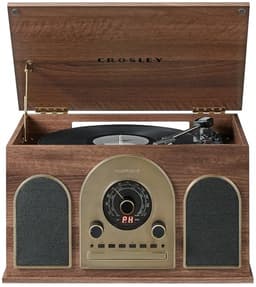
Crosley CR7025A Hayes 8-in-1
One box that plays everything, from the maker willing to publish numbers
Price as of October 6, 2026. #ad How we’re funded
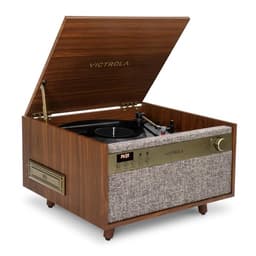
Victrola Century 6-in-1
A combo you can outgrow without replacing
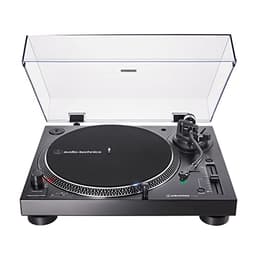
Audio-Technica AT-LP120XUSB
Digitizing records and learning proper setup
Frequently asked questions
Does vinyl sound better than CD?
There is no honest universal answer, and we have not run listening tests, so we will not pretend to one. What is checkable is that the two formats fail differently: a record's sound depends on that individual copy's condition, your stylus and your setup, while a disc plays the same way every time until it is physically damaged. The practical consequence is that a well-kept record on a well-set-up deck can be excellent and a neglected one cannot, whereas a disc is largely indifferent to how you treat the player.
Is vinyl really analog?
Not always, and the clearest documented case is Mobile Fidelity Sound Lab. In July 2022 the company's staff confirmed that Direct Stream Digital files had been used in creating its vinyl masters, covering at least 60% of titles by the end of 2011, including releases in its One-Step line; a class action over the 'Purely Analog' marketing followed and was later settled. If an all-analog chain matters to you, it is a thing to verify per release rather than to assume from the format.
Which is cheaper, vinyl or CD?
CDs are cheaper to buy and cheaper to keep. New records cost more per album than new discs almost everywhere, and the running costs are not comparable either: a record player needs a stylus replaced periodically - one retailer reference puts a typical elliptical or Shibata stylus at 800 to 1,000 hours, and Audio-Technica publishes roughly 300 to 500 hours for the conical stylus on its entry decks - plus brushes, fluid and sleeves. A disc player has no consumable that touches the media.
Do records wear out?
Yes, but slowly and mostly because of what is playing them. The groove is touched by a diamond on every play, so condition degrades over time, and the rate depends almost entirely on the stylus and the tracking force. A worn stylus or a mis-set force is what actually destroys records; a clean record played with a fresh, correctly balanced stylus lasts a very long time. CDs have no contact mechanism, so they fail from physical damage and disc rot rather than from use.
Why do records crackle and CDs do not?
Because a record's noise floor is a property of that physical copy. Dust and static in the groove are read by the stylus along with the music, which is why cleaning a record audibly changes it and why an anti-static brush before each side is the single most effective habit in vinyl. A disc is read optically with error correction, so surface dust usually produces either nothing or a complete dropout rather than a continuous crackle.
Should I buy a turntable and CD player combo?
It is a reasonable choice if the CD shelf matters as much as the record shelf and the system is for background listening. The honest caveat is that combo players almost never publish their cartridge or tracking force, which are the two figures that tell you whether a player is safe for your records, and their built-in amplification is modest - one of the few that does publish numbers states 10 W RMS and an 80 Hz low-frequency limit. Prefer the ones with an RCA line output so the cabinet is not the ceiling.
Can I digitize my records to get CD-quality files?
You can make your own digital copies, and the resolution of a home transfer is a published figure rather than a mystery: Audio-Technica states a 16-bit, 44.1 or 48 kHz USB output for the AT-LP120XUSB. What a transfer cannot do is remove the clicks, surface noise and wear that were in the groove - it captures the record as it is, which is why cleaning before capture matters more than any setting.
Is CD making a comeback like vinyl did?
We do not publish sales figures we have not verified, so we will not characterize the market. What we can say from the product side is that a lot of current one-box players ship with a CD mechanism alongside the platter, and that is a commercial signal about what buyers are asking for rather than an opinion about either format.
Sources
- Mobile Fidelity Sound Lab — product lines and the 2022 DSD disclosure — Documented timeline: Original Master Recording LPs (from 1977) use "half-speed mastering from the original analog master tapes"; UltraDisc One-Step (from 2016) presses "directly from the positive grooves cut into the master lacquer", with stampers lasting about 1,000 pressings; in July 2022 staff confirmed Direct Stream Digital files were used when creating vinyl masters, covering at least 60% of titles by the end of 2011 including One-Step releases; a class action alleging fraud over "Purely Analog" marketing followed in August 2022 (accessed September 7, 2026)
- Mobile Fidelity class action settlement notice — Official settlement notice for purchasers of MoFi "Original Master Recording" or "Ultradisc One-Step" vinyl records — the resolution of the 2022 action over the undisclosed digital step in a chain marketed as analog (accessed September 7, 2026)
- Elusive Disc — Elliptical or Shibata stylus, and when to replace one — Retailer reference: "Replace the stylus every 800-1000 hours (dependent on usage and model)" (accessed August 19, 2026)
- Audio-Technica — ATN3600LC replacement stylus — The replacement conical stylus for the AT3600L cartridge fitted to the AT-LP60X, and the only place Audio-Technica publishes that cartridge's tracking-force range: "Vertical Tracking Force 3.0 to 4.0 g (3.5 g standard)"; "Conical bonded", 0.6 mil; stylus life "Approx. 300-500 hours"; compatible with the AT-LP60X series, AT-LP60 series, AT-LP2D series, AT-PL300 series, AT-SB727, AT-SB2022, AT-LPGO-BT and AT-PL50 (accessed September 18, 2026)
- Audio-Technica — AT-LP120XUSB user manual, full published specification — The complete published table, re-read in full on this date (this manual was previously cited on this site only for the deck's dimensions). Turntable: type "Direct drive", motor "DC servo motor", "3-speed, fully manual operation" at 33-1/3, 45 and 78 RPM, die-cast aluminum platter, starting torque "> 1.0 kgf.cm", braking system "Electronic brake", wow and flutter "< 0.2% WRMS (33 RPM) at 3 kHz", signal-to-noise "> 50 dB", output PHONO "4 mV nominal at 1 kHz, 5 cm/sec" and LINE (MM) "240 mV nominal at 1 kHz, 5 cm/sec", phono pre-amp gain "36 dB nominal, RIAA equalized". Tonearm: "Static balanced S-shaped tonearm", effective length 230.5 mm, overhang 16 mm, maximum tracking error angle "Less than 3", stylus pressure adjustment range "0 to 4 g", applicable cartridge weight range "3.5 to 8.5 g". Cartridge and headshell: AT-VM95E, VM type, 47,000 ohms recommended load, 4.0 mV output, "0.3 x 0.7 mil bonded elliptical stylus", aluminum pipe cantilever, tracking force range "1.8 to 2.2 g (2.0 g standard)", cartridge weight 6.1 g, headshell AT-HS6 at 9 g including lead wire, headshell overhang adjustment "+/- 5 mm". USB function "16 bit 44.1 kHz or 48 kHz USB A/D, D/A selectable", computer interface "USB 1.1 Compliant". General: 452.0 mm (17.80") x 352.0 mm (13.86") x 141.6 mm (5.57"), 8 kg (17.6 lbs) without dust cover, 2.75 W, replacement stylus AT-VMN95E, replacement headshell AT-HS6, with a stylus target light, USB cable and RCA audio cable in the box (accessed October 5, 2026)
- Library of Congress — Caring for and cleaning grooved discs — Preservation guidance on cleaning and storing records to prevent damage (accessed July 24, 2026)
- Disc Makers — vinyl record weights: what is 180 gram, and is it important? — A record-pressing company on its own product: standard weight for a 12-inch record "averages around 140 grams"; on whether 180g sounds better, "The short answer is, no they don't sound any better"; and decisively, "The stampers/plates used for 180g records are the same as Standard weight records. The groove depths are the same." It allows that extra mass may damp micro-movements on high-end systems, and says the heavier disc mainly creates "an impression of higher quality" (accessed September 7, 2026)
- Crutchfield — How to choose the right turntable — Buying-guide reference on drive type, cartridges, preamps and setup (accessed July 24, 2026)
Keep reading
Best Turntable and CD Player Combos
If the answer is both formats in one cabinet, these are the players ranked.
See the picksAudiophile Pressings, Explained
What the premium reissue lines actually promise, and the one that got sued over it.
Read the guideHi-Res Audio vs Hi-Fi
The other format argument a vinyl buyer gets pulled into.
Read the guideHow to Record Vinyl to a Computer
Making your own digital copies, at the resolution the deck publishes.
Read the guide