Fluance RT81 vs RT82
One plinth, one platter, one arm length, two motors. Fluance's cheapest step up buys a third of the wow and flutter and costs you the phono stage — and there is a third deck at the RT82's exact price that nobody mentions.
How this is funded: we earn a commission if you buy through our links, at no extra cost to you. It never changes which product we recommend, and we’ll tell you plainly when to skip one. Full disclosure.
Fluance builds its turntables the way a parts catalog would: one plinth, one platter, one arm, and a short list of things that change as the price goes up. The RT81 and the RT82 sit next to each other on that list, and their published specification tables agree on sixteen rows out of forty — the same MDF cabinet in the same veneer, the same 553 g aluminum platter, the same rubber mat, the same 224 mm static-balanced S-type arm with the same overhang and the same Litz wire, the same tinted dust cover, the same two speeds and the same defeatable auto-stop.
Three things change, and one of them changes in the wrong direction. The RT82 gets a servo-controlled motor and the two speed figures underneath it improve sharply. It gets an Ortofon OM 10 in place of an Audio-Technica AT95E, and an arm rated for heavier cartridges than the RT81’s. And it loses the built-in phono preamp entirely, which means it is not a working system on its own.
The question that decides it: do you already have a phono stage?
The short answer
- Buy the RT82 if your amplifier, receiver or speakers already have a phono input. You get a third of the published wow and flutter, roughly an eighth of the published speed variation, a current-production cartridge and an arm whose published support window reaches the Ortofon 2M series. The mechanical part of the deck is simply better, and you are not paying for electronics you intend to bypass.
- Buy the RT81 if you are plugging into powered speakers or any line input and want to play a record this week. Its switchable stage makes it complete on day one and its bypass switch means the stage does not become dead weight when you upgrade. Plan on a current cartridge as its first improvement.
- Look hard at the RT81+ before you do either. Fluance prices it level with the RT82, and it is the RT81 with the current Audio-Technica cartridge already fitted and the preamp kept. At that price the three-way choice is better motor, better cartridge, or both plus a preamp purchase.
Criterion one: the two figures the servo motor moves
Fluance publishes a speed variation figure and a wow-and-flutter figure for every deck it sells, which is unusual at this money and is the reason this comparison can be argued rather than asserted. For the RT81 they are plus or minus 1.00% and 0.2%. For the RT82 they are 0.13% and 0.07%.
The two are not the same complaint. Speed variation is how far from 33 1/3 the platter sits: a steady offset that makes an entire side play slightly sharp or slightly flat. As arithmetic, a 1% error is about seventeen cents of pitch, roughly a sixth of a semitone; 0.13% is a little over two cents. Wow and flutter is the wobble around whatever speed the platter has settled on, and it is the figure people are describing when they say a turntable warbles on sustained piano or strings.
What Fluance says it changed to get there is the motor and how the motor is mounted. The RT81 runs a plain DC motor on three-point rubber isolation. The RT82 runs a DC motor with a servo controller that, in Fluance’s own words, “analyzes motor speed 500 times/sec”, sitting on under-mounted seven-point silicone isolation with a decoupling ring. Since the platter, the belt, the arm and the plinth are identical between the two decks, the motor assembly is the only plausible source of the difference — which is a cleaner attribution than most upgrade steps allow.
Two honest caveats. These are the manufacturer’s figures, measured on the manufacturer’s terms, and we have not put either deck on a test bench; nothing on this page is a listening claim. And the noise figures move far less than the speed figures do — 67 dB A-weighted against 68.5 dB weighted — while the RT81 is actually the deck that publishes an unweighted number as well, at 60 dB or higher. Where a maker gives you two measurement standards and its dearer deck gives you one, the honest comparison is the one it publishes for both, and that gap is about a decibel and a half.
Criterion two: the preamp that disappears
This is the row that reverses the direction of the upgrade. Fluance’s RT82 table reads “Separate Phono Preamp Required”, and lists both the line output and the preamp bypass as not applicable. Its only output is the cartridge’s own 4.0 mV phono signal, which is far too quiet and has the wrong frequency curve for any ordinary input.
The RT81’s stage is switchable between PHONO and LINE, puts out 140 mV in LINE mode, and — the part that matters most — publishes a full bypass, so every one of its own electronics drops out of the path when you switch it off. That is why the cheaper deck is not the disposable one: you can plug it into powered speakers today and into a proper phono stage in two years without the internal circuit coloring anything on the way through.
So price the RT82 as a deck plus a stage. Three ways to cover it, in rising order of cost: an amplifier or receiver with a PHONO input, which you may already own; powered speakers with a phono stage inside, which turns a preamp-less deck into a two-box system; or a standalone box, which is the route our do I need a phono preamp explainer walks through. What you must not do is assume it will work into an aux input, because it will not — that is the single most common bad surprise in this price bracket, and it is the reason Fluance keeps the RT81 in the range at all.
Criterion three: one cartridge is still in production
The RT81 ships an Audio-Technica AT95E: dual moving magnet, 3.5 mV output, 20 dB of channel separation at 1 kHz, on Fluance’s figures a 0.4 x 0.7 mil bonded elliptical diamond tracking at 2.0 g. The RT82 ships an Ortofon OM 10: moving magnet, 4.0 mV, 22 dB of separation on Ortofon’s own table, an elliptical tip Ortofon gives as r/R 8/18 um, tracking at 1.5 g. On paper the OM 10 is slightly ahead on every row where the two makers publish the same measurement.
The bigger difference is not on either spec table. Audio-Technica’s own product page for the AT95E carries a Discontinued badge, and so does its page for the ATN95E — the replacement stylus Fluance names in the RT81’s own specification table — which additionally reads “We’re sorry, but this item is unavailable.” Ortofon, meanwhile, still lists and prices the Stylus 10 for the OM 10. A stylus is a wear part, not a fixture, so that is a real difference in what owning each deck looks like in a couple of years: the RT82 has a sanctioned re-tip and the RT81, from its own cartridge’s maker, does not.
There is a small, genuine contradiction worth reporting rather than smoothing over. Fluance publishes the AT95E’s tip as 0.4 x 0.7 mil; Audio-Technica’s own ATN95E page describes the same stylus as 0.3 x 0.7 mil. Both figures appear in the matrix above, credited to whoever published them, and we do not pick between them.
None of this makes the RT81 a bad deck. Its headshell is the same H-4 bayonet fitting as the RT82’s and its mount is the same standard half-inch, so the cartridge is a consumable you can replace with something current — and the obvious replacement is the AT-VM95E, which Audio-Technica publishes at 4.0 mV, 1.8 to 2.2 g and 0.3 x 0.7 mil, with six interchangeable VM95-series styli above it because, in its own words, all VM95 cartridges share one body. Our cartridges under $200 roundup covers where that sits against the alternatives, and how to set up a cartridge covers fitting one.
Criterion four: the ceiling each arm publishes
This is the row almost nobody quotes and it may be the most useful one on the page. Fluance publishes a supported cartridge weight for each arm: 3.5 to 6.5 g for the RT81 and 5.0 to 7.5 g for the RT82. The effective masses differ too, at 28.2 g and 21.78 g respectively, both of which Fluance states without saying whether the headshell is included.
Put the popular upgrades against those windows. The Audio-Technica AT-VM95E weighs 6.1 g, so it fits inside both. Ortofon’s 2M Red and 2M Blue are published at 7.2 g, which is above the RT81’s stated ceiling and inside the RT82’s — and Fluance’s own next rung, the RT83, is this same arm with a 2M Red fitted at the factory. The cartridge will physically bolt to either headshell; what differs is whether the maker of the arm says that mass is supported, and on the RT81 it says it is not. If an eventual 2M-series cartridge is part of the plan, that alone is an argument for starting at the RT82.
Ortofon’s own answer to arm matching is worth knowing if you buy the RT82: the OM body carries a small removable weight-plate, and Ortofon’s instruction is to leave it in place on a standard arm and remove it on a low-mass one, at which point “the mass of your OM cartridge is now a mere 2.5 g”. What we will not do is compute a resonance figure for either pairing, because the two makers publish compliance on different terms — Ortofon gives the OM 10 as 20 um/mN with no measurement frequency stated, Audio-Technica gives the VM95E as 7 x 10⁻⁶ cm/dyne explicitly at 100 Hz — and numbers on different terms do not belong in the same sum.
One more asymmetry in the upgrade story, in the RT81’s favor for once. Ortofon markets the OM range as stylus-upgradeable, and in general terms its OM Series page says so. But its fitment lists are model-matched: the Stylus 10 page names the OM 10 among a long list of compatible bodies, while the Stylus 20 page lists only the 20-series bodies and does not name the OM 10 at all. So the sanctioned path for an RT82 owner who wants more is a new cartridge rather than a posher tip in the same body — which is exactly what the wider supported-weight window is for.
The third deck at the RT82’s price
Fluance’s own comparison chart, printed on both product pages, lists the RT81 at one price and then lists the RT81+ and the RT82 at the same price as each other, one step above it. Most RT81-versus-RT82 arguments are written as if that middle deck did not exist, and it changes the answer.
The RT81+ is the RT81 with three changes: the current AT-VM95E cartridge instead of the discontinued AT95E, an acrylic mat on a damped platter instead of the rubber mat, and three adjustable feet. Its published table is otherwise the RT81’s row for row — same DC motor, same three-point rubber isolation, same 0.2% wow and flutter, same plus or minus 1.00% speed variation, same 67 dB, same 28.2 g arm, same switchable preamp with the same 140 mV line output and the same full bypass.
So the real decision at that price is a fork, not a ladder. The RT82 spends the money on the motor and hands you the preamp problem. The RT81+ spends it on the cartridge and the mat and leaves the mechanism alone. If you want to think of it as arithmetic: a headshell-mounted VM95E kit costs more on its own than the step from the RT81 to the RT81+ did when we checked, so if a VM95E was always the plan, buying the deck that ships with one is the cheaper route to it. And if you like the acrylic idea but not the price, an acrylic or cork mat is one of the least expensive changes you can make to an RT81 you already own.
What both decks do identically
Worth saying plainly, because a comparison that only lists differences implies the rest is a mystery. Both are belt-drive decks with the motor off to one side of the platter rather than under it, which is the arrangement our belt versus direct drive guide explains in full. Both are manual: an auto-stop cuts the platter at the end of a side, but nothing lifts or returns the arm, so if you leave the room you come back to a stylus sitting in the run-out groove. Both give you an adjustable counterweight and adjustable anti-skate, which is the whole reason this pair belongs a class above the fixed-arm automatics — our tonearm balancing guide is ten minutes of reading that decides whether either deck performs as published. Both have a ground terminal. Both play 33 1/3 and 45 only, with Fluance printing “78 RPM — No” on each table. Neither has Bluetooth or USB.
The physical differences that are not performance: the RT82 is a little taller and about 0.9 lb heavier, its feet are height-adjustable where the RT81’s are fixed suspension feet, its headshell is 1.7 g lighter, and it brings a bubble level in the box that the RT81 does not. On an uneven shelf the adjustable feet and the level are genuinely useful; on a solid, flat surface they are a convenience.
The value calculation
Add up what each side of this comparison actually costs to get playing. The RT81 is complete in the box: deck, cartridge, preamp, cable with a ground wire. Its first sensible expense is a current cartridge, not because the AT95E sounds bad but because its maker has stopped selling the stylus that goes in it. The RT82 is complete in the box for anyone who already has a phono input, and is two purchases away from music for anyone who does not — and a phono stage good enough not to undo the motor upgrade is not a trivial line item.
The version of this that costs the least in total, for a reader starting from nothing, is usually the RT81 into powered speakers. The version that ends up the best turntable, for a reader who already has an amplifier with a phono input, is the RT82. And the version that annoys the fewest people in two years is the RT81+, because the cartridge is current, the preamp is there if you need it and bypassed if you do not. None of those three is a wrong answer; they are answers to different questions.
The decision, in one paragraph
These are the same turntable with two different motors and two different cartridges, and the cheaper one has a phono stage the dearer one deliberately does not. If you have somewhere to plug a phono signal, buy the RT82: its published speed figures are the better part of an order of magnitude tighter on one row and a third of the RT81’s on the other, its cartridge is still in production, and its arm is rated for the heavier cartridges you might eventually want. If you do not, buy the RT81 and use the switch — it is the cheapest deck in this range that is honestly finished in the box, and it sits at the top of our built-in preamp roundup for that reason. And before you commit either way, look at the RT81+ sitting at the RT82’s price with the current cartridge already on the headshell, because the question it answers may be the one you actually have.
The spec matrix
Sixteen of the forty rows are identical, including the platter, the plinth, the arm geometry and the dust cover. The rows that carry the decision are the motor, the two speed figures under it, the cartridge, the supported cartridge weight, and the phono preamp.
| Specification | RT81Fluance | RT82Fluance |
|---|---|---|
| Drivesame | Belt drive | Belt drive |
| Motor | DC motor | DC motor with servo controller, “analyzes motor speed 500 times/sec” |
| Motor isolation | Three-point rubber isolation | Under-mounted 7-point silicone with decoupling isolation ring |
| Wow and flutter | 0.2% | 0.07% |
| Speed variation | +/- 1.00% | 0.13% |
| Signal to noise (weighted) | 67 dB or higher (A-weighted, 20 kHz LPF) | 68.5 dB |
| Signal to noise (unweighted) | 60 dB or higher (20 kHz LPF) | Not published |
| Speedssame | 33 1/3 and 45 RPM (78 RPM: no) | 33 1/3 and 45 RPM (78 RPM: no) |
| Plattersame | Aluminum, 12 in, 1.22 lb (553 g), 0.62 in (16 mm) | Aluminum, 12 in, 1.22 lb (553 g), 0.62 in (16 mm) |
| Platter matsame | Rubber | Rubber |
| Auto-stop / fully automaticsame | Yes / no | Yes / no |
| Tonearmsame | Static balanced, S-type, aluminum | Static balanced, S-type, aluminum |
| Effective tonearm lengthsame | 8.82 in (224 mm) | 8.82 in (224 mm) |
| Overhangsame | 0.76 in (19.2 mm) | 0.76 in (19.2 mm) |
| Effective tonearm mass | 0.99 oz (28.2 g) | 0.77 oz (21.78 g) |
| Supported cartridge weight | 0.12-0.23 oz (3.5-6.5 g) | 0.18-0.25 oz (5.0-7.5 g) |
| Counterweight | Yes, 3.53 oz (100 g), adjustable | Yes, 3.60 oz (102 g), adjustable |
| Anti-skating | Yes | Yes, adjustable |
| Cueing lever / pivot bearingsame | Yes / yes | Yes / yes |
| Tonearm wiresame | 36 AWG Litz, 7 strand | 36 AWG Litz, 7 strand |
| Headshell | H-4 bayonet, 0.38 oz (10.7 g) | H-4 bayonet, 0.35 oz (9 g) |
| Cartridge | Audio-Technica AT95E, dual moving magnet | Ortofon OM 10, moving magnet |
| Stylus (maker's figure) | 0.4 x 0.7 mil bonded elliptical per Fluance; 0.3 x 0.7 mil per Audio-Technica | r/R 8/18 um elliptical per Ortofon; 0.3 x 0.7 mil per Fluance |
| Cartridge status at its own maker | Discontinued (cartridge and ATN95E stylus) | Current (Stylus 10 listed and priced) |
| Tracking force (Fluance's figure) | 2.0 g | 1.5 g |
| Cartridge output | 3.5 mV (+/- 3 dB) | 4.0 mV |
| Channel separation at 1 kHz | 20 dB | 22 dB (Ortofon's figure) |
| Cartridge weight | 5.7 g (+/- 0.5 g) | 5 g (Ortofon's figure) |
| Built-in phono preamp | Yes, PHONO/LINE switchable | No — separate phono preamp required |
| Preamp bypass | Yes, all electronics bypassed | Not applicable |
| Line output | 140 mV (-17 dBV) | None — phono output only |
| Phono output | 3.5 mV (+/- 3 dB) | 4.0 mV |
| Ground terminalsame | Yes | Yes |
| Plinthsame | MDF, high-gloss real wood veneer | MDF, high-gloss real wood veneer |
| Isolation feet | Suspension isolation feet | 3-point minimal-contact, height-adjustable rubber |
| Dust coversame | Yes, tinted | Yes, tinted |
| Bubble level in the box | No | Yes |
| Vertical tracking angle | 20 degrees, non-adjustable | Not published |
| Dimensions (H x W x D) | 5.75 x 16.5 x 14.25 in | 6 (+/- 0.5) x 16.5 x 14.25 in |
| Weight | 14.1 lb (6.4 kg) | 14.99 lb (6.8 kg) |
| Warrantysame | 2 years, plus lifetime support | 2 years, plus lifetime support |
Every figure is from Fluance’s own published specification table for each deck, read 2026-09-26, except the cartridge rows marked otherwise, which come from Audio-Technica’s and Ortofon’s own pages. We have not measured either turntable: the speed and noise figures are the maker’s claims on the maker’s terms. “Not published” means the figure is not stated in the sources cited below — it is never a value we estimated. Rows marked same are the ones where these decks do not differ.
All three decks, with live prices
The RT81+ is in this list because Fluance's own comparison chart prices it identically to the RT82, and because it is the RT81 with the cartridge upgrade already fitted. Prices are pulled live and dated; Fluance and Amazon discount these independently, so check all three buttons before deciding.
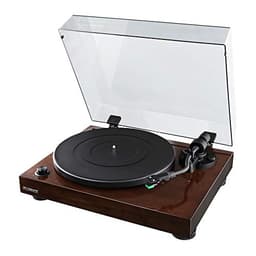
Fluance RT81
First serious turntable that you won't outgrow in a year
Price as of September 26, 2026. #ad How we’re funded
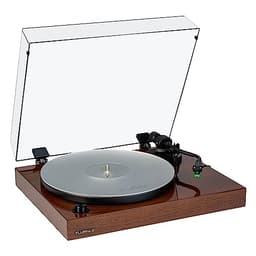
Fluance RT81+
Buying the RT81's obvious cartridge upgrade pre-fitted instead of adding it later
Price as of September 26, 2026. #ad How we’re funded
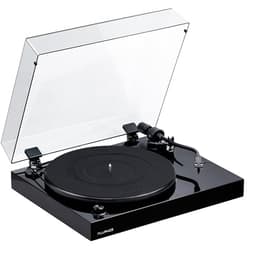
Fluance RT82
A step-up deck when you already have a phono preamp
Price as of September 26, 2026. #ad How we’re funded
What each deck asks you to buy next
The honest total cost of each side of this comparison. The RT81 ships a cartridge its maker has discontinued, so a current cartridge is its first upgrade. The RT82 ships no phono stage at all, so it is not a working system until one arrives.
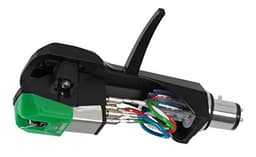
Audio-Technica AT-VM95E/H Headshell + Cartridge Kit
Upgrading the cartridge on a removable-headshell deck without doing the mounting yourself
Price as of September 26, 2026. #ad How we’re funded
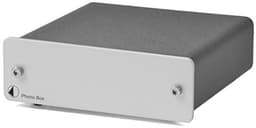
Pro-Ject Phono Box
A refined MM/MC upgrade for a separates system
Frequently asked questions
What is the difference between the Fluance RT81 and RT82?
Three things, and everything else on the two spec tables is the same. First, the motor: the RT82 adds a servo controller that Fluance says analyzes platter speed 500 times a second, sitting on 7-point silicone isolation rather than three-point rubber, and the two figures under it move accordingly - wow and flutter from 0.2% to 0.07%, speed variation from plus or minus 1.00% to 0.13%. Second, the cartridge: an Audio-Technica AT95E at 2.0 g gives way to an Ortofon OM 10 at 1.5 g, and the arm's published support window widens from 3.5-6.5 g to 5.0-7.5 g. Third, and this one runs the other way: the RT81's switchable built-in phono preamp is gone, so the RT82 needs a phono stage somewhere else in the system. Same plinth, same 553 g aluminum platter, same 224 mm S-type arm, same rubber mat, same tinted cover, same two speeds.
Is the Fluance RT82 worth the extra money over the RT81?
It is if you already own a phono stage, or your speakers or amplifier have one. Then the step up is pure mechanical gain - a third of the published wow and flutter, roughly an eighth of the published speed variation and a current-production Ortofon cartridge - for a modest difference in sticker price. It is not worth it if you would have to buy a phono preamp to make the deck work at all: a competent standalone stage costs a serious fraction of the deck, which pushes the real spend well past the RT81 and past the RT81+ too. That single question decides this comparison more often than any figure on the table.
Does the Fluance RT82 have a built-in preamp?
No. Fluance's own table says "Separate Phono Preamp Required", lists the line output as not applicable and the phono bypass as not applicable, and gives the phono output as 4.0 mV. You need an amplifier or receiver with a PHONO input, powered speakers with a phono stage built in, or a standalone phono preamp. The RT81 does have one - switchable between PHONO and LINE, with a 140 mV line output and a full bypass that takes all the electronics out of the path when you add a better stage later.
Which Fluance turntable has the better cartridge, the RT81 or the RT82?
The RT82's is the one still in production. Audio-Technica's own site badges both the AT95E cartridge the RT81 ships with and the ATN95E replacement stylus Fluance names for it as discontinued, and shows the stylus as unavailable. Ortofon still lists and prices the Stylus 10 for the OM 10. On published figures the OM 10 also tracks lighter (1.5 g against 2.0 g), puts out slightly more (4.0 mV against 3.5 mV) and claims 22 dB of channel separation against 20 dB. None of that makes the RT81's cartridge bad today - it makes it a cartridge you should plan to replace rather than re-tip.
Can I fit an Ortofon 2M Red to a Fluance RT81?
Check the weight before you buy. Ortofon publishes the 2M Red at 7.2 g, and Fluance publishes the RT81 arm's supported cartridge weight as 3.5 to 6.5 g - so a 2M Red is above the RT81's published window. The RT82's window is 5.0 to 7.5 g, which admits it, and Fluance's own next rung up, the RT83, is the same arm with a 2M Red fitted from the factory. Both decks use the same H-4 bayonet headshell and the same half-inch mount, so the cartridge physically attaches either way; what differs is whether the maker says the arm supports that mass. If you want a 2M-series cartridge, the honest reading of Fluance's own figures is to start at the RT82.
What is the Fluance RT81+ and how does it fit into this?
It is the RT81 with the current Audio-Technica AT-VM95E cartridge instead of the discontinued AT95E, an acrylic mat on a damped platter instead of the rubber one, and three adjustable feet - and Fluance's own comparison chart prices it exactly level with the RT82. Mechanically it is an RT81: same DC motor, same three-point rubber isolation, same 0.2% wow and flutter, same plus or minus 1.00% speed variation, same 28.2 g arm. So at that price you are choosing between a better motor with no preamp (RT82) and a current cartridge with the preamp kept (RT81+). Neither is the upgrade the other is.
How much does 1% speed variation actually matter?
As arithmetic, a 1% speed error is about 17 cents of pitch, or roughly a sixth of a semitone; the RT82's published 0.13% works out near 2 cents. Speed variation is a steady offset - everything plays slightly sharp or flat - while wow and flutter is the wobble around it, which is the one people describe as a warble on sustained piano or strings. We have not measured either deck and make no claim about what you would hear in your room. What we will say is that both of Fluance's published figures move in the same direction on the RT82, which is what you would expect from adding a servo controller, and that the platter, belt and arm are identical, so the motor is the only plausible cause.
Do the RT81 and RT82 play 78s, or have Bluetooth or USB?
Neither, on all three counts. Both are 33 1/3 and 45 RPM only - Fluance's tables print "78 RPM - No" on each - and neither has wireless or a digital output; Fluance's own note is that wireless playback requires a separate transmitter on the RCA output. Both are also manual decks with a defeatable auto-stop rather than auto-return: the arm stops the platter at the end of a side but does not lift or return itself. If you want Bluetooth, USB recording or 78 RPM, those are different decks on different pages of this site.
Sources
- Fluance — RT81 Elite turntable, published specifications — Manufacturer specification table, read live: belt drive, DC motor on three-point rubber isolation, 33 1/3 and 45 RPM (78 RPM "No"), speed variation +/- 1.00%, wow and flutter 0.2%, signal-to-noise "67 dB or higher (A-weighted, 20 kHz LPF)" and "60 dB or higher (unweighted, 20 kHz LPF)", aluminum platter 12 in / 1.22 lb (553 g) / 0.62 in (16 mm) with a rubber mat, static-balanced S-type aluminum tonearm 8.82 in (224 mm) effective length and 0.99 oz (28.2 g) effective mass, adjustable 100 g counterweight, anti-skating, cueing lever, pivot bearing, H-4 bayonet headshell 0.38 oz (10.7 g), "Audio Technica: AT95E" dual moving magnet cartridge with a 0.4 x 0.7 mil bonded elliptical diamond on an aluminum cantilever at 2.0 g tracking force, 20-20,000 Hz, 20 dB channel separation at 1 kHz, 3.5 mV phono output and 140 mV (-17 dBV) line output, switchable PHONO/LINE preamp with full bypass and a ground terminal, MDF plinth in real wood veneer, tinted dust cover, defeatable auto-stop, suspension isolation feet, 14.1 lb (6.4 kg), 1.5 W. Listed at 299.99 USD on the access date with no discontinuation notice (accessed September 26, 2026)
- Fluance — RT82 Reference turntable, published specifications — Manufacturer specification table: belt drive, servo-controlled DC motor, 0.07% wow and flutter, 68.5 dB weighted S/N, aluminum platter 553 g / 16 mm, static balanced S-type aluminum arm 224 mm / 21.78 g, H-4 bayonet headshell, Ortofon OM 10, no built-in preamp, 6.8 kg (accessed September 3, 2026)
- Fluance — RT81+ Elite turntable, published specifications — The third deck at the RT82's price, and the reason this comparison is not a two-way. Fluance's own comparison chart presents it as a separate current model rather than a replacement for the RT81, priced at 349.99 USD — the same sticker as the RT82 — and changes exactly three things against the RT81: the cartridge becomes the current Audio-Technica AT-VM95E (0.3 x 0.7 mil bonded elliptical, 4.0 mV, 20-22,000 Hz), the platter becomes damped aluminum 1.25 lb (566 g) under an ACRYLIC mat instead of rubber, and the feet become three adjustable rubber isolators. Everything else is the RT81's published table verbatim: same DC motor and three-point rubber isolation, same 0.2% wow and flutter, same +/- 1.00% speed variation, same 67 dB A-weighted signal-to-noise, same 28.2 g effective-mass S-type arm, same H-4 bayonet headshell, same switchable Texas Instruments PHONO/LINE preamp with 140 mV line output and full bypass, same MDF plinth, same 14.1 lb. A bubble level is added to the box (accessed September 26, 2026)
- Fluance — Reference series setup and FAQ (RT82/83/84/85) — Manufacturer setup documentation: counterweight, tracking force and cartridge compatibility for the Reference arms (accessed August 19, 2026)
- Audio-Technica — AT95E dual magnet cartridge (DISCONTINUED) — The cartridge the RT81 ships with, on its own maker's site, badged "Discontinued" above the product name and listed at 49.00 USD with no specification table rendered. The page's own description is the marketing copy Fluance's listing echoes: "The half-inch standard mount AT95E phonograph cartridge offers outstanding clarity and detail" with an "elliptical diamond stylus". Cited for the discontinuation itself, which is a fact about buying the RT81 in 2026 rather than a spec: the VM95 series is Audio-Technica's current half-inch line and the AT95E is not in it (accessed September 26, 2026)
- Audio-Technica — ATN95E replacement stylus (DISCONTINUED) — The other half of the discontinuation, and the one that actually costs an owner money: the only replacement stylus Audio-Technica lists for the AT95E body is badged "Discontinued", priced 52.00 USD and reads "We're sorry, but this item is unavailable." Its description is "0.3 x 0.7 elliptical replacement stylus for these cartridges: AT95E" — which also puts Audio-Technica's own tip figure for this cartridge (0.3 x 0.7 mil) at odds with the 0.4 x 0.7 mil Fluance publishes for the same cartridge. Both figures are reported on the page; neither is picked (accessed September 26, 2026)
- Audio-Technica — AT-VM95E cartridge — Manufacturer specs: 0.3 x 0.7 mil elliptical stylus on an aluminum cantilever, 4.0 mV output at 1 kHz / 5 cm/sec, 1.8-2.2 g tracking force (2.0 g standard), 20-22,000 Hz, 20 dB channel separation at 1 kHz, half-inch mount, AT-VMN95E replacement stylus, and the maker's own statement that "all VM95 Series share the same body" so the stylus "can be replaced with any of the six interchangeable AT-VMN95 replacement styli". Re-read on the access date below, which corrected a tracking-force range previously noted here as 1.8-2.3 g (accessed September 26, 2026)
- Ortofon — OM Series — Manufacturer specs for the OM 10: 4 mV output, 1,25-1,75 g tracking force (1,5 g recommended), elliptical stylus r/R 8/18, 20-22.000 Hz — and the stated upgrade path, "upgrade the performance of an entire music system very easily by upgrading the stylus" (accessed September 1, 2026)
- Ortofon — Stylus 10 replacement stylus — The RT82's wear part, with Ortofon's own fitment list: "Recommended for the following cartridges: Super OM 10, OM 10, OMP(p-mount) 10, OMB(Bulk) 10, OMT 10, LM 10, Concorde 10, Concorde EC 10, Concorde STD, TM 10H, LMB 12, SMB 12, and LMA 12." Published specs: elliptical, stylus tip radius r/R 8/18 um, tracking force range 1.25-1.75 g with 1.5 g (15 mN) recommended, dynamic lateral compliance 20 um/mN, tracking ability 60 um at 315 Hz, 20-20,000 Hz. Listed at 69,00 EUR and showing "Unavailable" in Ortofon's own European store on the access date — the part exists and has a price, but Ortofon is not the channel to buy it from (accessed September 26, 2026)
- Ortofon — Stylus 20 replacement stylus — Cited for what it does NOT say. The nude elliptical one rung above the RT82's stylus is 199,00 EUR and published at r/R 8/18 um, 25 um/mN dynamic lateral compliance, 70 um tracking ability at 315 Hz and the same 1.25-1.75 g range — but its fitment list reads "Recommended for the following cartridges: Super OM 20, OM 20, OMP 20, OMB 20, LM 20, Concorde 20, LM 20H, TM 20U, and TM 20H", with no OM 10 on it. Ortofon markets the OM range as stylus-upgradeable in general terms on its OM Series page, but it does not itself publish a Stylus 20-on-an-OM-10 recommendation, and this page says so rather than repeating the upgrade folklore (accessed September 26, 2026)
- Ortofon — 2M Red — Manufacturer specs: 5.5 mV output, 1.6-2.0 g tracking (1.8 g recommended), 47 kOhm load (accessed July 24, 2026)
Keep reading
Fluance RT81 Review
The full case for the cheaper deck, and the cartridge upgrade its arm will and will not take.
Read the reviewFluance RT82 Review
Why leaving the phono stage out is a decision rather than a cost cut.
Read the reviewFluance RT82 vs RT85
The next rung of the same ladder, with the acrylic platter and the 2M Blue priced separately.
Compare themBest Phono Preamps Under $200
The purchase the RT82 assumes you will make, ranked on gain and loading.
See the picks