Fluance RT82 vs RT85
Two decks off one chassis. The RT85 changes the platter and the cartridge and leaves everything else alone — so this is a rare case where you can price each upgrade separately.
How this is funded: we earn a commission if you buy through our links, at no extra cost to you. It never changes which product we recommend, and we’ll tell you plainly when to skip one. Full disclosure.
Fluance’s Reference range is unusually easy to reason about, because the decks share a chassis. The RT82 and the RT85 use the same belt drive, the same servo-controlled DC motor, the same 224 mm S-type aluminum tonearm, the same H-4 bayonet headshell, the same MDF plinth with real wood veneer, the same three-point adjustable isolation feet and the same footprint. Fluance publishes the same 0.07% wow and flutter for both.
The RT85 changes exactly two things: the platter goes from aluminum to acrylic, and the cartridge goes from an Ortofon OM 10 to an Ortofon 2M Blue. That is the entire upgrade, which is rare and useful, because it means you can price each half of it against what those parts cost on their own.
The question that decides it: would you have bought a 2M Blue anyway?
The short answer
- Buy the RT85if a cartridge in the 2M Blue’s class was always the plan. Fitted from the factory it costs less than buying the RT82 and adding one, and the acrylic platter comes free in that arithmetic.
- Buy the RT82if the rest of your system is not finished. The same arm and motor for less money, with the difference going to the phono stage neither deck includes — or to speakers, which change what you hear more than either cartridge does.
Upgrade one: the platter
The RT82’s platter is aluminum, 12 inches, 553 g, 16 mm. The RT85’s is acrylic, 12 inches, 1.56 kg, 16 mm. Same diameter, same thickness, nearly three times the mass.
Two separate things follow from that, and they are worth separating because marketing copy usually blurs them.
Mass buys speed stability. A heavier platter stores more rotational inertia, so a momentary change in motor torque or in drag from the stylus is absorbed by the flywheel instead of turning into audible speed variation. Note what Fluance publishes, though: 0.07% wow and flutter for both decks. The servo motor was already doing that job well enough that the heavier platter did not move the number. Believe the specification over the story.
Material buys damping.This is the better argument. Acrylic has a resonant character close to vinyl’s, so the record couples to the platter and the energy the stylus dumps into it is absorbed rather than reflected back up into the groove a moment later. Aluminum is stiffer and brighter and rings more readily, which is why aluminum-platter decks generally ship a felt or rubber mat and acrylic-platter decks generally do not. Our mat guidecovers the same trade-off from the other end — and explains why putting a felt mat on the RT85 would undo most of what you paid for.
Upgrade two: the cartridge
This is where most of the money goes, and it is the half that is easiest to value, because both cartridges are sold separately and their prices are public.
Ortofon publishes the OM 10 with an elliptical stylus at r/R 8/18 um, 4 mV output, a 1.25–1.75 gtracking range with 1.5 g recommended, and a 20–22,000 Hz response. The 2M Blue gets a nude elliptical at the same r/R 8/18 um, 5.5 mVoutput, 1.8 g recommended, 20–20,000 Hz to a stated +2 / −1 dB, and 25 dB of channel separation at 1 kHz.
Read those two lines carefully and the tip geometry is the same. What changes is how the diamond is mounted. On the OM 10 it is bonded— a small diamond fixed to a metal shank. On the 2M Blue it is nude— the diamond is the whole tip, mounted straight to the cantilever. Nude tips carry less mass at the point that has to reverse direction thousands of times a second, and lower moving mass is the actual mechanism behind the cleaner high frequencies and better separation people hear when they move up the range. It is not a marketing distinction; it is the distinction.
Both cartridges also have upgrade ladders of their own. The OM body takes the rest of the OM stylus range as a swap; the 2M body takes the 2M range. Neither locks you in, and replacement styli and what fits what covers the whole ladder.
The effective-mass row, and why it moved
Fluance quotes 21.78 g effective mass for the RT82 and 27.5 g for the RT85, on what is otherwise the same 224 mm arm. Effective mass includes everything hanging on the end of the arm, so the figure tracks the fitted cartridge and headshell rather than a different tube.
The practical consequence is the arm/cartridge resonance, which you want to land in roughly the 8–12 Hz window — above the warp and footfall frequencies below it, below the lowest musical content above it. Both of these combinations are factory pairings from a maker fitting its own cartridges to its own arm, and both sit in the medium-mass range that moving-magnet cartridges of this compliance are designed for. This is a row worth understanding if you plan to fit something exotic later; it is not a reason to choose between the two decks as sold.
What neither deck does
Neither has a phono preamp. Fluance’s tables say so in the same words for both: “No — separate phono preamp required.” Neither has Bluetooth or USB. Neither is automatic — you cue the arm and you lift it at the end of a side, and nothing stops the platter for you. Neither includes speakers.
The preamp is the one that changes the maths. If you do not already own a phono stage, the true cost of either deck is its price plus a phono preamp, and on a first system that box does more for what you hear than the step from an OM 10 to a 2M Blue does. If you are not sure whether you have one, this is the page to read first.
The value calculation
Price the upgrade the way Fluance built it — as two parts.
The 2M Blue sells on its own for a large share of the gap between these two decks. Whatever is left over is what you are paying for the acrylic platter. Put that way, the RT85 is straightforwardly good value if you wanted the cartridge. Buying the RT82 and fitting a 2M Blue afterwards costs more in total and leaves you with the aluminum platter and a spare OM 10.
The argument runs the other way only when the money has a better job elsewhere. A phono stage you actually chose, a pair of speakers a class up, or a record cleaning kit for a second-hand collection will each do more for a system than this cartridge step will. The RT82 exists to make that trade available, and taking it is not settling.
The decision, in one paragraph
These are the same turntable with two parts changed, so the question is not which deck is better — it is whether you want those two parts now or later. Buy the RT85 if a 2M Blue-class cartridge was always the destination, because fitted at the factory it is the cheapest route to one and the acrylic platter rides along. Buy the RT82 if there is still a weak link downstream, because the arm, the motor, the chassis and the published wow and flutter are identical, and the difference will do more good in the phono stage or the speakers than it will at the stylus.
The spec matrix
Ten of the nineteen rows are identical. The two that carry the whole price difference are the platter and the cartridge.
| Specification | RT82Fluance | RT85Fluance |
|---|---|---|
| Drivesame | Belt drive | Belt drive |
| Motorsame | DC motor, servo controller reading speed 500 times/sec | DC motor, servo controller reading speed 500 times/sec |
| Speedssame | 33 1/3 and 45 RPM | 33 1/3 and 45 RPM |
| Wow and fluttersame | 0.07% | 0.07% |
| Signal to noise | 68.5 dB (weighted) | 69 dB (weighted) |
| Platter | Aluminum, 12 in, 553 g, 16 mm | Acrylic, 12 in, 1.56 kg, 16 mm |
| Tonearmsame | Static balanced S-type aluminum, 224 mm | Static balanced S-type aluminum, 224 mm |
| Tonearm effective mass | 21.78 g | 27.5 g |
| Headshellsame | H-4 bayonet, removable | H-4 bayonet, 9 g, removable |
| Cartridge | Ortofon OM 10 | Ortofon 2M Blue |
| Stylus | Elliptical, r/R 8/18 um (0.3 x 0.7 mil) | Nude elliptical, r/R 8/18 um (0.3 x 0.7 mil) |
| Cartridge output | 4 mV | 5.5 mV |
| Tracking force | 1.25-1.75 g (1.5 g recommended) | 1.6-2.0 g (1.8 g recommended) |
| Frequency response | 20-22,000 Hz | 20-20,000 Hz, +2 / -1 dB |
| Built-in preampsame | No — external stage required | No — external stage required |
| Plinthsame | MDF with real wood veneer | MDF with real wood veneer |
| Isolation feetsame | 3-point, height-adjustable rubber | 3-point, height-adjustable rubber |
| Dimensions (H x W x D)same | 6 (+/-0.5) x 16.5 x 14.25 in | 6 (+/-0.5) x 16.5 x 14.25 in |
| Weight | 14.99 lb (6.8 kg) | 16.76 lb (7.6 kg) |
Turntable figures are Fluance’s own published specification tables for the RT82 and RT85; cartridge figures are Ortofon’s own pages for the OM series and the 2M Blue. All read 2026-09-03 — see Sources below. “Not published” means the figure is not stated in the sources cited below — it is never a value we estimated. Rows marked same are the ones where these decks do not differ.
Both decks, with live prices
Fluance discounts these two independently, so check both before deciding — the gap between them moves more than the hardware does.
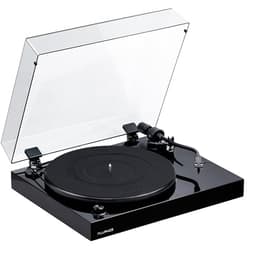
Fluance RT82
A step-up deck when you already have a phono preamp
Price as of October 22, 2026. #ad How we’re funded
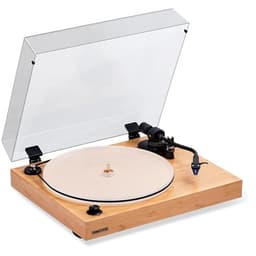
Fluance RT85
The most cartridge and platter per dollar under $600
Price as of October 22, 2026. #ad How we’re funded
Frequently asked questions
What is the difference between the Fluance RT82 and RT85?
Two things: the platter and the cartridge. The RT82 has a 553 g aluminum platter and an Ortofon OM 10; the RT85 has a 1.56 kg acrylic platter and an Ortofon 2M Blue. The drive, the servo-controlled motor, the 224 mm S-type tonearm, the H-4 headshell, the MDF plinth, the isolation feet, the dimensions and the published 0.07% wow and flutter are the same on both. Fluance quotes a half-decibel better signal-to-noise for the RT85, which follows from the cartridge's higher output.
Is the RT85 worth the extra money over the RT82?
Usually yes, but for a specific reason: the 2M Blue on its own costs a substantial fraction of the price gap, and the acrylic platter is thrown in on top. If you were going to upgrade the RT82's cartridge to something in the 2M Blue's class anyway, buying the RT85 is cheaper than buying the RT82 and then the cartridge. If you are happy with the OM 10 and want to spend the difference on a phono preamp or speakers, the RT82 is the better system decision.
Does the acrylic platter actually sound different from the aluminum one?
It is the more defensible half of the upgrade, for two mechanical reasons rather than one. It is nearly three times the mass — 1.56 kg against 553 g — which stores more rotational inertia and smooths short-term speed variation. And acrylic's resonant behaviour is close to vinyl's, so the record couples to it and stylus energy is absorbed rather than reflected back into the groove. Neither effect is dramatic; both are real, and neither shows up in Fluance's wow and flutter figure, which is 0.07% for both decks.
Do the RT82 and RT85 need a phono preamp?
Both do. Fluance's specification tables say 'No - Separate Phono Preamp Required' for each. Neither deck has a phono stage inside, so you need an amplifier with a phono input, powered speakers with one built in, or a separate box. Factor that into the comparison with any deck that includes one.
Can I upgrade the RT82's cartridge to a 2M Blue later?
Yes, and it is straightforward — the H-4 bayonet headshell means fitting a different cartridge is a pre-aligned assembly swap rather than a full alignment job. The catch is arithmetic: buying the RT82 and then a 2M Blue usually costs more than buying the RT85, which also throws in the acrylic platter. Upgrade later if you want to spread the cost, not to save money.
Is the Ortofon OM 10 a good cartridge?
It is genuinely good for what it costs. Ortofon publishes an elliptical stylus at r/R 8/18 um — the same tip geometry the 2M Blue quotes — with 4 mV output and a 1.25-1.75 g tracking range. The difference is that the 2M Blue's diamond is nude, mounted directly to the cantilever, where the OM 10's is bonded to a shank. Lower tip mass is the mechanism behind the extra detail, not a bigger number somewhere.
Which is better for a first serious turntable?
The RT82, in most cases. Both are fully manual decks that need a phono stage and ten minutes of setup, so neither is a beginner appliance — but the RT82 gets you the same arm, motor and chassis for less, and leaves budget for the preamp and speakers that a first system usually needs more than it needs a better cartridge.
Sources
- Fluance — RT82 Reference turntable, published specifications — Manufacturer specification table: belt drive, servo-controlled DC motor, 0.07% wow and flutter, 68.5 dB weighted S/N, aluminum platter 553 g / 16 mm, static balanced S-type aluminum arm 224 mm / 21.78 g, H-4 bayonet headshell, Ortofon OM 10, no built-in preamp, 6.8 kg. Re-checked live on 2026-10-05 for the 2M Blue review, which quotes one further row from the same table verbatim: "Supported Cartridge Weight: 0.18 - 0.25 oz (5.0 - 7.5 g)", the range that DOES accommodate a 7.2 g Ortofon 2M Blue where the RT81's does not. Still listed at 349.99 USD (accessed September 3, 2026)
- Fluance — RT85 Reference turntable, published specifications — Manufacturer specification table: 0.07% wow and flutter, 69 dB weighted S/N, acrylic platter 1.56 kg / 16 mm, static balanced S-type aluminum arm 224 mm / 27.5 g, H-4 bayonet headshell, Ortofon 2M Blue 0.3 x 0.7 mil nude elliptical, no built-in preamp, 7.6 kg (accessed September 3, 2026)
- Ortofon — OM Series — Manufacturer specs for the OM 10: 4 mV output, 1,25-1,75 g tracking force (1,5 g recommended), elliptical stylus r/R 8/18, 20-22.000 Hz — and the stated upgrade path, "upgrade the performance of an entire music system very easily by upgrading the stylus" (accessed September 1, 2026)
- Ortofon — 2M Blue — Manufacturer page for the nude elliptical 2M Blue and its stylus interchangeability (accessed August 11, 2026)
- Fluance — Reference series setup and FAQ (RT82/83/84/85) — Manufacturer setup documentation: counterweight, tracking force and cartridge compatibility for the Reference arms (accessed August 19, 2026)
- Crutchfield — How to choose a phono preamp — On why a phono signal needs a preamp and never running two at once (accessed July 24, 2026)
Keep reading
Fluance RT82 Review
The full case for the cheaper deck, and what leaving the preamp out is really for.
Read the reviewFluance RT85 Review
The acrylic platter and the 2M Blue, examined on their own terms.
Read the reviewAT-LP120XUSB vs Fluance RT82
The other side of the RT82 decision — versatility against a pure listening deck.
Compare themBest Phono Preamps Under $200
Neither deck has a phono stage. This is where the difference between them could go instead.
See the picks