AT-LP120XUSB vs Fluance RT82
Two decks at nearly the same price that made opposite decisions about where the money goes. One question sorts them.
How this is funded: we earn a commission if you buy through our links, at no extra cost to you. It never changes which product we recommend, and we’ll tell you plainly when to skip one. Full disclosure.
These two decks cost nearly the same and are built on opposite philosophies. The Audio-Technica spends part of its budget on versatility— USB, three speeds, a pitch fader, a switchable preamp, a removable headshell. The Fluance spends all of its budget on the mechanical chain and gives you nothing else at all.
The question that decides it: will this deck ever do anything other than play an album through a hi-fi?
The short answer
- Buy the AT-LP120XUSB if you will digitize records, play 78s, DJ or scratch even occasionally, want to swap cartridges easily, or want to plug into powered speakers with no extra box.
- Buy the Fluance RT82 if you only ever play albums through a system that already has a phono stage, and you would rather every dollar went into the motor, platter and cartridge.
Where they differ
Drive: direct versus belt
The Audio-Technica is direct drive— the platter sits on a DC servo motor. Speed is instant, does not drift over a side, and there is no belt to stretch or replace. The Fluance is belt drivewith an isolated, speed-controlled motor — the belt absorbs motor vibration before it can reach the stylus, at the cost of a consumable that ages.
At this price both are executed properly, and the choice matters far less than the internet suggests. It matters most for digitizing, where direct drive’s speed stability becomes a permanent property of the file. Full detail in belt drive vs direct drive.
The preamp
The AT-LP120XUSB has a switchable built-in phono preamp. The RT82 has none.
This is the difference with the biggest practical consequence. The Audio-Technica plugs into powered speakers or any aux input on day one. The Fluance needs an amplifier with a phono input, powered speakers with one built in, or a separate phono stage— a real cost to add to its price if you do not already own one.
The counter-argument is genuine: leaving the preamp out shortens the signal path and lets you choose a stage matched to your cartridge, which is why every deck above this price does the same thing.
Speeds and outputs
The Audio-Technica plays 33, 45 and 78 RPMand has a USB output. The Fluance plays 33 and 45 and has RCA only. If you own shellac or intend to archive anything, that is decisive — see the USB turntable roundup.
The headshell
The AT-LP120XUSB has a removable headshell. Changing cartridges becomes a one-minute swap of a pre-aligned assembly rather than an evening with a protractor. The Fluance has a fixed headshell, so every cartridge change is a full alignment job — see how to set up a cartridge.
The cartridge and its ladder
The Audio-Technica ships with the AT-VM95E, whose body accepts the entire VM95 stylus range — conical, elliptical, micro-linear, Shibata, 78 — as snap-on swaps needing no realignment. The Fluance ships with an Ortofon OM, a good cartridge with a shorter upgrade ladder.
Over five years that difference compounds. Every upgrade on the Audio-Technica is a stylus; several upgrades on the Fluance mean a new cartridge and a realignment. See needles and replacement styli.
Where they are the same
Both are fully manualwith adjustable counterweights and anti-skate — both are real hi-fi components rather than appliances. Both need speakers. Both need ten minutes of setup to perform as designed, and both will disappoint if that setup is skipped. Neither has Bluetooth.
The value calculation nobody does
Compare total system cost rather than sticker price. If you own an amplifier with a phono input, the two decks cost the same and the comparison is purely about features versus mechanics. If you do not, the RT82 needs a phono stage — so the Audio-Technica is effectively cheaper by that amount, and it throws in USB and a third speed.
That is why our best-for-the-money page treats a built-in preamp as real value rather than a compromise. It only becomes a compromise once you own something better.
What the published numbers say, and what they leave out
There is an asymmetry in this comparison that is worth naming, because it is the reason four cells in the matrix above are empty.
Fluance publishes a full specification table on its own product page: 0.07% wow and flutter, 68.5 dB weighted signal-to-noise, a 553 g aluminum platter at 16 mm, a 224 mm S-type tonearm with a 21.78 g effective mass, and a 9 g H-4 headshell. You can check every claim it makes.
Audio-Technica publishes comparable figures for the AT-LP120XUSB — in the manual that ships in the box. Its website answers automated requests with a 403, and the live product listing states none of them. So we left those cells blank rather than transcribe a number from a retailer who may have got it wrong.
Do not read the blanks as a verdict on the deck. Read them as a note about shopping: one of these makers put its measurements where a buyer can compare them before purchase, and the other did not. If measured specifications are how you prefer to decide, that alone is a point for the Fluance side of the range — see how the same tables read across the RT82 and the RT85.
The small thing nobody compares: stopping
Fluance’s table lists “Auto-Stop: Yes”for the RT82. The AT-LP120XUSB has nothing of the kind — its listing describes fully manual operation, with a hydraulically damped lift and a lockable rest but no mechanism that acts on its own.
Be precise about what the Fluance feature is. Fluance does not describe the mechanism, so read it as the deck stopping at the end of a side rather than as a full automatic return; the RT82 is still a manual deck with a cueing lever and you still lift the arm yourself. Even so, the practical difference is real. On the Audio-Technica, a record that ends while you are in another room leaves the stylus riding the run-out groove until someone notices, and styli are consumed by hours played whether or not there is music in the groove.
If a deck in your house is going to be left running — a shared living room, a household with children, an evening that ends on the sofa — that is a genuine point for the RT82 that no spec comparison usually surfaces. Our automatic versus manual guide covers the full spectrum, from decks that do nothing to decks that do everything.
The verdict
For most people asking this question, the AT-LP120XUSB is the safer buy. It does everything the Fluance does to a very similar standard, and it also digitizes, plays 78s, swaps cartridges easily and works without buying another box. Versatility is worth something real when you do not yet know how your listening will develop.
The RT82 is the better buy in one specific situation: you have a phono stage, you will never digitize, and you want the purest possible mechanical deck for the money. That is a legitimate and well-defined preference — it is just a narrower one than the marketing for either deck suggests.
The spec matrix
Three cells are blank on the Audio-Technica side. Fluance publishes platter mass, wow and flutter and signal-to-noise on its own product page; Audio-Technica publishes those figures only in the printed manual, and its website refuses automated requests.
| Specification | AT-LP120XUSBAudio-Technica | RT82Fluance |
|---|---|---|
| Drive | Direct drive, DC servo motor | Belt drive |
| Motor | DC servo, quartz speed lock | DC motor, servo controller reading speed 500 times/sec |
| Operationsame | Fully manual | Fully manual |
| Speeds | 33 1/3, 45 and 78 RPM | 33 1/3 and 45 RPM |
| Pitch control | Variable pitch, quartz speed lock | Not fitted |
| Cartridge | Audio-Technica AT-VM95E | Ortofon OM 10 |
| Stylus | Elliptical | Elliptical, r/R 8/18 um |
| Cartridge outputsame | 4.0 mV | 4 mV |
| Tracking force | 1.8-2.3 g | 1.25-1.75 g (1.5 g recommended) |
| Headshell | Removable half-inch headshell | H-4 bayonet, 9 g, removable |
| Anti-skatesame | Yes — adjustable dynamic | Yes — adjustable |
| Auto-stop | No — fully manual | Yes |
| Platter | Not published | Aluminum, 12 in, 553 g, 16 mm |
| Wow and flutter | Not published | 0.07% |
| Signal to noise | Not published | 68.5 dB (weighted) |
| Built-in preamp | Yes — switchable | No — external stage required |
| USB output | Yes | No |
| Dimensions (H x W x D) | 5.57 x 17.8 x 13.86 in (listing) | 6 (+/-0.5) x 16.5 x 14.25 in |
| Weight | 20.15 lb (listing) | 14.99 lb (6.8 kg) |
RT82 figures are Fluance’s own published specification table. AT-LP120XUSB figures are read from the live Amazon listing (2026-09-03) and from Audio-Technica’s own accessible pages for the VM95E and headshell fitment. See Sources below. “Not published” means the figure is not stated in the sources cited below — it is never a value we estimated. Rows marked same are the ones where these decks do not differ.
Both decks, with live prices
These two land within a few dollars of each other most of the time. Neither is the better deck in the abstract — they spent the same budget on different things.
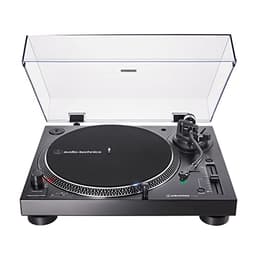
Audio-Technica AT-LP120XUSB
Digitizing records and learning proper setup
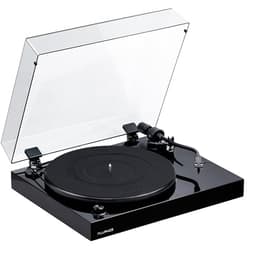
Fluance RT82
A step-up deck when you already have a phono preamp
Price as of October 15, 2026. #ad How we’re funded
Frequently asked questions
Is the AT-LP120XUSB or the Fluance RT82 better?
Neither is better in the abstract. The AT-LP120XUSB is more versatile — direct drive, three speeds, USB output, removable headshell, built-in preamp. The RT82 spends the same money on the mechanical parts and omits the electronics entirely. Versatility versus purity.
Which one is better for just listening to albums?
The Fluance RT82, marginally, because none of its budget went into a USB converter, pitch fader or third speed. But the gap is small, and the AT-LP120XUSB's adjustable arm and elliptical cartridge make it a perfectly good listening deck.
Do both of these need a phono preamp?
The RT82 does — it has no built-in stage at all. The AT-LP120XUSB has a switchable one, so it plugs into powered speakers or a line input as it comes. That difference can be worth $50-100 in extra purchases, so factor it into the price comparison.
Which one is better for digitizing records?
The AT-LP120XUSB, decisively. It has a USB output that records straight to a computer, three speeds including 78 RPM, and direct-drive speed stability that keeps a twenty-minute side from drifting. The RT82 has no digital output of any kind.
Is direct drive worse for sound quality than belt drive?
Not at this level. The historical concern was motor vibration reaching the platter without a belt to absorb it, and modern designs largely engineer that away. Setup and cartridge affect what you hear far more than the drive type does.
Which has the better cartridge?
They are comparable in quality but differ in upgrade path. The AT-LP120XUSB's AT-VM95E body takes the whole VM95 stylus range — conical to Shibata — as snap-on swaps. The RT82's Ortofon OM has a shorter ladder. Long-term, the Audio-Technica path is cheaper.
What are the published wow and flutter and signal-to-noise figures for these two?
Fluance publishes 0.07% wow and flutter and 68.5 dB weighted signal-to-noise for the RT82, on its own product page, alongside the platter's material and mass. Audio-Technica publishes comparable figures for the AT-LP120XUSB in the manual that ships in the box, but not on any page we can read — its website returns a 403 to automated requests and the live listing states none of them. We have left those cells blank in the matrix above rather than copy numbers from a third party.
Does either deck stop at the end of a side?
Fluance's specification table lists 'Auto-Stop: Yes' for the RT82, so the deck stops itself when a side ends. Fluance does not describe the mechanism, so read that as stopping rather than as a full automatic arm return — the RT82 is a manual deck with a cueing lever, and you still lift the arm. The AT-LP120XUSB is fully manual with no auto-stop at all: the stylus sits in the run-out groove until someone moves it.
Which one is physically bigger?
The Audio-Technica, by a clear margin. Its listing gives 17.8 inches wide by 13.86 deep by 5.57 high and 20.15 lb. Fluance publishes 16.5 by 14.25 by 6 inches (plus or minus half an inch) and 14.99 lb for the RT82. That is more than an inch of extra width and over five pounds. Measure the shelf, and leave clearance above it for the dust cover to hinge open.
Sources
- Crutchfield — How to choose the right turntable — Buying-guide reference on drive type, cartridges, preamps and setup (accessed July 24, 2026)
- Audio-Technica — AT-VM95E cartridge — Manufacturer specs: 0.3 x 0.7 mil elliptical stylus on an aluminum cantilever, 4.0 mV output at 1 kHz / 5 cm/sec, 1.8-2.2 g tracking force (2.0 g standard), 20-22,000 Hz, 20 dB channel separation at 1 kHz, half-inch mount, AT-VMN95E replacement stylus, and the maker's own statement that "all VM95 Series share the same body" so the stylus "can be replaced with any of the six interchangeable AT-VMN95 replacement styli". Re-read on the access date below, which corrected a tracking-force range previously noted here as 1.8-2.3 g (accessed September 26, 2026)
- Audio-Technica — VM95 Series cartridges — The shared-body VM95 range and its interchangeable stylus upgrade path (accessed July 24, 2026)
- Audio-Technica — Identifying the correct headshell for your turntable — Manufacturer guidance on headshell mounts, fitment and which tonearms accept a removable headshell (accessed August 19, 2026)
- Ortofon — 2M Red — Manufacturer specs: 5.5 mV output, 1.6-2.0 g tracking (1.8 g recommended), 47 kOhm load (accessed July 24, 2026)
- Ortofon — OM Series — Manufacturer specs for the OM 10: 4 mV output, 1,25-1,75 g tracking force (1,5 g recommended), elliptical stylus r/R 8/18, 20-22.000 Hz — and the stated upgrade path, "upgrade the performance of an entire music system very easily by upgrading the stylus" (accessed September 1, 2026)
- Fluance — RT82 Reference turntable, published specifications — Manufacturer specification table: belt drive, servo-controlled DC motor, 0.07% wow and flutter, 68.5 dB weighted S/N, aluminum platter 553 g / 16 mm, static balanced S-type aluminum arm 224 mm / 21.78 g, H-4 bayonet headshell, Ortofon OM 10, no built-in preamp, 6.8 kg. Re-checked live on 2026-10-05 for the 2M Blue review, which quotes one further row from the same table verbatim: "Supported Cartridge Weight: 0.18 - 0.25 oz (5.0 - 7.5 g)", the range that DOES accommodate a 7.2 g Ortofon 2M Blue where the RT81's does not. Still listed at 349.99 USD (accessed September 3, 2026)
- Crutchfield — How to choose a phono preamp — On why a phono signal needs a preamp and never running two at once (accessed July 24, 2026)
Keep reading
Audio-Technica AT-LP120XUSB Review
The full case for the versatile deck, including its real limits.
Read the reviewFluance RT82 Review
The full case for the purist deck, and the preamp it assumes.
Read the reviewBelt Drive vs Direct Drive
The mechanical trade-off underneath this whole comparison.
Read the comparisonBest Turntables Under $500
Everything else competing at this money.
See the picksFluance RT82 vs RT85
If the Fluance is winning here, this is the next question: is the acrylic platter and 2M Blue worth the step up?
Compare themAT-LP120X vs Rega Planar 1
The same Audio-Technica against a deck built so that nothing can be adjusted at all.
Compare them