Fluance vs Rega Planar 1 and Planar 2
One maker publishes a full page of measurements and fits an upmarket cartridge. The other publishes almost nothing and asks you to trust the engineering. Both positions are defensible — and only one of them is checkable.
How this is funded: we earn a commission if you buy through our links, at no extra cost to you. It never changes which product we recommend, and we’ll tell you plainly when to skip one. Full disclosure.
This comparison is unusual because the two makers do not agree on what a turntable specification is for.
Fluance publishes a full table on every product page: platter material, mass and thickness; tonearm effective length and effective mass; headshell weight; wow and flutter; a weighted signal-to-noise figure; the cartridge and its stylus geometry. You can put an RT82 and an RT85 side by side and see exactly what changed.
Rega publishes the components. The Planar 1 page names a hand-assembled RB110 arm, a brass main bearing, a 23 mm phenolic platter, a 24 V low-noise motor and an EBLT Advanced belt — and gives you no wow and flutter figure, no signal-to-noise figure, no platter mass and no tonearm effective mass. The Planar 2 page is the same shape.
The question that decides it: do you want a deck you can measure and adjust, or a deck you cannot get wrong?
The short answer
- Buy a Fluanceif you want the better cartridge for the money, an arm you can set to any cartridge’s spec, a removable headshell, auto-stop, and a maker whose claims you can check. The RT82 if the budget is tight, the RT85 if you want the 2M Blue and the acrylic platter.
- Buy a Rega Planar 1if you want a hi-fi deck with literally nothing to adjust, and you value hand assembly and Rega’s arm design over a spec sheet.
- Buy a Rega Planar 2if you want the Rega approach but intend to fit a better cartridge later — the RB220 is the first arm in the range that lets you set tracking force and bias yourself.
The tonearm is where Rega spends the money
Rega’s reputation rests on its arms, and it is deserved. The RB110 on the Planar 1 and the RB220 on the Planar 2 are hand-assembled, with what Rega describes as patented ultra-low friction bearings on the RB220, housed in a stiffer, lighter bearing housing. Bearing friction is the thing that stops an arm following a warped record faithfully, and it is genuinely hard to get right at this price.
What matters practically, though, is what each arm lets you do.
The Planar 1 manual is explicit on both counts: “Bias is automatically set on the RB110, no setting is required”, and the balance weight is pushed onto the rear of the arm “until it reaches the stop point”. There is no tracking-force dial. That is a design decision, not an omission: it is why Rega can claim set-up in under 30 seconds, and it is why a Planar 1 cannot be set up wrong.
The RB220 manual describes the opposite arrangement: “The RB220 has adjustable bias” with a slider, and tracking force applied “by rotating the balance weight… turning the weight 360 degrees will apply 2 grams”. That single difference is why the Planar 2 is a deck you can grow into and the Planar 1 is not.
Both Fluance decks give you an adjustable counterweight and an adjustable anti-skate control as standard, and a removable H-4 bayonet headshell on top — so a cartridge change is a pre-aligned assembly swap. Rega mounts its cartridges with two screws directly to a fixed headshell, so every change is a full alignment job. Our cartridge setup guide covers what that involves.
The cartridge gap is the widest single difference
Both Planars ship the Rega Carbon: a moving magnet with a conicalstylus, 2.5 mV output, tracking at 2–3 g. Rega sells a Carbon Pro elliptical stylus as an upgrade for the same body.
The RT82 ships the Ortofon OM 10: elliptical, r/R 8/18 um, 4 mV. The RT85 ships the Ortofon 2M Blue: nude elliptical, same tip geometry, 5.5 mV, 25 dB channel separation.
A conical tip is a sphere. It sits higher in the groove and cannot follow the finest modulation cut into the walls, which is most of the high-frequency information. An elliptical tip is narrower across the groove and wider along it, so it sits deeper and traces more. A nude elliptical adds lower moving mass on top of that. This is the largest audible difference on this page, and it is not close — see the stylus and needle guide for the full ladder.
The counter-argument, which Rega owners make and which has merit: the arm and bearing are the parts you cannot upgrade, and the cartridge is the part you can. Buy the better chassis, fit a better cartridge later. That reasoning works perfectly on the Planar 2. On the Planar 1 it runs into the arm, which gives you no way to set the tracking force a new cartridge asks for.
The platters are three different answers
Four decks, three approaches, and they are worth understanding as engineering rather than as a ranking.
- Aluminum (RT82, 553 g). Light and stiff. Cheap to make well, and the servo motor is doing most of the speed-stability work.
- Acrylic (RT85, 1.56 kg).Nearly three times the mass, so far more rotational inertia — and a material whose resonant behaviour is close to vinyl’s, so it damps the record rather than ringing under it.
- Phenolic (Planar 1, 23 mm). A dense resin laminate. Rega describes it as a higher-mass platter with an improved flywheel effect, and does not publish what it weighs.
- Optiwhite float glass (Planar 2, 10 mm).Rega’s long-standing choice: very consistent thickness, high mass at the rim where inertia counts most.
All four are legitimate. Only Fluance tells you what its platters weigh, and only Fluance tells you what the resulting wow and flutter is.
What the empty cells actually mean
Ten cells in the matrix above are blank on the Rega side. It would be unfair to read those as failures — Rega has argued for decades that the standard turntable measurements do not capture what makes a deck sound good, and it sells the design instead. That is a coherent position held by a company with a real engineering record.
It is also, from a buyer’s chair, an unverifiable one. If you want to know whether a deck holds speed, Fluance says 0.07% and Rega says nothing. You can take Rega’s reputation as the substitute for a number — plenty of people reasonably do — but you should know that is the trade you are making.
The reverse point is worth making too. A published figure is not a promise about how something sounds, and a 0.5 dB difference in signal-to-noise between two Fluance decks tells you nothing you would ever hear. Numbers are useful for comparing, not for predicting.
The small conveniences, which only one side has
Fluance publishes auto-stop and a cueing lever on both the RT82 and the RT85. Auto-stop means the deck stops at the end of a side instead of leaving the stylus riding the run-out groove until someone notices — on a fall-asleep evening that is hours of avoidable wear. Rega does not list either feature for the Planar 1 or Planar 2, so the matrix leaves those cells empty rather than guess.
Both Fluance decks also list gold-plated RCA outputs and a tinted dust cover; Rega supplies a dust cover with both Planars, smoked on the walnut-effect finishes and clear on the gloss ones.
Buying them is not the same experience
One practical point that never shows up on a spec sheet. Rega is not sold on Amazon.Live product searches on 2026-09-03 and again on 2026-10-11 returned Rega cartridges, drive belts, platters and power supplies, but no Planar turntable — which matches Rega’s authorized-dealer-only distribution.
That means Rega buying involves finding a dealer, and it means the Rega cards above carry no buy button: we earn nothing from a link to rega.co.uk, so it appears here only as the cited source of Rega’s published figures rather than as somewhere we are sending you to spend money. We would rather say that than quietly steer you toward the decks that pay us. Fluance sells direct and through Amazon, with the live prices in the cards above.
The decision, in one paragraph
If you want the most cartridge and the most adjustability per dollar, and you want to be able to check what you are told, buy Fluance — the RT82 if the phono stage and speakers still need funding, the RT85 if they do not. If you want a deck assembled by hand around an arm that is genuinely the best thing at the price, and you would rather not think about tracking force at all, buy the Planar 1 and put the Carbon Pro stylus on it when the conical wears. If you want Rega’s engineering andthe ability to fit a proper cartridge, the Planar 2 is the real answer — and it is the deck the Planar 1 quietly pushes you toward the moment you want to change anything.
The spec matrix
Ten cells on the Rega side are empty, and two on the Fluance side. Neither is a research gap — each is a figure that maker does not publish, on its own product pages or in the manuals we read.
| Specification | RT82Fluance | RT85Fluance | Planar 1Rega | Planar 2Rega |
|---|---|---|---|---|
| Drivesame | Belt drive | Belt drive | Belt, EBLT Advanced | Belt, EBLT Advanced |
| Motor | DC, servo controller reading speed 500 times/sec | DC, servo controller reading speed 500 times/sec | 24 V low-noise | 24 V low-noise, low-vibration assembly |
| Platter | Aluminum, 12 in, 553 g, 16 mm | Acrylic, 12 in, 1.56 kg, 16 mm | Phenolic, 23 mm | Optiwhite float glass, 10 mm |
| Bearing | Not published | Not published | Brass main bearing | 11 mm self-securing brass |
| Tonearm | Static balanced S-type aluminum, 224 mm | Static balanced S-type aluminum, 224 mm | Hand-assembled RB110 | Hand-assembled RB220 |
| Tonearm effective mass | 21.78 g | 27.5 g | Not published | Not published |
| Tracking force | Counterweight, adjustable | Counterweight, adjustable | Balance weight pushed to a fixed stop | Rotate balance weight — 360 degrees = 2 g |
| Anti-skate / bias | Yes — adjustable | Yes — adjustable | Automatic — no setting required | Adjustable bias slider |
| Headshell | H-4 bayonet, 9 g, removable | H-4 bayonet, 9 g, removable | Fixed — two-screw mount | Fixed — two-screw mount |
| Cartridge | Ortofon OM 10 | Ortofon 2M Blue | Rega Carbon | Rega Carbon |
| Stylus profile | Elliptical | Nude elliptical | Conical | Conical |
| Cartridge output | 4 mV | 5.5 mV | 2.5 mV | 2.5 mV |
| Wow and flutter | 0.07% | 0.07% | Not published | Not published |
| Signal to noise | 68.5 dB | 69 dB | Not published | Not published |
| Built-in preampsame | No | No | No | No |
| Auto-stop | Yes | Yes | Not published | Not published |
| Cueing lever | Yes | Yes | Not published | Not published |
| Dust coversame | Yes — tinted | Yes — tinted | Yes | Yes |
| Weight | 6.8 kg | 7.6 kg | 4.2 kg | 5.5 kg |
| Sold on Amazon | Yes | Yes | No — dealers only | No — dealers only |
Fluance figures are its own published specification tables for the RT82 and RT85. Rega figures are its own Planar 1 and Planar 2 product pages, the Planar 1 user manual and the RB220 tonearm manual. All read 2026-09-03 — see Sources below. “Not published” means the figure is not stated in the sources cited below — it is never a value we estimated. Rows marked same are the ones where these decks do not differ.
All four decks
The two Fluance decks carry live Amazon prices. Rega sells through authorized dealers only and is not listed on Amazon at all, so there is no Rega button here: an untracked link earns us nothing, and Rega's own pages stay cited as the source of its figures instead.
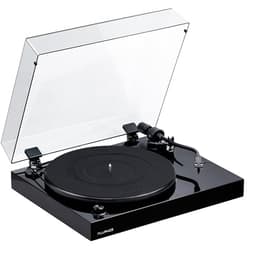
Fluance RT82
A step-up deck when you already have a phono preamp
Price as of October 22, 2026. #ad How we’re funded
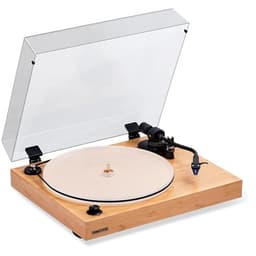
Fluance RT85
The most cartridge and platter per dollar under $600
Price as of October 22, 2026. #ad How we’re funded
 Illustrative photo
Rega Planar 1
Buyers who want a hi-fi deck with literally nothing to set up
Not sold on Amazon. Rega sells it through channels that pay us nothing, so there is no buy link and no price here. The figures on this page come from Rega’s own published specification, cited below.
Illustrative photoRega Planar 2
A Rega you can actually set up to a cartridge's spec
Not sold on Amazon. Rega sells it through channels that pay us nothing, so there is no buy link and no price here. The figures on this page come from Rega’s own published specification, cited below.
Frequently asked questions
Is a Rega Planar 1 better than a Fluance RT82?
They are built on opposite priorities, and the honest answer depends on which you value. The Rega has a hand-assembled RB110 arm, a brass main bearing and a 23 mm phenolic platter, and is designed so there is nothing to set up. The Fluance has an adjustable counterweight and anti-skate, a removable H-4 headshell, an elliptical Ortofon cartridge against Rega's conical Carbon, auto-stop, and a maker who publishes wow and flutter and signal-to-noise figures. Rega publishes neither.
Why does Rega not publish wow and flutter or signal-to-noise figures?
Rega's stated position for years has been that the standard measurements do not capture what makes a turntable sound good, so it sells the design decisions instead — the arm, the bearing, the platter, the motor. That is a coherent view held by a serious company. It is also unfalsifiable from a product page, which is worth saying plainly. If you want to compare decks on numbers, Rega has opted out of that comparison.
Which cartridge is better, the Rega Carbon or the Ortofon on the Fluance?
The Ortofons, on published specifications. Rega's Carbon is a conical moving magnet at 2.5 mV output tracking at 2-3 g. The Fluance RT82's Ortofon OM 10 is an elliptical at 4 mV; the RT85's 2M Blue is a nude elliptical at 5.5 mV. A conical tip sits higher in the groove and traces less of the fine modulation an elliptical reaches. Rega sells the Carbon Pro elliptical stylus as an upgrade for the same body.
Can I upgrade the cartridge on a Rega Planar 1?
Physically yes — it is a standard two-screw mount — but the arm works against you. The RB110's bias is automatic with no setting, and the manual instructs you to push the balance weight on until it reaches a stop point rather than dialing in a force. That is fine for the cartridge Rega fitted. It gives you no way to set the tracking force a different cartridge specifies. The Planar 2's RB220 does, which is the strongest argument for the step up.
Do Fluance or Rega turntables have a built-in phono preamp?
None of the four decks on this page does. Fluance states 'No - Separate Phono Preamp Required' on both its tables, and Rega's Planar 1 manual tells you to connect the phono output to an appropriate phono stage. Budget for one with any of them.
Why can't I buy a Rega Planar on Amazon?
Rega distributes through authorized dealers rather than open marketplaces. Live Amazon product searches on 2026-09-03 and again on 2026-10-11 returned Rega cartridges, drive belts, platters and power supplies but no Planar turntable. That is worth knowing before you compare prices: buying a Rega means finding a dealer. It is also why these cards carry no Rega button - a link we earn nothing from is not one we will dress up as a buy link, so Rega's own product page appears only as the cited source of its published figures.
Is the Planar 2 worth the step up from the Planar 1?
If you are buying Rega at all, probably yes, and for one reason more than the glass platter: the RB220 arm has an adjustable bias slider and a tracking force you set by rotating the balance weight — Rega documents 360 degrees as 2 grams. That makes the Planar 2 a deck you can fit a better cartridge to. The Planar 1 is not, in any meaningful sense.
Sources
- Fluance — RT82 Reference turntable, published specifications — Manufacturer specification table: belt drive, servo-controlled DC motor, 0.07% wow and flutter, 68.5 dB weighted S/N, aluminum platter 553 g / 16 mm, static balanced S-type aluminum arm 224 mm / 21.78 g, H-4 bayonet headshell, Ortofon OM 10, no built-in preamp, 6.8 kg. Re-checked live on 2026-10-05 for the 2M Blue review, which quotes one further row from the same table verbatim: "Supported Cartridge Weight: 0.18 - 0.25 oz (5.0 - 7.5 g)", the range that DOES accommodate a 7.2 g Ortofon 2M Blue where the RT81's does not. Still listed at 349.99 USD (accessed September 3, 2026)
- Fluance — RT85 Reference turntable, published specifications — Manufacturer specification table: 0.07% wow and flutter, 69 dB weighted S/N, acrylic platter 1.56 kg / 16 mm, static balanced S-type aluminum arm 224 mm / 27.5 g, H-4 bayonet headshell, Ortofon 2M Blue 0.3 x 0.7 mil nude elliptical, no built-in preamp, 7.6 kg (accessed September 3, 2026)
- Rega — Planar 1 turntable — Manufacturer page: hand-assembled RB110 tonearm, factory-fitted Carbon cartridge, 23 mm phenolic platter, brass main bearing, 24 V low-noise motor, EBLT Advanced belt, 447 x 117 x 360 mm, 4.2 kg, and the claim that "set-up is possible in under 30 seconds" (accessed September 3, 2026)
- Rega — Planar 1 user manual (PDF) — Manufacturer instructions: "Bias is automatically set on the RB110, no setting is required", the balance weight is pushed on "until it reaches the stop point", speed is changed by moving the belt between the pulley steps, and the phono output connects "to an appropriate phono stage" (accessed September 3, 2026)
- Rega — Planar 2 turntable — Manufacturer page: hand-assembled RB220 tonearm, "new float glass 'Optiwhite' 10 mm" platter, 11 mm self-securing brass bearing, 24 V low-noise low-vibration motor assembly, EBLT Advanced belt, high-gloss acrylic or walnut-effect laminated plinth, 447 x 117 x 360 mm, 5.5 kg (accessed September 3, 2026)
- Rega — RB220 tonearm user manual (PDF) — Manufacturer instructions: "The RB220 has adjustable bias", the bias system "will adjust the amount of bias as the tonearm tracks the record", and tracking force is applied "by rotating the balance weight… turning the weight 360 degrees will apply 2 grams" (accessed September 3, 2026)
- Rega — Carbon moving magnet cartridge — Manufacturer specs: moving magnet, conical stylus profile, 2.5 mV output at 1 kHz, 2-3 g tracking force, standard two-screw mount, user-replaceable stylus; supplied as standard on the Planar 1 and Planar 2 (accessed September 3, 2026)
- Ortofon — 2M Blue — Manufacturer page for the nude elliptical 2M Blue and its stylus interchangeability (accessed August 11, 2026)
- Ortofon — OM Series — Manufacturer specs for the OM 10: 4 mV output, 1,25-1,75 g tracking force (1,5 g recommended), elliptical stylus r/R 8/18, 20-22.000 Hz — and the stated upgrade path, "upgrade the performance of an entire music system very easily by upgrading the stylus" (accessed September 1, 2026)
Keep reading
AT-LP120X vs Rega Planar 1
The same argument against a deck that publishes everything and does four extra jobs.
Compare themFluance RT82 vs RT85
Which Fluance, if the Fluance side of this comparison is the one you want.
Compare themBest Turntable Brands
What each maker is actually good at, and where each one cuts corners.
Read the comparisonWhy Are Turntables So Expensive?
Where the money goes in a deck like these, and which parts genuinely cost what they cost.
Read the guide