AT-LP120X vs Rega Planar 1
A deck built to be adjusted, recorded from and plugged into anything, against one built so that nothing can be got wrong. They are not two versions of the same idea.
How this is funded: we earn a commission if you buy through our links, at no extra cost to you. It never changes which product we recommend, and we’ll tell you plainly when to skip one. Full disclosure.
This is the comparison that exposes what “beginner turntable” actually means, because these two decks answer it in opposite directions and both answers are right.
The Rega Planar 1 is built so that nothing can be set incorrectly. Its manual says bias is automatic on the RB110 and no setting is required; the balance weight is pushed on until it reaches a stop point; Rega claims set-up is possible in under 30 seconds. There is no tracking-force dial, no anti-skate control, no pitch fader, no preamp switch. There is a platter, an arm, a cartridge, a power switch and a pair of phono sockets.
The AT-LP120XUSB is built so that everything can be set. An adjustable counterweight, adjustable dynamic anti-skate, variable pitch with quartz speed lock, three speeds, a removable half-inch headshell, a switchable phono preamp and a USB output. Which necessarily means it can also be setbadly.
The question that decides it: do you want to operate this machine, or just use it?
The short answer
- Buy the AT-LP120XUSB if you will balance a tonearm, if you want a cartridge upgrade path that costs a stylus rather than a cartridge, if you might digitize records or play 78s, or if you do not yet own a phono stage.
- Buy the Rega Planar 1 if you want a hand-assembled belt-drive deck, you already have a phono stage and speakers, and the appeal is precisely that there is nothing on it to think about.
The arm is the whole comparison
Everything else on this page follows from one design decision, so it is worth being exact.
The RB110 is a hand-assembled arm with ultra-low friction bearings, and by any account it is very good at the mechanical job an arm has: hold the cartridge steady and get out of the way. Bearing quality is genuinely hard to buy at this price and Rega has spent decades on it.
But Rega deliberately closed the adjustments. Its own manual gives the whole story in two lines: “Bias is automatically set on the RB110, no setting is required”, and push the balance weight on “until it reaches the stop point”. Tracking force and anti-skate are fixed at values chosen for the Carbon cartridge Rega fits.
The AT-LP120XUSB gives you both controls plus a hydraulically damped lift and a lockable rest. Audio-Technica publishes the procedure for balancing this exact arm and setting force, and our guide to balancing a tonearm walks the same steps with the reasons attached.
Here is the honest consequence in both directions. An adjustable arm can carry any cartridge, because you can set the force that cartridge needs — and it can also be left unbalanced by an owner who never read the manual, which sounds worse than the fixed arm and wears records faster. A fixed arm cannot be improved and cannot be ruined. Pick the failure mode you would rather have.
The cartridge, and the ladder behind it
The Rega ships the Carbon: moving magnet, conicalstylus, 2.5 mV output, 2–3 g tracking force. The Audio-Technica ships the AT-VM95E: moving magnet, ellipticalstylus, 4.0 mV, 1.8–2.3 g.
A conical tip is a sphere with a single contact radius. It rides higher in the groove and physically cannot follow the finest modulation cut into the walls, which is where most high-frequency detail lives. An elliptical tip is narrower across the groove and longer along it, so it sits deeper and traces more. This is the most audible single difference between these two decks as sold.
The ladders diverge further. The VM95 body accepts Audio-Technica’s entire VM95 stylus range— conical, elliptical, micro-linear, Shibata, and a 78-specific tip — as snap-on swaps that need no realignment at all. Every future upgrade is a stylus, on the same pre-aligned headshell. Rega sells the Carbon Pro elliptical stylus for the Carbon body, which is a genuine improvement and, on the Planar 1, is essentially where the ladder ends. See replacement styli and what fits what.
Speed: a switch against lifting the platter
The AT-LP120XUSB selects 33 1/3, 45 and 78 RPM from the plinth, with a pitch fader and quartz lock alongside.
On the Planar 1, Rega’s manual tells you to change speed by moving the drive belt between the steps of the pulley. In practice that means lifting the platter off, moving the belt and putting the platter back — every time you play a 45.
If your collection is albums, this is a non-issue you will encounter twice a year. If you own a stack of singles or 12-inch 45 RPM pressings, it is a daily irritation, and it is the sort of thing that never appears in a review because the reviewer had the deck for a fortnight.
The 78 setting on the Audio-Technica carries the usual caveat: shellac 78s have a far wider groove than microgroove LPs and need a 78-specific stylus. The VM95 family sells one; the speed alone is not enough.
What the Audio-Technica does that the Rega will never do
- Digitize records. A class-compliant USB output means a computer sees the deck as an audio input with no drivers to install, and free software such as Audacity records from it. Direct-drive speed stability matters here more than anywhere else, because a drift becomes a permanent property of the file. See how to record vinyl to a computer.
- Work without another box. Its phono preamp is switchable, so it plugs into powered speakers, an aux input or a soundbar on day one — and switches off later when you add a better stage. The Planar 1 has none, and its manual tells you to connect the phono output to an appropriate phono stage. If you do not own one, add the price of a phono preamp to the Rega.
- Take any cartridge. Removable half-inch headshell, adjustable force, adjustable anti-skate.
What the Rega does that the Audio-Technica does not
- It is hand assembled around a serious arm.The RB110’s bearings are the part of a turntable that is hardest to buy cheaply, and Rega’s are the reason these decks have the reputation they do.
- It cannot be set up wrong. No tracking force to get wrong, no anti-skate to mismatch. On a shared system, or one nobody wants to fuss over, that is worth more than a spec sheet suggests.
- It is half the weight and considerably smaller.Rega publishes 447 by 360 by 117 mm and 4.2 kg. The Audio-Technica’s listing gives 17.8 by 13.86 by 5.57 inches and 20.15 lb — more than twice the mass. Measure the shelf.
- No belt-free maintenance advantage, but no fan of complexity either. The Rega’s belt is a consumable that will eventually need replacing; in exchange there is no servo, no USB board and no preamp inside the plinth.
Neither maker publishes what you might expect
One thing these two have in common: neither wow and flutter nor signal-to-noise appears in the sources we can read for either deck. Rega does not publish those figures at all — a long-standing and deliberate position, on the argument that the standard measurements do not capture what makes a deck sound good. Audio-Technica does publish them, in the manual in the box, but its website returns a 403 to automated requests and the live listing does not state them.
So this page does not compare them, and it does not fill those cells with numbers from a third party. If measured specifications are how you want to shop, note that Fluance publishes all of them on its own product pages, which is a genuine point in its favour at this money.
Buying them is not the same experience
The Audio-Technica is on Amazon with a live price in the card above. Rega is not.Live product searches on 2026-09-03 and again on 2026-10-11 returned Rega cartridges, drive belts, platters and power supplies but no Planar turntable, which matches Rega’s authorized-dealer-only distribution. Buying one means going to a dealer, so the Planar card above carries no button at all: a link we earn nothing from is not a link we will present as a buy link, and Rega’s own product page is cited instead as the source of the figures in the table.
The decision, in one paragraph
Buy the AT-LP120XUSB if the deck should grow with you: the elliptical cartridge is better today, the VM95 ladder makes every future upgrade cheap, the preamp means it works on day one, and the USB output and third speed are jobs the Rega cannot be made to do. Buy the Planar 1 if you want a hand-assembled belt-drive deck with a genuinely excellent arm and no controls to think about, you already own a phono stage, and your records are albums rather than singles. The one outcome to avoid is buying the Planar 1 expecting to upgrade it later — the arm gives you no way to set a new cartridge’s tracking force, and that is a ceiling the price does not warn you about.
The spec matrix
Every row is a fork rather than a ranking. The Audio-Technica gives you controls; the Rega removes them on purpose.
| Specification | AT-LP120XUSBAudio-Technica | Planar 1Rega |
|---|---|---|
| Drive | Direct drive, DC servo motor | Belt drive, EBLT Advanced belt |
| Motor | DC servo, quartz speed lock | 24 V low-noise |
| Operationsame | Fully manual | Fully manual |
| Speeds | 33 1/3, 45 and 78 RPM, selectable | Speed changed by moving the belt between pulley steps |
| Pitch control | Variable pitch, quartz speed lock | Not published |
| Tracking force | Adjustable counterweight | Balance weight pushed to a fixed stop |
| Anti-skate / bias | Yes — adjustable dynamic | Automatic — manual states no setting required |
| Headshell | Removable half-inch headshell | Fixed — two-screw mount |
| Cartridge | Audio-Technica AT-VM95E | Rega Carbon |
| Stylus profile | Elliptical | Conical |
| Cartridge output | 4.0 mV | 2.5 mV |
| Tracking force range | 1.8-2.3 g | 2-3 g |
| Platter | Not published | Phenolic, 23 mm |
| Bearing | Not published | Brass main bearing |
| Built-in preamp | Yes — switchable | No — external stage required |
| USB output | Yes | No |
| Dimensions (H x W x D) | 5.57 x 17.8 x 13.86 in (listing) | 117 x 447 x 360 mm, lid closed |
| Weight | 20.15 lb (listing) | 4.2 kg (9.3 lb) |
| Sold on Amazon | Yes | No — authorized dealers only |
AT-LP120XUSB figures are read from the live Amazon listing (2026-09-03) and from Audio-Technica’s own accessible pages for the VM95E and headshell fitment — its product pages answer automated requests with a 403. Rega figures are its own Planar 1 product page and user manual, read the same day. See Sources below. “Not published” means the figure is not stated in the sources cited below — it is never a value we estimated. Rows marked same are the ones where these decks do not differ.
Both decks
The Audio-Technica carries a live Amazon price. Rega is not listed on Amazon at all, so its link goes to Rega's own product page and earns us nothing.
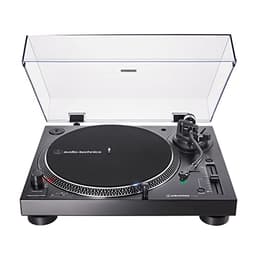
Audio-Technica AT-LP120XUSB
Digitizing records and learning proper setup
 Illustrative photo
Rega Planar 1
Buyers who want a hi-fi deck with literally nothing to set up
Not sold on Amazon. Rega sells it through channels that pay us nothing, so there is no buy link and no price here. The figures on this page come from Rega’s own published specification, cited below.
Frequently asked questions
Is the Rega Planar 1 better than the AT-LP120X?
They are built for different owners. The Planar 1 is a hand-assembled belt-drive deck with an RB110 arm, brass main bearing and 23 mm phenolic platter, designed so there is nothing to set — Rega claims setup in under 30 seconds. The AT-LP120XUSB is a direct-drive deck with an adjustable counterweight, adjustable anti-skate, three speeds, a pitch fader, a removable headshell, a switchable phono preamp and a USB output. If you want a machine to operate, the Audio-Technica. If you want a machine to leave alone, the Rega.
Which one has the better cartridge?
The Audio-Technica, clearly. It ships the AT-VM95E, an elliptical at 4.0 mV. Rega ships the Carbon, a conical at 2.5 mV. A conical stylus is a sphere: it rides higher in the groove and cannot trace the fine modulation an elliptical reaches. Rega sells the Carbon Pro elliptical stylus as an upgrade, which is a real fix — but it is money on top of the deck.
Can I upgrade the cartridge on a Rega Planar 1?
You can bolt a different one on — it is a standard two-screw mount — but the arm limits what that achieves. The Planar 1's manual states that bias is automatic on the RB110 and no setting is required, and that the balance weight is pushed on until it reaches a stop point. There is no tracking-force dial. So you can fit a cartridge that wants a different force and you have no way to give it one. The AT-LP120XUSB's counterweight and anti-skate let you set whatever a new cartridge specifies, on a removable headshell.
How do you change speed on a Rega Planar 1?
By hand. Rega's own manual instructs you to change the speed by moving the drive belt between the steps of the pulley, which means lifting the platter off. The Audio-Technica selects 33 1/3, 45 or 78 RPM with a control on the plinth. If you play a lot of 45 RPM singles or 12-inch pressings, that is a difference you will feel every day.
Does the Rega Planar 1 need a phono preamp?
Yes. Rega's manual instructs you to connect the phono output to an appropriate phono stage, and there is no preamp inside. The AT-LP120XUSB has a switchable one, so it plugs into powered speakers or a line input as it comes. Add the price of a phono stage to the Planar 1 before you compare the two.
Is direct drive worse than belt drive for sound quality?
Not at this level, and the old objection has largely been engineered out. The original concern was that without a belt to absorb it, motor vibration reaches the platter. Modern direct-drive designs damp that, and what you get in exchange is instant speed, stability across a long side and no belt to age. Setup and cartridge affect what you hear far more than the drive type does.
Why can't I buy a Rega Planar 1 on Amazon?
Rega sells through authorized dealers rather than open marketplaces. Live Amazon product searches on 2026-09-03 and again on 2026-10-11 returned Rega cartridges, belts, platters and power supplies but no Planar turntable. So the Planar 1 card here has no buy button: we earn nothing from a link to rega.co.uk, and Rega's own product page is cited as the source of its figures rather than used as a storefront.
Sources
- Audio-Technica — AT-VM95E cartridge — Manufacturer specs: 0.3 x 0.7 mil elliptical stylus on an aluminum cantilever, 4.0 mV output at 1 kHz / 5 cm/sec, 1.8-2.2 g tracking force (2.0 g standard), 20-22,000 Hz, 20 dB channel separation at 1 kHz, half-inch mount, AT-VMN95E replacement stylus, and the maker's own statement that "all VM95 Series share the same body" so the stylus "can be replaced with any of the six interchangeable AT-VMN95 replacement styli". Re-read on the access date below, which corrected a tracking-force range previously noted here as 1.8-2.3 g (accessed September 26, 2026)
- Audio-Technica — VM95 Series cartridges — The shared-body VM95 range and its interchangeable stylus upgrade path (accessed July 24, 2026)
- Audio-Technica — Identifying the correct headshell for your turntable — Manufacturer guidance on headshell mounts, fitment and which tonearms accept a removable headshell (accessed August 19, 2026)
- Audio-Technica — Balancing the tonearm and setting tracking force — Manufacturer procedure for zero-balancing an arm, then dialing tracking force and anti-skate (accessed August 19, 2026)
- Rega — Planar 1 turntable — Manufacturer page: hand-assembled RB110 tonearm, factory-fitted Carbon cartridge, 23 mm phenolic platter, brass main bearing, 24 V low-noise motor, EBLT Advanced belt, 447 x 117 x 360 mm, 4.2 kg, and the claim that "set-up is possible in under 30 seconds" (accessed September 3, 2026)
- Rega — Planar 1 user manual (PDF) — Manufacturer instructions: "Bias is automatically set on the RB110, no setting is required", the balance weight is pushed on "until it reaches the stop point", speed is changed by moving the belt between the pulley steps, and the phono output connects "to an appropriate phono stage" (accessed September 3, 2026)
- Rega — Carbon moving magnet cartridge — Manufacturer specs: moving magnet, conical stylus profile, 2.5 mV output at 1 kHz, 2-3 g tracking force, standard two-screw mount, user-replaceable stylus; supplied as standard on the Planar 1 and Planar 2 (accessed September 3, 2026)
- Crutchfield — How to choose the right turntable — Buying-guide reference on drive type, cartridges, preamps and setup (accessed July 24, 2026)
Keep reading
Fluance vs Rega Planar 1 and Planar 2
The same Rega argument against a maker that publishes everything it measures.
Compare themAudio-Technica AT-LP120XUSB Review
The full case for the direct-drive deck, and its real limits.
Read the reviewAutomatic vs Manual Turntables
Both decks here are manual — this is what that actually asks of you.
Read the guideBest Turntables Under $500
Everything else competing at this money, with live prices.
See the picks