PLATTER & PLINTH

The Best Record Weights and Clamps

A record weight is the one accessory that can make your turntable worse. Mass is the spec that decides it, three makers publish guidance on which mass suits which deck, and almost nobody selling one repeats it.

By Stephen V.Last updated How we pick

A record weight is a machined lump of metal that sits on the spindle and presses the record onto the platter. It is sold on adjectives — tighter bass, blacker backgrounds, better transients — and bought on hope. What it actually changes is mechanical and modest: it couples the disc to the platter, it flattens a mild warp for as long as it is sitting there, and it adds inertia to the rotating mass.

It also adds load to a bearing and drag to a motor that were designed without it. That is why this page ranks by published mass rather than by a sound quality nobody here has measured. Ortofon sells the same stabilizer in a 240 g and a 350 g version and states which decks each one is for. Fluance publishes a 760 g ceiling for its own turntables and makes compatibility conditional on “compatible motor capacity.” Record Doctor sells a clamp specifically because a clamp does not put that load on the bearing — and tells you outright not to use it on a Rega. Three makers, one axis, and it is the axis every listing avoids.

We own none of these and have not listened to any of them. Every figure below is read from the maker’s own published data or the live retail listing, and every “Not published” means exactly that. All six are purchasable right now with live prices.

If you have arrived here because a record sounds wrong, start elsewhere. A weight does not fix a worn stylus, a dirty record or a bouncing shelf, and our vinyl setup guide for beginners puts a weight firmly in the “not yet” column for good reason.

How this is funded:we earn a commission if you buy through our links, at no extra cost to you. It never changes which product we recommend, and we’ll tell you plainly when to skip one. Full disclosure.

Quick picks

Ranked on published specs, drive/motor design and buyer fit. Select a row to jump to the full write-up. We have not heard most of these units — here is exactly what we do instead.

#ProductBest forPrice
1
Hudson Hi-Fi SmallBen Record Weight

Hudson Hi-Fi SmallBen Record Weight

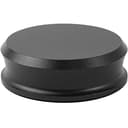
The mass most decks actually want, from a maker that puts its name on the thing, at the lowest price in this class. At 9 oz (about 255 g) it sits on the band Ortofon publishes for entry-class belt-drive players, and the leather pad means metal never meets the label. Hudson publishes the mass, the metal and the pad — and beyond a 3 x 1.5 in figure in the listing copy, nothing else.

Best overall
$20.95 · View on Amazon

Price as of September 9, 2026. #ad How we’re funded

2
Fluance RW03 Record Weight Stabilizer

Fluance RW03 Record Weight Stabilizer

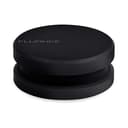
The only weight here whose maker publishes every number that decides whether it fits: 760 g of steel, a 7.4 mm spindle hole 18.6 mm deep, an anti-resonant rubberized coat and a velvet base. It is also three times the mass of anything else on this page, which makes it right for a heavy platter and wrong for a light belt-drive motor — a caveat Fluance states itself.

Best for a heavy platter
$42.96 · View on Amazon

$49.9914% off

Price as of September 9, 2026. #ad How we’re funded

3
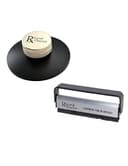
Record Doctor Low Profile Record Clamp

Record Doctor Low Profile Record Clamp

The one product here that applies pressure without adding much mass. A carbon-steel collet grips the spindle and pulls the record down onto the platter, so the clamping force is reacted through the spindle instead of being dumped on the bearing — Pangea's own argument for the design, and the reason this is the answer when your deck should not carry 400 grams. It stands 1.1 in tall, so the dust cover still closes.

Best clamp
$39.95 · View on Amazon

Price as of September 9, 2026. #ad How we’re funded

4
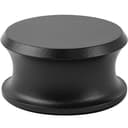
Hudson Hi-Fi BigBen Record Weight

Hudson Hi-Fi BigBen Record Weight

The SmallBen with four more ounces of steel in it. At 13 oz (about 369 g) it lands almost exactly where Ortofon puts its Heavy stabilizer — belt-drive decks with a heavy platter, or direct drive with a motor built for the load — for a few dollars more than the light one. Solid steel, vegan leather pad, black or chrome.

Best mid-mass weight
$26.99 · View on Amazon

Price as of September 9, 2026. #ad How we’re funded

5
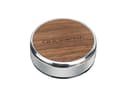
Andover Audio Record Damping Weight

Andover Audio Record Damping Weight

265 g of machined aluminum with a walnut insert and a rubber base — the same mass band as the Hudson SmallBen in a considerably nicer object, for roughly triple the money. Andover publishes the mass, the materials and the dimensions on its listing and nothing about fitment; its own product page carries no specification table at all.

Best wood and aluminum
$59.00 · View on Amazon

Price as of September 9, 2026. #ad How we’re funded

6
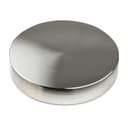
Pro-Ject Record Puck PRO

Pro-Ject Record Puck PRO

The lightest thing here at 190 g, the most expensive, and the only one that publishes the rule which actually decides fitment: the spindle must not stand more than 10.5 mm above a seated record. Nickel-plated aluminum, felt pad, 78 mm across and 16 mm tall. If you own a Pro-Ject, this is the puck built around your spindle.

Best published fitting rule
$82.44 · View on Amazon

Price as of September 9, 2026. #ad How we’re funded

The picks in full

#1Best overall

Hudson Hi-Fi SmallBen Record Weight

The mass most decks actually want, from a maker that puts its name on the thing, at the lowest price in this class. At 9 oz (about 255 g) it sits on the band Ortofon publishes for entry-class belt-drive players, and the leather pad means metal never meets the label. Hudson publishes the mass, the metal and the pad — and beyond a 3 x 1.5 in figure in the listing copy, nothing else.

Strengths

  • 9 oz (about 255 g) is inside the band Ortofon publishes for entry-class belt-drive players
  • Protective leather pad on the underside, so the metal never touches the label
  • The cheapest weight here from a company that puts its own name on it
  • Place-and-play — nothing to screw down and nothing to over-tighten

Trade-offs

  • Hudson publishes no spindle diameter and no clearance figure, so you have to measure your own deck
  • The listing's 10 x 5 x 3 in dimensions are shipping figures, not the weight itself
  • Its sound-quality claims are unverifiable — we have not heard it and nobody has published a measurement
  • Matte black and chrome are separate listings, so the price depends on which finish you click
Mass9 oz (about 255 g)
TypePlace-on weight
MaterialMetal, matte black or chrome (alloy not published)
Label padLeather
Dimensions3" x 1.5" (from the listing copy)
Spindle fitNot published

Note. Hudson sells the same design at three masses — SpaceBen at 8 oz, SmallBen at 9 oz, BigBen at 13 oz. Choosing between them is a platter-and-motor question, not a quality one.

Specifications read from the manufacturer / product listing, on September 8, 2026. “Not published” means the maker does not state that figure.

#2Best for a heavy platter

Fluance RW03 Record Weight Stabilizer

The only weight here whose maker publishes every number that decides whether it fits: 760 g of steel, a 7.4 mm spindle hole 18.6 mm deep, an anti-resonant rubberized coat and a velvet base. It is also three times the mass of anything else on this page, which makes it right for a heavy platter and wrong for a light belt-drive motor — a caveat Fluance states itself.

Strengths

  • 760 g (26.8 oz) of solid steel — the most mass here, for the platters that can take it
  • Fluance publishes the whole fitment spec: 2.760" diameter, 1.098" height, 0.291" spindle hole, 0.732" hole depth
  • Rubberized anti-resonant finish over the steel, with a velvet base against the label
  • Fluance's own support site clears its Classic, Elite and Reference decks for weights up to exactly this mass

Trade-offs

  • Far more mass than an entry-class belt-drive motor is built to spin — Fluance's own condition is a "compatible motor capacity"
  • Fluance states it does not work with 7-inch singles that need a 45 adapter
  • Your spindle has to be 7.4 mm across and clear an 18.6 mm deep recess, which not every deck is
  • Heavy enough that dropping it onto a record is a real risk rather than a theoretical one
Mass760 g (26.8 oz)
TypePlace-on weight
MaterialSteel, anti-resonant rubberized finish
Label padVelvet
Diameter2.760" (70.1 mm)
Height1.098" (27.9 mm)
Spindle hole0.291" (7.4 mm) across, 0.732" (18.6 mm) deep
7-inch singlesNot compatible when a 45 adapter is needed

Note. Fluance's support site puts the ceiling for its own Classic, Elite and Reference turntables at 760 grams. This weight sits exactly on that limit, not comfortably under it.

Specifications read from the manufacturer / product listing, on September 8, 2026. “Not published” means the maker does not state that figure.

#3Best clamp

Record Doctor Low Profile Record Clamp

The one product here that applies pressure without adding much mass. A carbon-steel collet grips the spindle and pulls the record down onto the platter, so the clamping force is reacted through the spindle instead of being dumped on the bearing — Pangea's own argument for the design, and the reason this is the answer when your deck should not carry 400 grams. It stands 1.1 in tall, so the dust cover still closes.

Strengths

  • 153 g (5.4 oz) — the lowest mass here, and the maker's stated reason for the design
  • Screw-down collet holds the record against the platter rather than relying on mass alone
  • 1.1" tall when tightened, so it clears most dust covers
  • Non-resonant phenolic body and a stainless knob you can set the pressure by feel

Trade-offs

  • Record Doctor states plainly: "Not recommended for use with Rega turntables"
  • The collet has to grip your spindle, and no compatible spindle range is published
  • Over-tightening presses the record against a platter that may not be perfectly flat
  • Fussier than a weight — every side change means screwing down and unscrewing again
Mass5.4 oz (153 g)
TypeScrew-down collet clamp
Height1.1" tightened on the spindle
Diameter3.1" (7.9 cm)
BodyNon-resonant phenolic
ColletCarbon structural steel
KnobTextured stainless steel
Maker's exclusionNot recommended for Rega turntables

Note. Distributed by Pangea Audio under the Record Doctor name — the same brand as the Record Doctor VI cleaning machine covered in our cleaning-machine roundup.

Specifications read from the manufacturer / product listing, on September 8, 2026. “Not published” means the maker does not state that figure.

#4Best mid-mass weight

Hudson Hi-Fi BigBen Record Weight

The SmallBen with four more ounces of steel in it. At 13 oz (about 369 g) it lands almost exactly where Ortofon puts its Heavy stabilizer — belt-drive decks with a heavy platter, or direct drive with a motor built for the load — for a few dollars more than the light one. Solid steel, vegan leather pad, black or chrome.

Strengths

  • 13 oz (about 369 g) sits close to Ortofon's published 350 g Heavy figure for heavy platters and direct drive
  • Solid steel with a vegan leather pad, in black or chrome
  • Place-and-play, and the knurled body lifts off one-handed

Trade-offs

  • Hudson publishes no dimensions and no spindle figure for it at all
  • Too much mass for a light entry-class belt drive — this is the step up, not the default
  • Nothing separates it from the SmallBen except weight, so there is no case for owning both
  • The listing's sound claims are marketing copy, not measurement
Mass13 oz (about 369 g)
TypePlace-on weight
MaterialSolid steel
Label padVegan leather
FinishBlack or chrome
DimensionsNot published
Spindle fitNot published

Note. Hudson's own product page states the mass, the steel and the pad and then stops. Everything else on that page is a claim about sound rather than a specification.

Specifications read from the manufacturer / product listing, on September 8, 2026. “Not published” means the maker does not state that figure.

#5Best wood and aluminum

Andover Audio Record Damping Weight

265 g of machined aluminum with a walnut insert and a rubber base — the same mass band as the Hudson SmallBen in a considerably nicer object, for roughly triple the money. Andover publishes the mass, the materials and the dimensions on its listing and nothing about fitment; its own product page carries no specification table at all.

Strengths

  • 9.35 oz (about 265 g) is the mass band that suits most belt-drive decks
  • Machined aluminum with a real walnut insert and a rubber base against the label
  • Published 2.875" diameter and 1" height, so dust-cover clearance can be checked before buying
  • From the maker whose SpinBase this site already covers

Trade-offs

  • Roughly triple the price of a steel weight of the same mass — the walnut is what you are buying
  • Andover's own product page publishes no spec table, so every figure here comes from the listing
  • The listing claims "tighter bass", "better transient and attack" and a "deeper sound stage" — none of it measured by anyone
  • No published spindle diameter and no clearance figure
Mass9.35 oz (about 265 g)
TypePlace-on weight
MaterialsMachined aluminum, walnut insert, rubber base
Diameter2.875" (73 mm)
Height1" (25 mm)
FitsEP and LP records
Spindle fitNot published

Note. Model number AAMD1WGTWN01NA. Andover lists it for sale on its own site without a specification table, which is why the figures here are the listing's.

Specifications read from the manufacturer / product listing, on September 8, 2026. “Not published” means the maker does not state that figure.

#6Best published fitting rule

Pro-Ject Record Puck PRO

The lightest thing here at 190 g, the most expensive, and the only one that publishes the rule which actually decides fitment: the spindle must not stand more than 10.5 mm above a seated record. Nickel-plated aluminum, felt pad, 78 mm across and 16 mm tall. If you own a Pro-Ject, this is the puck built around your spindle.

Strengths

  • Pro-Ject publishes the fitment rule outright — spindle height with the record fitted must not exceed 10.5 mm
  • 190 g is light enough that bearing and motor load are a non-issue on almost any deck
  • Nickel-plated aluminum with a felt pad on the underside
  • 78 mm across and 16 mm tall, so it clears a dust cover comfortably

Trade-offs

  • The highest price here for the least mass — the machining and the badge are what cost
  • At 190 g it does less of everything a weight does than a 265 g or 369 g one
  • Stock was in single digits when we checked the listing
  • The 10.5 mm spindle rule rules out decks that would happily take a taller weight
Mass190 g
TypePlace-on puck
MaterialNickel-plated aluminum
Diameter78 mm (3.07")
Height16 mm (0.63")
Label padFelt
Spindle ruleMax 10.5 mm spindle height with the record fitted

Note. Pro-Ject prints the 10.5 mm limit in bold on its own listing. The measurement it asks for — how far your spindle stands above a seated record — is the one that decides fitment for every weight on this page, including the ones that allow more of it.

Specifications read from the manufacturer / product listing, on September 8, 2026. “Not published” means the maker does not state that figure.

How we chose these six

Four criteria, applied in this order. None of them is a listening claim, because we make none.

  1. The maker publishes the mass. This is the whole specification. A weight sold without a stated mass cannot be matched to a platter, a motor or a bearing, and matching is the only decision you are making. That single rule removed most of what a search for “record weight” returns.
  2. It is a real, identifiable brand. This category is swamped by unbranded discs of turned aluminum sold under a rotating cast of storefront names, several of which publish a mass and nothing else. Every pick here comes from a company that also makes turntables, cartridges, cleaning machines or hi-fi accessories under its own name and can be held to what it prints.
  3. The masses had to differ. There is no point ranking six 250 g pucks. The set runs from 153 g to 760 g, because the mass band is the decision and the finish is not.
  4. It has to be buyable today. Every listing here was checked for a live, in-stock offer with a real price before it went on the page. Two well-known products failed that check and are named below rather than quietly left out.

What a record weight actually does

Three mechanisms, and Fluance — a company that sells both turntables and weights, so it has an interest in the answer being “yes” — describes them in plainer language than most:

  • It couples the record to the platter. A record is a thin, springy disc lying loose on a mat. Pressing its center down puts more of its surface in contact with what is underneath, so vibration in the disc has somewhere to go. Fluance’s phrasing is that the added mass “reduces unwanted vibrations from transferring to the stylus during playback.”
  • It flattens a mild warp, temporarily. This is the effect people actually notice. A weight can “temporarily level that playing surface on slightly warped records so that your stylus can optimally track the grooves.” It will not do anything for a badly warped record, and it is not a repair — lift it off and the warp is still there.
  • It adds inertia. More rotating mass resists speed change, which is why Fluance claims “a more consistent speed, resulting in improved wow and flutter.” That is also precisely where the cost sits: inertia the motor did not expect is inertia the motor has to accelerate and hold.

And here is the same company’s caution, which almost nobody reselling a weight repeats: “some turntables are designed to handle the pressure of a record weight, there are turntables where the motor will get stressed by the extra mass.” That sentence is the reason this page exists.

Mass is the spec, and there are three bands

Ortofon is the only maker in this class that has split its own product line by deck type and published the split, so its guidance is the most useful thing available to anyone shopping this category. It sells the same aluminum stabilizer in two masses:

  • 240 g (Standard) is “intended for use with entry-class belt drive players,” and elsewhere Ortofon adds sub-chassis decks — the suspended designs — to that same lighter recommendation.
  • 350 g (Heavy) is “intended for use with belt drive players with heavy platters or direct drive players with powerful motors.”

Read the two together and the shape of the category falls out. Under about 250 g is the safe band for the deck most people reading this owns: a belt-driven entry or mid turntable with a stamped or light MDF platter and a small synchronous motor. Around 350 g is the step up, and it wants either a genuinely heavy platter or the torque of a direct-drive motor underneath it. Above that you are into specialist territory: the 760 g Fluance is more than twice Ortofon’s heavy figure, and Fluance clears it only for its own Classic, Elite and Reference decks and for other turntables with a “compatible motor capacity.”

Three practical readings of that:

  1. If your deck is an entry belt drive, buy in the 150–270 g band and stop. The Hudson SmallBen, the Andover and the Pro-Ject puck are all inside it.
  2. If your platter is heavy — acrylic, or thick machined aluminum — the 350–400 g band is open to you. A deck like the Fluance RT85 with a 1.56 kg acrylic platter is a different mechanical proposition from a budget deck with a stamped one.
  3. If your turntable’s maker publishes a limit, that limit wins over anything on this page. Fluance publishes one. Most makers do not, which is a fact about the industry rather than permission to guess.

The measurement to take before you order

Every weight on this page drops over the spindle, and every one of them has a recess of a fixed depth. If your spindle stands taller than that recess, the weight rests on the spindle tip instead of on the record — which does nothing useful and can rock. Two makers publish the number:

  • Pro-Ject prints it on the listing for the Record Puck PRO in bold: “The spindle height with the record placed on it must not exceed 10.5mm!”
  • Ortofon states its stabilizers suit players “with a diameter of up to 18 mm from the record surface to the center spindle tip.”
  • Fluance publishes the recess itself rather than the rule: a 0.291 in (7.4 mm) hole, 0.732 in (18.6 mm) deep.

So the measurement is: put a record on the platter, and measure from the top of the record to the tip of the spindle. Under 10.5 mm and everything here fits. Between 10.5 mm and 18 mm and the Pro-Ject is out. Over 18 mm and you need to check each product individually, because most of the category simply does not say. Also check the spindle’s diameter — the standard is around 7 mm, which is what Fluance’s 7.4 mm hole is cut for, and a screw-down clamp needs a spindle its collet can actually grip.

One more fitment trap, and it is the reason the heaviest pick carries a caveat: a weight with a deep recess will not sit on a 7-inch single played with a 45 adapter. Fluance states this for the RW03 explicitly.

Weight or clamp? They are not the same product

A weight presses down with its own mass, and all of that mass ends up on the platter bearing. A clamp grips the spindle with a collet and pulls the record down against the platter; the force is reacted through the spindle itself, so what the bearing carries is only the clamp’s own mass. Record Doctor makes exactly that argument for its own product — a clamp’s “low mass design does not apply excessive stress to turntable bearings like record weights can” — and at 153 g it is the lightest thing here by a distance.

The trade-offs are real in both directions. A clamp is fussier: you screw it down every side and unscrew it every side, and you can over-tighten it against a platter that is not perfectly flat. It also needs a spindle within its collet’s grip range, and Record Doctor publishes no range — only an exclusion, and it is a significant one: “Not recommended for use with Rega turntables.” That rules it out for a deck this site rates highly in its class, which is a fact worth having before you buy rather than after.

A weight is simpler in every way. Drop it on, lift it off. If your deck can carry the mass, a weight is the less error-prone choice; if it cannot, the clamp is the only version of this idea that is safe to use.

Who should not buy either

Five cases where the correct spend is zero, and between them they cover most people who land on a page like this.

  • You own a Rega, or any deck whose maker advises against one. Record Doctor prints the Rega exclusion on its own clamp. When a maker tells you its product does not suit your turntable, that is not marketing caution to be read around.
  • Your deck is a light, fully automatic entry machine. A small synchronous motor spinning a light stamped platter has no margin for several hundred grams, and an automatic mechanism has to move an arm against that load as well. If your deck is a fully automatic one from our automatic turntable roundup, this is the accessory to skip.
  • You are trying to fix noise. Crackle, sibilance and surface noise are cleaning and stylus problems. A weight does not touch any of them. Start with a cleaning kit and then with a fresh stylus.
  • You are trying to fix skipping. Skipping is tracking force, anti-skate, level or footfall — the whole diagnostic sequence is in turntable troubleshooting. Pressing the record down harder is treating a symptom with a heavier symptom.
  • Your records are badly warped. A weight levels a mild warp while it sits there. A dished or edge-warped record needs storage that stops it happening to the rest of the collection — see record storage and sleeves, and how to spot a bad pressing if the warp arrived in the shrink wrap.

Two products we would have ranked, and could not

Audio-Technica’s AT618a Disc Stabilizer is the obvious omission from a list like this. Its listing came back with an expected-availability status and no in-stock offer when we checked it, which fails our fourth criterion, so it is named here rather than ranked. The same applies to Ortofon’s own stabilizers: the 240 g and 350 g versions whose published guidance shapes this entire page were showing one or two units each. We are not going to rank a product that may be gone before you click. If either changes, this page changes with it.

The unbranded end of the market — the cheap turned-aluminum pucks that fill the search results — is excluded on the second criterion, not on price. Several publish a mass. None of them publishes a spindle rule, none names a deck type, and there is no maker standing behind the figure. In a category whose entire risk is putting the wrong mass on the wrong bearing, a mass with nobody’s name on it is not a specification.

Using one without doing damage

Four habits, none of which cost anything.

  1. Lower it, do not drop it. The 760 g Fluance is a solid steel object landing on a plastic disc from whatever height you let go at. Guide it down the spindle with your fingers still on it.
  2. Check the pad every few months. Every pick here has something soft on the underside — velvet on the Fluance, leather on both Hudsons, felt on the Pro-Ject, rubber on the Andover. That pad is the only thing between machined metal and your record label, and grit embedded in it turns the weight into an abrasive.
  3. Re-check tracking force after you start using one. A weight does not change tracking force, but it does change how flat the record sits, and this is a good moment to confirm the arm is set where you think it is — how to balance a tonearm covers the procedure.
  4. Listen for the motor. The failure mode of too much mass is not dramatic. Speed drifts slightly flat, the deck takes noticeably longer to come up to speed, or the motor becomes audible when the platter is loaded. Any of those means the weight is too heavy for your deck — take it off.

Fluance also notes something small and genuinely useful: the weight can live on the spindle when the deck is not playing, so it is not one more object hunting for a home on the shelf. Mats and weights interact, too — Fluance clears its own weights for use with a platter mat or an acrylic platter, and if you are stacking one on the other, the geometry argument in our platter mat roundup applies to the pair rather than to either alone.

The honest summary

A record weight is a real accessory with a real, small, mechanical effect, sold with claims far larger than that effect. It belongs in the same category as 180 gram vinyl: more mass, sold as more quality, with the actual benefit conditional and modest. Buy one if you play mildly warped records, if your deck can carry the mass, and if you have already done the cleaning and the setup. Buy the mass band your turntable suits rather than the biggest number you can afford — the only way to get this purchase wrong is to over-buy.
Frequently asked questions

Do record weights actually work?

They do three measurable-in-principle things: couple the record more firmly to the platter, temporarily flatten a mild warp, and add rotating inertia. Fluance — which sells both turntables and weights — describes exactly those three and claims improved wow and flutter from the inertia. What nobody has published is a measurement of how much difference that makes on a given deck, and we have not made one either. Treat it as a small mechanical change with a real cost attached, not an upgrade.

How heavy should a record weight be?

Match it to your turntable, not to your budget. Ortofon publishes the clearest guidance in the category: its 240 g Standard stabilizer is intended for entry-class belt-drive players and sub-chassis decks, and its 350 g Heavy version for belt-drive players with heavy platters or direct-drive players with powerful motors. Above that is specialist territory — Fluance's 760 g RW03 is cleared for its own Classic, Elite and Reference decks and for other turntables with, in its words, a compatible motor capacity.

Can a record weight damage my turntable?

It can stress the motor and load the bearing beyond what the designer allowed for. Fluance states it plainly: some turntables are designed to handle the pressure of a record weight, and there are turntables where the motor will get stressed by the extra mass. The symptoms are undramatic — the platter takes longer to reach speed, the speed sits slightly flat, or the motor becomes audible under load. If you see any of those, take the weight off.

Is a record clamp better than a record weight?

It is a different mechanism with a different trade. A clamp screws onto the spindle and pulls the record down, so the clamping force is reacted through the spindle and the bearing only carries the clamp's own mass — Record Doctor makes that argument for its 153 g clamp directly. A weight presses down with mass alone, all of which the bearing carries. The clamp is the safer choice on a light deck; the weight is simpler to live with, because a clamp has to be screwed down and released for every side.

Will a record weight flatten a warped record?

Only while it is sitting there, and only for a mild warp. Fluance's own description is that a weight temporarily levels the playing surface on slightly warped records so the stylus can track the grooves. Lift it off and the warp is unchanged. A dished or edge-warped record is a storage problem rather than a playback one — store records vertically with support and the rest of the collection stays flat.

Do I need a record weight on a Rega turntable?

Record Doctor states on its own clamp listing: not recommended for use with Rega turntables. When the maker of the accessory names your deck as an exclusion, that is the answer. Rega's own design approach — light platters and a low-mass sub-platter — is the reason its owners are routinely told to leave clamps and weights alone.

Will a record weight fit my turntable?

Measure the spindle. Put a record on the platter and measure from the top of the record to the tip of the spindle. Pro-Ject's Record Puck PRO requires that figure to be no more than 10.5 mm; Ortofon states its stabilizers suit players with up to 18 mm from the record surface to the spindle tip; Fluance publishes the recess instead — a 7.4 mm hole, 18.6 mm deep. Also check spindle diameter, which is around 7 mm on most decks, and note that a weight with a deep recess will not sit on a 7-inch single played with a 45 adapter.

What is the best record weight to buy?

For the entry-class belt-drive deck most people own, the Hudson Hi-Fi SmallBen at 9 oz (about 255 g) — it is in the mass band Ortofon publishes for that deck type, it has a leather pad against the label, and it is the cheapest branded weight here. Step up to the 13 oz BigBen or the Fluance RW03 only if your platter is genuinely heavy or your deck is direct drive, and buy the Record Doctor clamp instead if your turntable should not carry added mass at all.

Sources

  • Ortofon — Record stabilizer (Standard and Heavy)The maker's own split of the class by mass: the 240 g Standard is "intended for use with entry-class belt drive players", while the 350 g Heavy is "intended for use with belt drive players with heavy platters or direct drive players with powerful motors". Both are machined solid aluminum, anodized, with "a smooth felt sheet on the bottom [that] protects the label surface". It also publishes the clearance rule — the stabilizer suits players "with a diameter of up to 18 mm from the record surface to the center spindle tip" (accessed September 8, 2026)
  • Ortofon — Record stabilizer product pageOrtofon's main-site page for the same stabilizer, which adds the suspended-deck half of the guidance: "The Standard version is ideal for entry-level and sub-chassis turntables." Both versions are described as having "a premium satin matte anodized finish" with the "Ortofon textured wave-grip", aluminum with a smooth felt underside (accessed September 8, 2026)
  • Fluance — HiFi Vinyl Record Weight (RW03)Manufacturer specification: 26.808 oz (760 g), "Steel with Rubberized Finish", velvet base, 2.760 in diameter, 1.098 in height, 0.291 in (7.4 mm) spindle hole diameter and 0.732 in (18.6 mm) spindle hole depth. Compatibility is stated conditionally — all Fluance turntables "and any other turntables with a spindle diameter of 0.74 cm and a height lower than 1.86 cm, and compatible motor capacity" — and it is listed as not compatible with 7-inch records requiring a 45 adapter (accessed September 8, 2026)
  • Fluance support — Can I use a record weight or stabilizer?A turntable maker publishing a ceiling for its own decks: the Classic, Elite and Reference turntables are "compatible with weights up to 760 grams or 26.808 ounces", weights "can be used when using platter mats or the acrylic platter", and the weight "can be stored on the spindle of your turntable when not in use" (accessed September 8, 2026)
  • Fluance — What does a record weight do?The same maker on the mechanism and its limit: added mass "reduces unwanted vibrations from transferring to the stylus during playback", "temporarily level[s] that playing surface on slightly warped records", and increases platter inertia for "a more consistent speed, resulting in improved wow and flutter". Its own caution is the important part — "some turntables are designed to handle the pressure of a record weight, there are turntables where the motor will get stressed by the extra mass" (accessed September 8, 2026)
  • Record Doctor / Pangea Audio — Low Profile Record ClampManufacturer specification: 5.4 oz (153 g), 1.1 in high when tightened on the spindle, 3.1 in diameter, non-resonant phenolic body, carbon structural steel collet, textured stainless knob. The design argument is published outright — a clamp's "low mass design does not apply excessive stress to turntable bearings like record weights can" — and so is the exclusion: "Not recommended for use with Rega turntables" (accessed September 8, 2026)
  • Pro-Ject — Record Puck PROManufacturer specification: 190 g, nickel-plated aluminum, 78 mm diameter, 16 mm height, with the label "protected by the felt pad on the underside". Pro-Ject also publishes the fitment rule the rest of the category leaves to the buyer: "The spindle height with the record placed on it must not exceed 10.5mm" (accessed September 8, 2026)
  • Hudson Hi-Fi — BigBen 13-ounce record weightThe maker's own page for the 13 oz (about 369 g) weight: solid steel in black or chrome with a "vegan leather protective pad" between the weight and the record. No dimensions, no spindle diameter and no compatibility statement are published — which is why those rows read "Not published" on our page (accessed September 8, 2026)

Keep reading