The fitment table
Find your deck in the left column. The third column decides what you are allowed to buy; the fourth is what Fluance already gave you.
| Your Fluance | Built-in preamp | Supported cartridge weight | Cartridge fitted at the factory |
|---|
| RT81 | Yes — switchable, full bypass | 0.12 - 0.23 oz (3.5 - 6.5 g) | Audio-Technica AT95E (discontinued by Audio-Technica) |
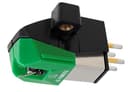
| RT81+ | Yes — switchable, full bypass | Published as the RT81 table, row for row | Audio-Technica AT-VM95E (6.1 g) |
| RT82 | No | 0.18 - 0.25 oz (5.0 - 7.5 g) | Ortofon OM 10 |
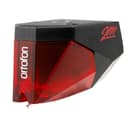
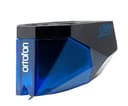
| RT85 | No | Not published in Fluance’s RT85 table | Ortofon 2M Blue (7.2 g) |
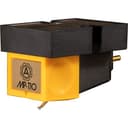
| RT85N | No | Not published in Fluance’s RT85N table | Nagaoka MP-110 (6.5 g), on a 9 g H-4 headshell |
| RT87 | No | Not published in Fluance’s RT87 table | Ortofon 2M Blue, or an AT-VM95ML on the alternate configuration |
Three rows deserve a note rather than a guess. Fluance publishes a supported cartridge weight for the RT81 and the RT82 and not for the RT85 series, so we do not print a window for those decks. What we can say is what Fluance does: it fits a 7.2 g Ortofon 2M Blue to the RT85 and RT87 itself, which is the best available evidence that those arms are built for that mass. The arms differ as well — Fluance publishes 21.78 g effective mass for the RT82 arm, 27.5 g for the RT85 and 21.1 g for the RT85N — which is part of why the factory cartridge differs between two decks that share a platter.
How we ranked them
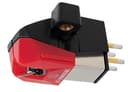
- Does it fit the RT81 arm? The RT81 is the Fluance most owners have, and Fluance caps it at 6.5 g. The AT-VM95E (6.1 g), the AT-VM95ML (6.1 g) and the Nagaoka MP-110 (6.5 g) are inside that window. Ortofon’s 2M Red and 2M Blue, both published at 7.2 g, are not. A cartridge that fits every rung ranks above one that fits most of them.
- Published stylus profile. Conical, bonded elliptical, nude elliptical, micro-linear — in that order, and the step most people hear most clearly is from conical to elliptical. The AT-VM95E publishes a 0.3 x 0.7 mil elliptical; the AT-VM95ML a 2.2 x 0.12 mil micro-linear; the 2M Blue a nude elliptical with r/R 8/18 micrometers.
- Whether there is a stylus ladder above it. A cartridge whose tip can be upgraded without touching alignment is worth more than its own specification. Every AT-VM95 body accepts any VMN95 stylus; an Ortofon 2M Red body accepts a 2M Blue stylus; Nagaoka sells the JN-P110 for the MP-110. All three are real ladders, which is why none of these picks is a sealed design.
- Tracking force against what your arm can set. Every Fluance RT deck has an adjustable counterweight and anti-skate, so any of these is settable: 1.8 to 2.2 g for the AT-VM95E, 1.5 to 2.0 g for the MP-110, 1.6 to 2.0 g for both Ortofons. This row is what makes a Fluance a different proposition from a fixed-arm automatic, where none of these cartridges can be used at all.
The money-saving rule on an RT85, RT85N or RT87
If your deck came with an Ortofon 2M Blue or a Nagaoka MP-110, you already own a cartridge other people buy as an upgrade. The correct spend is a stylus when the one you have wears: Ortofon’s Stylus 2M Blue drops into the body you own, and Nagaoka’s JN-P110 does the same for the MP-110. No screws, no lead wires, no protractor, no change in alignment. Our replacement stylus picks cover that route, and cartridge vs stylus explains the distinction if the two words have been used interchangeably at you. The one case for buying a whole cartridge on these decks is the one our 2M Blue review documents: when the loose stylus is harder to buy than the complete cartridge.
What to do about the RT81’s discontinued AT95E
The RT81 ships with an Audio-Technica AT95E, and Audio-Technica has badged both that cartridge and its ATN95E replacement stylus as discontinued on its own site. The deck is unaffected — it takes any standard half-inch cartridge inside its published weight window — but it does make the RT81 the Fluance where planning a cartridge purchase rather than a re-tip is the sensible default. The AT-VM95E is the current descendant of that fitting, which is why it leads this page. Fluance itself sells the RT81+ as the RT81 with exactly that swap already done, which is about as clear an endorsement of the pairing as a maker can give; our Fluance range page lays out how the rest of the ladder differs.
Fitting it without undoing the benefit
A new cartridge that is badly aligned sounds worse than the old one that was aligned correctly, and on a Fluance there are three jobs: overhang, tracking force and anti-skate. The H-4 bayonet headshell helps — the RT85N and RT87 publish a removable headshell, so the cartridge comes off as an assembly and you can keep the old one on its own shell as a swap-back. Our cartridge setup guide walks through alignment, our tonearm balancing guide covers the counterweight arithmetic, and a tracking force gauge is how you confirm the number instead of trusting the dial. If you are buying a second headshell to make swaps painless, our headshell guide covers what fits.
One thing a cartridge will not fix
No Fluance above the RT81+ has a phono preamp inside it, so if you own an RT82 or higher and your records sound thin and quiet, the problem is the missing phono stage rather than the cartridge. That is a different purchase entirely, and on an RT82 it is a mandatory one. Worth knowing before you spend: a better cartridge into no phono stage is still inaudible.