Ortofon 2M Red vs 2M Blue
The same cartridge body with a different diamond on the front — which means the upgrade costs half what most people pay for it.
How this is funded: we earn a commission if you buy through our links, at no extra cost to you. It never changes which product we recommend, and we’ll tell you plainly when to skip one. Full disclosure.
Ortofon’s 2M range is built on a deliberate piece of design: the cartridges share a body, and what separates them is the stylus on the front. The Red and the Blue are the two most common, they sit one rung apart, and the practical consequence catches people out constantly.
If you already own a 2M Red, you should almost never buy a 2M Blue cartridge. You should buy a 2M Blue stylus. It produces the identical result for less money and no setup work.
The actual difference: bonded versus nude
Both are elliptical tips, meaning the diamond is narrower side-to-side than a conical one so it sits deeper in the groove. The difference is how the diamond is mounted.
On the 2M Red, the diamond is bonded— the small tip is fixed to a metal shank, which is then fixed to the cantilever. Cheaper to manufacture, and it adds mass right at the point where the stylus has to change direction thousands of times a second.
On the 2M Blue, the diamond is nude— the whole tip is one piece of diamond mounted directly to the cantilever. Less mass at the business end means less inertia, and less inertia means the tip follows rapid groove modulation more accurately.
High-frequency modulations are the fastest and smallest, so that is where the difference shows: cymbals, string harmonics, the decay of a piano note, the air around a voice.
How much difference does it make?
Real, and smaller than the marketing implies. It is a refinement of the same basic tip geometry, not a change of category the way conical-to-elliptical is.
For honesty’s sake: we own neither cartridge and make no listening claims about them — our method is published, and it is specification reading rather than testing we did not do. What can be said from the published figures is that both are elliptical moving-magnet cartridges with the same 1.8 g recommended tracking force, differing in diamond mounting. The nude construction is a genuine and well-understood engineering advantage; how audible it is in your system depends on everything downstream of it.
The money question
Here is where this comparison becomes practical rather than academic. There are three ways to end up with a 2M Blue tip on your turntable:
- Buy the complete 2M Blue cartridge. Correct if you have no Ortofon cartridge at all, or your existing body is damaged.
- Buy the 2M Blue stylus and fit it to a 2M Red body you own. Cheaper, identical result, no realignment. Ortofon states this compatibility explicitly.
- Buy a 2M Red cartridge now and the Blue stylus later.The sensible path if the budget is staged — you get a good cartridge immediately and a clean upgrade when you want it.
Option two is the one people miss. A whole cartridge includes a body you already own, and you would then have a spare Red body doing nothing. The same logic applies across Audio-Technica’s VM95 range and Nagaoka’s MP series — see cartridge vs stylus for why this works.
What does not change
- Tracking force.Ortofon specifies 1.8 g for the Blue, and the Red’s recommended figure is the same. A stylus swap needs no recalibration — though it is worth confirming the counterweight has not drifted while you had your hands in there.
- Phono stage.Both are high-output moving magnet at the standard 47 kOhm loading. Any MM input works — see gain and impedance.
- Alignment. The body does not move, so overhang, azimuth and zenith are all preserved.
- Mount. Standard half-inch, fitting any tonearm with an adjustable counterweight.
Which should you buy?
You own a 2M Red: buy the Blue stylus. Cheapest route, identical outcome, ten seconds of work.
You own no Ortofon cartridge and have the budget: buy the complete 2M Blue. Starting one rung up is sensible if the money is there, and the Red stylus is not something you would ever want back.
You own no Ortofon cartridge and the budget is tight: buy the 2M Red now. It is a good cartridge, and the Blue stylus is waiting whenever you want it.
You are choosing between families rather than rungs:weigh the ladders rather than the cartridges. Ortofon’s 2M range has fewer, more expensive steps; Audio-Technica’s VM95 range has more steps at lower prices and reaches micro-linear and Shibata profiles. Our AT-VM95E vs 2M Red comparison makes that case, and cartridges under $200 lays out both.
Two ways to buy this upgrade
If you already own a 2M Red body, the stylus on its own is still the cheapest route to the same result — but Ortofon sells that stylus through its dealers and there is no live Amazon listing for it as we write this, so the prices we can quote are for the complete cartridges. Prices are live and dated.
2M Red — complete cartridge
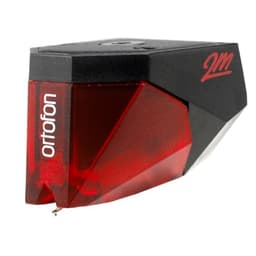
Ortofon 2M Red
A step-up cartridge with a clear upgrade path
2M Blue — complete cartridge
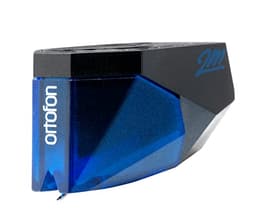
Ortofon 2M Blue
The standard step up from a 2M Red without changing bodies
Price as of October 15, 2026. #ad How we’re funded
Frequently asked questions
What is the difference between the Ortofon 2M Red and 2M Blue?
The stylus. The 2M Red uses a bonded elliptical diamond — the tip is fixed to a metal shank — while the 2M Blue uses a nude elliptical diamond mounted directly. Less mass at the tip means it follows high-frequency groove modulation more accurately. The bodies are otherwise the same family.
Can I upgrade a 2M Red to a 2M Blue with just the stylus?
Yes, and Ortofon states this explicitly — the 2M Blue stylus is sold as an upgrade for a 2M Red body. It snaps on with no realignment because the cartridge body never moves. Buying the whole 2M Blue cartridge when you already own a Red is paying twice for the same body.
Is the 2M Blue worth the extra money over the 2M Red?
As a stylus-only upgrade on a body you already own, usually yes — it is a real improvement in high-frequency tracking for a moderate cost. As a whole new cartridge when you already have a Red, no: you would be buying a duplicate body.
What tracking force does the Ortofon 2M Blue need?
Ortofon publishes 1.8 g as the recommended tracking force. Set it with the counterweight after balancing the arm, and set anti-skate to roughly the same figure. The 2M Red's recommended force is also 1.8 g, so a stylus swap needs no change.
Do the 2M Red and 2M Blue need different phono preamps?
No. Both are high-output moving magnet cartridges that work with any standard MM phono input at 47 kOhm. There is a small difference in output voltage between them, but nothing that requires a different stage or a gain change.
Is the Ortofon 2M Blue better than the AT-VM95ML?
They take different approaches: the 2M Blue is a nude elliptical, the AT-VM95ML is a micro-linear, which has a longer contact patch and generally retrieves more detail. Which is better depends on which body you already own — buy the stylus that fits your cartridge.
Sources
- Ortofon — 2M Red — Manufacturer specs: 5.5 mV output, 1.6-2.0 g tracking (1.8 g recommended), 47 kOhm load (accessed July 24, 2026)
- Ortofon — 2M Blue — Manufacturer page for the nude elliptical 2M Blue and its stylus interchangeability (accessed August 11, 2026)
- Crutchfield — Phono cartridge guide — Reference on cartridge types, styli and mounting (accessed July 24, 2026)
- Audio-Technica — VM95 Series cartridges — The shared-body VM95 range and its interchangeable stylus upgrade path (accessed July 24, 2026)
Keep reading
Ortofon 2M Blue Review
The Blue on its own, and what to do when the stylus-swap route is out of stock.
Read the reviewOrtofon 2M Red Review
The cheaper half of this comparison, in full.
Read the reviewBest Turntable Needles & Replacement Styli
The stylus-only upgrade path, across every major cartridge family.
See the picksAT-VM95E vs Ortofon 2M Red
The tier below, and which family to buy into in the first place.
Read the comparisonBest Turntable Cartridges Under $200
Everything competing with the 2M Blue at this money.
See the picksHow to Replace a Turntable Stylus
The two-minute swap this whole comparison depends on.
Read the guide