Cartridge vs Stylus
Two words, two parts, and a $100 difference between buying the right one and the wrong one.
How this is funded: we earn a commission if you buy through our links, at no extra cost to you. It never changes which product we recommend, and we’ll tell you plainly when to skip one. Full disclosure.
These two words get used interchangeably, including by retailers, and the confusion has a real cost: people routinely buy a whole cartridge for around $100 when the $50 stylus would have done the identical job — or buy a stylus that physically cannot fit what they own.
The distinction takes one paragraph to learn and saves money every few years.
The cartridge is the whole assembly
The cartridgeis the small box that bolts to the end of the tonearm. Inside it are the magnets and coils that turn mechanical movement into an electrical signal — the actual generator. On the back are four pins that connect to the tonearm’s lead wires; on top are two threaded holes or bolt slots that fix it to the headshell.
The cartridge does not wear out in normal use. Its magnets do not weaken meaningfully and its coils do not degrade. Barring physical damage, a cartridge body can outlive several styli.
The stylus is the front part that comes off
The stylus assemblyis the plastic piece that clips onto the front of the cartridge. It carries the cantilever — a thin tube, usually aluminum — with the diamond tip at its end, plus the rubber suspension that lets the cantilever move.
This is the part that wears. The diamond rides in a groove under a gram or two of force with a contact patch measured in microns, and over hundreds of hours it develops flat facets. The rubber suspension hardens with age too.
“Needle” means stylus. It is the everyday word for the same object, and both appear on retail listings.
Which one do you need to buy?
Almost always the stylus.If your cartridge sounds dull, harsh on sibilance, or distorted on inner grooves, the stylus is worn and the body is fine. Buy the stylus for your cartridge family, snap it on, and you are done — no realignment, because the body never moves.
Buy the whole cartridge only when:
- The body is physically damaged — bent pins, cracked housing.
- Your cartridge is old enough that no replacement stylus is made for it any more.
- You want to move to a different family entirely — from Ortofon to Audio-Technica, say — which means a full alignment job.
- You own a moving-coil cartridge. Most have a non-replaceable stylus and must go back to the manufacturer for a re-tip. That running cost is a real part of the MM versus MC decision.
What is interchangeable and what is not
Cartridges: largely interchangeable
Nearly every cartridge uses a standard half-inch two-screw mount, so an Audio-Technica, Ortofon, Nagaoka, Sumiko or Grado will all physically fit any tonearm with an adjustable counterweight. What differs is mass and compliance, which affect how well a given cartridge suits a given arm — but at the prices on this site, essentially all of them work with essentially all of the arms.
The exception is fixed-arm decks. An Audio-Technica AT-LP60X and similar automatics carry a proprietary mount with no counterweight, so no standard cartridge fits and none can be balanced if it did. Those decks take model-specific styli only — the ATN3600LC in that case.
Styli: not interchangeable at all
A stylus assembly fits only its own cartridge family. An AT-VMN95 stylus fits any AT-VM95 body. An Ortofon 2M stylus fits a 2M body. A Nagaoka JN-P110 fits an MP-110. None of them cross over, and forcing one is how cantilevers get bent.
The upgrade consequence
This is why the cartridge/stylus distinction is worth more than a definition. On the families built around a shared body, a better stylus is a better cartridge for a fraction of the price and none of the setup work.
The Audio-Technica VM95 body takes conical, elliptical, micro-linear, Shibata and 78-specific styli. Buy the cheapest cartridge in that range and every future upgrade is a ten-second swap. Ortofon’s 2M range works the same way — the 2M Blue stylus upgrades a 2M Red body, which is exactly what our 2M Red vs 2M Blue comparison concludes.
So the buying advice on this whole site reduces to one sentence: buy into a family with a good stylus ladder, then upgrade the tip rather than the cartridge. The options are laid out in best turntable needles and replacement styli.
One more part: the headshell
Occasionally a third word appears. A headshellis the small platform the cartridge bolts to, which then clips onto the tonearm. Some decks have a removable one — the AT-LP120XUSB does — which lets you mount and align a cartridge away from the deck and swap the whole assembly in a minute. Most decks in this price range have the headshell integrated into the arm, so cartridge changes happen in place.
The same part, sold two ways
The complete cartridge and the stylus assembly on its own, from the same family. If you already own the body, you only ever need the second one.
The cartridge — body plus stylus
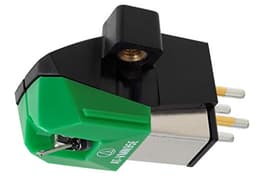
Audio-Technica AT-VM95E
The first cartridge upgrade for most decks
The stylus alone
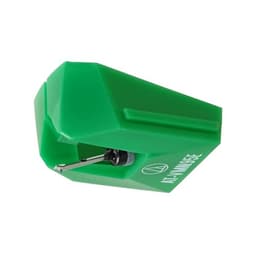
Audio-Technica AT-VMN95E Replacement Stylus
Replacing a worn stylus without touching the alignment
Frequently asked questions
What is the difference between a cartridge and a stylus?
The cartridge is the whole assembly that bolts to the tonearm — body, magnets, coils and electrical pins. The stylus is the detachable front part carrying the cantilever and the diamond tip that rides in the groove. The stylus is a consumable; the cartridge generally is not.
Do I need to replace the cartridge or just the stylus?
Almost always just the stylus. It is the only part that wears, and on most moving-magnet cartridges it detaches and snaps back on. Replace the whole cartridge only if the body is damaged, styli are no longer made for it, or you want to move to a different family.
Is the needle the same as the stylus?
Yes. 'Needle' is the everyday word and 'stylus' is the technical one, and both refer to the diamond tip and its cantilever in a detachable assembly. Retailers use both, sometimes on the same listing.
Are cartridges and styli interchangeable between brands?
Cartridges largely are — most use a standard half-inch two-screw mount that fits nearly any tonearm with an adjustable counterweight. Styli are not: an assembly fits only its own cartridge family, so an Audio-Technica stylus will not fit an Ortofon body.
How do I know which stylus my cartridge takes?
Read the model printed on the cartridge body, or check the turntable's manual for the fitted cartridge. Then buy the stylus for that exact family — an AT-VMN95 stylus for any AT-VM95 body, an Ortofon 2M stylus for a 2M body.
Can I put a better stylus on my existing cartridge?
Within the same family, yes, and it is the cheapest real upgrade in vinyl. A VM95 body accepts conical, elliptical, micro-linear and Shibata styli, all snapping on with no realignment. Ortofon's 2M range works the same way with fewer steps.
Sources
- Audio-Technica — AT-VM95E cartridge — Manufacturer specs: 0.3 x 0.7 mil elliptical stylus on an aluminum cantilever, 4.0 mV output at 1 kHz / 5 cm/sec, 1.8-2.2 g tracking force (2.0 g standard), 20-22,000 Hz, 20 dB channel separation at 1 kHz, half-inch mount, AT-VMN95E replacement stylus, and the maker's own statement that "all VM95 Series share the same body" so the stylus "can be replaced with any of the six interchangeable AT-VMN95 replacement styli". Re-read on the access date below, which corrected a tracking-force range previously noted here as 1.8-2.3 g (accessed September 26, 2026)
- Audio-Technica — AT-VMN95E replacement stylus — Manufacturer page for the elliptical VM95-series replacement stylus and its fitment list (accessed August 11, 2026)
- Audio-Technica — VM95 Series cartridges — The shared-body VM95 range and its interchangeable stylus upgrade path (accessed July 24, 2026)
- Crutchfield — Phono cartridge guide — Reference on cartridge types, styli and mounting (accessed July 24, 2026)
Keep reading
Are Turntable Cartridges Interchangeable?
Whether your deck will accept a different cartridge at all.
Read the explainerBest Turntable Needles & Replacement Styli
Which stylus fits your cartridge, and which one to buy.
See the picksHow to Replace a Turntable Stylus
The two-minute job, once you know which part you need.
Read the guideBest Turntable Cartridges Under $200
For when it really is the whole cartridge that needs replacing.
See the cartridgesHow to Set Up a Cartridge
The longer job a full cartridge change requires.
Read the guide