Ortofon 2M Blue Review
Same body, same tip radius, same tracking force as the 2M Red - and a nude diamond instead of a bonded one. The three published figures that move, and why the cheap route to this cartridge is the one you usually cannot take.
How this is funded: we earn a commission if you buy through our links, at no extra cost to you. It never changes which product we recommend, and we’ll tell you plainly when to skip one. Full disclosure.
The short version
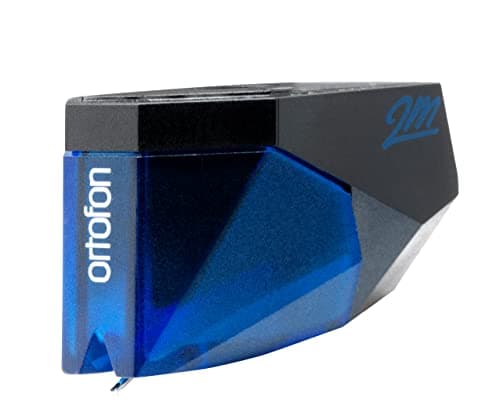
Ortofon 2M Blue
The 2M Red's body carrying a nude elliptical diamond, and Ortofon's own specification table says precisely what that buys: channel separation of 25 dB against the Red's 22, tracking ability of 80 um at 315 Hz against 70, and a frequency-response tolerance of +2/-1 dB against +3/-1. Everything else - tip radius, compliance, weight, tracking force, output, loading - is identical. Buy it as a complete cartridge when the standalone Stylus 2M Blue is unavailable, which on Amazon it reliably is. Do not buy it for an arm whose maker publishes a cartridge-weight limit below 7.2 g.
Strengths
- Nude elliptical diamond tracks more accurately than the Red's tipped stylus
- Drops straight onto a 2M Red body — buy the stylus alone if you own a Red
- Universal half-inch mount fits essentially every standard headshell and tonearm
Trade-offs
- Roughly twice the price of the 2M Red for a real but not dramatic improvement
- Ortofon's own 2M Bronze and Black sit above it, so the upgrade ladder keeps going
| Type | Moving magnet (MM) |
|---|---|
| Stylus | Nude elliptical (replaceable) |
| Mount | Universal half-inch |
| Upgrade path | Stylus-only swap from a 2M Red body |
| Output | Not published on this listing |
| Tracking force | Not published on this listing |
Specifications read from the manufacturer / product listing, accessed 2026-08-11. We have not measured this unit — what we do instead.
Price as of October 6, 2026. #ad How we’re funded
The cartridge everyone recommends the cheap way
Ask anywhere what to do about an Ortofon 2M Red and the answer comes back the same: do not buy a 2M Blue cartridge, buy a 2M Blue stylus and press it onto the Red you already own. It is excellent advice, it is cheaper, it takes about five seconds, and Ortofon itself endorses it — the Stylus 2M Blue page lists its fitment as the 2M Blue family and then adds, in the maker’s own words, And the perfect upgrade to your: 2M Red, 2MR Red, 2M Red Premounted.
We make that argument ourselves in 2M Red versus 2M Blue. So why review the whole cartridge?
Because the part is frequently not for sale. On the day we read Ortofon’s own specification pages for this review, the Stylus 2M Blue showed “Unavailable” in Ortofon’s own store. When this site audited every product link in September 2026, four separate searches for a genuine Ortofon 2M Blue stylus came back with no live listing — only third-party “compatible” needles, which we refuse to recommend because nobody publishes what is actually on the end of them. Meanwhile the complete 2M Blue cartridge is listed and priced.
That is the practical situation this review exists to handle: the cheap route is the right one when it is open, and it usually is not. We have not heard this cartridge — what we do instead is read Ortofon’s published table against the 2M Red’s, line by line, and tell you exactly which rows move.
What changes, in Ortofon’s own numbers
Three rows move, and they are consistent with each other rather than scattered, which is the sign of a real engineering difference rather than marketing.
Channel separation at 1 kHz: 25 dB, against 22 dB for the 2M Red. Separation is how well the left groove wall’s signal stays out of the right channel. More of it is what people describe as a wider, more clearly placed stereo image.
Tracking ability at 315 Hz: 80 um, against 70 um. This is the maximum groove modulation the stylus can follow without losing contact. Loud, heavily modulated passages — brass, massed strings, anything mastered hot — are where a cartridge runs out of tracking ability, and it is the figure we would weight most heavily on a page about a record collection rather than a test bench.
Frequency response: 20–20,000 Hz at +2 / −1 dB, against +3 / −1 dB. The range is identical; the tolerance band is one decibel tighter at the top.
That is the entire published difference. Everything else on Ortofon’s two tables is the same number twice: output 5.5 mV, channel balance 1.5 dB, compliance 20 um/mN, tracking force 1.6–2.0 g with 1.8 g recommended, internal impedance 1.3 kOhm, inductance 700 mH, recommended load 47 kOhm and 150–300 pF, aluminum cantilever, cartridge weight 7.2 g — and, the one that surprises people, stylus tip radius r/R 8/18 um on both.
Nude versus bonded: the only real difference
If the tip radius is the same, what are you paying for? The mounting. The 2M Red’s stylus is an elliptical diamond; the Blue’s is a nude elliptical diamond. A bonded stylus is a small diamond tip glued to a metal shank; a nude stylus is one piece of diamond fixed straight to the cantilever. The nude version has less mass at the very end of the arm.
Lower tip mass is easier to accelerate, and a groove asks the stylus to accelerate constantly — which is precisely why the two figures that improve are tracking ability and channel separation rather than, say, output or frequency range. The physics and the spec sheet agree, and that is rarer than it should be.
What we will not do is translate 3 dB of separation into adjectives we have not earned. We own no units and we measure nothing; our editorial policy rules out dressing a spec comparison up as a listening test. The published figures are better in a way consistent with the design change, and the rest is your room and your records. If you want the argument about cartridge types rather than cartridge tiers, moving magnet versus moving coil is the page for that.
The 7.2 g problem, and the deck it rules out
Here is the practical check almost nobody makes before buying this cartridge. Ortofon publishes a weight of 7.2 g. Turntable makers publish a supported cartridge weight range for their arms, and the ranges at this price are narrower than people assume.
Fluance publishes 3.5–6.5 g for the RT81. A 2M Blue is outside that range — not marginally, and not according to us, but according to the company that built the arm. The RT82’s published range is 5.0–7.5 g, which accommodates it, and Audio-Technica publishes 3.5–8.5 g for the AT-LP120XUSB, which accommodates it with room to spare. If you are weighing those two decks anyway, our RT81 versus AT-LP120XUSB comparison sets out the rest of the differences.
The 2M Red weighs the same 7.2 g, so this is not a reason to prefer the Red — it is a reason to read your own deck’s published figure before spending anything on either. And it is a reminder that a cartridge is a mechanical match to an arm first and a sound second, which is the whole subject of are turntable cartridges interchangeable.
One figure that does not change when you move from Red to Blue is compliance: 20 um/mN on both. That matters because compliance and arm mass together set the arm-cartridge resonance. Swapping a Red for a Blue — or fitting either to the same arm — does not change that part of the equation at all, which is one more reason the 2M series is so widely fitted at the factory.
What it asks of the rest of your system
At 5.5 mV, this is a high-output moving-magnet cartridge and any MM phono input will drive it: no step-up transformer, no high-gain moving-coil setting, no exotica. If you are running the deck into a turntable’s own switchable stage or a standalone unit from our phono preamp roundup, you are already in the right place.
The row worth checking is the recommended load capacitance of 150–300 pF. Load resistance of 47 kOhm is effectively universal on MM inputs; capacitance varies between stages and cables, and an MM cartridge sitting far outside its stated window shows it as a lifted or dulled top end. Gain and impedance explained is the page for that in detail. It is not a reason to avoid the cartridge. It is a reason not to pair a nude diamond with a stage whose maker publishes nothing at all.
And the diamond only earns its money if it is pointed the right way. Alignment, overhang and tracking force all need doing properly on a cartridge at this level — how to set up a cartridge covers the job, and a tracking-force gauge is how you land on 1.8 g rather than near it. On an arm with a fixed, factory-set force and no counterweight, none of that is possible, which is why this cartridge does not belong on a budget automatic.
The three ways to own one, ranked by what it costs you
One: buy the stylus, if it exists today. Roughly half the price of the cartridge, five seconds to fit, and Ortofon’s own recommended upgrade path from a 2M Red. Check Ortofon’s dealers as well as Amazon, and refuse any listing that will not name Ortofon as the maker — our replacement-stylus roundup explains why third-party “compatible” needles are a false economy.
Two: buy the complete cartridge. What this review is about, and the route that is reliably available. You end up with a spare Red body if you were upgrading, which is not nothing — fit it to a second headshell and you own two cartridges, a trick turntable headshells explained covers.
Three: buy a turntable with one already fitted. Often the cheapest arithmetic of all. The Fluance RT85 ships a 2M Blue from the factory, aligned, on a deck with an acrylic platter — and the cartridge accounts for a large share of what that turntable costs. If you are buying both at once, start there rather than adding a $200 cartridge to a $300 deck.
Who should buy it — and who should not
Buy the 2M Blue if you have a real arm and no stylus to buy. An adjustable counterweight, anti-skate, a removable headshell, a published cartridge weight range that includes 7.2 g, and a stage that loads it properly: tick those and this is one of the most sensible upgrades in vinyl, because it is a known quantity with published figures and a documented path upward to Bronze and Black.
Buy a 2M Red instead if you are starting from nothing. Same body, same radius, same fitment, two-thirds less money, and you can fit the Blue stylus the day it comes back in stock. That is the sequence we recommend by default, and the 2M Red review makes the case.
Buy an Audio-Technica VM95-series cartridge instead if you want the ladder to be cheap. Audio-Technica publishes five VMN95 styli for one body — conical through Shibata — and its replacement styli are consistently easier to buy than Ortofon’s. AT-VM95E versus Ortofon 2M Red is where those two philosophies meet, and our cartridge roundup ranks the field.
Buy nothing if your deck has a fixed cartridge. The budget automatics have no counterweight and no removable headshell, so no cartridge upgrade is possible at all — the stylus is the only moving part you can change. That is not a flaw to be fixed with money; it is what that class of deck is. Our AT-LP70X review is an example of doing that well, and the upgrade path there is a VMN95 stylus, not an Ortofon.
Frequently asked questions
Is the Ortofon 2M Blue worth it over the 2M Red?
On Ortofon's own figures there is a real, specific gain: channel separation rises from 22 dB to 25 dB at 1 kHz, tracking ability at 315 Hz from 70 um to 80 um, and the frequency-response tolerance tightens from +3/-1 dB to +2/-1 dB. That is what a nude diamond buys. Whether it is worth roughly double the money depends on the rest of your system - an arm that can be aligned properly and a phono stage loading it at 47 kOhm will show the difference; a fixed-force budget deck will not.
Should I buy a 2M Blue cartridge or just a 2M Blue stylus?
The stylus, if you can get one, and Ortofon says so itself: the Stylus 2M Blue page lists it as "the perfect upgrade to your: 2M Red, 2MR Red, 2M Red Premounted". It is the cheaper half of the same diamond, and fitting it takes seconds. The problem is supply. On our access date Ortofon's own store showed the Stylus 2M Blue "Unavailable", and when we audited this site's product links in September 2026 no genuine Ortofon 2M Blue stylus had a live Amazon listing at all - only third-party "compatible" needles, which we do not recommend. When the stylus is not purchasable, the complete cartridge is the route that exists.
What tracking force does the Ortofon 2M Blue need?
Ortofon publishes a range of 1.6-2.0 g (16-20 mN) with 1.8 g (18 mN) recommended - identical to the 2M Red. That is the figure to set with a gauge rather than by counting turns on a counterweight dial, because the published range is only 0.4 g wide and the difference between 1.6 g and 2.0 g is audible as well as mechanical.
Will the 2M Blue fit my turntable?
It is a standard half-inch mount, so the holes line up on almost any removable headshell. The number to check is weight: Ortofon publishes 7.2 g, and some makers publish a supported cartridge-weight range that excludes it. Fluance publishes 3.5-6.5 g for the RT81, which means a 2M Blue is outside the range its own maker states; the RT82's published range is 5.0-7.5 g and the AT-LP120XUSB's is 3.5-8.5 g, both of which accommodate it. Check your own deck's figure before ordering.
What phono preamp settings does the 2M Blue want?
It is a moving-magnet cartridge with 5.5 mV of output, so any MM phono input will drive it comfortably - no step-up, no high-gain moving-coil stage. Ortofon publishes a recommended load resistance of 47 kOhm and, more specifically, a recommended load capacitance of 150-300 pF. The resistance is standard on every MM input; the capacitance is the one some stages get wrong, and it is worth checking if you are spending this much on a diamond.
What does "nude" mean on a stylus?
A nude stylus is a single piece of diamond mounted directly to the cantilever. A bonded stylus is a smaller diamond tip glued to a metal shank, which is cheaper to make and heavier at the tip. Less mass at the tip means the stylus can follow fine, fast groove modulations more faithfully - which is exactly the pattern in Ortofon's published numbers here, where the tip radius is identical to the Red's (r/R 8/18 um) and the tracking-ability and separation figures are the ones that improve.
Can I upgrade a 2M Blue later?
Yes, the same way you would have arrived at it. The 2M series shares one body across Red, Blue, Bronze and Black, so a Bronze or Black stylus drops onto this cartridge without re-aligning anything. That makes the 2M Blue a middle rung rather than a destination - and it is the reason the series is so widely fitted at the factory.
Which turntables come with a 2M Blue fitted?
On this site, the Fluance RT85 - it is the cartridge that makes that deck unusual value, because the 2M Blue alone costs a meaningful fraction of the turntable. If you are shopping a deck and a cartridge at the same time, buying a turntable with the Blue already fitted and aligned is often cheaper than buying both separately, and it removes the alignment job entirely.
Sources
- Ortofon — 2M Blue, published specifications — The maker's own table, read live on this date: output voltage "5.5 mV", channel balance at 1 kHz "1.5 dB", channel separation at 1 kHz "25 dB", frequency range "20-20.000 Hz + 2 / - 1 dB", tracking ability at 315 Hz "80 um", compliance (dynamic, lateral) "20 um/mN", stylus type "Nude Elliptical diamond", stylus tip radius "r/R 8/18 um", tracking force range "1.6-2.0 g (16-20 mN)" with "1.8 g (18 mN)" recommended, tracking angle 20 degrees, internal impedance (DC resistance) "1.3 kOhm", internal inductance "700 mH", recommended load resistance "47 kOhm", recommended load capacitance "150-300 pF", cartridge colour "Black/Blue", cartridge weight "7.2 g", cantilever "Aluminium", coil wire "OFC Wire". Listed at 199,00 EUR and showing "Unavailable" in Ortofon's own European store on the access date — the cartridge is current, but Ortofon is not the channel to buy it from (accessed October 5, 2026)
- Ortofon — 2M Red, published specifications — The other half of the comparison, read live the same day and cited for the three rows that actually move between the two cartridges — and the four that do not. Published: output voltage at 1 kHz, 5 cm/sec "5.5 mV", channel balance at 1 kHz "1.5 dB", channel separation at 1 kHz "22 dB", frequency response 20 Hz - 20 kHz "+ 3 / - 1 dB", tracking ability at 315 Hz "70 um", compliance (dynamic, lateral) "20 um/mN", stylus type "Elliptical diamond", stylus tip radius "r/R 8/18 um", cantilever "Aluminium", tracking force range "1.6-2.0 g (16-20 mN)" with "1.8 g" recommended, internal impedance "1.3 kOhm", internal inductance "700 mH", recommended load "47 kOhm" and "150-300 pF", cartridge weight "7.2" g. Listed at 99,00 EUR and "Unavailable" in Ortofon's own store on the access date. The identical rows are the point: same tip radius, same compliance, same weight, same tracking force, same output, same load (accessed October 5, 2026)
- Ortofon — Stylus 2M Blue replacement stylus — The sentence the whole 2M Blue buying decision turns on, in Ortofon's own words. Fitment: "Recommended for following cartridges: 2M Blue, 2MR Blue, 2M Blue Premounted", followed by "And the perfect upgrade to your: 2M Red, 2MR Red, 2M Red Premounted" — the maker itself positions this stylus as the way to turn a 2M Red into a 2M Blue. Published figures identical to the complete cartridge's: stylus type "Nude Elliptical", tip radius "r/R 8/18 um", recommended tracking force "1.8 g (18 mN)", range "1.6-2.0 g (16-20 mN)", compliance "20 um/mN". Listed at 149,00 EUR and "Unavailable" in Ortofon's own store on the access date, which matches this site's 2026-09-28 finding that no genuine Ortofon 2M Blue stylus has a live Amazon listing either (accessed October 5, 2026)
- Ortofon — Stylus 2M Red — Manufacturer specs for the replacement stylus: elliptical tip, r/R 8/18 µm tip radius, 0.5 mg equivalent tip mass, 20-20,000 Hz +3/-1 dB, 70 µm tracking ability at 315 Hz, 20 µm/mN lateral compliance, 1.6-2.0 g tracking force (1.8 g recommended), and the maker's own "up to 1000 hours is possible" stylus-life statement (accessed September 28, 2026)
- Fluance — RT81 Elite turntable, published specifications — Manufacturer specification table, read live: belt drive, DC motor on three-point rubber isolation, 33 1/3 and 45 RPM (78 RPM "No"), speed variation +/- 1.00%, wow and flutter 0.2%, signal-to-noise "67 dB or higher (A-weighted, 20 kHz LPF)" and "60 dB or higher (unweighted, 20 kHz LPF)", aluminum platter 12 in / 1.22 lb (553 g) / 0.62 in (16 mm) with a rubber mat, static-balanced S-type aluminum tonearm 8.82 in (224 mm) effective length and 0.99 oz (28.2 g) effective mass, adjustable 100 g counterweight, anti-skating, cueing lever, pivot bearing, H-4 bayonet headshell 0.38 oz (10.7 g), "Audio Technica: AT95E" dual moving magnet cartridge with a 0.4 x 0.7 mil bonded elliptical diamond on an aluminum cantilever at 2.0 g tracking force, 20-20,000 Hz, 20 dB channel separation at 1 kHz, 3.5 mV phono output and 140 mV (-17 dBV) line output, switchable PHONO/LINE preamp with full bypass and a ground terminal, MDF plinth in real wood veneer, tinted dust cover, defeatable auto-stop, suspension isolation feet, 14.1 lb (6.4 kg), 1.5 W. Listed at 299.99 USD on the access date with no discontinuation notice. Re-read live on 2026-10-05 for the RT81 vs AT-LP120XUSB head-to-head and the 2M Blue review, every figure above unchanged and still listed at 299.99 USD; two rows quoted on those pages are confirmed verbatim from the same table — "Supported Cartridge Weight: 0.12 to 0.23 oz (3.5 to 6.5 g)", which EXCLUDES the 7.2 g Ortofon 2M Blue, and "Cartridge Weight: 5.7 g (+/- 0.5 g)" (accessed September 26, 2026)
- Fluance — RT82 Reference turntable, published specifications — Manufacturer specification table: belt drive, servo-controlled DC motor, 0.07% wow and flutter, 68.5 dB weighted S/N, aluminum platter 553 g / 16 mm, static balanced S-type aluminum arm 224 mm / 21.78 g, H-4 bayonet headshell, Ortofon OM 10, no built-in preamp, 6.8 kg. Re-checked live on 2026-10-05 for the 2M Blue review, which quotes one further row from the same table verbatim: "Supported Cartridge Weight: 0.18 - 0.25 oz (5.0 - 7.5 g)", the range that DOES accommodate a 7.2 g Ortofon 2M Blue where the RT81's does not. Still listed at 349.99 USD (accessed September 3, 2026)
- Fluance — RT85 Reference turntable, published specifications — Manufacturer specification table: 0.07% wow and flutter, 69 dB weighted S/N, acrylic platter 1.56 kg / 16 mm, static balanced S-type aluminum arm 224 mm / 27.5 g, H-4 bayonet headshell, Ortofon 2M Blue 0.3 x 0.7 mil nude elliptical, no built-in preamp, 7.6 kg (accessed September 3, 2026)
- Audio-Technica — AT-LP120XUSB user manual, full published specification — The complete published table, re-read in full on this date (this manual was previously cited on this site only for the deck's dimensions). Turntable: type "Direct drive", motor "DC servo motor", "3-speed, fully manual operation" at 33-1/3, 45 and 78 RPM, die-cast aluminum platter, starting torque "> 1.0 kgf.cm", braking system "Electronic brake", wow and flutter "< 0.2% WRMS (33 RPM) at 3 kHz", signal-to-noise "> 50 dB", output PHONO "4 mV nominal at 1 kHz, 5 cm/sec" and LINE (MM) "240 mV nominal at 1 kHz, 5 cm/sec", phono pre-amp gain "36 dB nominal, RIAA equalized". Tonearm: "Static balanced S-shaped tonearm", effective length 230.5 mm, overhang 16 mm, maximum tracking error angle "Less than 3", stylus pressure adjustment range "0 to 4 g", applicable cartridge weight range "3.5 to 8.5 g". Cartridge and headshell: AT-VM95E, VM type, 47,000 ohms recommended load, 4.0 mV output, "0.3 x 0.7 mil bonded elliptical stylus", aluminum pipe cantilever, tracking force range "1.8 to 2.2 g (2.0 g standard)", cartridge weight 6.1 g, headshell AT-HS6 at 9 g including lead wire, headshell overhang adjustment "+/- 5 mm". USB function "16 bit 44.1 kHz or 48 kHz USB A/D, D/A selectable", computer interface "USB 1.1 Compliant". General: 452.0 mm (17.80") x 352.0 mm (13.86") x 141.6 mm (5.57"), 8 kg (17.6 lbs) without dust cover, 2.75 W, replacement stylus AT-VMN95E, replacement headshell AT-HS6, with a stylus target light, USB cable and RCA audio cable in the box (accessed October 5, 2026)
- Crutchfield — Phono cartridge guide — Reference on cartridge types, styli and mounting (accessed July 24, 2026)
Keep reading
Ortofon 2M Red vs 2M Blue
The head-to-head, including the stylus-swap route this review keeps pointing at.
Compare themOrtofon 2M Red Review
The cartridge below it, and the one most people should actually start from.
Read the reviewBest Cartridges Under $200
Where this sits against the Audio-Technica and Nagaoka alternatives at the money.
See the picksFluance RT85 Review
The deck that ships a 2M Blue fitted and aligned, which is often the cheaper way to own one.
Read the reviewHow to Set Up a Cartridge
Alignment, overhang and tracking force - the work that decides whether this diamond pays off.
Read the guide