Ortofon 2M Red Review
The cartridge that appears on more upgrade shortlists than any other, and the one whose real argument is not the diamond it ships with but the one you can fit later.
How this is funded: we earn a commission if you buy through our links, at no extra cost to you. It never changes which product we recommend, and we’ll tell you plainly when to skip one. Full disclosure.
The short version
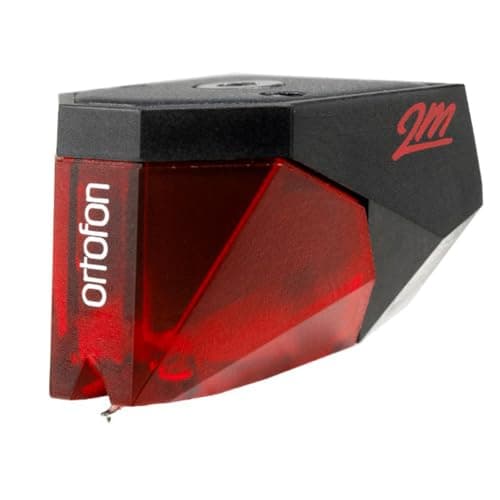
Ortofon 2M Red
A moving-magnet cartridge with an elliptical diamond and 5.5 mV output, universally compatible with half-inch mounts, and specified for the standard 47 kΩ load every phono stage provides. It is the default first upgrade from a factory conical for good reasons — and its strongest argument is that a 2M Blue stylus drops into the same body later without touching the alignment.
Strengths
- Refined elliptical stylus with a detailed, lively presentation
- Fit a 2M Blue stylus later for a drop-in upgrade
- A known quantity found on many respected decks
Trade-offs
- Higher tracking mass suits a mid-quality arm, not the flimsiest ones
- Some listeners find the top end a touch bright
| Type | Moving magnet (MM) |
|---|---|
| Stylus | Elliptical (replaceable) |
| Output | 5.5 mV |
| Tracking force | 1.6 - 2.0 g (1.8 g typical) |
| Mount | Standard 1/2-inch |
Specifications read from the manufacturer / product listing, accessed 2026-07-24. We have not measured this unit — what we do instead.
Price as of October 12, 2026. #ad How we’re funded
Why this cartridge is everywhere
The 2M Red occupies a specific position: it is the cartridge people are told to buy when they ask what to do first with a decent turntable. That recommendation has been repeated so often that it is worth checking whether it still holds up. Mostly it does, for three reasons that are all visible on the specification sheet.
It is an elliptical diamond.Most turntables under $300 ship with a conical stylus — a simple spherical tip that rides the center of the groove. An elliptical tip has two different radii: wider front-to-back, narrower side-to-side. The narrow side radius means it contacts the groove wall along a shorter vertical line, so it can follow modulation that is physically too small for a conical tip to enter. That is a real, mechanical difference, not a marketing one.
Its output is 5.5 mV.Ortofon publishes that figure, and it is on the generous side for a moving-magnet cartridge. High output means the cartridge works comfortably with cheap fixed-gain preamps, with the built-in stages in turntables, and with the phono inputs on powered speakers — it will not sound quiet on any of them.
It is made by a company that makes nothing else. Ortofon is a Danish specialist that has been building cartridges since 1948. That is not proof of anything on its own, but it does mean the 2M series is a designed range rather than an accessory line, which is what makes the upgrade path below possible.
The real argument: the stylus you fit later
Here is the thing the 2M Red is genuinely special for, and it is not about how it sounds today.
The 2M series shares a common cartridge body. The Red, Blue, Bronze and Black differ in their styli — the little replaceable assembly that clips onto the front. Buy a 2M Red, and later buy a 2M Blue stylus, and you have a 2M Blue. The old stylus pulls off, the new one pushes on. No screws, no lead wires, no protractor, no realignment.
Two consequences that change the buying decision:
- You can defer the expensive half.Buy the Red now, live with it, and upgrade the stylus when you want to — without another mounting job on your kitchen table.
- The upgrade is genuinely large. The 2M Blue uses a nudeelliptical diamond — the whole tip is diamond rather than a small diamond bonded to a metal shank. Less mass at the tip means better tracking of rapid modulation, which is most audible in the inner grooves.
The full arithmetic of that swap, including when it is worth doing, is in 2M Red vs 2M Blue.
What it needs from your turntable
Fitment is the question that stops most cartridge purchases, so check these three before ordering:
- A standard half-inch mount.Two screw holes 12.7 mm apart on the underside of the headshell. Every manual deck has this. Budget automatic decks with fixed arms do not.
- An adjustable counterweight.Ortofon specifies 1.6–2.0 g with 1.8 g recommended, and you cannot set that without one. A fixed-force arm is factory-matched to its own cartridge and cannot be re-dialed.
- A moving-magnet phono stage.Any of them — the 2M Red is specified for the universal 47 kΩ load, which is what every MM input provides.
Our cartridge fitment guide covers the exceptions in more detail, including P-mount and the automatic-deck problem.
Setting it up
The mounting job itself is small screws and four colored wires, and it is described step by step in how to set up a cartridge. Two 2M-specific notes:
Tracking force.1.8 g is the number. Zero-balance the arm first so the counterweight scale means something, then dial it — the procedure is in how to balance a tonearm. Below the range the stylus mistracks and does more damage than a heavy setting would; above it you add unnecessary wear.
Anti-skate.Set it to match the tracking force. The 2M body’s squared-off profile makes it easy to check alignment against a protractor’s grid lines, which is a small practical advantage over rounder-bodied cartridges.
Where it does not make sense
Three cases where the standard recommendation is wrong:
You already own an elliptical. If your deck came with an AT-VM95E or an Ortofon OM10, the 2M Red is a lateral move. Save the money towards a 2M Blue stylus, an AT-VM95ML, or a genuine step up.
Your turntable has a fixed arm.No counterweight means no way to set 1.8 g. Fit the manufacturer’s replacement stylusinstead — on some budget decks a better stylus for the existing cartridge is the entire available upgrade, and it is worth doing.
Your preamp is the weak link. A better cartridge feeding a poor phono stage is a mismatch. If you are running the built-in preamp in a cheap deck, a standalone stage may be the better first purchase.
Who should buy it
Buy the 2M Red if your deck has an adjustable arm and a conical cartridge; if you want an upgrade path you can take later without redoing the mounting; or if your phono stage is fixed-gain and you want a cartridge with output to spare.
Buy the AT-VM95Einstead if you want the longest and cheapest stylus ladder available — the VM95 range runs from conical to Shibata on one body. Compare them directly in AT-VM95E vs Ortofon 2M Red, and see the whole field in best turntable cartridges.
Frequently asked questions
Is the Ortofon 2M Red a good upgrade?
From a conical cartridge — the AT3600L or similar fitted to budget decks — yes, clearly. An elliptical diamond contacts the groove wall along a narrower vertical line, which retrieves high-frequency detail a conical tip physically cannot reach. From an existing elliptical like the AT-VM95E it is a sideways move rather than an upgrade.
What turntables does the Ortofon 2M Red fit?
Any turntable with a standard half-inch (two-screw) cartridge mount and an adjustable counterweight — which covers essentially every manual deck and a minority of automatics. It will not fit the fixed, non-adjustable arms on budget automatic turntables like the AT-LP60X.
What tracking force does the 2M Red need?
Ortofon specifies a range of 1.6-2.0 grams with 1.8 g recommended. Set it with the counterweight after zero-balancing the arm, and match anti-skate to the same figure. Guessing here is the fastest way to wear both the stylus and your records.
Can you upgrade a 2M Red to a 2M Blue?
Yes, and this is the cartridge's best feature. The 2M series shares a body, so fitting a 2M Blue stylus to a 2M Red body gives you a 2M Blue — no remounting, no realignment, no tools beyond your fingers. It is the cheapest genuine upgrade in vinyl.
What phono preamp does the Ortofon 2M Red need?
Any standard moving-magnet stage. Its 5.5 mV output is on the high side for an MM cartridge, so it works comfortably with fixed-gain budget preamps and with the built-in stages in turntables and powered speakers. It is specified for a 47 kΩ load, which is the universal MM standard.
Is the 2M Red better than the Audio-Technica AT-VM95E?
They are close competitors with different characters and similar capability — both elliptical, both moving magnet, both around the same price. The VM95E has the longer and cheaper stylus upgrade ladder; the 2M Red has the higher output and the well-known 2M Blue step. Our head-to-head comparison covers the detail.
Sources
- Ortofon — 2M Red — Manufacturer specs: 5.5 mV output, 1.6-2.0 g tracking (1.8 g recommended), 47 kOhm load (accessed July 24, 2026)
- Ortofon — 2M Blue — Manufacturer page for the nude elliptical 2M Blue and its stylus interchangeability (accessed August 11, 2026)
- Crutchfield — Phono cartridge guide — Reference on cartridge types, styli and mounting (accessed July 24, 2026)
- Elusive Disc — Turntable setup guide: tracking force & anti-skate — Step-by-step on balancing the tonearm, setting tracking force and anti-skate (accessed July 24, 2026)
Keep reading
Ortofon 2M Blue Review
The rung above this one: 25 dB of separation against 22, and the same 7.2 g to check against your arm.
Read the reviewEssential Jazz Records on Vinyl
Acoustic material is where a cartridge like this shows its work.
See the picksOrtofon 2M Red vs 2M Blue
The stylus-swap upgrade this cartridge is built around.
Read the comparisonAT-VM95E vs Ortofon 2M Red
The other cartridge on every upgrade shortlist, head to head.
Read the comparisonBest Turntable Cartridges
Where the 2M Red sits in the wider field.
See the picksHow to Set Up a Cartridge
Mounting, alignment and tracking force, in order.
Read the guide