PLATTER & PLINTH

The Best Headphones for Vinyl

A turntable cannot drive headphones. So the question is not which pair sounds best — it is which pair the socket you already own can actually drive.

By Stephen V.Last updated How we pick

The verdict

The Sennheiser HD 599 is the pick for most people listening to records on headphones — it is open-backed and over-ear, and Sennheiser publishes 50 ohms with 106 dB SPL at 1 kHz / 1 Vrms, which is the combination that lets the headphone socket on an ordinary receiver or phono preamp drive it to a real listening level with nothing else bought. If someone else is in the room, the beyerdynamic DT 770 PRO (80 Ohm) is the closed-back answer at the same kind of money. And if $30 is the budget, the Koss KPH30i is not a consolation prize: 60 ohms and a published 101 dB SPL means it goes loud from anything.

Start with the thing most headphone roundups skip, because it is the thing that decides whether your purchase works. A turntable’s output — phono or line — cannot drive headphones. There is no headphone socket on a Fluance RT81, an Audio-Technica AT-LP120XUSB or a Pro-Ject Debut, and there is nothing wrong with any of them. The signal has to pass through something with a headphone amplifier in it first: a receiver with a front-panel jack, a phono stage that includes a headphone output, or a dedicated headphone amp. Our guide to listening to vinyl with headphones walks through the three routes and what each one costs.

That is why this page is organized around two published numbers rather than around adjectives. Impedance, in ohms, is how hard the pair is to drive. Sensitivity, in dB, is how loud it goes for a given input. A 250-ohm pair and a 50-ohm pair can measure identically on a bench and behave completely differently on the back of a $200 receiver — one plays, one whispers. Every figure below is the maker’s own, read from the maker’s own page on the date in the sources block, and where a maker publishes nothing we say so instead of borrowing a number from a forum.

Second thing worth saying out loud: open or closedmatters more to your household than to your ears. Open-backed pairs sound larger and leak in both directions. Closed pairs isolate and sound smaller. For records — where the point is often a whole side in one sitting, at night — that is a domestic decision as much as an audio one.

How this is funded: we earn a commission if you buy through our links, at no extra cost to you. It never changes which product we recommend, and we’ll tell you plainly when to skip one. Full disclosure.

Quick picks

Ranked on published specs, drive/motor design and buyer fit. Select a row to jump to the full write-up. We have not heard most of these units — here is exactly what we do instead.

#ProductBest forPrice
1
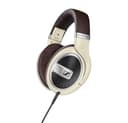
Sennheiser HD 599

Sennheiser HD 599

The pair that needs nothing else. Sennheiser publishes 50 ohms and 106 dB SPL at 1 kHz / 1 Vrms, which is the combination that lets the headphone jack on a receiver or a phono preamp drive it properly — and an open-back, over-ear design is what makes a record sound like a room rather than two drivers strapped to your head.

Best overall
$226.73 · View on Amazon

$239.956% off

Price as of October 21, 2026. #ad How we’re funded

2
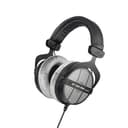
beyerdynamic DT 770 PRO (80 Ohm)

beyerdynamic DT 770 PRO (80 Ohm)

The closed-back answer, and the one to buy if anyone else is in the room. beyerdynamic publishes 5 Hz - 35,000 Hz, 80 ohms and 96 dB nominal SPL, with replaceable velour pads and a spring-steel headband on a pair that has been in continuous production long enough to have a parts supply.

Best closed-back
$199.99 · View on Amazon

Price as of October 21, 2026. #ad How we’re funded

3
beyerdynamic DT 990 PRO (250 Ohm)

beyerdynamic DT 990 PRO (250 Ohm)

The open-back sibling of the DT 770, sold here in its 250-ohm form — which is the point and the warning in the same sentence. Given a headphone amplifier or an interface it is one of the most revealing pairs at this money; given the headphone socket on a $200 receiver it will simply play quietly.

Best with a headphone amp
$199.99 · View on Amazon

Price as of October 21, 2026. #ad How we’re funded

4
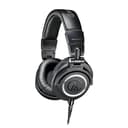
Audio-Technica ATH-M50x

Audio-Technica ATH-M50x

The most-recommended closed-back pair of the last decade, and the one that folds flat into a bag. What the listing publishes is the construction — 45 mm large-aperture drivers with rare-earth magnets, copper-clad aluminum voice coils, a detachable cable and 90-degree swiveling earcups. What it does not publish is a single electrical figure, which is why this card quotes none.

Best for packing away
$159.00 · View on Amazon

Price as of October 21, 2026. #ad How we’re funded

5
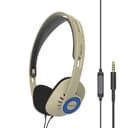
Koss KPH30i

Koss KPH30i

The cheapest thing on this site that is genuinely worth owning. Koss publishes 15 Hz - 25,000 Hz, 60 ohms and 101 dB SPL for an open-air on-ear pair that costs less than a single record — and the limited lifetime warranty means a broken headband is a replacement rather than a landfill.

Best under $50
$29.99 · View on Amazon

Price as of October 21, 2026. #ad How we’re funded

The picks in full

#1Best overall

Sennheiser HD 599

The pair that needs nothing else. Sennheiser publishes 50 ohms and 106 dB SPL at 1 kHz / 1 Vrms, which is the combination that lets the headphone jack on a receiver or a phono preamp drive it properly — and an open-back, over-ear design is what makes a record sound like a room rather than two drivers strapped to your head.

Strengths

  • 50 ohms with a published 106 dB SPL at 1 Vrms - loud enough from an amplifier's own headphone output, with no separate headphone amp to buy
  • Published 12 Hz - 38,500 Hz and under 0.1% THD at 100 dB SPL
  • Two detachable cables in the box: 3 m with a 6.3 mm plug for the rack, 1.2 m with a 3.5 mm for everything else

Trade-offs

  • Open-back leaks in both directions - the room hears your record and you hear the room
  • 250 g of plastic and velour at a price where closed-back rivals feel more expensive in the hand
  • The listing we can verify as live is the Ivory finish; the black version comes and goes
TypeOpen-back, over-ear (circumaural)
Frequency response12 Hz - 38,500 Hz
Impedance50 ohms
Sensitivity106 dB SPL (1 kHz / 1 Vrms)
THD< 0.1% (1 kHz, 100 dB SPL)
CablesDetachable: 3 m / 6.3 mm and 1.2 m / 3.5 mm
Weight250 g

Note. Sennheiser's specification table lists the two cable lengths above while the what's-in-the-box section of the same page describes a single 1.80 m cable. We have quoted the specification table and flagged the discrepancy rather than picking the figure that reads better.

Specifications read from the manufacturer / product listing, on October 19, 2026. “Not published” means the maker does not state that figure.

#2Best closed-back

beyerdynamic DT 770 PRO (80 Ohm)

The closed-back answer, and the one to buy if anyone else is in the room. beyerdynamic publishes 5 Hz - 35,000 Hz, 80 ohms and 96 dB nominal SPL, with replaceable velour pads and a spring-steel headband on a pair that has been in continuous production long enough to have a parts supply.

Strengths

  • Closed-back: nothing leaks out, so the record is yours and the room stays quiet
  • Published 5 Hz - 35,000 Hz and 96 dB nominal SPL at 80 ohms
  • Replaceable grey velour pads - the one part that wears out is a part you can buy

Trade-offs

  • Fixed 3 m straight cable: not detachable, so a cable fault is a repair rather than a swap
  • 80 ohms is still a real load - it plays from a laptop, but beyerdynamic's own listing says it sounds best from an interface or a headphone amp
  • Closed cups and velour get warm over a full LP side
TypeClosed-back, over-ear (circumaural)
Frequency response5 Hz - 35,000 Hz
Impedance80 ohms nominal
Sensitivity96 dB nominal SPL
Ear padsReplaceable grey velour
CableStraight 3 m, 3.5 mm plug with 6.35 mm adapter
Weight375 g including cable

Note. beyerdynamic publishes no THD and no power-handling figure for this model, so neither appears above. The 80-ohm version is what this listing sells; the 250-ohm DT 770 PRO is the same cabinet with a different load, and it is not interchangeable in practice - 250 ohms from a receiver jack is quiet.

Specifications read from the manufacturer / product listing, on October 19, 2026. “Not published” means the maker does not state that figure.

#3Best with a headphone amp

beyerdynamic DT 990 PRO (250 Ohm)

The open-back sibling of the DT 770, sold here in its 250-ohm form — which is the point and the warning in the same sentence. Given a headphone amplifier or an interface it is one of the most revealing pairs at this money; given the headphone socket on a $200 receiver it will simply play quietly.

Strengths

  • Open-back, with the same published 5 Hz - 35,000 Hz range and 96 dB nominal SPL as the closed DT 770
  • A 250-ohm load is easy on an amplifier's output stage and shrugs off a long cable run
  • Velour pads and a coiled 3 m cable, both replaceable, on a design that predates most of its rivals

Trade-offs

  • 250 ohms needs real drive - this is the one pick here that we would not buy without an amplifier or interface in hand
  • Open-back AND bright: it leaks, and it is the least forgiving pair on this page with a worn stylus
  • The coiled cable is heavy and it is not detachable
TypeOpen-back, over-ear (circumaural)
Frequency response5 Hz - 35,000 Hz
Impedance250 ohms (the version this listing sells - see note)
Sensitivity96 dB nominal SPL
Ear padsReplaceable velour
CableCoiled 3 m, 3.5 mm plug with 6.35 mm adapter
Weight250 g without cable

Note. beyerdynamic's DT 990 PRO page carries ONE technical-data table for the family and prints 80 ohms in it, while selling the 250-ohm version separately and naming a "coiled cable (250 ohms)" in its own comparison section. The Amazon listing is explicitly the 250-ohm model, so that is the figure quoted here - with the caveat that the maker does not break the impedance row out per version.

Specifications read from the manufacturer / product listing, on October 19, 2026. “Not published” means the maker does not state that figure.

#4Best for packing away

Audio-Technica ATH-M50x

The most-recommended closed-back pair of the last decade, and the one that folds flat into a bag. What the listing publishes is the construction — 45 mm large-aperture drivers with rare-earth magnets, copper-clad aluminum voice coils, a detachable cable and 90-degree swiveling earcups. What it does not publish is a single electrical figure, which is why this card quotes none.

Strengths

  • 45 mm large-aperture drivers with rare-earth magnets and copper-clad aluminum voice coils, per the listing
  • Detachable cable and 90-degree swiveling earcups - the pair on this page that packs down
  • Professional-grade pads and headband material, replaceable as service parts

Trade-offs

  • Audio-Technica publishes no impedance, sensitivity or frequency-response figure on the listing we cite, and its own spec page refuses an automated request - so its electrical load is the one thing on this page we cannot verify
  • Closed-back and fairly tight: the soundstage is smaller than any open pair here
  • The bass lift that made it a studio favorite is not neutral, and a warm pressing can get warmer
TypeClosed-back, over-ear (circumaural)
Drivers45 mm large-aperture, rare-earth magnets, copper-clad aluminum voice coils
ImpedanceNot published on this listing
SensitivityNot published on this listing
Frequency responseNot published on this listing
CableDetachable
Earcups90-degree swiveling, collapsible

Note. Audio-Technica's own product pages return 403 to an automated fetch - this site has recorded the same behavior on three previous runs - so this table is read from the Amazon listing alone and every figure that listing does not print is marked NOT PUBLISHED rather than borrowed from a third party. Treat the M50x here as the build-and-portability pick whose electrical specification we have not been able to cite.

Specifications read from the manufacturer / product listing, on October 19, 2026. “Not published” means the maker does not state that figure.

#5Best under $50

Koss KPH30i

The cheapest thing on this site that is genuinely worth owning. Koss publishes 15 Hz - 25,000 Hz, 60 ohms and 101 dB SPL for an open-air on-ear pair that costs less than a single record — and the limited lifetime warranty means a broken headband is a replacement rather than a landfill.

Strengths

  • Published 15 Hz - 25,000 Hz and 101 dB SPL at 60 ohms: efficient enough for any headphone socket
  • Open-air on-ear design, under an ounce on the head, with a limited lifetime warranty
  • Costs less than most replacement styli

Trade-offs

  • On-ear foam pads with no isolation at all - it leaks like a small speaker
  • Koss publishes no driver size, no THD and no weight, so three rows of its table are simply absent
  • The in-line microphone and remote are on the cable whether you want them or not
TypeOn-ear, open-air
Frequency response15 Hz - 25,000 Hz
Impedance60 ohms
Sensitivity101 dB SPL (condition not published)
Cable4 ft, 3.5 mm, with in-line microphone and remote
WarrantyLimited lifetime

Note. Koss states 101 dB SPL without printing the measurement condition, so it cannot be lined up against Sennheiser's 106 dB at 1 Vrms as though the two were the same test. What the 60-ohm rating does tell you is that this pair will go loud from anything with a headphone socket.

Specifications read from the manufacturer / product listing, on October 19, 2026. “Not published” means the maker does not state that figure.

How these were ranked

  • Impedance against the socket you own.Three of these pairs sit between 50 and 80 ohms, which is the band an amplifier’s own headphone output handles without complaint. One is 250 ohms, and it is ranked as what it is: the pick for someone who already has a headphone amp or an audio interface, not a general recommendation.
  • Sensitivity with its condition attached.Sennheiser publishes 106 dB SPL at 1 kHz / 1 Vrms. Koss publishes 101 dB SPL and no condition at all. beyerdynamic publishes 96 dB “nominal”. Those are not the same test, so this page does not rank them against each other as though a bigger number automatically wins.
  • What the maker publishes, not what the internet repeats. Audio-Technica’s own pages refuse an automated request, as they have on three previous runs here, so the ATH-M50x card quotes the construction its Amazon listing prints and marks impedance, sensitivity and frequency response as not published. It is ranked lower for exactly that reason.
  • Whether the parts that wear out can be replaced. Velour pads flatten and cables fail. Both beyerdynamic pairs take replaceable pads; the Sennheiser and the Audio-Technica take a detachable cable; the Koss is covered by a limited lifetime warranty. A pair you can repair is a pair you keep.
  • Wired only. No Bluetooth pair is on this page. A record is an analog signal; sending it through a lossy codec to put it back into your ears is a convenience, not an upgrade, and if that is the setup you want, the answer is a Bluetooth turntable rather than a specific pair of cans.

What will actually drive these

A headphone socket is not a standard. The one on a $200 receiver and the one on a dedicated amplifier differ by an order of magnitude in output, and that gap is where most disappointing headphone purchases live. Three routes work for records, in rising order of cost:

Route one: the headphone jack on a receiver or integrated amplifier

If the turntable already runs into a stereo receiver, the jack on the front is the free option, and for the 50 to 80-ohm pairs here it is usually enough. This is the route the HD 599 was picked for. Our amplifier roundup flags which models publish a headphone output; the Sony STR-DH190 is the obvious example, because it has both a phono input and a full-size headphone jack, so one box covers the whole chain.

Route two: a phono stage with a headphone amplifier inside

The neatest answer for a deck that feeds powered speakers, because nothing in that chain has a headphone socket anywhere. A phono preamp with a headphone output takes the cartridge signal, applies the RIAA curve and drives the headphones directly. See our phono preamp picks, and read the headphone-output row before you buy: most boxes in that roundup do not have one.

Route three: a dedicated headphone amplifier after a line output

The route the DT 990 PRO (250 Ohm) needs. A 250-ohm load asks for voltage swing that a receiver jack often cannot deliver, and the symptom is not distortion but simple quietness — you turn it up, it does not get loud, and you conclude the headphones are bad. They are not. They are unamplified.

Where headphones genuinely beat speakers for records

Two places, and they are worth being specific about. The first is surface noise: headphones put you closer to it. A pressing that sounds clean across the room will reveal its ticks and its groove wear on a decent pair of open-backed cans, which is useful if you are grading used records and unwelcome if you were enjoying them. Our guide on how to spot a bad pressing is easier to follow with headphones on.

The second is the room. A pair of speakers is playing your room as much as your record, and most rooms are not good. Headphones remove the room from the equation entirely, which is why a $200 pair of headphones can out-resolve a $600 pair of speakers in a bad space — and why speaker placement is the cheapest upgrade available to anyone who prefers speakers.

What headphones cannot fix is anything upstream. A worn stylus sounds worse on headphones, not better, because you are closer to it. If a record is distorting on sibilants or the inner grooves are a mess, the problem is at the end of the tonearm and no pair on this page will hide it — see how often to replace a stylus.

Open against closed, decided properly

Three of these five are open: the HD 599, the DT 990 PRO and the Koss. Two are closed: the DT 770 PRO and the ATH-M50x. The useful way to choose is not soundstage versus isolation in the abstract, but these three questions.

  • Is anyone else in the room? Open-backed headphones are audible from a few feet away at listening volume. beyerdynamic says so plainly in its own listing copy for the DT 990 PRO: the sound is audible to others. If a partner is asleep or working, that settles it.
  • Is the room noisy? Open pairs let noise in as well as out. A dishwasher two rooms away is part of the mix.
  • Do you want to hear the record or inspect it? Open designs are generally the more revealing of the two at a given price, which cuts both ways on a used pressing.

Three things not to spend money on yet

A headphone DAC. Vinyl is analog from groove to ear; there is no digital stage in the chain to improve. A DAC only enters the picture if you are recording the deck to a computer, which our recording guide covers.

An exotic cable. The detachable cables on the Sennheiser and the Audio-Technica are worth having because they make a cable fault a $20 problem instead of a repair. That is the whole argument for them.

A second pair “for bass”. If the low end sounds thin on every record, suspect the chain before the headphones: a phono-level signal plugged into a line input gives exactly that symptom, with the RIAA curve left unreversed. Our phono versus line explainer has the three-fault diagnostic.
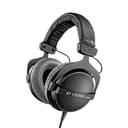
Frequently asked questions

What are the best headphones for listening to vinyl?

The Sennheiser HD 599 for most people: it is open-backed and over-ear, and Sennheiser publishes 50 ohms with 106 dB SPL at 1 kHz / 1 Vrms, so an ordinary receiver or phono preamp headphone socket can drive it properly. For a shared room, the beyerdynamic DT 770 PRO (80 Ohm) is the closed-back pick at similar money. For under $50, the Koss KPH30i publishes 60 ohms and 101 dB SPL, which is efficient enough for any headphone output.

Can I plug headphones directly into my turntable?

Almost never. A turntable's output - phono or line - has no headphone amplifier behind it, and most decks have no headphone socket at all. The signal has to pass through a receiver with a headphone jack, a phono preamp that includes a headphone output, or a dedicated headphone amplifier. A handful of all-in-one players do include a socket; a component turntable does not.

Do I need a headphone amp for vinyl?

It depends entirely on the impedance of the pair you buy. At 50 to 80 ohms - the Sennheiser HD 599, the beyerdynamic DT 770 PRO (80 Ohm), the Koss KPH30i at 60 ohms - the headphone output on a normal receiver or phono stage is usually enough. At 250 ohms, as on the DT 990 PRO sold here, a dedicated headphone amp or an audio interface is effectively required: the failure mode is not distortion, it is that the pair never gets loud.

Open-back or closed-back headphones for records?

Open-back if you listen alone in a quiet room: the presentation is larger and generally more revealing at the same price. Closed-back if anyone else is in the room, because open pairs are clearly audible from a few feet away at listening volume - beyerdynamic states this in its own product copy. Three of our five picks are open and two are closed, and the choice is more domestic than audiophile.

Will headphones make a cheap turntable sound better?

They will make it sound clearer, which is not the same thing. Headphones remove the room from the chain, so a modest deck can sound surprisingly good on them. But they also put you closer to surface noise, mistracking and stylus wear - so a worn stylus or a deck with a fixed ceramic cartridge gets more obvious, not less. Fix the stylus first.

Are wireless headphones worth it for vinyl?

Only for convenience. A record is an analog signal, and sending it over Bluetooth means digitizing it, compressing it with a lossy codec and converting it back - all of which can be fine, none of which is an upgrade. If wireless is the priority, the cleaner approach is a Bluetooth turntable transmitting to whatever headphones you already own, rather than choosing a pair for its codec support.

Why do the sensitivity figures on this page look so different?

Because they are different measurements. Sennheiser publishes 106 dB SPL at 1 kHz / 1 Vrms, a voltage-referenced figure. Koss publishes 101 dB SPL with no condition stated. beyerdynamic publishes 96 dB as a nominal figure. A dB/mW number and a dB/V number for the same pair of headphones can differ by more than 10 dB, so we quote each maker's condition and decline to rank them as if the figures were comparable.

Why is the Audio-Technica ATH-M50x ranked fourth?

Because we cannot verify its electrical specification. Audio-Technica's own product pages return an error to an automated request, and the Amazon listing we cite publishes the construction - 45 mm large-aperture drivers, rare-earth magnets, copper-clad aluminum voice coils, a detachable cable - but no impedance, sensitivity or frequency-response figure. It is a well-built, portable closed-back pair; it is ranked below pairs whose published numbers we can show you.

Sources

  • Sennheiser — HD 599, published specifications — The maker's own table for SKU 506831, read live on this date: acoustic principle "open", ear coupling "Over-Ear", frequency response "12 Hz to 38,500 Hz", impedance "50 Ohm", sound pressure level "106dB SPL (1kHz/1Vrms)", THD "< 0.1% (1kHz, 100dBSPL)", weight "250 g", and connectors "1: 6.3mm 2: 3.5mm detachable". Note the discrepancy inside Sennheiser's own page: the specification table lists cable lengths "1: 3m 2: 1.2m" while the what's-included section describes a single "1.80 m detachable cable". The 1 Vrms condition on the 106 dB figure is what makes it comparable with another maker's voltage-referenced number and NOT with a dB/mW figure (accessed October 19, 2026)
  • beyerdynamic — DT 770 PRO, published specifications — Read live on this date for the closed-back pick: operating principle "Closed", frequency response "5 - 35.000 Hz", nominal impedance "80 ohms", nominal sound pressure level "96 dB", "Soft, circumaural and replaceable ear pads" in grey velour for the 80 and 250 ohm versions, cable "Straight connecting cable with mini-jack plug (3.5 mm) & 1/4\" adapter (6.35 mm)", weight "375 grams, including the cable". beyerdynamic publishes NO THD and NO power-handling figure for this model, which is why neither appears on this site (accessed October 19, 2026)
  • beyerdynamic — DT 990 PRO, published specifications — The open-back sibling, read the same day. Published: operating principle "Open", frequency response "5 - 35.000 Hz", nominal sound pressure level "96 dB", soft replaceable circumaural velour pads, weight "250 g" without cable. IMPORTANT for any future run: this page carries ONE technical-data table for the whole DT 990 PRO family and prints "80 ohms" in it, while separately offering a 250-ohm version and naming "Coiled cable (250 ohms)" in its own comparison section. beyerdynamic does not break the impedance row out per version, so the 250-ohm figure this site quotes is the variant named on the retail listing, not a second maker table (accessed October 19, 2026)
  • Koss — KPH30i, published specifications — Koss's own product page, read live on this date: frequency response "15-25,000 Hz", impedance "60 Ohms", "101 dB SPL" with no measurement condition stated, a "4 foot" cable, an "open-air design" on-ear fit, an in-line microphone and remote, and a limited lifetime warranty. Koss publishes no driver size, no THD and no weight - three rows this site therefore leaves absent rather than estimating (accessed October 19, 2026)

Keep reading