PLATTER & PLINTH

The Best Polk Speakers for a Turntable

Polk builds easy-to-drive speakers at prices that leave money for the rest of the system — which is exactly the trade a record setup wants.

By Stephen V.Last updated How we pick

The verdict

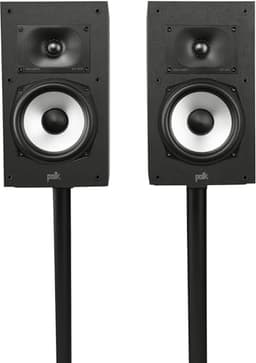
The Polk Monitor XT20 is the Polk pair to buy for a turntable. It is the bookshelf pair in the Monitor XT line, and a standmount is the right shape for a record system: it goes on stands beside the deck rather than on the floor. Polk publishes a 6.5-inch woofer and a 4- and 8-ohm operating rating for it — a bigger cone than most bookshelf rivals at the money, in a pair any modest integrated amplifier is comfortable with. It is for a listener with an amplifier and a pair of stands. If the room is larger and the speakers are going on the floor anyway, the Polk Monitor XT60 is the tower in the same line and often costs less than the bookshelf pair. The budget pick is the Polk T15, the cheapest Polk we rank and still a real passive pair rather than a compromise.

Polk Audio Monitor XT20

Best Polk for vinyl

Polk Audio Monitor XT20

$219.00 · View on Amazon

$279.0022% off

Price as of November 22, 2026. #ad How we’re funded

Polk sits in a useful place for anyone building a record system. Every pair here is passive— drivers and a cabinet, needing an amplifier and a phono stage elsewhere in the chain — and all three are priced low enough that the amplifier is still affordable afterwards. On a five-purchase system (deck, cartridge, phono stage, amplifier, speakers) that balance matters more than any single specification.

This page ranks them on what decides your next purchase: the drivers, the impedancerating — how hard the pair is to drive — and, where Polk publishes it, sensitivity, which is how much sound you get per watt. Polk prints a full specification table for the XT60 and a much shorter one for the other two, so several cells below read “Not published”. Every figure here is Polk’s own; none is borrowed from a retailer to fill a gap.

Read the sensitivity figures against each other and not against another maker. Polk, Klipsch and ELAC do not all quote on the same test, which is why our bookshelf roundup keeps each number next to its condition instead of sorting one column. Within one brand’s own range the comparison is clean, and that is what this page is for.

How this is funded: we earn a commission if you buy through our links, at no extra cost to you. It never changes which product we recommend, and we’ll tell you plainly when to skip one. Full disclosure.

Quick picks

Ranked on published specs, drive/motor design and buyer fit. Select a row to jump to the full write-up. We have not heard most of these units — here is exactly what we do instead.

#ProductBest forPrice
1
Polk Audio Monitor XT20

Polk Audio Monitor XT20

A 6.5-inch dynamically balanced woofer and a one-inch tweeter, rated for 4- and 8-ohm operation. The big woofer buys low-end weight that the 5-inch competition can't match, which suits bass-heavy pressings and rooms where a subwoofer isn't welcome.

Best overall
$219.00 · View on Amazon

$279.0022% off

Price as of November 22, 2026. #ad How we’re funded

2
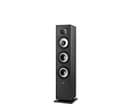
Polk Audio Monitor XT60

Polk Audio Monitor XT60

The cheapest way into a tower from a maker with a fifty-year speaker catalog, and the only one here that gets its bass from passive radiators rather than a port. Polk publishes 38 Hz - 40 kHz from a single 6.5-inch woofer loaded by two 6.5-inch passive radiators, which is how a 20-lb cabinet reaches as low on paper as the 41-lb Klipsch.

Best floorstanding
$229.00 · View on Amazon

Price as of November 22, 2026. #ad How we’re funded

3
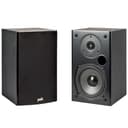
Polk Audio T15

Polk Audio T15

A 5.25-inch Dynamic Balance driver and a 0.75-inch tweeter from a brand with fifty years of speaker-building behind it, at a price that undercuts most of the field. Polk sells it into home theater, but as a stereo pair on the end of a turntable it is one of the safest sub-$150 buys there is.

Budget pick
$112.00 · View on Amazon

$149.0025% off

Price as of November 22, 2026. #ad How we’re funded

The picks in full

#1Best overall

Polk Audio Monitor XT20

A 6.5-inch dynamically balanced woofer and a one-inch tweeter, rated for 4- and 8-ohm operation. The big woofer buys low-end weight that the 5-inch competition can't match, which suits bass-heavy pressings and rooms where a subwoofer isn't welcome.

Strengths

  • 6.5" woofer gives noticeably more low-end body than 5" rivals
  • Rated for both 4- and 8-ohm amplifiers, so pairing is forgiving
  • Timbre-matched to the rest of the Monitor XT range if the system grows

Trade-offs

  • Designed and marketed primarily for home theater — voicing leans toward impact over delicacy
  • The larger cabinet needs more shelf depth than a 5-inch pair
TypePassive 2-way bookshelf
Woofer6.5" dynamically balanced
Tweeter1"
Impedance4 and 8 ohm compatible
PlacementBookshelf or stand
Built-in preampNo — passive

Note. Polk sells these into home-theater systems, so listings talk about Atmos and surround. Ignore that: as a stereo pair on the end of a turntable and a small amp, they are simply a big-woofer bookshelf speaker at a fair price.

Specifications read from the manufacturer / product listing, on August 11, 2026. “Not published” means the maker does not state that figure.

#2Best floorstanding

Polk Audio Monitor XT60

The cheapest way into a tower from a maker with a fifty-year speaker catalog, and the only one here that gets its bass from passive radiators rather than a port. Polk publishes 38 Hz - 40 kHz from a single 6.5-inch woofer loaded by two 6.5-inch passive radiators, which is how a 20-lb cabinet reaches as low on paper as the 41-lb Klipsch.

Strengths

  • Two 6.5-inch passive radiators instead of a port, so there is no port noise and less wall sensitivity
  • 38 Hz - 40,000 Hz published and Hi-Res Audio certified, at the lowest price on this page
  • Polk publishes a recommended amplifier range — 25 to 200 W per channel — which most makers here do not

Trade-offs

  • Sold as ONE speaker, and at this price that is the easiest mistake on the page to make
  • 86 dB at 1 W / 1 m — the joint-lowest sensitivity here, so a flea-watt amplifier is not enough
  • A single 6.5-inch active woofer doing bass and midrange both; the ELAC and the Fluance split those jobs
TypePassive 2-way floorstander with twin passive radiators
Sold asSingle speaker
Woofer1 x 6.5" bi-laminate paper
Passive radiators2 x 6.5"
Tweeter1" Terylene dome
Frequency response38 Hz - 40,000 Hz
Sensitivity86 dB (1 W @ 1 m)
ImpedanceCompatible with 4 and 8 ohm outputs
Crossover2,200 Hz
Recommended amplifier25 - 200 W per channel
Cabinet36.4" H x 7.5" W x 9.09" D, 20 lbs each

Note. A passive radiator is a driver with no motor — the powered woofer drives it through the air trapped in the cabinet. It buys low-end extension from a small box without cutting a port, which is why this is the tower here you can place nearest a wall.

Specifications read from the manufacturer / product listing, on October 3, 2026. “Not published” means the maker does not state that figure.

#3Budget pick

Polk Audio T15

A 5.25-inch Dynamic Balance driver and a 0.75-inch tweeter from a brand with fifty years of speaker-building behind it, at a price that undercuts most of the field. Polk sells it into home theater, but as a stereo pair on the end of a turntable it is one of the safest sub-$150 buys there is.

Strengths

  • Established speaker maker rather than a marketplace brand at this price
  • 5.25" Dynamic Balance driver gives more low-end body than the 4" competition
  • Wall-mountable, and easy for any amplifier to drive

Trade-offs

  • 0.75" tweeter is smaller than the 1" domes on the step-up pairs, and the top end is less airy for it
  • Voiced and marketed for home theater — competent rather than refined on music
TypePassive 2-way bookshelf
Woofer5.25" Dynamic Balance
Tweeter0.75"
Power handling100 W
MountingWall-mountable
Built-in preampNo — passive

Note. Polk's marketing talks about 5.1 systems and surround expansion. Ignore it — bought as a stereo pair for a turntable, this is simply a well-made budget bookshelf speaker from a maker with a long track record.

Specifications read from the manufacturer / product listing, on August 12, 2026. “Not published” means the maker does not state that figure.

How these were ranked

  • What Polk publishes, model by model — and it is not the same for each. Polk prints a full table for the XT60: 38 Hz – 40 kHz, a sensitivity figure, a nominal impedance, a crossover point and a recommended amplifier range. For the XT20 and the T15 it publishes the drivers and the impedance or power handling and no sensitivity and no frequency response at all. Those rows read “Not published” in the table below rather than carrying a number borrowed from a retailer, and it is why the tower is the only pick here we can argue on measurement.
  • Impedance, as published.A nominal rating tells you what the amplifier has to be comfortable with — the XT20 is rated for 4- and 8-ohm operation, a wider tolerance than most pairs at the price. Nobody in this class publishes a full impedance curve, so the minimum dip is unknown for all three and the table does not pretend otherwise.
  • Shape against the room. For records specifically, a standmount on stands beats a tower on the floor more often than people expect: it gets the tweeter to ear height and gets the cabinet off the same surface as the turntable, which removes a real acoustic feedback path. That is why the bookshelf pair is ranked first even where the tower costs less.
  • Live price at the last refresh, with the as-of date on every button. Prices in this line move around, and the ranking here is on specification rather than on which pair is cheapest this week.

What these still need

All three are passive, so the price on the button is not the price of a system. Each needs an amplifier, and the signal needs exactly one phono stagebetween the cartridge and that amplifier — in the deck, in the amplifier, or in its own box. Two in series is the most common wiring mistake in vinyl and it sounds like distorted mud.

The cheapest honest route is an integrated amplifier that includes a phono input, so one box covers both jobs; our amplifier picks flag which models publish one. If you would rather not buy an amplifier at all, Polk is the wrong brand for you and a powered pair with a phono input is the right answer — fewer boxes, less money, a lower ceiling.

Budget for standswith the bookshelf pairs. On a sideboard the tweeter sits well below ear height, and a stand is the cheapest meaningful improvement available once the speakers are chosen — ahead of any cable.

Polk against the alternatives at the same money

Against Klipsch, the difference is the tweeter. Klipsch uses a horn-loaded design with very high published sensitivity, which is forward and detailed and unforgiving of a worn stylus or a noisy pressing. Polk’s dome-tweeter designs are the gentler listen, which on a collection of second-hand records is a genuine advantage rather than a weakness. Our Klipsch roundup covers that side.

Against ELAC, the trade is price against cabinet. The ELAC Debut 2.0 B5.2 in our under-$500 picks is a denser, heavier box; the Polk pairs are easier to drive and leave more of the budget for the amplifier. Neither is wrong, and the deciding question is usually whether the amplifier is already bought.

Against a powered pair, Polk is the better speaker and the worse system. That is the honest framing for every passive recommendation on this site: you are buying something that upgrades — change the amplifier, change the phono stage, keep the speakers for twenty years — at the cost of needing more boxes on day one.

What the deck in front of them should be

Anything with an adjustable counterweight and an elliptical cartridge is a fair match for a dome-tweeter pair at this money. Our picks under $500 are the band that pairs naturally, and the belt-drive picks cover the decks whose motor isolation suits a quiet listening setup.
Frequently asked questions

What is the best Polk speaker for a turntable?

The Polk Monitor XT20, the bookshelf pair in the Monitor XT line. A standmount is the right shape for a record system - on stands it puts the tweeter at ear height and gets the cabinet off the turntable's own furniture, which removes a feedback path. Polk publishes a 6.5-inch woofer and 4- and 8-ohm operation for it, a bigger cone than most bookshelf rivals at the money. Note that Polk does not publish a sensitivity figure for this model, only for the XT60 tower.

Do Polk speakers need an amplifier?

Yes. Every Polk pair on this page is passive: drivers and a cabinet, with no amplification and no phono stage inside. A turntable cannot connect to them directly. You need an amplifier, and a phono stage has to exist exactly once between the cartridge and that amplifier - in the deck, in the amplifier, or in a separate box.

Polk or Klipsch for vinyl?

Klipsch if you want detail and have a low-power amplifier - its horn-loaded tweeters publish very high sensitivity. Polk if your records are mostly second-hand, because a dome tweeter is the more forgiving listen and a horn exposes groove wear and surface noise. Both are easy enough to drive that a modest integrated amplifier is enough.

Is a tower speaker better than a bookshelf pair for records?

Not usually, and this surprises people. A tower puts more cabinet in the room and reaches lower, but vinyl carries little energy below about 40 Hz by design, so the extra depth is mostly headroom. A bookshelf pair on stands gets the tweeter to ear height and off the turntable's surface, which matters more for a record system than the bottom octave does.

How much amplifier power do Polk speakers need?

Less than the power-handling numbers suggest, because those are tolerances rather than requirements. Polk publishes a recommended amplifier range only for the XT60; for the XT20 and T15 it publishes no sensitivity figure at all, so the honest answer is that a competent 20 to 40 W integrated amplifier is the normal pairing at this price, and a 4-ohm-capable one is the safer choice for the XT20. Spending heavily on amplifier power is one of the least effective upgrades in a record system.

Can I compare Polk's sensitivity figures with Klipsch's?

Only loosely, and on this page mostly not at all - Polk publishes a sensitivity figure for the XT60 and none for the XT20 or T15. Even where both makers print one they do not quote on the same test: Klipsch publishes at 2.83 V / 1 m half-space anechoic and other brands use different references, so a one or two decibel gap across brands can be a measurement artifact. Compare within a brand's own range, not across.

Sources

  • Polk Audio — Monitor XT60 floor-standing tower speaker, published specifications — Polk's own product page and specification table: drivers "(1) 1" (2.54 cm) Terylene Dome Tweeter" and "(1) 6.5" (16.51 cm) Bi-laminate Paper Woofer" plus "(2) 6.5" (16.51cm) Passive Bass Radiators", total frequency response "38Hz -> 40,000Hz", sensitivity "86 dB" at "(1 watt @ 1 meter)", recommended amplifier power "25 watts -> 200 watts" per channel, "Compatible with 4- and 8-ohm outputs", crossover "2200 Hz", 7.5" x 36.4" x 9.09" (19.05 x 92.5 x 23.08 cm) and 20 lbs / 9.07 kg, and "Hi-Res Audio certified". Also the source for the pricing unit: Polk lists it "/ each", not per pair (accessed October 3, 2026)
  • Crutchfield — Home speakers buying guide — Reference on choosing passive vs powered speakers, room size and amplifier pairing (accessed August 11, 2026)
  • Crutchfield — Understanding speaker and amplifier wattage ratings — On RMS versus peak power, and matching an amplifier's output to a speaker's rating (accessed August 11, 2026)

Keep reading