PLATTER & PLINTH

The Best Speakers Under $1,000 for a Turntable

At this budget the question stops being which pair sounds better and becomes which pair leaves enough money for the amplifier it needs.

By Stephen V.Last updated How we pick

The verdict

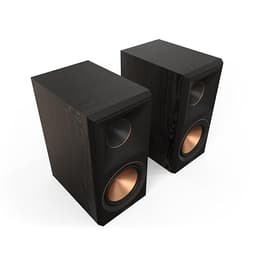
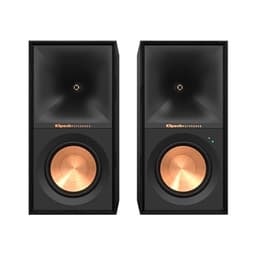
The Klipsch RP-600M II is the pick under $1,000.Klipsch publishes 94.5 dB sensitivity at 2.83 V / 1 m, the highest of any passive pair we rank, which means a modest amplifier drives it properly — so the pair leaves real money in the budget for the rest of the chain. It is for a listener with an amplifier already on the rack, or one in the plan, and 13 inches of shelf depth to give it. If the amplifier is not in the plan, take the Klipsch R-50PM instead: it has the amplification and a phono input inside, so a turntable connects with one cable. The budget pick is the ELAC Debut 2.0 B5.2, the cheapest pair here that still belongs in this conversation.

Klipsch RP-600M II

Best overall (passive)

Klipsch RP-600M II

$449.99 · View on Amazon

Price as of November 22, 2026. #ad How we’re funded

Klipsch R-50PM

Best if you have no amplifier

Klipsch R-50PM

$449.99 · View on Amazon

$649.9931% off

Price as of November 22, 2026. #ad How we’re funded

A thousand dollars is the band where speaker shopping gets genuinely confusing, because two different products are sold at the same price. A passive pair is drivers and a cabinet: it needs an amplifier, and the turntable needs a phono stage somewhere as well. A poweredpair has the amplifier inside, and the ones on this page have a phono input too — so the same money buys either the better speaker or the complete system, and you have to decide which you are shopping for.

This page prices them as what they cost to run. Where a pick is passive, the copy says what it still needs. Where a pick is powered, it says what it replaces. Our powered versus passive explainer is the longer version of that decision, and our picks under $500 are the tier below this one.

One measurement note that matters at this price. Sensitivity and frequency response are only comparable when the test conditions match. Klipsch publishes at 2.83 V / 1 m half-space anechoic and quotes response at ±3 dB; Q Acoustics publishes response at -6 dB, a more generous condition. Those numbers are not two points on one scale, and this page keeps each figure attached to its own condition rather than sorting one column.

How this is funded: we earn a commission if you buy through our links, at no extra cost to you. It never changes which product we recommend, and we’ll tell you plainly when to skip one. Full disclosure.

Quick picks

Ranked on published specs, drive/motor design and buyer fit. Select a row to jump to the full write-up. We have not heard most of these units — here is exactly what we do instead.

#ProductBest forPrice
1
Klipsch RP-600M II

Klipsch RP-600M II

The most sensitive speaker on this page and the only one with a Cerametallic woofer. Klipsch publishes 94.5 dB at 2.83 V / 1 m, 44 Hz - 25 kHz +/-3 dB and 100 W continuous power handling, in an internally braced cabinet with bi-wire binding posts and a rear Tractrix port. If you are running a low-power tube or class-A amplifier, this is the Klipsch built for it.

Best overall
$449.99 · View on Amazon

Price as of November 22, 2026. #ad How we’re funded

2
Klipsch R-50PM

Klipsch R-50PM

The shortest complete Klipsch system for a record player. Klipsch's own spec sheet lists the analog input as "Phono/Line analog (with switch and ground screw terminal)", so a deck with no preamp plugs straight in and its earth wire has a post to land on - and the manual carries a page headed CONNECTIONS - TURNTABLE. 120 W total, a 5.25" TCP woofer and a published 55 Hz limit.

Best without an amplifier
$449.99 · View on Amazon

$649.9931% off

Price as of November 22, 2026. #ad How we’re funded

3
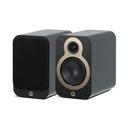
Q Acoustics 3030c

Q Acoustics 3030c

The big brother, and the one that earns the money if the shelf can take it: a 142 mm version of the same C3 cone in a cabinet with 12.5 L of internal volume against the 3020c's 6.9, for a published 48 Hz against 60 Hz. It is slightly less sensitive than its smaller sibling, not more, which is the detail most buyers get backwards.

Best for a smaller room
$655.00 · View on Amazon

Price as of November 22, 2026. #ad How we’re funded

4
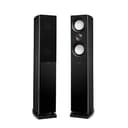
Fluance XL8F Reference

Fluance XL8F Reference

The only pick on this page sold as a finished stereo PAIR, and the one that goes deepest: Fluance publishes 35 Hz, reached with an isolated down-firing 8-inch woofer that the dual 6.5-inch midranges never have to attempt. It is a genuine three-way with a 100/3,000 Hz crossover and bi-wire posts, at a pair price that undercuts two of the single speakers here.

Best floorstanding pair
$599.99 · View on Amazon

Price as of November 22, 2026. #ad How we’re funded

5
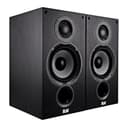
ELAC Debut 2.0 B5.2

ELAC Debut 2.0 B5.2

The Debut series is the default recommendation in this price band for a reason: a woven aramid-fiber woofer, a wide-roll cloth dome reaching 35 kHz, braced MDF cabinets and front-firing ports so you can actually put them on a shelf. Balanced rather than exciting, which is what you want for long album listening.

Budget pick
$269.00 · View on Amazon

$379.0029% off

Price as of November 22, 2026. #ad How we’re funded

The picks in full

#1Best overall

Klipsch RP-600M II

The most sensitive speaker on this page and the only one with a Cerametallic woofer. Klipsch publishes 94.5 dB at 2.83 V / 1 m, 44 Hz - 25 kHz +/-3 dB and 100 W continuous power handling, in an internally braced cabinet with bi-wire binding posts and a rear Tractrix port. If you are running a low-power tube or class-A amplifier, this is the Klipsch built for it.

Strengths

  • 94.5 dB published sensitivity - the highest here, and the reason low-watt amplifiers get paired with Klipsch
  • A 6.5" Cerametallic woofer takes the published low end to 44 Hz, deep enough to skip a subwoofer for most records
  • Dual binding posts for bi-wiring or bi-amping, and cork pads rather than rubber bumpers for stand use

Trade-offs

  • Still passive: an amplifier and a phono stage are separate purchases on top of it
  • Published at 15.75" tall and 13" deep - this is a big "bookshelf" speaker and it will not fit a shallow shelf
  • The titanium tweeter on an expanded horn is the most forward treble in the lineup; it rewards good pressings and exposes bad ones
TypePassive 2-way bookshelf, bass-reflex (rear Tractrix port)
Woofer6.5" Cerametallic cone with Faraday rings
Tweeter1" titanium LTS vented, hybrid cross-section expanded Tractrix horn
Frequency response44 Hz - 25 kHz +/-3 dB
Sensitivity94.5 dB (2.83 V / 1 m, half-space anechoic, in-room)
Impedance8 ohms compatible
Crossover1,500 Hz
Power handling100 W continuous / 400 W peak
InputsDual aluminum binding posts (bi-wire / bi-amp)
CabinetInternally braced MDF, 15.75 x 7.95 x 13", 18.1 lb

Note. Sensitivity is the whole argument for this speaker. At a published 94.5 dB it needs roughly a quarter of the amplifier power an 88 dB speaker does to reach the same level, which is why Reference Premiere turns up so often on the end of small tube amplifiers. Klipsch qualifies the figure the way it does the rest of the range - 2.83 V into half-space - so read it against other Klipsch numbers first.

Specifications read from the manufacturer / product listing, on September 29, 2026. “Not published” means the maker does not state that figure.

#2Best without an amplifier

Klipsch R-50PM

The shortest complete Klipsch system for a record player. Klipsch's own spec sheet lists the analog input as "Phono/Line analog (with switch and ground screw terminal)", so a deck with no preamp plugs straight in and its earth wire has a post to land on - and the manual carries a page headed CONNECTIONS - TURNTABLE. 120 W total, a 5.25" TCP woofer and a published 55 Hz limit.

Strengths

  • Switchable phono/line input WITH a ground screw terminal - the detail most powered speakers leave off
  • 120 W total system power and a published 55 Hz - 20 kHz response, the most of any powered model here
  • Optical, USB, 3.5 mm, Bluetooth and a subwoofer output, so the turntable is not the only thing it serves

Trade-offs

  • One cabinet is active and the other is passive, so mains has to reach the right speaker and the supplied 4 m of wire has to reach the left
  • Klipsch publishes no sensitivity or nominal impedance for it - normal for a powered design, but it means you cannot compare it with the passive pairs on the figure that decides those
  • Bluetooth is input-only and there is no network streaming at this price; that is what The Fives II adds
TypePowered (active) bookshelf pair, bass-reflex (rear port)
Phono preampYes - switchable phono/line with ground screw terminal
Woofer5.25" spun-copper TCP
Tweeter1" aluminum LTS on a 90x90 square Tractrix horn
Frequency response55 Hz - 20 kHz (dynamic bass extension 44 Hz)
Total system power120 W (240 W peak), 60 W per channel continuous at under 1% THD
Maximum output104 dB
Crossover1,663 Hz (passive)
SensitivityNot published
InputsBluetooth, phono/line RCA, 3.5 mm, USB digital, optical digital
OutputsSingle RCA line-level subwoofer output
CabinetMDF, 14 x 7 x 10.8", 24.8 lbs

Note. The ground screw terminal is why this sits above the powered pairs that offer only a phono input. A moving-magnet cartridge picks up mains hum through an unearthed deck, and a phono input with nowhere to put the earth wire is a phono input you may end up not using. Klipsch prints the terminal on the spec sheet and labels it in the manual.

Specifications read from the manufacturer / product listing, on September 29, 2026. “Not published” means the maker does not state that figure.

#3Best for a smaller room

Q Acoustics 3030c

The big brother, and the one that earns the money if the shelf can take it: a 142 mm version of the same C3 cone in a cabinet with 12.5 L of internal volume against the 3020c's 6.9, for a published 48 Hz against 60 Hz. It is slightly less sensitive than its smaller sibling, not more, which is the detail most buyers get backwards.

Strengths

  • Published 48 Hz - 30 kHz (-6 dB) - 12 Hz lower than the 3020c, from a 5.5" cone
  • 12.5 L effective cabinet volume against 6.9 L, which is where that extension comes from
  • Crossover 100 Hz lower than the 3020c's, at 2.5 kHz, in the same sealed-tweeter design

Trade-offs

  • 86.5 dB sensitivity is HALF a dB LOWER than the 3020c, and the minimum impedance drops to 3.9 ohms - a bigger speaker here is not an easier one to drive
  • A 12.8 x 8.1 x 13.0" cabinet at 16.5 lbs each: this is a stand speaker that happens to be called a bookshelf
  • Passive, and the most expensive pair Q Acoustics puts in this range
TypePassive 2-way reflex standmount
Bass unit1 x 142 mm (5.5") C3 Continuous Curved Cone
Treble unit1 x 22 mm (0.9"), hermetically sealed, isolated from the baffle
Frequency response48 Hz - 30 kHz (-6 dB)
Sensitivity86.5 dB (1 m, 2.83 Vrms @ 1 kHz)
Impedance6 ohms nominal, 3.9 ohms minimum
Crossover2.5 kHz
Recommended amplifier power25 - 90 W
Cabinet324 x 205 x 329 mm (12.8 x 8.1 x 13.0"), 12.5 L effective volume
Weight7.5 kg (16.5 lbs) each
Built-in preampNo - passive

Note. Q Acoustics' own table, same page family as the 3020c and the same -6 dB condition on the response. This is the model that replaced the discontinued 3030i in the US catalog, but it is not a drop-in equivalent: the 3030i used a 165 mm driver and published 46 Hz, so the new 3030c is a smaller-driver design that gives up 2 Hz on paper.

Specifications read from the manufacturer / product listing, on October 19, 2026. “Not published” means the maker does not state that figure.

#4Best floorstanding pair

Fluance XL8F Reference

The only pick on this page sold as a finished stereo PAIR, and the one that goes deepest: Fluance publishes 35 Hz, reached with an isolated down-firing 8-inch woofer that the dual 6.5-inch midranges never have to attempt. It is a genuine three-way with a 100/3,000 Hz crossover and bi-wire posts, at a pair price that undercuts two of the single speakers here.

Strengths

  • Sold as a PAIR — the sticker is the whole speaker budget, not half of it
  • 35 Hz - 25 kHz published, the deepest low end on this page, from a dedicated down-firing 8-inch woofer
  • A true 3-way at 100/3,000 Hz, so neither the tweeter nor the midranges are asked to make bass

Trade-offs

  • The biggest cabinet here at 45.86 inches and 47.70 lbs each — this is furniture, and it needs the floor space
  • A down-firing 8-inch woofer on a suspended wooden floor is the worst case for turntable feedback of anything on this page
  • 87 dB at 1 W / 1 m means a real amplifier, not a 15 W desktop unit
TypePassive 3-way, 4-driver floorstander, rear dual-port bass reflex
Sold asPair
WooferIsolated down-firing 8" polymer-treated high-excursion driver
MidrangeDual 6.5" woven glass fiber composite
Tweeter1" neodymium balanced silk dome, ferrofluid cooled
Frequency response35 Hz - 25 kHz
Sensitivity87 dB @ 1 W / 1 m
Impedance8 ohms compatible
Crossover100 / 3,000 Hz
Power handling80 - 160 W RMS
InputsGold-plated 5-way bi-amp / bi-wire binding posts
Cabinet45.86" H x 9.25" W x 12.99" D, 47.70 lbs each

Note. Fluance quotes sensitivity at 1 W / 1 m and Klipsch quotes it in-room at 2.83 V / 1 m. Those are different measurements, so the 87 dB here is not nine decibels worse than the Klipsch's 96 dB in any room you will actually use — but it is still the one that wants the bigger amplifier.

Specifications read from the manufacturer / product listing, on October 3, 2026. “Not published” means the maker does not state that figure.

#5Budget pick

ELAC Debut 2.0 B5.2

The Debut series is the default recommendation in this price band for a reason: a woven aramid-fiber woofer, a wide-roll cloth dome reaching 35 kHz, braced MDF cabinets and front-firing ports so you can actually put them on a shelf. Balanced rather than exciting, which is what you want for long album listening.

Strengths

  • Front-firing port means shelf and near-wall placement doesn't wreck the bass
  • Woven aramid-fiber woofer is stiffer and better damped than paper or polypropylene
  • Thick braced MDF cabinets — the enclosure is where budget speakers usually cut corners

Trade-offs

  • Needs an amplifier, and rewards a decent one
  • Deliberately neutral voicing — no built-in excitement if that is what you want
TypePassive 2-way bass reflex bookshelf
Woofer5.25" woven aramid fiber
Tweeter1" cloth dome with waveguide
High-frequency responseUp to 35,000 Hz
CabinetBraced MDF, front-firing port
Built-in preampNo — passive

Note. The front port is the practical detail. Rear-ported speakers pushed against a wall get boomy; these were designed for the bookshelf people actually put them on. ELAC has since followed this generation with the Debut 3.0 DB53 (aluminum-dome tweeter, 48 Hz to 38 kHz); the B5.2 stays the pick here because it is still sold, and at run-out pricing it is the better buy for the money until stock is gone.

Specifications read from the manufacturer / product listing, on August 11, 2026. “Not published” means the maker does not state that figure.

How these were ranked

  • Total cost to make a record play. A $450 passive pair plus a $250 amplifier is a $700 system; a $450 powered pair with a phono input is a $450 system. Both are on this page and the copy on each pick says which it is. A roundup that ignores this is how people end up with speakers and nothing to drive them.
  • Published sensitivity, read with its condition.At this budget it decides how much amplifier you need, and every 3 dB roughly halves the power required for the same level. The 94.5 dB of the top pick against the 86.5 dB of the Q Acoustics is a real gap — close to four times the power for the same loudness.
  • Whether it suits vinyl specifically. Records carry little energy below about 40 Hz by design, because large low-frequency excursions push a stylus out of the groove. So a pair that is honest into the mid-40s from a controlled cabinet serves an LP better than a bigger number achieved with a boomy port.
  • Cabinet size against real furniture. Two of these are called bookshelf speakers and will not fit a bookshelf. Where that is true the pick says so, because a deep ported cabinet pressed against a panel undoes the engineering you paid for.
  • Live price at the last refresh. Every pick sat under $1,000 when the price feed last ran, and every button carries its own as-of date.

What the amplifier costs, if you need one

Three of the five picks here are passive and need amplification. The happy part of buying a sensitive speaker is that the amplifier can be the cheap part: at 92 to 94.5 dB, 20 to 30 W of honest power plays loudly in a normal room, and Klipsch’s own power-handling figures are tolerances rather than requirements. Our amplifier pickscover both the integrated amplifiers that include a phono input — one box for both jobs — and the cheaper boards that need a separate phono stage in front.

And the phono stage has to exist exactly once in the chain: inside the deck, inside the amplifier, or in its own box. Two in series produces distorted, uncontrollably loud mud, and it is the most common wiring mistake in vinyl. Our do I need a phono preamp page walks it properly.

Budget for standstoo, on any of the standmount picks. At this price the tweeter is meant to sit near ear height, and getting the cabinets off the same furniture as the turntable also removes a real acoustic feedback path — which our placement page covers for records specifically.

What the deck in front of them should be

A pair at this level shows you what the source is doing, which cuts both ways. A $150 automatic with a conical stylus will play perfectly well through any of these and will also make its own compromises audible. The sensible partner is a deck with an adjustable counterweight and an elliptical cartridge or better — the territory of our picks under $500 and under $1,000.

If the whole budget — deck, cartridge, phono stage, amplifier, speakers — is around a thousand dollars rather than the speakers alone, then the powered pick on this page is the honest answer and the passive picks are not. One box fewer is worth more at that point than any specification on this page.

Frequently asked questions

What are the best speakers under $1,000 for a turntable?

The Klipsch RP-600M II if you have an amplifier or plan to buy one: Klipsch publishes 94.5 dB sensitivity at 2.83 V / 1 m, the highest of any passive pair we rank, so a modest amplifier drives it properly. The Klipsch R-50PM if you do not want an amplifier at all - it has amplification and a phono input built in, so a turntable connects with one cable.

Do I need an amplifier for speakers at this price?

For the passive picks, yes - they are drivers and a cabinet and make no sound alone. For the powered picks, no: the amplifier is inside, and the ones here also include a phono input so the turntable connects directly. That is the single most important distinction on this page, because it changes the total cost by hundreds of dollars.

Is a $1,000 pair of speakers overkill for vinyl?

No, but it is the wrong place to start. A record system is five purchases - deck, cartridge, phono stage, amplifier, speakers - and the stylus does more for how it sounds than any single component. If the speakers would consume the whole budget, buy a cheaper pair and a better deck. Our picks under $500 and under $200 exist for exactly that reason.

Can I compare the frequency response figures on this page directly?

Only where the conditions match. Klipsch quotes response at plus or minus 3 dB; Q Acoustics quotes it at -6 dB, which allows the output to have fallen twice as far in decibel terms before the number is printed. So a Klipsch 44 Hz and a Q Acoustics 48 Hz are not two points on one scale. This page keeps each figure next to its own condition instead of sorting one column.

Will these fit on a bookshelf?

Two of them will not, despite the category name. The RP-600M II is published at 15.75 inches tall and 13 inches deep, and the Q Acoustics 3030c at 12.8 by 13.0 inches - both are stand speakers. All the standmounts here have rear-firing ports and want air behind them, so a shelf that traps the port exaggerates the low end and blurs what the cabinet bracing is there to protect.

How much amplifier power do these need?

Less than the power-handling figures suggest, because those are tolerances rather than requirements. At 92 to 94.5 dB sensitivity, 20 to 30 W of honest power reaches loud levels in a normal room. The lower-sensitivity picks ask for more: Q Acoustics recommends 25 to 90 W for the 3030c and publishes a 3.9-ohm minimum impedance, which is a reason to buy an amplifier rated for 4-ohm loads.

Sources

  • Klipsch — Reference Premiere RP-600M II spec sheet (PDF) — Manufacturer specification table, read live: frequency response 44 Hz - 25 kHz +/-3 dB, sensitivity "94.5dB @ 2.83V / 1m", power handling 100 W / 400 W, nominal impedance "8 Ohms Compatible", crossover 1,500 Hz, high-frequency driver "1" Titanium LTS Vented Tweeter with Hybrid Cross-Section Expanded Tractrix Horn", low-frequency driver "6.5" Cerametallic Cone Woofer with Faraday rings", enclosure "MDF (Internally Braced)", "Bass Reflex via rear-firing Tractrix Port", inputs "Dual aluminum binding posts/bi-wire/bi-amp", 15.75" (40.0 cm) H x 7.95" (20.2 cm) W x 13.00" (33.0 cm) D, 18.1 lb (8.20 kg), finishes Ebony and Walnut, and "Cork pads replace rubber bumpers for security on a stand or table". Same sensitivity footnote as the Reference sheets (accessed September 29, 2026)
  • Klipsch — R-50PM powered monitors spec sheet (PDF) — Manufacturer specification table, read live. System description "Powered Monitor (pair)", frequency response 55 Hz - 20 kHz, "DYNAMIC BASS EXTENSION 44Hz", maximum output 104 dB, "120W Total System Power (240W Peak)" and "60W per channel cont. @ <%1 THD", 1" (2.5 cm) aluminum LTS tweeter on a 90 x 90 square Tractrix horn, "Single 5.25" (13.3cm) spun-copper TCP woofer", crossover "1663 Hz (Passive)", MDF, "Bass-reflex via rear-firing port", 14" (35.6 cm) H x 7" (17.8 cm) W x 10.8" (27.4 cm) D, 24.8 lbs (11.2 kg). The input list is the reason this model is on the page: "Bluetooth wireless technology / Phono/Line analog (with switch and ground screw terminal) / 3.5mm analog mini jack / USB digital / Optical digital", with a "Single RCA line level output for connection to subwoofer". The header badges read TURNTABLE READY, PC READY, TV READY and NO RECEIVER NEEDED. NO sensitivity and NO nominal impedance row is printed — which is why this site records both as not published for the powered models (accessed September 29, 2026)
  • Q Acoustics — 3030c, published specifications — The larger standmount from the same range and the same page family, read the same day: bass unit "1 x 142 mm (5.5 in)", treble unit "1 x 22 mm (0.9 in)", frequency response "48 Hz - 30 kHz" at -6 dB, nominal impedance "6 Ohm", minimum impedance "3.9 Ohm", sensitivity "86.5 dB" at 1 m / 2.83 Vrms / 1 kHz, crossover frequency "2.5 kHz", recommended amplifier power "25-90 W", effective volume "12.5 L", dimensions "324 x 205 x 329 mm (12.8 x 8.1 x 13.0 in)", weight "7.5 Kg (16.5 lbs)". The counter-intuitive row is the sensitivity: the bigger speaker is half a dB LOWER than the 3020c and its minimum impedance is 0.2 ohms lower, so it is marginally the harder load of the two (accessed October 19, 2026)
  • ELAC — Debut 3.0 DB53 bookshelf speaker — The maker's own page for the generation after the B5.2: "Building on the success of the acclaimed DB52, the Debut 3.0 DB53 delivers greater clarity, refinement, and balance in an even more compact bookshelf design." Published specification: 1-inch aluminum dome tweeter, 5.25-inch aramid-fiber woofer, frequency response 48 Hz to 38 kHz (-6 dB), sensitivity 86.5 dB at 2.83 V / 1 m, nominal impedance 6 ohms. ELAC's DB52 (B5.2) page was still live on the access date with no discontinuation wording, and the B5.2 remained in stock on Amazon below its list price (accessed September 21, 2026)
  • Fluance — XL8F Reference three-way floorstanding loudspeakers, published specifications — Fluance's own product page and specification table: model "XL8F", configuration "3 Way - 4 Driver Floorstanding Main Speakers (pair)", tweeter "1 inch Neodymium Balanced Silk Dome Ferrofluid Cooled", midrange "Dual 6.5 inch Woven Glass Fiber Composite Drivers with Butyl Rubber Surrounds", woofer "Isolated Down-firing 8 inch Polymer Treated High Excursion Driver with Butyl Rubber Surround", power handling "80 - 160 Watts RMS", frequency response "35 Hz - 25 kHz", sensitivity "87 dB @ 1 W / 1 m", crossover "100/3000 Hz Phase Coherent - PCB Mounted Circuitry", "8 Ohm Compatible", enclosure "Tuned Rear Dual Port Bass Reflex Tower Design Dampened", 45.86 x 9.25 x 12.99 inches (116.5 x 23.5 x 33 cm) and 47.70 lb (21.64 kg) per speaker, with gold-plated 5-way bi-amp/bi-wire binding posts. Listed at 599.99 USD for the PAIR on the access date — the one pick on this site's floorstander page whose sticker is not half a system (accessed October 3, 2026)
  • Crutchfield — Home speakers buying guide — Reference on choosing passive vs powered speakers, room size and amplifier pairing (accessed August 11, 2026)
  • Crutchfield — Understanding speaker and amplifier wattage ratings — On RMS versus peak power, and matching an amplifier's output to a speaker's rating (accessed August 11, 2026)

Keep reading