Klipsch R-40PM vs R-50PM
Identical input panels, identical tweeter, identical subwoofer output. Five published figures differ, and one of them decides this.
How this is funded: we earn a commission if you buy through our links, at no extra cost to you. It never changes which product we recommend, and we’ll tell you plainly when to skip one. Full disclosure.
The short answer: buy the R-50PM for a living room and the R-40PM for a desk or a small room, because nothing that matters to a turntable differs between them. Klipsch gives both pairs the same analog input — a switchable phono/line input with a ground screw terminal — the same tweeter on the same horn, the same five inputs and the same subwoofer output. What you are choosing between is 70 W and a 4-inch woofer in an 11.8-inch cabinet, or 120 W and a 5.25-inch woofer in a 14-inch one.
The one row that is identical, and why it is the reason to buy either
Both spec sheets print the analog input the same way: “Phono/Line analog (with switch and ground screw terminal)”. Three things follow from that single line.
The phono stage is inside.A turntable with no preamp of its own — a Fluance RT82 or RT85, a Pro-Ject, a U-Turn — plugs in and plays. No separate box, no third power socket.
It switches. A deck whose own stage is switched on feeds the same socket at line level instead. That matters because exactly one phono stage belongs in the chain — two in series is the loud, harsh fault.
There is a ground screw terminal. This is the detail that separates these two from most powered speakers claiming a phono input. A moving-magnet cartridge picks up mains hum through an unearthed deck, and a phono input with nowhere to land the earth wire is one you may end up not using. Klipsch prints the terminal on both sheets and labels it in the manual.
What actually differs
The woofer, and the bass limit under it.4 inches against 5.25 inches, and a published 60 Hz against 55 Hz. Five hertz sounds like nothing written down; it is roughly the bottom note of a four-string bass against a tone you feel rather than hear. Both sheets then add a separate “dynamic bass extension” figure — 52 Hz and 44 Hz — which is Klipsch’s own term and not a ±3 dB response claim, so it is listed separately above rather than treated as the real limit.
Power, and the ceiling it buys. 70 W total against 120 W, both quoted as continuous per channel at under 1% THD, and a maximum output of 100 dB against 104 dB. The 4 dB is the useful number: it is the difference between a pair that is comfortably loud in a bedroom and one that fills a living room with the windows open. If you will never ask for 100 dB, the extra 50 W is headroom you are paying to own and not to use.
The crossover, slightly. 1,730 Hz on the R-40PM against 1,663 Hz on the R-50PM. Both pass a little of the upper vocal range to a horn-loaded tweeter; the R-50PM passes marginally less of it, which is the same direction the passive R-40M and R-50M move in.
The cabinet, which is often the real decision.11.8 x 5.7 x 10.1 inches and 18.3 lbs for the pair, against 14 x 7 x 10.8 inches and 24.8 lbs. Both are rear ported, so both want a few inches of clearance behind them — measure the shelf before you choose, because a bigger speaker shoved against a wall sounds worse than a smaller one placed properly. Our placement guide covers the clearance each port type wants.
What neither sheet tells you
Klipsch publishes no sensitivity and no nominal impedancefor either pair. On a powered speaker that is defensible — the amplifier is already matched to the drivers, so the figures have nothing left to decide — but it does mean you cannot line either of these up against the passive R-40M (91 dB) or R-50M (92 dB) on the row that normally settles a Klipsch comparison. If comparing on published sensitivity matters to you, you are shopping for passive speakers and an amplifier, which is a different purchase with a different total.
The other thing worth knowing before either arrives: on the PM-series pairs the mains lead and every input land on one cabinet, and the supplied speaker wire has to reach the other. Our R-50PM review works through what the manual says about that, and it applies to the R-40PM the same way.
Which to buy
Buy the R-40PMfor a desk, a bedroom, a narrow shelf, or anywhere the pair sits within arm’s reach. Klipsch badges it PC READY as well as TURNTABLE READY, and with USB digital and optical inputs alongside the phono input it genuinely does both jobs.
Buy the R-50PM for a living room, a bigger listening position, or any room where you want the bass to arrive rather than be implied. It is the pair we pick on the phono-input speaker roundup, and the 5.25-inch woofer is the reason.
Buy neitherif an amplifier with a phono input is already on your shelf. In that case the passive R-50M costs less than either of these and publishes a 92 dB sensitivity figure that says a small amplifier is enough — see speakers under $500 for how the three routes price out as whole systems.
The spec matrix
Eight of the fourteen rows are identical, including the whole input panel and the tweeter. The decision lives in the woofer, the bass limit, the power rating, the maximum output and the cabinet size.
| Specification | R-40PMKlipsch | R-50PMKlipsch |
|---|---|---|
| Analog inputsame | Phono/Line analog, with switch and ground screw terminal | Phono/Line analog, with switch and ground screw terminal |
| Woofer | 4" spun-copper TCP | 5.25" spun-copper TCP |
| Tweetersame | 1" aluminum LTS, 90x90 square Tractrix horn | 1" aluminum LTS, 90x90 square Tractrix horn |
| Frequency response | 60 Hz - 20 kHz (dynamic bass extension 52 Hz) | 55 Hz - 20 kHz (dynamic bass extension 44 Hz) |
| Total system power | 70 W (240 W peak), 35 W/ch continuous at under 1% THD | 120 W (240 W peak), 60 W/ch continuous at under 1% THD |
| Maximum output | 100 dB | 104 dB |
| Crossover | 1,730 Hz (passive) | 1,663 Hz (passive) |
| Sensitivitysame | Not published | Not published |
| Nominal impedancesame | Not published | Not published |
| Inputssame | Bluetooth, phono/line RCA, 3.5 mm, USB digital, optical digital | Bluetooth, phono/line RCA, 3.5 mm, USB digital, optical digital |
| Outputssame | Single RCA line-level subwoofer output | Single RCA line-level subwoofer output |
| Cabinet | MDF, 11.8 x 5.7 x 10.1" | MDF, 14 x 7 x 10.8" |
| Weight | 18.3 lbs (pair) | 24.8 lbs |
| Portsame | Rear | Rear |
Every figure is from Klipsch’s own published specification sheet for each model, plus the rear-panel legend in the owner’s manual the two pairs share. We have not measured either pair: the power and output figures are Klipsch’s claims on Klipsch’s terms, and the two “dynamic bass extension” numbers are a separate class of claim from the ±3 dB response figures on the passive models. “Not published” means the figure is not stated in the sources cited below — it is never a value we estimated. Rows marked same are the ones where these decks do not differ.
Both pairs, with live prices
Both are complete systems for a turntable - no amplifier, no phono preamp, nothing else to buy. Prices are pulled live and dated; Klipsch discounts these independently of each other, and on a good day the gap between them closes to very little.
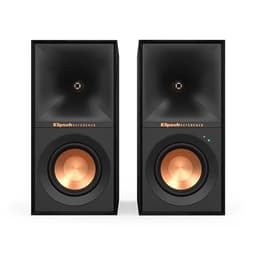
Klipsch R-40PM
A desk or a small room where the R-50PM would be too big
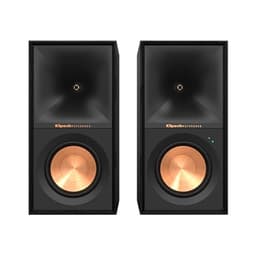
Klipsch R-50PM
A complete vinyl system in two boxes, with the phono stage already inside
The passive alternative, if you own an amplifier
The R-40M and R-50M are the same drivers without the electronics. If an amplifier with a phono input is already on your shelf, these cost less and publish a sensitivity figure the powered pairs do not.
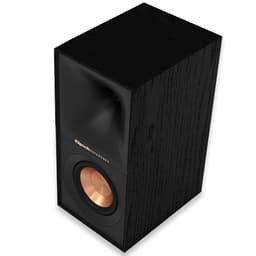
Klipsch R-40M
Getting real volume out of a small, inexpensive amplifier
Price as of October 16, 2026. #ad How we’re funded
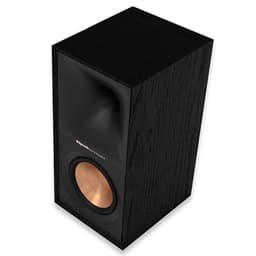
Klipsch R-50M
The passive Klipsch pair to buy if the budget stretches past the R-40M
Price as of October 16, 2026. #ad How we’re funded
Frequently asked questions
What is the difference between the Klipsch R-40PM and R-50PM?
Size and power, not features. Klipsch gives both the same analog input - a switchable phono/line input with a ground screw terminal - the same 1 inch aluminum LTS tweeter on a 90x90 Tractrix horn, the same five inputs and the same subwoofer output. The R-50PM has a 5.25 inch woofer against the R-40PM's 4 inch, 120 W total system power against 70 W, a published 55 Hz low limit against 60 Hz, 104 dB maximum output against 100 dB, and a cabinet 2.2 inches taller and 1.3 inches wider.
Which one should I buy for a turntable?
The R-50PM if the speakers are going in a living room you intend to fill, and the R-40PM if they are going on a desk, a narrow shelf or into a bedroom. Nothing about the turntable side of the decision differs: both take a preamp-less deck directly, both have the ground screw terminal, and both switch to line level for a deck whose own preamp is switched on.
Is the R-50PM worth the extra money?
If the room is big enough to use it. The two figures that justify the premium are the 5 Hz of extra bass extension and the 4 dB of extra maximum output, and 4 dB is roughly the difference between comfortably loud and clearly loud. In a small room you will never reach the R-40PM's 100 dB ceiling, so the premium buys headroom you do not use.
Do either of them need a phono preamp?
No, and that is the whole point of the PM models. Klipsch prints the analog input as 'Phono/Line analog (with switch and ground screw terminal)' on both spec sheets, which means the phono stage is inside and the turntable's earth wire has somewhere to land. Set the switch to phono for a deck with no preamp of its own, or to line for a deck whose built-in stage is switched on - exactly one phono stage in the chain.
Can I compare these with Klipsch's passive speakers on sensitivity?
No, because Klipsch publishes no sensitivity and no nominal impedance for either powered pair. That is not an oversight: on a powered speaker the amplifier is already matched to the drivers, so the figure has nothing left to tell you. It does mean a straight R-50PM against R-50M comparison on that row is impossible, which is worth knowing before you try to make one.
What does 'dynamic bass extension' mean on these spec sheets?
It is Klipsch's own term for a lower figure than the stated frequency response - 52 Hz on the R-40PM against a 60 Hz response, and 44 Hz on the R-50PM against 55 Hz. It is a different kind of claim from a response figure quoted with a plus or minus 3 dB tolerance, and this page treats it as a separate row rather than as the real bass limit.
Do I need a subwoofer with either pair?
Not for records, in most rooms. Both publish a single RCA line-level subwoofer output if you want one, and the R-40PM is the pair more likely to benefit given its 4 inch woofer and 60 Hz limit. Bear in mind that a warped record produces energy below 20 Hz that a subwoofer will happily reproduce as pumping - a phono stage with a subsonic filter is the fix for that, not a smaller subwoofer.
Sources
- Klipsch — R-40PM powered monitors spec sheet (PDF) — Manufacturer specification table, read live, printed in the same format as the R-50PM's. System description "Powered Monitor (pair)", frequency response 60 Hz - 20 kHz, "DYNAMIC BASS EXTENSION 52Hz", maximum output 100 dB, "70W Total System Power (240W Peak)" and "35W per channel cont. @ <%1 THD", 1" (2.5 cm) aluminum LTS tweeter on a 90 x 90 square Tractrix horn, "Single 4" (10.2cm) spun-copper TCP woofer", crossover "1730 Hz (Passive)", MDF, bass-reflex via rear-firing port, the same input list including "Phono/Line analog (with switch and ground screw terminal)", the same single RCA subwoofer output, 11.8" (30 cm) H x 5.7" (14.5 cm) W x 10.1" (25.65 cm) D and "18.3 lbs (8.3 kg) (pair)". In the box: remote, "4M speaker wire with soldered tips", a 2 m power cord and a 2 m USB A-to-B cable. No sensitivity or impedance row, as above (accessed September 29, 2026)
- Klipsch — R-50PM powered monitors spec sheet (PDF) — Manufacturer specification table, read live. System description "Powered Monitor (pair)", frequency response 55 Hz - 20 kHz, "DYNAMIC BASS EXTENSION 44Hz", maximum output 104 dB, "120W Total System Power (240W Peak)" and "60W per channel cont. @ <%1 THD", 1" (2.5 cm) aluminum LTS tweeter on a 90 x 90 square Tractrix horn, "Single 5.25" (13.3cm) spun-copper TCP woofer", crossover "1663 Hz (Passive)", MDF, "Bass-reflex via rear-firing port", 14" (35.6 cm) H x 7" (17.8 cm) W x 10.8" (27.4 cm) D, 24.8 lbs (11.2 kg). The input list is the reason this model is on the page: "Bluetooth wireless technology / Phono/Line analog (with switch and ground screw terminal) / 3.5mm analog mini jack / USB digital / Optical digital", with a "Single RCA line level output for connection to subwoofer". The header badges read TURNTABLE READY, PC READY, TV READY and NO RECEIVER NEEDED. NO sensitivity and NO nominal impedance row is printed — which is why this site records both as not published for the powered models (accessed September 29, 2026)
- Klipsch — R-40PM and R-50PM owner's manual (PDF) — The manual both powered models share. Cited for three things the spec sheet only implies: the contents page carries a section headed "CONNECTIONS - TURNTABLE" (page 9), the rear-panel legend labels a "Phono/Line Switch", "Phono Inputs" and a "Ground Screw Terminal" as separate numbered items, and the diagram labels the pair as "RIGHT SPEAKER (ACTIVE)" — so the powered cabinet is the right one, the left is passive, and the supplied 4 m speaker wire has to span the gap (accessed September 29, 2026)
- Klipsch — Reference R-40M spec sheet (PDF) — Manufacturer specs: 91 dB in-room sensitivity, 71 Hz - 21 kHz +/-3 dB, 8 ohms compatible, 1,770 Hz crossover, 50 W / 200 W power handling (accessed August 28, 2026)
- Klipsch — Reference R-50M spec sheet (PDF) — Manufacturer specification table, read live: frequency response 58 Hz - 21 kHz +/-3 dB, sensitivity 92 dB (In-Room), power handling 75 W / 300 W, nominal impedance "8 ohms Compatible", crossover 1,560 Hz, high-frequency driver "1" Aluminum LTS tweeter mated to a 90 x 90 square Tractrix Horn", low-frequency driver "Single 5.25" spun-copper TCP woofer", enclosure MDF, "Bass-Reflex via rear-firing ports", inputs "Single Gold Plated Binding Posts", 13.9" (354 mm) H x 7" (178 mm) W x 9" (229 mm) D, 11 lbs (5 kg), Black Textured Wood Grain Vinyl. The sensitivity asterisk reads "SPL at 1M, half-space anechoic with 2.83V input". Read alongside the R-40M sheet, which is printed in the identical format — the two are directly comparable line for line (accessed September 29, 2026)
Keep reading
Klipsch R-50PM Review
The larger pair in full, including what the manual says about which cabinet the mains and inputs land on.
Read the reviewBest Speakers With a Phono Preamp Built In
Every pair that takes a turntable directly, ranked on whether the earth wire has anywhere to go.
See the picksKlipsch R-40M vs R-50M
The passive version of this same comparison, where sensitivity is published and decides it.
Compare themBest Speakers Under $500
Where both pairs sit against the passive and powered alternatives at the same money.
See the picks