Klipsch R-50PM Review
Most powered speakers make you add a phono preamp. This pair has one inside, with somewhere to land the turntable's earth wire — which is the detail that decides whether a record player works with them at all.
How this is funded: we earn a commission if you buy through our links, at no extra cost to you. It never changes which product we recommend, and we’ll tell you plainly when to skip one. Full disclosure.
The short version
Klipsch R-50PM
A pair of powered bookshelf speakers that will run a turntable with no other box in the chain: Klipsch publishes the analog input as 'Phono/Line analog (with switch and ground screw terminal)', 120 W total system power with 60 W per channel continuous, a 55 Hz to 20 kHz response and 104 dB maximum output. Buy it if you own, or are buying, a deck with no built-in phono stage and you want a complete system in two boxes. Skip it if your turntable already has a switchable preamp and you would rather spend the same money on passive speakers plus an amplifier, or if you need network streaming, which this model does not have at any price.
Strengths
- Switchable phono/line input WITH a ground screw terminal - the detail most powered speakers leave off
- 120 W total system power and a published 55 Hz - 20 kHz response, the most of any powered model here
- Optical, USB, 3.5 mm, Bluetooth and a subwoofer output, so the turntable is not the only thing it serves
Trade-offs
- One cabinet is active and the other is passive, so mains has to reach the right speaker and the supplied 4 m of wire has to reach the left
- Klipsch publishes no sensitivity or nominal impedance for it - normal for a powered design, but it means you cannot compare it with the passive pairs on the figure that decides those
- Bluetooth is input-only and there is no network streaming at this price; that is what The Fives II adds
| Type | Powered (active) bookshelf pair, bass-reflex (rear port) |
|---|---|
| Phono preamp | Yes - switchable phono/line with ground screw terminal |
| Woofer | 5.25" spun-copper TCP |
| Tweeter | 1" aluminum LTS on a 90x90 square Tractrix horn |
| Frequency response | 55 Hz - 20 kHz (dynamic bass extension 44 Hz) |
| Total system power | 120 W (240 W peak), 60 W per channel continuous at under 1% THD |
| Maximum output | 104 dB |
| Crossover | 1,663 Hz (passive) |
| Sensitivity | Not published |
| Inputs | Bluetooth, phono/line RCA, 3.5 mm, USB digital, optical digital |
| Outputs | Single RCA line-level subwoofer output |
| Cabinet | MDF, 14 x 7 x 10.8", 24.8 lbs |
Specifications read from the manufacturer / product listing, accessed 2026-09-29. We have not measured this unit — what we do instead.
What it is, in one paragraph
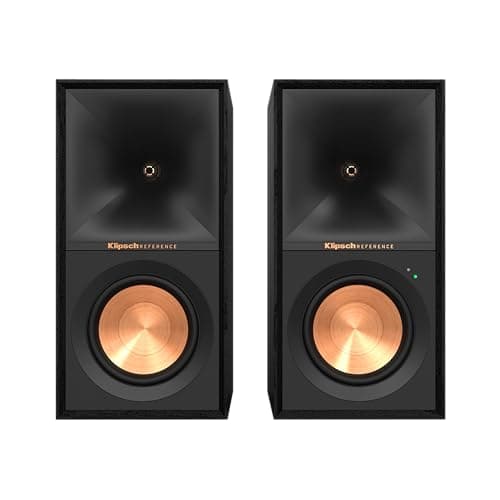
The R-50PM is a pair of powered bookshelf speakers: the amplification is inside the cabinets, so there is no receiver or integrated amplifier to buy. What separates it from the rest of that class, and the reason it leads our Bluetooth speaker picks, is one line on Klipsch’s own spec sheet: the analog input is listed as “Phono/Line analog (with switch and ground screw terminal)”. A turntable with no preamp of its own plugs into it directly, and the earth wire that comes out of that turntable has a post to land on.
Everything else is a conventional, well-specified powered monitor. Klipsch publishes a 1-inch aluminum LTS tweeter on a 90 x 90 square Tractrix horn, a single 5.25-inch spun-copper woofer, a passive crossover at 1,663 Hz, a bass-reflex cabinet with a rear-firing port, and 14 x 7 x 10.8 inches at 24.8 lb for the pair. We have not heard this pair; everything below is read from the maker’s published specification sheet and the owner’s manual, both cited in Sources.
The phono input is the whole argument
A phono cartridge puts out a few millivolts and the signal carries the RIAA curve, so it needs equalization and a large amount of gain before anything else can use it. That job happens in a phono preamp, and the question for any powered speaker is simply whether one is inside. Most of the class says no, which means a separate box on the shelf and two more cables.
The R-50PM says yes, and then goes one step further than its rivals. Having a phono input is necessary; having somewhere to land the ground wire is what makes it usable. An ungrounded turntable hums, and the hum is loudest exactly where the signal is smallest — our hum and grounding guide works through why. Klipsch lists the ground screw terminal as its own numbered item in the rear-panel legend, and the manual carries a contents entry headed CONNECTIONS - TURNTABLE. That is a maker telling you, in its own documentation, that a record player is a first-class source for this product.
One rule comes with it. If your turntable has a built-in phono stage — most decks under about $400 do — set the speakers to LINE, not PHONO. Two phono stages in series produce a distorted, far-too-loud mess, and it is the single most common wiring mistake in vinyl. Our phono vs line guide covers the switch, and do I need a phono preamp settles which box in your chain should be doing the work.
What the power figures mean
Klipsch publishes 120 W total system power (240 W peak) and 60 W per channel continuous at under 1% THD, with a maximum output of 104 dB. The second figure is the useful one: continuous power at a stated distortion level is a real engineering number, where “peak” is a marketing one. Sixty watts a side into a cabinet this size is more than a normal room asks for, and the 104 dB maximum is the honest ceiling.
The published frequency response is 55 Hz to 20 kHz, with a separate dynamic bass extension figure of 44 Hz. Those are two different claims and we quote both rather than merging them: the first is the response, the second is what the processing reaches for at volume. For records, 55 Hz is below the fundamental of almost everything you will play; the exception is organ and synth-heavy material, which is what the single RCA subwoofer output is there for.
The cabinet layout, which nobody mentions
This is the practical detail that catches people out, and it is in the manual rather than the marketing. The pair is active-and-passive, not a matched pair of active speakers: the diagram labels the right cabinet “RIGHT SPEAKER (ACTIVE)”. All the electronics, every input and the mains lead are on that one box, and a run of speaker wire carries the left channel across to the passive cabinet.
Two consequences. First, the mains socket has to be near the right-hand speaker, not near the turntable. Second, the supplied wire has to reach the left speaker — Klipsch supplies four meters, which is generous for a normal shelf and tight for speakers either side of a wide television. Measure that run before you buy, because it dictates your whole layout. If you are putting them on stands, our speaker stand picks cover height and cable routing, and keeping the speakers off the turntable’s furniture matters more here than usual: a 24.8 lb pair driven hard next to a deck is the classic recipe for acoustic feedback.
What Klipsch does not publish
Two rows are missing from the spec sheet and we record them as missing rather than filling them in: sensitivity and nominal impedance. For a powered speaker that is normal — both figures describe how a passive speaker behaves when an external amplifier drives it, and here the amplifier is already matched to the drivers. The consequence is that you cannot line the R-50PM up against a passive pair on the numbers that usually decide those comparisons. Our bookshelf speaker picks rank the passive field on exactly those two figures, which is the clearest way to see the difference in how the two classes are sold.
The other absences are features rather than figures. Bluetooth here is input only, so the speakers receive from a phone and cannot send anywhere. There is no network streaming — no Wi-Fi, no AirPlay, no HDMI-ARC — which is the main thing The Fives II adds higher up the range. And the digital inputs that are here, USB and optical, are for a computer and a television rather than for a turntable.
Where it sits in the Klipsch range
| Published row | R-40PM | R-50PM | The Fives II |
|---|---|---|---|
| Phono input | Yes, with ground screw terminal | Yes, with ground screw terminal | Yes, dedicated phono input |
| Woofer | 4 in spun copper | 5.25 in spun copper | 5.25 in Jet Cerametallic |
| Frequency response | 60 Hz - 20 kHz (52 Hz DBE) | 55 Hz - 20 kHz (44 Hz DBE) | 50 Hz - 25 kHz +/-3 dB |
| Total system power | 70 W (35 W per channel cont.) | 120 W (60 W per channel cont.) | Not published |
| Maximum output | 100 dB | 104 dB | 103 dB (1 m, stereo pair) |
| Network and TV | No | No | HDMI-ARC, streaming |
| Subwoofer output | Yes | Yes | Yes |
Read down the first row and the shape of the range is clear: the phono input is not a premium feature here, it is the family trait. What the money buys is cabinet size, continuous power and, at the top, the television and streaming connectivity. The full range is on our Klipsch for vinyl page, which reads every current model for the same question.
Setting it up with a turntable
Four steps, in order. Put the active (right) cabinet where the mains socket is and run the supplied wire to the left one. Run the turntable’s RCA cables to the phono inputs, and its ground wire to the ground screw — tightened onto bare metal, not resting against it. Set the rear switch to PHONO if your deck has no preamp, or to LINE if it does. Then start the volume low: a phono stage into a 60 W amplifier is a lot of gain, and the first record is not the moment to find that out.
If the result hums, work through the hum guide rather than guessing — with a ground screw present, an unconnected earth wire is the first thing to check and the easiest to fix. If the sound is thin and quiet, the switch is on LINE with a deck that has no preamp. If it is distorted and far too loud, there are two phono stages in the chain.
Who should buy it
Buy the R-50PM if you want a complete system in two boxes and your turntable has no phono stage, or if you want the option of using a better deck later without buying more electronics. It is the shortest honest path from a record player to sound in a normal-sized room, and the ground screw is the detail that makes it work with the decks that most need it — the preamp-less Fluance RT82, RT85 and the Pro-Ject Debut range, all of which we cover on our under $500 picks.
Buy something else if your deck already has a switchable preamp and you were always going to add an amplifier — in which case passive speakers plus an integrated amp gives you more speaker per dollar, and our amplifier picks and powered vs passive guide lay out that trade. Buy the R-40PM instead if the room is a desk or a bedroom, and The Fives II if the same speakers have to serve a television over HDMI.
The two rungs either side of it, with live prices
The R-40PM is the same input panel in a smaller cabinet; The Fives II is the step up that adds HDMI-ARC and network streaming. Both carry the phono input that makes this family work with a turntable.
Klipsch R-40PM
A desk or a small room where the R-50PM would be too big
Klipsch The Fives II
A premium all-in-one living-room system
Price as of October 12, 2026. #ad How we’re funded
Frequently asked questions
Does the Klipsch R-50PM have a phono preamp?
Yes. Klipsch's spec sheet lists the analog input as 'Phono/Line analog (with switch and ground screw terminal)', and the owner's manual labels a Phono/Line switch, phono inputs and a ground screw terminal as separate items on the rear panel. That means a turntable with no built-in preamp connects straight to the speakers, with the switch set to PHONO, and nothing else is needed in between.
Can you connect a record player directly to the R-50PM?
Yes, and the manual has a section headed 'CONNECTIONS - TURNTABLE' to prove the use case is intended rather than incidental. Run the deck's RCA cables to the phono inputs, set the rear switch to PHONO, and land the turntable's ground wire on the ground screw. If your turntable has its own built-in preamp, switch the speakers to LINE instead - never run two phono stages in series.
What is the ground screw terminal for?
A moving-magnet cartridge produces a signal measured in millivolts, and the metal parts of a turntable act as an aerial for mains hum if they are not earthed. The ground wire that comes out of most decks has to land on the box that contains the phono input. Plenty of powered speakers advertise a phono input and provide nowhere to put that wire; Klipsch prints the terminal on the spec sheet and labels it in the manual, which is the single biggest reason this pair sits above them.
How loud will the R-50PM go?
Klipsch publishes 120 W total system power (240 W peak), 60 W per channel continuous at under 1% THD, and a maximum output of 104 dB. That is a figure for a normal living room with room to spare rather than for a party in a hall. We have not measured the pair ourselves - those are the maker's published numbers.
Does the R-50PM need a subwoofer?
Not for most rooms. Klipsch publishes 55 Hz to 20 kHz, with a 44 Hz dynamic bass extension figure, from a 5.25-inch woofer in a rear-ported cabinet - enough for the bass on almost any record. The reason the option exists is that the pair has a single RCA line-level subwoofer output, so adding one later is a cable rather than a rethink.
Which speaker is the powered one?
The right one. The manual's diagram labels it 'RIGHT SPEAKER (ACTIVE)', which means mains power and every input cable goes to that cabinet, and the supplied speaker wire has to reach from it to the passive left speaker. Measure that run before you decide where the turntable sits - it is the practical constraint most buyers discover after the box is open.
R-50PM or R-40PM - which should I buy?
They share the input panel, including the phono switch and the ground screw, so the decision is size and output rather than features. Klipsch publishes 55 Hz to 20 kHz and 120 W total for the R-50PM against 60 Hz to 20 kHz and 70 W total for the R-40PM, with a 5.25-inch woofer against a 4-inch. For a desk or a small room the R-40PM is the right one; for a living room, the R-50PM.
What does the R-50PM not do?
Three things worth knowing before you buy. Its Bluetooth is input-only, so it receives from a phone but cannot send. It has no network streaming - no Wi-Fi, no AirPlay, no HDMI - which is what The Fives II adds further up the range. And Klipsch publishes no sensitivity and no nominal impedance for it, which is normal for a powered design but means you cannot compare it with passive speakers on the figures that decide those.
Sources
- Klipsch — R-50PM powered monitors spec sheet (PDF) — Manufacturer specification table, read live. System description "Powered Monitor (pair)", frequency response 55 Hz - 20 kHz, "DYNAMIC BASS EXTENSION 44Hz", maximum output 104 dB, "120W Total System Power (240W Peak)" and "60W per channel cont. @ <%1 THD", 1" (2.5 cm) aluminum LTS tweeter on a 90 x 90 square Tractrix horn, "Single 5.25" (13.3cm) spun-copper TCP woofer", crossover "1663 Hz (Passive)", MDF, "Bass-reflex via rear-firing port", 14" (35.6 cm) H x 7" (17.8 cm) W x 10.8" (27.4 cm) D, 24.8 lbs (11.2 kg). The input list is the reason this model is on the page: "Bluetooth wireless technology / Phono/Line analog (with switch and ground screw terminal) / 3.5mm analog mini jack / USB digital / Optical digital", with a "Single RCA line level output for connection to subwoofer". The header badges read TURNTABLE READY, PC READY, TV READY and NO RECEIVER NEEDED. NO sensitivity and NO nominal impedance row is printed — which is why this site records both as not published for the powered models (accessed September 29, 2026)
- Klipsch — R-40PM and R-50PM owner's manual (PDF) — The manual both powered models share. Cited for three things the spec sheet only implies: the contents page carries a section headed "CONNECTIONS - TURNTABLE" (page 9), the rear-panel legend labels a "Phono/Line Switch", "Phono Inputs" and a "Ground Screw Terminal" as separate numbered items, and the diagram labels the pair as "RIGHT SPEAKER (ACTIVE)" — so the powered cabinet is the right one, the left is passive, and the supplied 4 m speaker wire has to span the gap (accessed September 29, 2026)
- Klipsch — R-40PM powered monitors spec sheet (PDF) — Manufacturer specification table, read live, printed in the same format as the R-50PM's. System description "Powered Monitor (pair)", frequency response 60 Hz - 20 kHz, "DYNAMIC BASS EXTENSION 52Hz", maximum output 100 dB, "70W Total System Power (240W Peak)" and "35W per channel cont. @ <%1 THD", 1" (2.5 cm) aluminum LTS tweeter on a 90 x 90 square Tractrix horn, "Single 4" (10.2cm) spun-copper TCP woofer", crossover "1730 Hz (Passive)", MDF, bass-reflex via rear-firing port, the same input list including "Phono/Line analog (with switch and ground screw terminal)", the same single RCA subwoofer output, 11.8" (30 cm) H x 5.7" (14.5 cm) W x 10.1" (25.65 cm) D and "18.3 lbs (8.3 kg) (pair)". In the box: remote, "4M speaker wire with soldered tips", a 2 m power cord and a 2 m USB A-to-B cable. No sensitivity or impedance row, as above (accessed September 29, 2026)
- Klipsch — The Fives II spec sheet (PDF) — Manufacturer specification table, read live: "Powered Monitor (pair)", frequency response 50 Hz - 25 kHz +/-3 dB, max output "103 dB (1M Stereo Pair)", "1" (2.5cm) Titanium LTS vented tweeter with Tractrix horn", "5.25" Jet Cerametallic woofer", "MDF with genuine wood veneer", bass-reflex via rear-firing port, high-resolution audio 96 kHz / 24-bit, "2.4Ghz/5Ghz 802.11ac (2x2 MIMO) Wi-Fi" plus Ethernet, "Bluetooth 5.4 - A2DP CODECS: SBC, AAC", inputs "HDMI-ARC/eARC with CEC, Bluetooth, RCA Phono, RCA Analog, USB-C Audio, USB-A, Optical digital", outputs a single RCA subwoofer line out plus an HDMI output, 12.9" (327 mm) H x 7.2" (181 mm) W x 10.7" (273.1 mm) D, "PRIMARY: 18.2 lbs (8.26kg) - SECONDARY: 15.5 lbs (7.16kg)", finishes Walnut, Ebony and Red Oak. The description names the built-in streaming platforms (Google Cast, Apple AirPlay 2, Spotify Connect, Tidal Connect, Qobuz Connect) and the Onkyo electronics collaboration. Like the other powered models, it prints no sensitivity and no nominal impedance (accessed September 29, 2026)
- Klipsch — Heritage Premium Audio range — Klipsch's own page for the hand-built Heritage line, cited on the question of "vintage Klipsch": the models listed as current production on the access date are the Heresy IV, Forte IV and Cornwall IV, alongside La Scala and Klipschorn on the range navigation. All are floorstanding and all sit far above the bookshelf price band this site covers — evidence that the heritage look people search for is still made new, not only found secondhand (accessed September 29, 2026)
- Crutchfield — Home speakers buying guide — Reference on choosing passive vs powered speakers, room size and amplifier pairing (accessed August 11, 2026)
- Crutchfield — How to choose a phono preamp — On why a phono signal needs a preamp and never running two at once (accessed July 24, 2026)
- Crutchfield — Understanding speaker and amplifier wattage ratings — On RMS versus peak power, and matching an amplifier's output to a speaker's rating (accessed August 11, 2026)
- Elliott Sound Products — Phono preamp / RIAA equalization — Technical reference on RIAA pre-emphasis and the inverse playback curve (accessed July 24, 2026)
Keep reading
Best Speakers With a Phono Preamp
Every powered pair you can plug a turntable straight into, ranked on that input.
See the picksBest Bluetooth Speakers for a Record Player
Where the R-50PM leads, and why the wired input decides a wireless purchase.
See the picksBest Klipsch Speakers for Vinyl
The whole current range read for one question: is there a phono input inside?
See the picksHow to Connect a Turntable to a Receiver
The alternative route: passive speakers, an amplifier, and the phono input question.
Read the guide