Klipsch R-40M vs R-50M
Same tweeter, same horn, same 8-ohm rating, same binding posts. Three published figures differ, and for a record player one of them does most of the deciding.
How this is funded: we earn a commission if you buy through our links, at no extra cost to you. It never changes which product we recommend, and we’ll tell you plainly when to skip one. Full disclosure.
The short answer: the R-50M is the one to buy for a record player, and the crossover is the reason rather than the bass. Klipsch drops it from 1,770 Hz to 1,560 Hz, which means less of the vocal range is handed to a horn-loaded tweeter — and vocals are most of what is on a record. The 13 Hz of extra low-frequency reach and the full extra decibel of sensitivity come along with it. Buy the R-40M instead when the speakers are going on a desk, where the smaller cabinet fits and the bass difference is least audible.
What is identical
Half the spec sheet. Both pairs use the same 1-inch aluminum LTS tweeter on the same 90×90 square Tractrix horn, both are rated 8 ohms compatible, both are two-way bass-reflex designs with rear ports, and both terminate in single gold-plated binding posts. Neither has a phono input, because neither has any electronics at all.
That shared tweeter is why this comparison is unusually easy to settle. The treble character is the same on both; you are choosing how much of the midrange that tweeter has to cover, and how much air the woofer below it moves.
The three rows that decide it
The crossover: 1,770 Hz against 1,560 Hz.This is the row most buying guides skip and the one that matters most here. Every hertz below the crossover is the woofer’s work; everything above it goes to the horn. The R-50M’s lower crossover keeps about 210 Hz more of the upper midrange on a 5.25-inch cone instead of a 1-inch dome behind a horn flare. On a close-miked vocal that is the audible difference between the two pairs, and it is the same direction Klipsch moves in further up the range — the RP-600M II crosses over at 1,500 Hz.
The low-frequency limit: 71 Hz against 58 Hz, both ±3 dB. Thirteen hertz, stated with a tolerance on both sheets, so the comparison is fair. In musical terms the R-40M stops around the bottom of a cello and the R-50M carries most of an electric bass. Neither is a subwoofer, and on a record neither needs to be: the bass cut into a groove is limited by what a stylus can track, which is one of the reasons vinyl rarely asks for the bottom octave.
Sensitivity: 91 dB against 92 dB.One decibel, which is nearly nothing — and that is the useful finding. Both figures are high, both are quoted on the same terms (in-room, 2.83 V at 1 m, half-space anechoic), and both mean the same thing for your wallet: a small, cheap amplifier is enough. Do not pick between these two on sensitivity. Pick between a Klipsch and a lower-sensitivity rival on it.
What it costs to make either one play
Both are passive, so the price on the button is not the price of a system. Add an amplifier — the amplifier roundupstarts at about $90 for a class-D unit — and a phono stage if your turntable has none of its own. A Fluance RT81 or an Audio-Technica AT-LP120XUSB has one inside; a Fluance RT82 or RT85 does not, in which case see phono preamps for Fluance decks.
One box can cover both jobs: a receiver with a PHONO input, such as the Sony STR-DH190, which publishes a phono input, 100 W per channel into 8 ohms and a 6 to 16 ohm speaker impedance range — comfortably inside the 8-ohm rating both Klipsch pairs carry. Our receiver guide walks through the wiring, including where the ground wire goes.
Placement, which is not optional on either
Both pairs are rear ported. Pushed hard against a wall, the port output arrives late and the low end turns boomy, which is the commonest reason a new pair of Klipsch disappoints out of the box. Leave a few inches of clearance, get the tweeter near ear height — a standis usually the cheapest way — and toe them in toward where you actually sit. Our placement guide covers the distances, and none of it costs anything.
If the speakers must sit on a shelf with their backs to a wall, buy a front-ported pair instead: the ELAC Debut 2.0 B5.2 on our bookshelf roundup was designed for exactly that constraint.
The spec matrix
Six of the twelve rows are identical, including the tweeter, the horn, the impedance rating and the connections. The decision lives in the woofer, the low-frequency limit, the crossover point and the power handling.
| Specification | R-40MKlipsch | R-50MKlipsch |
|---|---|---|
| Typesame | Passive 2-way bookshelf, bass-reflex (rear ports) | Passive 2-way bookshelf, bass-reflex (rear ports) |
| Woofer | 4" spun-copper TCP | 5.25" spun-copper TCP |
| Tweetersame | 1" aluminum LTS, 90x90 square Tractrix horn | 1" aluminum LTS, 90x90 square Tractrix horn |
| Frequency response | 71 Hz - 21 kHz +/-3 dB | 58 Hz - 21 kHz +/-3 dB |
| Sensitivity | 91 dB in-room (2.83 V / 1 m, half-space anechoic) | 92 dB in-room (2.83 V / 1 m, half-space anechoic) |
| Impedancesame | 8 ohms compatible | 8 ohms compatible |
| Crossover | 1,770 Hz | 1,560 Hz |
| Power handling | 50 W continuous / 200 W peak | 75 W continuous / 300 W peak |
| Inputssame | Single gold-plated binding posts | Single gold-plated binding posts |
| Phono inputsame | No - passive | No - passive |
| Cabinet | MDF, 11.7 x 5.8 x 8.5" | MDF, 13.9 x 7 x 9" |
| Weight | 7 lbs each | 11 lbs each |
Every figure is from Klipsch’s own published specification sheet for each model. We have not measured either pair. Note the condition Klipsch prints on both sensitivity figures — in-room, 2.83 V at 1 m, half-space anechoic — which is more generous than a 1 W / 1 m figure from another maker, so read 91 dB and 92 dB against each other rather than against a rival brand’s number. “Not published” means the figure is not stated in the sources cited below — it is never a value we estimated. Rows marked same are the ones where these decks do not differ.
Both pairs, with live prices
Both are passive: these prices buy speakers, not a system. An amplifier and a phono stage are still required, and the sensitivity figures above are what let the amplifier be a cheap one.
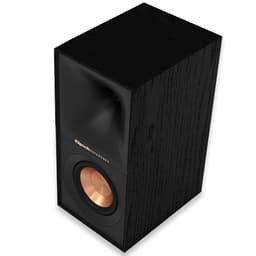
Klipsch R-40M
Getting real volume out of a small, inexpensive amplifier
Price as of October 16, 2026. #ad How we’re funded
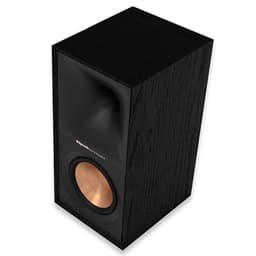
Klipsch R-50M
The passive Klipsch pair to buy if the budget stretches past the R-40M
Price as of October 16, 2026. #ad How we’re funded
What either pair needs behind it
At 91 to 92 dB, a small amplifier reaches loud levels with both pairs. The Fosi V3 is the cheapest honest option and needs a phono stage in front of it; the Sony STR-DH190 publishes a phono input, so it covers both jobs in one box.
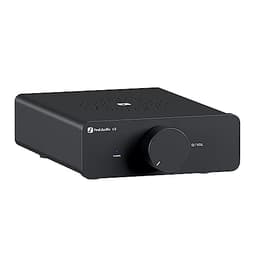
Fosi Audio V3
The cheapest amplifier worth putting behind passive speakers
Price as of October 16, 2026. #ad How we’re funded
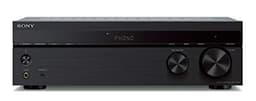
Sony STR-DH190
One box that replaces both the phono preamp and the amplifier
Price as of October 16, 2026. #ad How we’re funded
Frequently asked questions
What is the difference between the Klipsch R-40M and R-50M?
Driver size and the three figures that follow from it. Klipsch publishes a 4 inch woofer, 71 Hz to 21 kHz plus or minus 3 dB, 91 dB sensitivity, a 1,770 Hz crossover and 50 W continuous power handling for the R-40M, against a 5.25 inch woofer, 58 Hz to 21 kHz plus or minus 3 dB, 92 dB, a 1,560 Hz crossover and 75 W for the R-50M. The tweeter, the horn, the 8-ohm rating and the binding posts are identical.
Which is better for a record player?
The R-50M, and the crossover is the reason as much as the bass. At 1,560 Hz it hands less of the vocal range to a horn-loaded tweeter than the R-40M's 1,770 Hz does, which on close-miked vocals - most of what is on a record - is the audible difference. The extra 13 Hz of low-frequency reach is the part people notice first and the part that matters less.
Is the R-50M worth the extra money?
If the room is more than a desk, yes. You are buying a 5.25 inch woofer, 13 Hz of extra bass extension and a crossover 210 Hz lower, for roughly the price of a decent phono preamp. If the speakers are going on a desk at close range, the R-40M's smaller cabinet is the better physical fit and the bass difference matters least at a meter's distance.
Do I need an amplifier for the R-40M or R-50M?
Yes. Both are passive and make no sound on their own, and neither has a phono input - so a record player needs an amplifier, with a phono stage either in that amplifier or in a separate box. The high sensitivity means the amplifier can be small: at 91 to 92 dB a 20 to 30 W integrated amplifier reaches loud levels in a normal room.
How much amplifier power do these need?
Far less than the power handling figures suggest. 50 W continuous (R-40M) and 75 W (R-50M) are ceilings, not requirements. Every 3 dB of sensitivity halves the power needed for a given level, so at Klipsch's published 91 to 92 dB these go satisfyingly loud on a 20 W amplifier. Power handling tells you what they survive, not what they want.
Can I put these against a wall?
Not hard against one. Both are rear ported, which means a wall close behind the cabinet turns the low end boomy and smears the midrange. Leave a few inches and toe them in toward the listening position. If the speakers have to sit on a shelf against a wall, a front-ported pair like the ELAC Debut 2.0 B5.2 is the better choice.
Should I buy the R-50PM instead and skip the amplifier?
It is worth pricing. The R-50PM is the powered version of this driver complement with an amplifier and a switchable phono input with a ground screw terminal inside, so it replaces the speakers, the amplifier and the phono preamp in one purchase. It costs more than the R-50M alone and less than the R-50M plus a good amplifier plus a phono stage, and Klipsch publishes no sensitivity for it because the amplifier is already matched.
Sources
- Klipsch — Reference R-40M spec sheet (PDF) — Manufacturer specs: 91 dB in-room sensitivity, 71 Hz - 21 kHz +/-3 dB, 8 ohms compatible, 1,770 Hz crossover, 50 W / 200 W power handling (accessed August 28, 2026)
- Klipsch — Reference R-50M spec sheet (PDF) — Manufacturer specification table, read live: frequency response 58 Hz - 21 kHz +/-3 dB, sensitivity 92 dB (In-Room), power handling 75 W / 300 W, nominal impedance "8 ohms Compatible", crossover 1,560 Hz, high-frequency driver "1" Aluminum LTS tweeter mated to a 90 x 90 square Tractrix Horn", low-frequency driver "Single 5.25" spun-copper TCP woofer", enclosure MDF, "Bass-Reflex via rear-firing ports", inputs "Single Gold Plated Binding Posts", 13.9" (354 mm) H x 7" (178 mm) W x 9" (229 mm) D, 11 lbs (5 kg), Black Textured Wood Grain Vinyl. The sensitivity asterisk reads "SPL at 1M, half-space anechoic with 2.83V input". Read alongside the R-40M sheet, which is printed in the identical format — the two are directly comparable line for line (accessed September 29, 2026)
- Klipsch — R-50PM powered monitors spec sheet (PDF) — Manufacturer specification table, read live. System description "Powered Monitor (pair)", frequency response 55 Hz - 20 kHz, "DYNAMIC BASS EXTENSION 44Hz", maximum output 104 dB, "120W Total System Power (240W Peak)" and "60W per channel cont. @ <%1 THD", 1" (2.5 cm) aluminum LTS tweeter on a 90 x 90 square Tractrix horn, "Single 5.25" (13.3cm) spun-copper TCP woofer", crossover "1663 Hz (Passive)", MDF, "Bass-reflex via rear-firing port", 14" (35.6 cm) H x 7" (17.8 cm) W x 10.8" (27.4 cm) D, 24.8 lbs (11.2 kg). The input list is the reason this model is on the page: "Bluetooth wireless technology / Phono/Line analog (with switch and ground screw terminal) / 3.5mm analog mini jack / USB digital / Optical digital", with a "Single RCA line level output for connection to subwoofer". The header badges read TURNTABLE READY, PC READY, TV READY and NO RECEIVER NEEDED. NO sensitivity and NO nominal impedance row is printed — which is why this site records both as not published for the powered models (accessed September 29, 2026)
- Crutchfield — Home speakers buying guide — Reference on choosing passive vs powered speakers, room size and amplifier pairing (accessed August 11, 2026)
- Crutchfield — Understanding speaker and amplifier wattage ratings — On RMS versus peak power, and matching an amplifier's output to a speaker's rating (accessed August 11, 2026)
Keep reading
Klipsch R-40M Review
The smaller pair in full, including what 91 dB sensitivity does to your amplifier budget.
Read the reviewBest Klipsch Speakers for Vinyl
The whole Klipsch range ranked on one question: is there a phono input inside the box?
See the picksKlipsch R-40PM vs R-50PM
The powered version of this comparison, where the phono stage is already inside.
Compare themBest Speakers Under $500
Where both pairs sit once the amplifier and the phono stage are priced in honestly.
See the picks