Audio-Technica AT-LP120XUSB Review
A direct-drive deck with a DJ pedigree, three speeds, a USB output and a fully adjustable arm — and the clearest case on this site of a turntable that does two jobs at once.
How this is funded: we earn a commission if you buy through our links, at no extra cost to you. It never changes which product we recommend, and we’ll tell you plainly when to skip one. Full disclosure.
The short version
Audio-Technica AT-LP120XUSB
The most versatile deck under $400: direct drive with instant, unwavering speed, a fully manual tonearm with adjustable anti-skate, three speeds including 78 RPM, a switchable phono preamp and a USB output that records straight to a computer. Buy it if you digitize, DJ or want one deck that does everything. Skip it if you only ever play albums and would rather that money went into a better cartridge.
Strengths
- Direct drive with high torque — instant speed and a stable, DJ-style platter
- USB output records vinyl straight to a computer
- Full manual control: counterweight, anti-skate, pitch, and three speeds including 78 RPM
Trade-offs
- Fully manual — no auto return
- Heavier and larger than the belt-drive decks; overkill if you only ever play at home casually
| Drive | Direct drive |
|---|---|
| Operation | Manual |
| Cartridge | Audio-Technica AT-VM95E (elliptical) |
| Built-in preamp | Yes — switchable |
| Speeds | 33 1/3, 45 and 78 RPM |
| USB output | Yes |
Specifications read from the manufacturer / product listing, accessed 2026-10-05. We have not measured this unit — what we do instead.
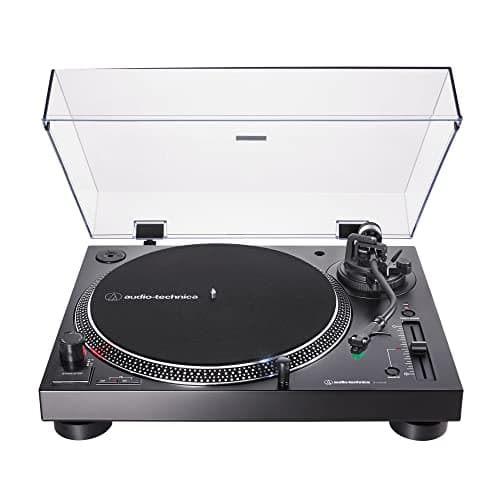
The AT-LP120XUSB is the deck people buy when they cannot decide. It has the direct-drive motor and pitch control of a DJ turntable, the adjustable tonearm and elliptical cartridge of a listening deck, a USB output for archiving, and a switchable phono preamp so it works with anything. On paper that reads as a product trying to be everything.
In practice it mostly succeeds, and the reason is that Audio-Technica did not compromise the tonearm to get there. Everything else on this deck is a feature bolted onto a serious foundation.
What direct drive gives you here
In a direct-drive deck the platter sits on the motor spindle rather than being turned by a belt. Two consequences matter for a listener.
First, speed is instant and stays put. There is no belt to stretch, slip or need replacing every few years, and no spin-up delay. Over a twenty-minute side, speed accuracy does not drift. That matters most for digitizing, where a slow drift becomes a permanent property of the file, and for piano and sustained strings where wavering pitch is audible.
Second, torque. The platter resists a hand on it, which is what makes cueing and scratching possible and is irrelevant if you never do either.
Third, and the one people buy this deck for without realizing it: a third speed. Audio-Technica publishes 33 1/3, 45 and 78 RPM here, which the belt-drive automatics in the range do not, and which puts this deck at the top of our 78 RPM turntable picks. For where it sits against the rest of the brand’s ladder — and the one row that caps each deck in it — see our Audio-Technica range page.
The historical objection to direct drive was that motor vibration could reach the platter without a belt to absorb it. Modern designs largely engineer that away, and this deck uses a DC servo motor. Our belt vs direct drive guide covers the trade in full — the short version is that at this price, both are executed well enough that setup and cartridge matter more.
The tonearm is the reason to take it seriously
This is where the AT-LP120XUSB separates from every fixed-arm deck below it. It is fully manual with an adjustable counterweight and adjustable dynamic anti-skate, so you set tracking force to whatever the cartridge specifies rather than accepting a factory value.
It also has a removable headshell. That is worth more than it sounds: a cartridge change on a fixed headshell is a fiddly alignment job with a protractor, whereas a removable headshell lets you mount and align a second cartridge at a table and swap the whole assembly in about a minute. If you ever want a 78 stylus, a mono cartridge or a spare, this is the feature that makes it practical. See how to set up a cartridge.
The cartridge it ships with
The AT-VM95E, an elliptical dual moving magnet, is a genuinely good cartridge and the one we recommend most often on this site — see our AT-VM95E review. On a deck at this price, having it fitted from the factory is a real part of the value.
More importantly, it is a VM95 body. Every stylus in that family — conical, elliptical, micro-linear, Shibata, 78 — snaps onto it with no realignment. So the upgrade path from this deck is a stylus purchase, not a cartridge purchase. That is the single best thing about buying into Audio-Technica, and it is covered in needles and replacement styli.
The USB output, honestly assessed
The deck contains an analog-to-digital converter and presents itself to a computer as a class-compliant audio input. No drivers, no interface box, free software. For anyone archiving out-of-print records, that is the entire reason to buy this deck over a belt-drive equivalent.
Two honest caveats. Above roughly $200 a dedicated USB audio interface generally converts better than the circuit inside a turntable, so a purist archiving a valuable collection might prefer to run the analog output into one of those. And the capture is only ever as good as what feeds it — a worn stylus or a mistracking arm records its own distortion permanently. Clean the record, check the tracking force, then hit record. Our USB turntable roundup covers the alternatives.
Setting it up
The cartridge arrives mounted and aligned, so the work is the arm. Balance it, set tracking force to the AT-VM95E’s specification, set anti-skate to match, and check the deck is level. Fifteen minutes, and it is the difference between this deck performing as designed and performing worse than a $180 automatic.
Then decide the preamp question. Leave the switch on LINE to feed powered speakersor an aux input. Switch it to PHONO if you are running into an amplifier’s phono input or a separate phono stage. Never both — two phono stages in series is the most common setup fault in vinyl and it sounds distorted and far too loud.
What it is not
It is not the best-sounding deck at this price for someone who only plays albums. The money spent on the USB converter, the pitch fader, the target light and the third speed is money not spent on the platter, plinth or arm bearings. A belt-drive deck at the same price that spent all of it on those — the Fluance RT82, most obviously — puts more of your money into pure playback.
It is also fully manual, with no auto-return. Fall asleep to a side and the stylus circles the run-out groove until someone lifts it.
Who should buy it
Buy the AT-LP120XUSB if you want to digitize records, if you DJ or scratch at all, if you want three speeds including 78, or if you want a single deck that will cover every use case you might develop over the next decade. The removable headshell and the VM95 stylus ladder mean it stays useful through several upgrades.
Buy something else if you exclusively play albums through a hi-fi and none of the extra features appeal — in which case a belt-drive deck at the same money, plus a better cartridge, is the more direct route to better sound. If you are specifically shopping the direct-drive class rather than this one deck, our direct-drive picks put it against its two siblings on the published rows.
Frequently asked questions
Is the Audio-Technica AT-LP120XUSB good for listening, or just DJing?
It is genuinely good for both. The DJ heritage shows in the direct-drive motor, pitch fader and target light, but the tonearm is fully adjustable with anti-skate and it ships with the elliptical AT-VM95E cartridge — which is a listening cartridge, not a DJ one.
Does the AT-LP120XUSB need a phono preamp?
No. It has a switchable built-in phono preamp, so it plugs into powered speakers or any line input as it comes. Switch it to PHONO and bypass the internal stage when you add a separate phono preamp or use an amplifier with a phono input.
How do I record vinyl with the AT-LP120XUSB?
Connect the supplied USB cable to a computer. The deck is class-compliant, so it appears as an audio input with no drivers to install, and free software such as Audacity records from it. Record uncompressed — WAV at 24-bit — and convert copies afterwards.
Can the AT-LP120XUSB play 78 RPM records?
It has a 78 RPM speed setting, but playing shellac properly also needs a 78-specific stylus, because a 78 groove is much wider than a microgroove LP's. Audio-Technica sells one for the VM95 family, which is a practical advantage of the cartridge this deck ships with.
Is the AT-LP120XUSB better than the Fluance RT81?
They are built for different things. The AT-LP120XUSB adds direct drive, three speeds, USB and a removable headshell; the RT81 costs less and is a simpler belt-drive listening deck. If you will never digitize or DJ, the extra money is better spent on a cartridge.
What is the difference between the AT-LP120XUSB and the AT-LP120XBT-USB?
The BT model adds Bluetooth output with aptX Adaptive so it can stream to a wireless speaker. Mechanically they are closely related. If you will only ever use wired outputs, the plain AT-LP120XUSB costs meaningfully less and sounds the same over RCA.
Sources
- Crutchfield — How to choose the right turntable — Buying-guide reference on drive type, cartridges, preamps and setup (accessed July 24, 2026)
- Audio-Technica — AT-VM95E cartridge — Manufacturer specs: 0.3 x 0.7 mil elliptical stylus on an aluminum cantilever, 4.0 mV output at 1 kHz / 5 cm/sec, 1.8-2.2 g tracking force (2.0 g standard), 20-22,000 Hz, 20 dB channel separation at 1 kHz, half-inch mount, AT-VMN95E replacement stylus, and the maker's own statement that "all VM95 Series share the same body" so the stylus "can be replaced with any of the six interchangeable AT-VMN95 replacement styli". Re-read on the access date below, which corrected a tracking-force range previously noted here as 1.8-2.3 g (accessed September 26, 2026)
- Audio-Technica — VM95 Series cartridges — The shared-body VM95 range and its interchangeable stylus upgrade path (accessed July 24, 2026)
- Elusive Disc — Turntable setup guide: tracking force & anti-skate — Step-by-step on balancing the tonearm, setting tracking force and anti-skate (accessed July 24, 2026)
Keep reading
Fluance RT81 vs AT-LP120XUSB
This deck against the belt-drive default, including the 17.8-inch width that rules platforms out.
Compare themEssential Hip-Hop Records on Vinyl
What to spin first on a direct-drive deck — and why running time matters here.
See the picksAT-LP120XUSB vs Fluance RT82
Direct drive against belt drive at almost identical money.
Read the comparisonAT-LP60X vs AT-LP120XUSB
Whether this deck is worth the step up from the entry automatic.
Read the comparisonFluance RT85 vs AT-LP120X
This deck against a pure listening machine with an Ortofon 2M Blue and an acrylic platter.
Compare themAT-LP120X vs Rega Planar 1
This deck against one built so that nothing on it can be adjusted at all.
Compare themBest USB Turntables
Where this deck sits against everything else that digitizes.
See the picksBelt Drive vs Direct Drive
The trade-off this deck sits on the direct side of.
Read the comparisonBest Turntable Needles & Replacement Styli
The VM95 stylus ladder this deck's cartridge opens up.
See the styli