Fluance RT81 vs AT-LP120XUSB
The two decks this site recommends most often, finally put side by side. One is a belt-drive wooden plinth that does one job well; the other is a direct-drive workshop with 78 RPM, a USB output and a cartridge whose parts are still in production.
How this is funded: we earn a commission if you buy through our links, at no extra cost to you. It never changes which product we recommend, and we’ll tell you plainly when to skip one. Full disclosure.
The verdict, before the forty rows
These are the two decks this site recommends more often than any others, and until now they have never been put side by side. The Fluance RT81 is the top pick on six of our roundups. The Audio-Technica AT-LP120XUSB is the deck we point at every time somebody wants to digitize records or learn to set an arm up properly. They sit close enough in price to be cross-shopped and they are built on opposite philosophies.
The short answer: buy the RT81 if you want the better-looking, quieter-on-paper, narrower deck to play albums through speakers, and the AT-LP120XUSB if you need 78 RPM, a USB output, or a cartridge whose replacement parts still exist. Those three rows decide most purchases, and only one deck has any of them.
What does not decide it is the drive system, despite being the headline difference. We have not measured either turntable — what we do instead is read what each maker publishes and refuse to compare figures measured differently. Which, on this page, turns out to be most of them.
Belt against direct: what actually changes
Fluance builds the RT81 as a belt drive with a DC motor on three-point rubber isolation. The motor sits off to one side, a rubber belt carries its rotation to the platter, and the belt absorbs some of the motor’s vibration on the way — that is the entire engineering argument for belt drive, and it is why nearly every deck at this price uses one. The cost is a consumable: belts stretch, and a stretched belt shows up as speed drift.
Audio-Technica builds the AT-LP120XUSB as a direct drive with a DC servo motor under the platter. There is no belt to replace. Audio-Technica publishes starting torque above 1.0 kgf.cm and an electronic brake, which is why the platter is up to speed almost immediately and stops when told — the DJ-descended behavior that also makes it the deck of choice for anyone cueing by hand.
Neither arrangement is inherently the better-sounding one, and we lay the general case out in belt drive versus direct drive. What you should take from this section is narrower: the Fluance trades a maintenance item for a little vibration isolation, and the Audio-Technica trades that isolation for immediacy and one fewer thing to buy.
The three things only the Audio-Technica can do
78 RPM. Fluance’s own table prints 78 RPM: No. Audio-Technica publishes 33-1/3, 45 and 78 RPM and describes the deck as 3-speed. If there is shellac in the house — a parent’s collection, an estate sale box — this row ends the comparison on its own. The honest footnote is that proper 78 playback also wants a dedicated 78 stylus, which is a much wider groove than the elliptical tip either deck ships, so the Audio-Technica lets you play them where the Fluance cannot, not that it plays them ideally.
A USB output. Audio-Technica publishes 16 bit at 44.1 or 48 kHz, selectable, over a USB 1.1 compliant interface. That is CD resolution, not hi-res, and it is enough for archiving a collection to files. The RT81 has no USB at all. You can still digitize from it — our guide to recording vinyl to a computer covers the audio-interface route that works with any deck — but that is another box and another cable.
A cartridge with a future. This is the row nobody notices and the one we would weight most heavily. The RT81 ships an Audio-Technica AT95E. On Audio-Technica’s own site that cartridge is badged Discontinued, and so is its only listed replacement stylus, the ATN95E, whose page reads We’re sorry, but this item is unavailable. The AT-LP120XUSB ships an AT-VM95E — the current half-inch line — on a standard AT-HS6 headshell, and Audio-Technica lists five VMN95 styli as compatible with that body, from the conical VMN95C up to the Shibata-profiled VMN95SH.
So the Fluance’s stock cartridge is a dead end, and the Audio-Technica’s is the start of a ladder. That is fixable on the Fluance — it has a standard H-4 bayonet headshell, so any half-inch cartridge fits, and our cartridge roundup and fitment explainer cover how — but fixing it is a purchase, and that purchase belongs in the price comparison.
The two things only the Fluance can do
Fit. Audio-Technica publishes 452.0 mm (17.80 in) wide and 8 kg (17.6 lb). Fluance publishes 16.5 in wide and 14.1 lb. Two and a half inches sounds academic until you shop for somewhere to put it: Fluance’s own IB40 isolation base publishes a footprint limit of 17.13 x 14.96 in, which the AT-LP120XUSB exceeds and the RT81 clears easily. Our isolation feet and platforms roundup ranks on exactly this, and the wide deck rules several products out.
Stop by itself. The RT81 has a defeatable auto-stop: at the end of a side the platter stops, even though you still cue the arm yourself. The AT-LP120XUSB is fully manual — Audio-Technica’s own table says so — which means a record that finishes while you are in another room keeps turning with the stylus sitting in the run-out groove. Neither is a sound-quality matter. Both are things you will notice weekly for years. If that is the deciding factor for you, read automatic versus manual turntables and consider an actual automatic instead.
The numbers that look decisive and are not
Fluance publishes wow and flutter of 0.2%, speed variation of +/- 1.00% and a signal-to-noise ratio of 67 dB or higher, A-weighted, 20 kHz LPF — plus 60 dB or higher unweighted. Audio-Technica publishes wow and flutter below 0.2% WRMS at 3 kHz (33 RPM) and a signal-to-noise ratio of more than 50 dB, with no weighting stated and no speed-variation figure at all.
Read those as two companies describing their own products on their own terms, because that is what they are. A-weighting flatters a noise figure by discounting the frequencies the ear is least sensitive to, so Fluance’s 67 dB and Audio-Technica’s 50 dB are not seventeen decibels apart in any meaningful sense. The same applies to the wow-and-flutter pair: one is a plain percentage, the other is weighted RMS at a stated test frequency. The only sound conclusion is Fluance publishes a more complete specification, which is worth something in itself, and that both decks are in the ordinary range for belt and direct drives at this money.
Two rows are genuinely comparable, because both makers publish the same thing in the same units. The line outputs differ — 140 mV against 240 mV — which means the Audio-Technica plays louder at the same volume setting, and nothing more. And the supported cartridge weight ranges differ: Fluance supports 3.5–6.5 g, Audio-Technica 3.5–8.5 g. That extra two grams is real headroom if you ever want a heavier cartridge, which is the one place the arm specs actually point in the same direction as the upgrade story.
Setting each one up
Both are manual decks with adjustable counterweights and anti-skating, so both require the same job: fit the headshell, balance the arm, set the tracking force, set anti-skate, level the plinth. Our turntable setup guide and tonearm balancing guide walk through it, and a tracking-force gauge is how you confirm the number rather than trusting the dial.
Two differences matter in practice. The Audio-Technica publishes a tracking-force adjustment range of 0 to 4 g, a maximum tracking error angle of less than 3 degrees and +/- 5 mm of overhang adjustment at the headshell, which is the kit for aligning a cartridge properly; Fluance publishes none of those three figures. Against that, the Audio-Technica also gives you more ways to get it wrong, which is exactly why we recommend it to people who want to learn and the Fluance to people who do not.
The Audio-Technica also ships a stylus target light, which sounds like a gimmick until you cue by hand in a dim room. And both decks publish a ground terminal and a switchable stage, so if you later add an external phono preamp, connect the ground wire before you conclude the preamp hums.
Who should buy which
Buy the Fluance RT81 if this is the only deck you plan to own. It is quieter on its own published terms, it is the better-looking object by a distance — a real wood veneer over MDF against a plastic-topped plinth — it stops itself at the end of a side, and it fits on shelves and isolation platforms the Audio-Technica does not. Budget for a current cartridge, and read the full RT81 review for why.
Buy the AT-LP120XUSB if you want to do things to your records rather than just play them. Digitizing, 78s, cartridge experiments, learning alignment properly: this is the deck with the torque, the adjustments, the parts supply and the port. It is bigger, heavier and plainer, and it does not care. The full AT-LP120XUSB review covers what fully manual really asks of you.
Buy neither if you will not cue an arm by hand. Both of these are manual decks, and a surprising number of people discover that about themselves in week two. The honest alternative is an automatic that still keeps an upgradeable stylus — the AT-LP70X — or the wider field in best automatic turntables.
Whichever you pick, neither makes a sound by itself. Both will drive powered speakers straight out of the box on their line setting, which remains the cheapest complete system we know how to recommend.
The spec matrix
Only seven rows are identical. The ones that carry the decision are the drive, the third speed, the USB output, the two cartridge rows, the supported cartridge weight and the 17.8-inch width.
| Specification | RT81Fluance | AT-LP120XUSBAudio-Technica |
|---|---|---|
| Drive | Belt drive | Direct drive |
| Motor | DC motor | DC servo motor |
| Motor isolation | Three-point rubber isolation | Not published |
| Starting torque | Not published | > 1.0 kgf.cm |
| Braking system | Not published | Electronic brake |
| Speeds | 33 1/3 and 45 RPM (78 RPM: no) | 33 1/3, 45 and 78 RPM |
| Wow and flutter (maker's own method) | 0.2% | < 0.2% WRMS (33 RPM) at 3 kHz |
| Speed variation | +/- 1.00% | Not published |
| Signal to noise (maker's own method) | 67 dB or higher (A-weighted, 20 kHz LPF); 60 dB or higher unweighted | > 50 dB |
| Operation | Manual, with defeatable auto-stop | Fully manual — no auto-stop |
| Platter | Aluminum, 12 in, 1.22 lb (553 g), 0.62 in (16 mm) | Die-cast aluminum |
| Platter mat | Rubber | Felt |
| Tonearmsame | Static balanced, S-type | Static balanced, S-shaped |
| Effective tonearm length | 8.82 in (224 mm) | 9.07 in (230.5 mm) |
| Overhang | 0.76 in (19.2 mm) | 0.63 in (16 mm) |
| Maximum tracking error angle | Not published | Less than 3 degrees |
| Effective tonearm mass | 0.99 oz (28.2 g) | Not published |
| Counterweight | Yes, 3.53 oz (100 g), adjustable | Yes, adjustable |
| Tracking-force adjustment range | Not published | 0 to 4 g |
| Supported cartridge weight | 0.12-0.23 oz (3.5-6.5 g) | 3.5 to 8.5 g |
| Anti-skatingsame | Yes | Yes |
| Pitch control | No | Yes, variable (per the maker's listing) |
| Headshell | H-4 bayonet, 0.38 oz (10.7 g) | AT-HS6, 9 g with lead wire, +/- 5 mm overhang adjustment |
| Cartridge | Audio-Technica AT95E, dual moving magnet | Audio-Technica AT-VM95E, VM |
| Stylus (maker's figure) | 0.4 x 0.7 mil bonded elliptical per Fluance; 0.3 x 0.7 mil per Audio-Technica | 0.3 x 0.7 mil bonded elliptical |
| Cartridge status at Audio-Technica | Discontinued — cartridge and ATN95E stylus both badged so | Current — five VMN95 styli listed as compatible |
| Tracking force | 2.0 g (Fluance's figure) | 1.8 to 2.2 g (2.0 g standard) |
| Cartridge output | 3.5 mV (+/- 3 dB) | 4.0 mV at 1 kHz, 5 cm/sec |
| Cartridge weight | 5.7 g (+/- 0.5 g) | 6.1 g (0.22 oz) |
| Built-in phono preampsame | Yes, PHONO/LINE switchable | Yes, PHONO/LINE switchable |
| Preamp gain | Not published | 36 dB nominal, RIAA equalized |
| Phono output | 3.5 mV (+/- 3 dB) | 4 mV nominal at 1 kHz, 5 cm/sec |
| Line output | 140 mV (-17 dBV) | 240 mV nominal at 1 kHz, 5 cm/sec |
| Preamp bypasssame | Yes, all electronics bypassed | Yes, selector switch |
| Ground terminalsame | Yes | Yes |
| USB output | No | Yes — 16 bit, 44.1 or 48 kHz selectable, USB 1.1 compliant |
| Plinth | MDF, high-gloss real wood veneer | Not published |
| Dust coversame | Yes, tinted | Yes |
| Stylus target light | No | Yes |
| Dimensions (W x D x H) | 16.5 x 14.25 x 5.75 in | 17.80 x 13.86 x 5.57 in |
| Weight | 14.1 lb (6.4 kg) | 17.6 lb (8 kg), without dust cover |
| Power consumption | 1.5 W | 2.75 W |
| Replacement stylus | ATN95E (discontinued) | AT-VMN95E |
Every figure is the maker’s own published specification — Fluance’s RT81 product page and Audio-Technica’s AT-LP120XUSB manual, both read 2026-10-05 — except the cartridge-status rows, which come from Audio-Technica’s own cartridge and stylus pages. We have not measured either deck. Note that the two speed and noise figures are published under DIFFERENT conditions by different companies and are not like-for-like: Fluance prints a plain 0.2% and an A-weighted signal-to-noise figure, Audio-Technica prints a WRMS figure at 3 kHz and an unweighted one. Comparing them directly would be the kind of confidently wrong number this site exists not to print. “Not published” means the figure is not stated in the sources cited below — it is never a value we estimated. Rows marked same are the ones where these decks do not differ.
Both decks, with live prices
Prices are pulled live and dated. Fluance discounts through its own store and Amazon independently, and Audio-Technica's street price swings more than most, so check both buttons before deciding — the gap between these two has been as wide as a cartridge and as narrow as nothing.
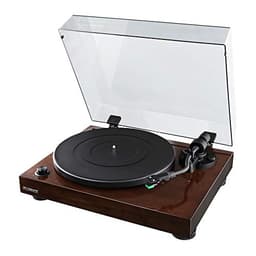
Fluance RT81
First serious turntable that you won't outgrow in a year
Price as of October 6, 2026. #ad How we’re funded
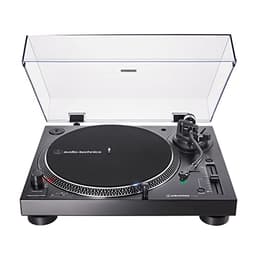
Audio-Technica AT-LP120XUSB
Digitizing records and learning proper setup
What each deck asks you to buy next
The honest total cost of each side. The RT81 ships a cartridge its own maker has discontinued, so a current cartridge on a spare headshell is its first real upgrade. The AT-LP120XUSB ships a current cartridge and a decent internal stage, so its first upgrade is the stage rather than the stylus.
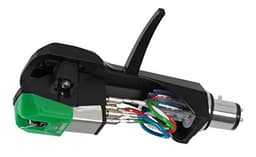
Audio-Technica AT-VM95E/H Headshell + Cartridge Kit
Upgrading the cartridge on a removable-headshell deck without doing the mounting yourself
Price as of October 6, 2026. #ad How we’re funded
Fluance PA10
A solid mid-priced MM upgrade
Price as of October 6, 2026. #ad How we’re funded
Frequently asked questions
Is the Fluance RT81 or the AT-LP120XUSB better?
They are better at different jobs, and the published specs say which. Buy the RT81 if you will play albums through speakers and want the quieter, prettier, lighter deck - Fluance publishes a 67 dB A-weighted signal-to-noise figure and a real wood veneer plinth, and it is two and a half inches narrower. Buy the AT-LP120XUSB if you need any of the three things the Fluance cannot do: 78 RPM, a USB output for digitizing records, or a cartridge you can upgrade five ways without replacing the whole thing. Nothing about direct drive makes it sound better; it makes it start faster and hold speed differently.
Is direct drive better than belt drive for a turntable?
No - it is different, and the difference is mostly mechanical rather than sonic. A direct-drive platter sits on the motor, so it reaches speed almost immediately and holds it without a belt to stretch; Audio-Technica publishes more than 1.0 kgf.cm of starting torque and an electronic brake on this deck. A belt absorbs some motor vibration before it reaches the platter, which is why belt drive dominates at this price, and it is a consumable - Fluance's own support material and Audio-Technica's manuals both treat belts as a periodic replacement. We argue the whole question in our belt drive versus direct drive guide.
Does the Fluance RT81 play 78 RPM records?
No. Fluance's specification table lists 33 1/3 and 45 RPM and prints "78 RPM: No" explicitly. The AT-LP120XUSB publishes all three speeds. If you have inherited shellac, that single row decides this comparison - though note that playing 78s properly also wants a dedicated 78 stylus, which neither deck ships.
Can you record vinyl to a computer with the RT81?
Not directly - it has no USB output. You would need an audio interface between the deck's line output and the computer, which is the route our guide to recording vinyl to a computer covers and which works with any turntable. The AT-LP120XUSB has USB built in, published as 16 bit at 44.1 or 48 kHz selectable, which is CD resolution rather than hi-res.
Which cartridge is better, the AT95E or the AT-VM95E?
The AT-VM95E on the Audio-Technica, and the reason is availability rather than sound. Audio-Technica badges both the AT95E cartridge and its only replacement stylus, the ATN95E, as discontinued on its own site - the stylus page reads "We're sorry, but this item is unavailable." The AT-VM95E is the current half-inch line, and Audio-Technica lists five VMN95 styli as compatible with that body, from conical up to Shibata. On paper the two tips are close; one has a parts supply and the other does not.
Will the AT-LP120XUSB fit on a turntable isolation platform?
Check the width first. Audio-Technica publishes 452.0 mm (17.80 in) across, and Fluance's own IB40 isolation base publishes a footprint limit of 17.13 x 14.96 in - so the AT-LP120XUSB is wider than that platform allows, while the 16.5-inch RT81 fits with room to spare. This is the most-overlooked consequence of choosing the heavier deck, and it is the reason our isolation roundup ranks on footprint as well as load rating.
Do either of these need a phono preamp?
No. Both publish a switchable built-in phono stage with a ground terminal, so either will feed a line input or powered speakers out of the box and either can be bypassed later. The line outputs differ - Fluance publishes 140 mV, Audio-Technica 240 mV - which means the Audio-Technica will sound louder at the same volume setting, not better. Our phono preamp explainer covers when an external stage is actually an upgrade.
Which one is quieter?
On the published figures the RT81, but the figures are not comparable and we will not pretend otherwise. Fluance publishes "67 dB or higher (A-weighted, 20 kHz LPF)" and "60 dB or higher" unweighted; Audio-Technica publishes "> 50 dB" with no weighting stated. An A-weighted number is almost always the flattering one, so the honest reading is that Fluance has published a more detailed and more favorable-looking specification, not that we have measured a 17 dB gap.
Sources
- Fluance — RT81 Elite turntable, published specifications — Manufacturer specification table, read live: belt drive, DC motor on three-point rubber isolation, 33 1/3 and 45 RPM (78 RPM "No"), speed variation +/- 1.00%, wow and flutter 0.2%, signal-to-noise "67 dB or higher (A-weighted, 20 kHz LPF)" and "60 dB or higher (unweighted, 20 kHz LPF)", aluminum platter 12 in / 1.22 lb (553 g) / 0.62 in (16 mm) with a rubber mat, static-balanced S-type aluminum tonearm 8.82 in (224 mm) effective length and 0.99 oz (28.2 g) effective mass, adjustable 100 g counterweight, anti-skating, cueing lever, pivot bearing, H-4 bayonet headshell 0.38 oz (10.7 g), "Audio Technica: AT95E" dual moving magnet cartridge with a 0.4 x 0.7 mil bonded elliptical diamond on an aluminum cantilever at 2.0 g tracking force, 20-20,000 Hz, 20 dB channel separation at 1 kHz, 3.5 mV phono output and 140 mV (-17 dBV) line output, switchable PHONO/LINE preamp with full bypass and a ground terminal, MDF plinth in real wood veneer, tinted dust cover, defeatable auto-stop, suspension isolation feet, 14.1 lb (6.4 kg), 1.5 W. Listed at 299.99 USD on the access date with no discontinuation notice. Re-read live on 2026-10-05 for the RT81 vs AT-LP120XUSB head-to-head and the 2M Blue review, every figure above unchanged and still listed at 299.99 USD; two rows quoted on those pages are confirmed verbatim from the same table — "Supported Cartridge Weight: 0.12 to 0.23 oz (3.5 to 6.5 g)", which EXCLUDES the 7.2 g Ortofon 2M Blue, and "Cartridge Weight: 5.7 g (+/- 0.5 g)" (accessed September 26, 2026)
- Audio-Technica — AT-LP120XUSB user manual, full published specification — The complete published table, re-read in full on this date (this manual was previously cited on this site only for the deck's dimensions). Turntable: type "Direct drive", motor "DC servo motor", "3-speed, fully manual operation" at 33-1/3, 45 and 78 RPM, die-cast aluminum platter, starting torque "> 1.0 kgf.cm", braking system "Electronic brake", wow and flutter "< 0.2% WRMS (33 RPM) at 3 kHz", signal-to-noise "> 50 dB", output PHONO "4 mV nominal at 1 kHz, 5 cm/sec" and LINE (MM) "240 mV nominal at 1 kHz, 5 cm/sec", phono pre-amp gain "36 dB nominal, RIAA equalized". Tonearm: "Static balanced S-shaped tonearm", effective length 230.5 mm, overhang 16 mm, maximum tracking error angle "Less than 3", stylus pressure adjustment range "0 to 4 g", applicable cartridge weight range "3.5 to 8.5 g". Cartridge and headshell: AT-VM95E, VM type, 47,000 ohms recommended load, 4.0 mV output, "0.3 x 0.7 mil bonded elliptical stylus", aluminum pipe cantilever, tracking force range "1.8 to 2.2 g (2.0 g standard)", cartridge weight 6.1 g, headshell AT-HS6 at 9 g including lead wire, headshell overhang adjustment "+/- 5 mm". USB function "16 bit 44.1 kHz or 48 kHz USB A/D, D/A selectable", computer interface "USB 1.1 Compliant". General: 452.0 mm (17.80") x 352.0 mm (13.86") x 141.6 mm (5.57"), 8 kg (17.6 lbs) without dust cover, 2.75 W, replacement stylus AT-VMN95E, replacement headshell AT-HS6, with a stylus target light, USB cable and RCA audio cable in the box (accessed October 5, 2026)
- Audio-Technica — AT-VM95E cartridge — Manufacturer specs: 0.3 x 0.7 mil elliptical stylus on an aluminum cantilever, 4.0 mV output at 1 kHz / 5 cm/sec, 1.8-2.2 g tracking force (2.0 g standard), 20-22,000 Hz, 20 dB channel separation at 1 kHz, half-inch mount, AT-VMN95E replacement stylus, and the maker's own statement that "all VM95 Series share the same body" so the stylus "can be replaced with any of the six interchangeable AT-VMN95 replacement styli". Re-read on the access date below, which corrected a tracking-force range previously noted here as 1.8-2.3 g (accessed September 26, 2026)
- Audio-Technica — VM95 Series cartridges — The shared-body VM95 range and its interchangeable stylus upgrade path (accessed July 24, 2026)
- Audio-Technica — AT95E dual magnet cartridge (DISCONTINUED) — The cartridge the RT81 ships with, on its own maker's site, badged "Discontinued" above the product name and listed at 49.00 USD with no specification table rendered. The page's own description is the marketing copy Fluance's listing echoes: "The half-inch standard mount AT95E phonograph cartridge offers outstanding clarity and detail" with an "elliptical diamond stylus". Cited for the discontinuation itself, which is a fact about buying the RT81 in 2026 rather than a spec: the VM95 series is Audio-Technica's current half-inch line and the AT95E is not in it (accessed September 26, 2026)
- Audio-Technica — ATN95E replacement stylus (DISCONTINUED) — The other half of the discontinuation, and the one that actually costs an owner money: the only replacement stylus Audio-Technica lists for the AT95E body is badged "Discontinued", priced 52.00 USD and reads "We're sorry, but this item is unavailable." Its description is "0.3 x 0.7 elliptical replacement stylus for these cartridges: AT95E" — which also puts Audio-Technica's own tip figure for this cartridge (0.3 x 0.7 mil) at odds with the 0.4 x 0.7 mil Fluance publishes for the same cartridge. Both figures are reported on the page; neither is picked (accessed September 26, 2026)
- Fluance — IB40 Turntable Isolation Base — Manufacturer specification: 10.49 lb (4.76 kg) of MDF, 2.5 x 17.13 x 14.96 in (H x W x D), a high-gloss real wood veneer finish, four height-adjustable silicone rubber feet and an integrated bubble level. It publishes both limits that matter — a maximum supported weight of 25 lb (11.34 kg) and a maximum turntable footprint of 17.13 x 14.96 in — and describes the feet as making "minimal contact with the surface below allowing the turntable to decouple from vibrational disturbances" (accessed September 11, 2026)
- Crutchfield — How to choose the right turntable — Buying-guide reference on drive type, cartridges, preamps and setup (accessed July 24, 2026)
- Crutchfield — How to choose a phono preamp — On why a phono signal needs a preamp and never running two at once (accessed July 24, 2026)
Keep reading
Belt Drive vs Direct Drive
The mechanical argument underneath this page, without either brand in the way.
Read the guideFluance RT81 Review
The belt-drive side on its own, including the discontinued-cartridge problem in full.
Read the reviewAudio-Technica AT-LP120XUSB Review
The direct-drive side on its own: USB, 78 RPM and what fully manual actually asks of you.
Read the reviewAudio-Technica AT-LP70X Review
If this whole page sounds like work, the automatic that still keeps an upgradeable stylus.
Read the reviewBest USB Turntables
Where the AT-LP120XUSB sits among decks built for digitizing a collection.
See the picks