PLATTER & PLINTH

The Best Portable Record Players

Three products are sold as portable and only one of them publishes battery operation. Which reading of the word you need decides the purchase — and one of these three will wear your records faster than the other two.

By Stephen V.Last updated How we pick

The verdict

If portable means it runs without a wall socket, there is one answer: the Numark PT01 Scratch, which publishes operation from six D batteries or AC, a built-in speaker, a carry handle, three speeds including 78 RPM, and a class-compliant USB interface for recording. It is for the person playing records somewhere there is no power. If portable means a case you can close and carry, with the speakers inside, the Victrola Journey is the honest budget pick — with the caveat we will not bury: its ceramic cartridge tracks heavy, so it is for thrift-store records and background play rather than a pressing you care about. If portable really means small, self-contained and wireless — a deck that moves from room to room and pairs with whatever speaker is there — the House of Marley Stir It Up Wireless is the one to buy, because it is the only one of the three with a real Audio-Technica moving-magnet cartridge and a switchable phono stage. That is also the one we would buy with our own money.

A record player is a machine that drags a diamond through a groove at a controlled angle and a controlled force. Everything that makes a turntable portable — light chassis, small platter, fixed arm, speakers in the same box as the stylus — works against that. So this page is not a pretense that portability is free. It is about choosing which part of the compromise you want to make.

Start by deciding which of the three meanings applies to you. Battery power is the only one that is a hard specification, and exactly one deck we rank publishes it: the Numark PT01 Scratch, on six D cells. A carry case with speakers is the suitcase class — self-contained, cheap, and the one with the real record-wear question attached. Compact and wireless is the newest reading: a normal small deck with Bluetooth out, which carries easily because it needs no amplifier and no wires at the far end.

One thing we are not going to do is invent a fourth category. There is no battery-powered hi-fi deck in our picks because we could not find a live listing for one that we would stand behind. If what you actually want is good sound that moves around the house, the honest answer is the third reading — a compact deck with Bluetooth and a portable speaker — and the page explains why below.

How this is funded: we earn a commission if you buy through our links, at no extra cost to you. It never changes which product we recommend, and we’ll tell you plainly when to skip one. Full disclosure.

Quick picks

Three picks for three different readings of the word, ranked by how much of a record player survives the portability. Every figure comes from the maker’s published specification or the listing cited under each deck, read on the date shown there. Prices are live and dated on each button. We have not measured these decks; here is exactly what we do instead.

#ProductBest forPrice
1
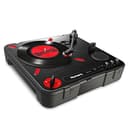
Numark PT01 Scratch

Numark PT01 Scratch

A battery-powered portable with a built-in speaker, a scratch slide switch and a class-compliant USB interface for recording. It is a tool for portablist DJs and for digitizing odd-format records anywhere, not a hi-fi deck — but within that brief nothing else at the price does the job.

Best battery powered
$169.00 · View on Amazon

Price as of October 10, 2026. #ad How we’re funded

2
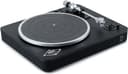
House of Marley Stir It Up Wireless

House of Marley Stir It Up Wireless

A belt-drive turntable built from bamboo and recycled materials, with Bluetooth out and a switchable built-in preamp. It has no speakers of its own — it's a real deck that streams — so it sits between the all-in-ones and the separates, and it's the pick if sustainability matters to you.

Best compact and wireless
3
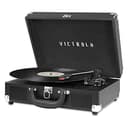
Victrola Journey

Victrola Journey

The classic portable suitcase player: cheap, cheerful, Bluetooth-equipped and genuinely portable. We include it honestly — it's fine as a gift or a dorm-room novelty, but its ceramic cartridge tracks heavy, so it is not the deck for records you care about.

Best suitcase on a budget
$57.82 · View on Amazon

$89.9936% off

Price as of October 10, 2026. #ad How we’re funded

The picks in full

#1Best battery powered

Numark PT01 Scratch

A battery-powered portable with a built-in speaker, a scratch slide switch and a class-compliant USB interface for recording. It is a tool for portablist DJs and for digitizing odd-format records anywhere, not a hi-fi deck — but within that brief nothing else at the price does the job.

Strengths

  • Runs on six D batteries or AC — genuinely portable, with a carry handle
  • Class-compliant USB interface records to a Mac or PC with no drivers
  • Three speeds including 78 RPM, plus RCA and headphone outputs

Trade-offs

  • Built-in speaker and portable cartridge are nowhere near hi-fi standard
  • Tracking force is not adjustable in the way a hi-fi deck's is — not the deck for a treasured pressing
DriveBelt drive, portable chassis
PowerAC adapter or 6 D batteries (not included)
DigitalClass-compliant USB recording interface
OutputsRCA, headphone, built-in speaker
Speeds33 1/3, 45 and 78 RPM
IncludedCartridge, removable slipmat, dust cover

Note. Buy it for portability and scratching. If it is going to sit on a shelf and play albums, a $180 automatic like the AT-LP60X will treat your records far better and sound far better doing it.

Specifications read from the manufacturer / product listing, on August 11, 2026. “Not published” means the maker does not state that figure.

#2Best compact and wireless

House of Marley Stir It Up Wireless

A belt-drive turntable built from bamboo and recycled materials, with Bluetooth out and a switchable built-in preamp. It has no speakers of its own — it's a real deck that streams — so it sits between the all-in-ones and the separates, and it's the pick if sustainability matters to you.

Strengths

  • Bamboo plinth and recycled/regrind materials — a genuinely eco-focused build
  • Bluetooth output plus a switchable built-in preamp
  • Audio-Technica cartridge and a proper (if simple) tonearm

Trade-offs

  • No built-in speakers — you supply the speaker or headphones
  • Bluetooth-out is convenient but not the highest-fidelity path
DriveBelt drive
WirelessBluetooth output
CartridgeAudio-Technica (moving magnet)
Built-in preampYes — switchable
Speeds33 1/3 and 45 RPM
MaterialsBamboo + recycled/regrind

Note. Because it has a real cartridge and a switchable preamp, it doubles as a legitimate starter deck — pair it with powered speakers over the wired output and it steps well beyond suitcase territory.

Specifications read from the manufacturer / product listing, on August 13, 2026. “Not published” means the maker does not state that figure.

#3Best suitcase on a budget

Victrola Journey

The classic portable suitcase player: cheap, cheerful, Bluetooth-equipped and genuinely portable. We include it honestly — it's fine as a gift or a dorm-room novelty, but its ceramic cartridge tracks heavy, so it is not the deck for records you care about.

Strengths

  • Very inexpensive and truly portable in a suitcase form
  • Bluetooth out to a wireless speaker
  • Simple, fun, and needs nothing else to work

Trade-offs

  • Ceramic cartridge tracks at a high force — hard wear on records over time
  • Built-in speakers are novelty-grade; not for critical listening
TypePortable suitcase, built-in speakers
DriveBelt drive
CartridgeCeramic (non-upgradeable)
BluetoothOut
Speeds33 1/3, 45 and 78 RPM
Built-in preampYes

Note. The honest caveat: a ceramic cartridge and high tracking force are fine for thrift-store records and background play, but we would not spin a valuable or new pressing on any suitcase player, this one included.

Specifications read from the manufacturer / product listing, on July 24, 2026. “Not published” means the maker does not state that figure.

The three readings, side by side

RowNumark PT01 ScratchHouse of Marley Stir It Up WirelessVictrola Journey
Runs on batteriesYes — 6 D cells or AC adapterNoNo
Speakers in the boxYes, one built-in speakerNo — you supply the speakerYes, a stereo pair in the case
CartridgePortable cartridge, includedAudio-Technica moving magnetCeramic, non-upgradeable
WirelessNoBluetooth outputBluetooth output
Built-in phono preampNot publishedYes — switchableYes
Speeds33 1/3, 45, 78 RPM33 1/3 and 45 RPM33 1/3, 45, 78 RPM
Other outputsRCA and headphoneWired output through the switchable preampNot published
DigitizingClass-compliant USB, no driversNoNo

The row that does most of the work is the cartridge. A ceramic pickup is the cheap, robust solution used in suitcase players: it puts out a big signal that needs no real phono stage, and it tracks at a force well above what a hi-fi cartridge uses. A moving-magnet cartridge like the Audio-Technica in the Stir It Up is the normal hi-fi type, and it is the reason that deck can be treated as a starter turntable rather than a novelty. If the difference between those two words is new to you, our cartridge types guide explains the field, and do cheap turntables ruin records covers the wear question in detail.

How we ranked them

  1. Does it do the thing the word promises? Battery operation is the only portability claim that is a specification rather than a vibe, so the deck that publishes it ranks first for the person who needs it. Everything else sold as portable is really “light and self-contained”.
  2. How much of a record player survives. A real cartridge, a switchable phono stage and a wired output mean the deck can grow into a system. That is why the Stir It Up outranks the suitcase in the overall reading even though it has no speakers of its own.
  3. What it costs your records. We do not have measured tracking-force figures for any of these three, and we will not publish an invented one. What is published is the cartridge type, and a ceramic pickup in a suitcase is a known high-force design. That is the caveat on the budget pick, stated in its own card as well as here.
  4. Whether it does a second job well. The PT01 earns its place twice: it is the battery deck, and its class-compliant USB interface makes it the one portable that will digitize a record on a kitchen table. Our USB turntable picks rank that job properly.

The honest best-sounding portable setup

If what you want is a record playing in the garden, the kitchen or a different room each week, the arrangement that sounds best is not a suitcase. It is a compact deck with Bluetooth out plus one powered or portable speaker. The deck stays on a level surface where it belongs, the speaker goes wherever the people are, and the cartridge is a real one. That is exactly what the Stir It Up is built for, and several other decks transmit Bluetooth too — our Bluetooth turntable picks list the ones that send rather than only receive, and our Bluetooth speaker picks cover the other half of that chain.

The thing a portable cannot escape is physics: a stylus tracking a groove is sensitive to vibration and to level, and both get worse the more you move the machine. Play it standing still, on something solid, and lift the arm before you pick the deck up. Our leveling guide is short and it applies more to a portable than to anything else on this site.

What a suitcase player is actually for

We rank one, honestly, because the question gets asked honestly. A suitcase player is the right purchase in three situations: a gift for someone who has been given a few records and owns no system, a dorm room or office where a pair of speakers would be unwelcome, and a box of charity-shop LPs nobody minds about. In all three the appeal is that it needs nothing else at all.

It is the wrong purchase if the records matter. A ceramic cartridge at a high tracking force takes more out of a groove than a correctly balanced elliptical does, the built-in speakers sit in the same box as the stylus, and nothing on it can be upgraded. If that is your situation, the smallest real deck is a better buy than the biggest suitcase — our picks under $200 and are suitcase record players bad both go further into that trade.
Frequently asked questions

What is the best portable record player?

It depends which kind of portable you mean. For genuine battery operation, the Numark PT01 Scratch is the pick - it publishes six D cells or AC, a built-in speaker, a carry handle and three speeds. For a compact deck that moves around the house and pairs with any speaker, the House of Marley Stir It Up Wireless is better, because it has a real Audio-Technica moving-magnet cartridge and a switchable phono stage. For the cheapest self-contained suitcase, the Victrola Journey, with the ceramic-cartridge caveat attached.

Are there any battery-powered record players?

Very few, and only one in our picks: the Numark PT01 Scratch, which publishes operation from six D batteries or its AC adapter. Most products described as portable are mains powered and portable only in the sense that they are light and self-contained. If running without a socket is the actual requirement, that specification is the one to look for on the listing, and it is usually absent.

Do portable record players damage records?

The suitcase kind can, over time, and the reason is the cartridge rather than the portability. Ceramic pickups track at a much higher force than a hi-fi moving-magnet cartridge set correctly, and a fixed arm with no counterweight cannot be adjusted down. Playing a record occasionally on one will not destroy it; making it the only player for a collection you care about will wear those records faster than a properly balanced deck would.

Can a portable record player play 78s?

Two of our three select 78 RPM - the Numark PT01 Scratch and the Victrola Journey - but the speed is only half the job. A shellac 78 needs a stylus cut for its much wider groove, and neither deck ships with one. For the full version of that problem, including the tracking force a fixed arm cannot set, see our 78 RPM page.

Is a suitcase record player worth it?

As a gift, a dorm-room player or a way to spin charity-shop records, yes - it needs nothing else to work and it costs very little. As the player for a collection you are building, no: the ceramic cartridge, the fixed arm and the speakers mounted in the same box as the stylus are all compromises you cannot upgrade away. A basic separate deck plus powered speakers is the better long-term purchase at not much more money.

What is the best portable record player with Bluetooth?

Two of our picks transmit Bluetooth: the House of Marley Stir It Up Wireless and the Victrola Journey. The Stir It Up is the better one by a distance because it also has a real cartridge and a switchable phono stage, so it works as a wired starter deck as well. Note the direction of travel - you want a deck that sends Bluetooth to a speaker, not one that receives Bluetooth from a phone.

Can I record vinyl with a portable turntable?

With the Numark PT01 Scratch, yes. It publishes a class-compliant USB interface, which means a Mac or PC sees it as an audio input with no drivers to install. That makes it the one portable in this class that will digitize a record anywhere there is a laptop, which is why it also appears on our USB turntable page.

How should I pack a portable record player to travel with it?

Lock or secure the tonearm first - every arm has a rest, and most have a clip - and never transport the deck with a record on the platter. If the platter lifts off, take it off. Keep the stylus guard on. Records travel vertically, never stacked flat, and never in the same bag position where they can bow against a hard edge; our packing and shipping guide covers that part in full.

Sources

  • Crutchfield — How to choose the right turntable — Buying-guide reference on drive type, cartridges, preamps and setup (accessed July 24, 2026)
  • Audio-Technica — AT-VM95SP, the VM95-series 78 RPM cartridge — The part that makes a 78 playable rather than merely spinnable, with the maker's complete table read live on this date. Published: stylus shape "3.0 mil conical" against the AT-VM95E's 0.3 x 0.7 mil elliptical; vertical tracking force "4.5-5.5 g (5.0 g standard)", which is more than double the VM95E's 1.8-2.2 g and the reason a fixed-force tonearm cannot run one; output voltage "2.7 mV (1 kHz, 5 cm/sec.)"; mounting "Half-inch"; cartridge weight "6.1g"; stylus construction "Bonded round shank"; cantilever "Aluminum pipe"; channel separation "NA"; replacement stylus "AT-VMN95SP". Audio-Technica's own description: "This VM95 Series cartridge with 3.0 mil conical stylus fits half-inch mount turntables. While this cartridge is designed to play 78 RPM mono records, it is, nevertheless, a stereo cartridge". NOT ranked on this site: we hold no verified retail listing for it, so it is named and cited rather than sold (accessed October 6, 2026)
  • Audio-Technica — cartridges for 78 / shellac / SP records — The maker's own product category for the format, confirming that 78 playback is treated as a distinct cartridge requirement rather than a speed setting. Used to support the central claim of the 78 RPM roundup: the third speed is the easy half of that purchase (accessed October 6, 2026)
  • Library of Congress — Caring for and cleaning grooved discs — Preservation guidance on cleaning and storing records to prevent damage (accessed July 24, 2026)
  • Elusive Disc — Elliptical or Shibata stylus, and when to replace one — Retailer reference: "Replace the stylus every 800-1000 hours (dependent on usage and model)" (accessed August 19, 2026)
  • What Hi-Fi? — Moving magnet vs moving coil cartridges — On the output-level and detail trade-off between MM and MC cartridges (accessed July 24, 2026)

Keep reading