How these were ranked
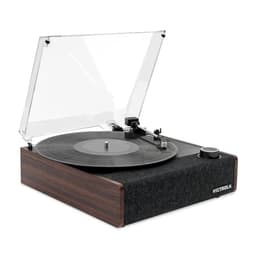
- A replaceable magnetic cartridge, named by Victrola.The Eastwood II publishes an Audio-Technica AT-3600LA — the same family of pickup fitted to entry component decks. A sealed ceramic cartridge, which the cheapest players in this class use, tracks heavier and cannot be replaced, so the player degrades until it is thrown away.
- A way for the sound to leave the cabinet. Bluetooth out, an RCA output or a headphone jack all count. This is the single feature that turns a one-box player into a first step rather than a dead end, because the built-in speakers are the hard ceiling on every player here.
- What the maker will put in writing.Where Victrola publishes a figure we quote it. Where it does not — and it does not publish speaker sizes, amplifier power, tracking force or stylus profile for any of these — the spec table says so instead of guessing.
- Live price at the last refresh, with the as-of date on every button. No number on this page was typed into the copy.
The suitcase question, answered honestly
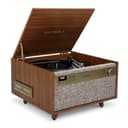
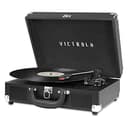
One pick here is a suitcase player, and this site has written at length on whether suitcase record players are bad. The short version: the thing that damages records is a heavy-tracking, non-replaceable ceramic cartridge, and the cheapest players in this format use one. A suitcase is a fine way to play an ordinary record in a bedroom, and a poor way to play a pressing you care about.
So the Journey is the budget pick, named as such, with that caveat attached rather than hidden. If your records are charity-shop copies and the point is portability and $60, it does the job. If the collection includes anything you would be upset to wear out, spend up to the Eastwood II or step outside the category entirely.
Victrola against a component deck
This is the comparison most buyers are actually making, and the honest answer depends on one thing: do you own speakers?
If you do not, a Victrola is a complete system for the price of a deck alone, and the convenience is real. If you do — or if you would buy a pair — the Audio-Technica AT-LP60X at a similar price is a better turntable in every mechanical respect: a published switchable phono stage, full automation, and a deck you can wire into anything. It also makes no sound on its own. Our Audio-Technica vs Victrola comparison puts the two side by side on the row that decides it, and turntables with speakers prices the separates route as a whole system.
One more route worth knowing. Because the Eastwood II has Bluetooth out, you can buy it now and add a Bluetooth speaker later without replacing the player. That is the cheapest upgrade path in this whole category and it is the main reason the Eastwood II is ranked first.
What to buy with it
Two things, both cheap. A stylus brush and a record brush: the pickup on these players is as vulnerable to dust as any other, and our accessories under $25 page covers the whole maintenance layer. And a replacement styluswhen the first one has its hours on it — for the AT-3600LA family that is an ATN3600 tip, which our replacement styli under $50 page covers, including the elliptical version that is a genuine upgrade over the stock conical tip.
What not to buy: a counterweight, a mat or an isolation platform. None of these players has an adjustable arm to balance, and the cabinet is the resonance path rather than the surface underneath it. Spend the money on records.
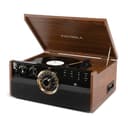
Two of these cabinets also hold a cassette deck, which is a reason people choose them over a conventional deck and a specification almost nobody publishes properly. Our best record players with a cassette deck page ranks the Victrolas against the Crosley and Jensen cabinets on what each maker states about the tape transport.