Audio-Technica vs Victrola: Which Should You Buy?
These two brands are cross-shopped constantly and they are not really competing. One sells a turntable that needs speakers; the other sells a box that needs nothing. The cartridge row is where the real difference lives.
How this is funded: we earn a commission if you buy through our links, at no extra cost to you. It never changes which product we recommend, and we’ll tell you plainly when to skip one. Full disclosure.
The short answer: buy the Audio-Technica if you have, or will buy, something to play it through — it is a real turntable with a replaceable cartridge and a switchable preamp. Buy the Victrola Eastwood II if you want one object that plays a record out of the box with nothing else in the house, and accept that the sound ceiling is set by the speakers in the plinth. What you should not do is compare the two on price alone, because one of those prices includes speakers and the other does not.
They are not the same kind of product
This comparison gets asked constantly, and the reason it is confusing is that the two brands sell different things that sit on the same shelf in the same price band.
Audio-Technica sells component turntables. An AT-LP60X produces an electrical signal and nothing else. It has a switchable built-in phono preamp, which is the feature that lets it drive powered speakers directly, but you still have to own those speakers. In exchange you get a deck built around a cartridge Audio-Technica also sells separately, on a chassis the company designs as the entry rung of a range that runs up to adjustable-arm decks.
Victrola sells all-in-one players. The Eastwood II has the amplifier and the speakers inside the same cabinet as the platter. Plug it in, drop the stylus, hear music. That is a genuine feature and the reason the category exists — our all-in-one picks rank the class honestly rather than dismissing it.
So the first question is not “which brand is better” but do you own speakers? If yes, the Audio-Technica is almost always the better buy. If no, and you are not buying any, the all-in-one is doing a job the turntable cannot do at all.
The cartridge row is the one that matters
Victrola’s reputation comes from its cheap suitcase players, and it is deserved: those use a sealed ceramic cartridge that tracks at a high force and cannot be upgraded or, in most cases, replaced. A ceramic pickup pressing into a groove is what people mean when they say a player “eats records”. We rank one of those decks — the Journey — and we say the same thing on its card.
The Eastwood II is a different product from the same brand, and the difference is exactly this row: Victrola fits a replaceable Audio-Technica cartridge. That means a worn stylus is a part you buy rather than a player you throw away, and it means the tracking behavior is in the same family as the AT-LP60X’s rather than a generation behind it. If you take one thing from this page, take this: judge any player in this price band on whether the cartridge is replaceable, not on the badge.
The AT-LP60X publishes an AT3600L conical cartridge with a replaceable stylus, and Audio-Technica publishes two styli for that body — the conical ATN3600LC at roughly 300 to 500 hours, and the elliptical ATN3600LE at about 300 hours, which is the one real upgrade available for the deck. Both are published at the same 3.0 to 4.0 g tracking force, because the arm sets the force rather than the cartridge. Our cartridges for Audio-Technica decks page explains why that deck takes no cartridge at all, only a stylus.
What neither of them can do
Both decks use a fixed tonearm: no counterweight, no anti-skate, no tracking-force dial. That is the trade for automation and for the price, and it is the honest ceiling on both products. You cannot set the tracking force your cartridge specifies, you cannot fit a different cartridge, and you cannot correct a mistracking problem by adjustment — the arm is what it is.
That matters more than any brand argument. A deck with an adjustable arm lets you balance it properly, confirm the force with a gauge, and fit a better cartridge when the first one wears out. The cheapest deck we rank that does all three is the Fluance RT81, and the step from a fixed arm to an adjustable one is the most meaningful upgrade in this whole category — AT-LP60X vs Fluance RT81 puts exactly that choice side by side.
Sound: what each one is limited by
We have not heard either deck and we publish no listening comparison. What can be said from the published specifications is where each one’s ceiling comes from, and the ceilings are in different places.
The Audio-Technica’s ceiling is its cartridge and arm: a conical stylus reads less of the groove wall than an elliptical, and a fixed arm cannot be optimized. Everything downstream is your choice, so the same deck through $400 speakers sounds like a different machine from the same deck through $80 ones.
The Victrola’s ceiling is its speakers, and it is a hard one: small drivers in the same cabinet as a spinning platter, with no room for a real cabinet volume. No cartridge upgrade changes that. What the Eastwood II does offer is a way around it — Bluetooth out, so the player can send the record to a bigger speaker once you own one. That single feature is why we rank it above the sealed all-in-ones, and why it is the all-in-one we would actually give someone.
Which to buy, by situation
- You already own a Bluetooth speaker, a soundbar or any amplifier. Buy the Audio-Technica. The built-in preamp means it connects to almost anything, and you are not paying twice for speakers you already have.
- You own nothing and want to play records tonight. Buy the Eastwood II. It is the all-in-one with a replaceable cartridge and a route out through Bluetooth, which is as future-proof as this category gets.
- You are buying a gift and do not know what they own. The all-in-one is the safer gift for exactly that reason — it cannot arrive incomplete. Our gift guide works through the same question.
- You are building a system you intend to keep. Buy neither: start at a deck with an adjustable counterweight and anti-skate, and put the difference into speakers. Our picks under $300 are where that line sits.
- You have inherited valuable records. Buy neither, for the reason in the section above: a fixed arm cannot be set to the force a cartridge specifies, and worn or mistracking styli are what actually damage records. Our do cheap turntables ruin records guide covers the evidence.
What to add, whichever you choose
If you buy the Audio-Technica, the next purchase is speakers — our speaker picks start at the pairs that cost less than the deck, and our receiver connection guide covers the case where you already own an amplifier and want to use it. If you buy the Victrola, the next purchase is not an upgrade at all: it is a cleaning kit and a set of inner sleeves, because on a fixed-arm player the thing you can most improve is the condition of the records going onto it.
The spec matrix
The AT-LP60X against the Victrola Eastwood II - the strongest deck each brand offers at the price most people are comparing them at. The rows that decide it are the cartridge, the built-in speakers and what you still have to buy.
| Specification | AT-LP60XAudio-Technica | Eastwood IIVictrola |
|---|---|---|
| What it is | Component turntable - needs speakers or an amplifier | All-in-one player with speakers built into the plinth |
| Drivesame | Belt drive | Belt drive |
| Operation | Fully automatic | Not published |
| Cartridge | Audio-Technica AT3600L, conical, replaceable stylus | Audio-Technica, replaceable |
| Tonearm adjustmentsame | Fixed arm - no counterweight or anti-skate | Fixed arm |
| Built-in preamp | Yes - switchable | Yes |
| Built-in speakers | No | Yes |
| Bluetooth | No | In and out |
| Speeds | 33 1/3 and 45 RPM | 33 1/3, 45 and 78 RPM |
| USB output | No | Not published |
| What you still have to buy | Powered speakers, or an amplifier and passive speakers | Nothing |
Every value is read from the maker’s published specification or the retail listing cited under each product below, on the date shown there. Not published means that maker does not state the figure — it is not an estimate of ours. Prices are live on each button and dated. “Not published” means the figure is not stated in the sources cited below — it is never a value we estimated. Rows marked same are the ones where these decks do not differ.
Both decks, with live prices
One is a turntable and one is a complete system, so the sticker prices are not comparing the same thing: add speakers to the left-hand column before you judge it.
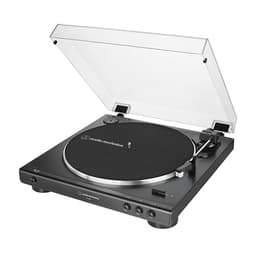
Audio-Technica AT-LP60X
A safe, genuinely automatic first deck under $200
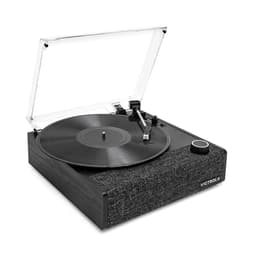
Victrola Eastwood II
An all-in-one you won't have to throw away later
Price as of October 12, 2026. #ad How we’re funded
Frequently asked questions
Is Audio-Technica better than Victrola?
For records you care about, yes - but they are not really the same product. An Audio-Technica AT-LP60X is a component turntable with a replaceable AT3600L cartridge that needs speakers or an amplifier to make sound. A Victrola Eastwood II is an all-in-one with speakers in the box. If you want the best playback, the Audio-Technica plus powered speakers wins. If you want one object that plays a record on the day it arrives, the Victrola does something the Audio-Technica cannot.
Are Victrola turntables bad for your records?
It depends entirely on which Victrola. The cheap suitcase players use a sealed ceramic cartridge that tracks at a high force and cannot be upgraded, and we would not put a record we valued on one. The Eastwood II is a different proposition: Victrola fits a replaceable Audio-Technica cartridge, which is the single thing that separates a player you can live with from one you cannot. Buy on the cartridge row, not the brand.
What is the difference between the AT-LP60X and a Victrola?
The AT-LP60X is a turntable only - no speakers - with a fully automatic belt drive, a switchable built-in phono preamp and an Audio-Technica AT3600L conical cartridge whose stylus you can replace. The Victrola Eastwood II has speakers and a preamp built in, adds Bluetooth in and out and a third speed, and also uses a replaceable Audio-Technica cartridge. The AT needs something to play through; the Victrola needs nothing.
Do I need speakers for an Audio-Technica turntable?
Yes. Every Audio-Technica deck we rank is a component turntable: it produces a signal, not sound. The cheapest complete route is a pair of powered speakers, because the AT-LP60X's built-in preamp means nothing else is needed in between. The alternative is an amplifier or receiver plus passive speakers, which costs more and sounds better as you climb.
Which is better for a beginner?
If someone wants to play a record this evening with no further purchases and no decisions, the all-in-one is the honest answer and nobody should be made to feel bad about it. If they already have a Bluetooth speaker or any amplifier, or they are buying records they intend to keep, the AT-LP60X plus the speakers they own is both cheaper in the long run and kinder to the records.
Can you upgrade a Victrola?
Within limits, and the limit is the arm. On the Eastwood II you can replace the stylus, because Victrola fitted an Audio-Technica cartridge rather than a sealed ceramic one, and you can send the signal to a better speaker over Bluetooth out. What you cannot do on either brand's entry decks is fit a different cartridge or adjust tracking force, because both use a fixed arm with no counterweight.
Does the Victrola play 78s and the Audio-Technica not?
The Eastwood II publishes 33 1/3, 45 and 78 RPM; the AT-LP60X publishes 33 1/3 and 45 only. But the speed is only half of what a 78 needs: shellac records have a much wider groove and want a stylus cut for it, which neither deck ships with. A three-speed selector on a player with a microgroove stylus is not the same thing as 78 RPM playback.
What should I buy instead of both?
If the budget stretches, a deck with an adjustable counterweight and anti-skate - the Fluance RT81 is the cheapest one we rank - plus powered speakers. That combination lets you set tracking force to the figure the cartridge maker publishes and fit a better cartridge later, which is the point at which a turntable stops being a sealed appliance and starts being a system.
Sources
- Audio-Technica — AT-LP60X turntable — Manufacturer specs for the fully automatic belt-drive AT-LP60X (accessed August 11, 2026)
- Audio-Technica — AT-LP60X user manual — The light end of the same question: 359.5 mm (14.15 in) wide x 97.5 mm (3.84 in) high x 373.3 mm (14.70 in) deep, 2.6 kg (5.73 lb). It fits every platform here with room to spare — and at about 1.4 lb per corner it sits below the load range every compliant isolator on this page publishes (accessed September 11, 2026)
- Audio-Technica — ATN3600LC replacement stylus — The replacement conical stylus for the AT3600L cartridge fitted to the AT-LP60X, and the only place Audio-Technica publishes that cartridge's tracking-force range: "Vertical Tracking Force 3.0 to 4.0 g (3.5 g standard)"; "Conical bonded", 0.6 mil; stylus life "Approx. 300-500 hours"; compatible with the AT-LP60X series, AT-LP60 series, AT-LP2D series, AT-PL300 series, AT-SB727, AT-SB2022, AT-LPGO-BT and AT-PL50 (accessed September 18, 2026)
- Audio-Technica — ATN3600LE elliptical replacement stylus — The AT-LP60X's one upgrade rung, from the maker: "This elliptical bonded stylus makes it easy to upgrade the sound quality of any turntable equipped with an ATN3600L or ATN3600LC conical stylus, such as the turntables in our popular AT-LP60X series"; stylus shape "Elliptical bonded", dimensions "0.3 x 0.7 mil"; "Vertical Tracking Force 3.0 to 4.0 g (3.5 g standard)"; stylus life "Approx. 300 hours"; the same compatibility list as the ATN3600LC. Read alongside the VM95C page, this is the fact the comparison turns on: the LP60X's elliptical option still tracks at 3.5 g, because the force is set by the arm and the cartridge body it was designed for, not by the stylus (accessed September 18, 2026)
- Crutchfield — How to choose the right turntable — Buying-guide reference on drive type, cartridges, preamps and setup (accessed July 24, 2026)
- Library of Congress — Caring for and cleaning grooved discs — Preservation guidance on cleaning and storing records to prevent damage (accessed July 24, 2026)
- Elusive Disc — Elliptical or Shibata stylus, and when to replace one — Retailer reference: "Replace the stylus every 800-1000 hours (dependent on usage and model)" (accessed August 19, 2026)
- What Hi-Fi? — Moving magnet vs moving coil cartridges — On the output-level and detail trade-off between MM and MC cartridges (accessed July 24, 2026)
Keep reading
Best All-in-One Record Players
If the Victrola side of this comparison is winning, this is the field it sits in.
See the picksAudio-Technica AT-LP60X Review
The deck on the left of the table, in full, including what the fixed arm costs.
Read the reviewAre Suitcase Record Players Bad?
The cheaper Victrolas, and the cartridge figures behind the reputation.
Read the guideBest Turntables for Beginners
Where both of these sit against the decks with an adjustable arm.
See the picks