Victrola Eastwood II Review
The all-in-one this site is willing to recommend, and the published reason why: a belt drive and a replaceable Audio-Technica cartridge instead of a sealed ceramic pickup.
How this is funded: we earn a commission if you buy through our links, at no extra cost to you. It never changes which product we recommend, and we’ll tell you plainly when to skip one. Full disclosure.
The short version
Victrola Eastwood II
Buy it as a complete, honest first record player with a way out. Do not buy it as a deck you will keep, and do not buy it for records you care about.
Strengths
- Uses a replaceable Audio-Technica cartridge rather than a sealed ceramic one
- Bluetooth OUT lets you send records to a proper speaker as you upgrade
- Built-in speakers and preamp — genuinely plug-and-play
Trade-offs
- Built-in speakers are convenient, not hi-fi — the sound ceiling is low
- Not the deck for a collector who wants the best from valued pressings
| Type | All-in-one with built-in speakers |
|---|---|
| Drive | Belt drive |
| Cartridge | Audio-Technica AT-3600LA (replaceable) |
| Bluetooth | 5.1, listed as both an input and an output |
| Built-in preamp | Internal, for its own speakers; RCA output level not published |
| Speeds | 33 1/3, 45 and 78 RPM |
| Outputs | Bluetooth, headphone, RCA |
| Cabinet | MDF and plastic, 12.83 x 12.09 x 4.53", 5 lb |
| Power | DC 5 V / 1.0 A |
Specifications read from the manufacturer / product listing, accessed 2026-10-19. We have not measured this unit — what we do instead.
Price as of November 2, 2026. #ad How we’re funded
What it is, in one paragraph
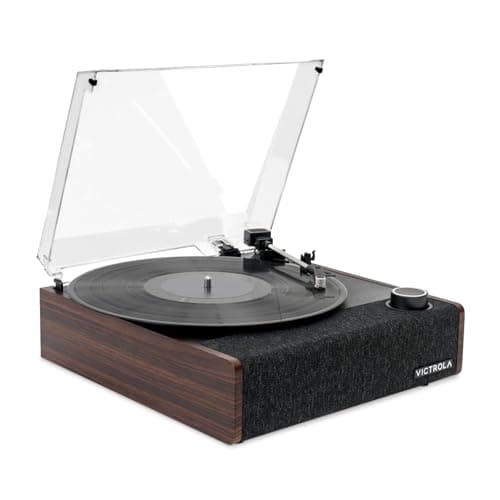
The Eastwood II is an all-in-one record player: a belt-driven three-speed turntable at 33 1/3, 45 and 78 RPM with an Audio-Technica AT-3600LA cartridge, built-in speakers behind a fabric grille, a removable dust cover and Bluetooth 5.1 listed as both an input and an output, in an MDF and plastic cabinet measuring 12.83 x 12.09 x 4.53 inches and weighing 5 lb. Victrola sells it as VTA-74 in black, espresso and oak. We have not handled one. Every figure on this page comes from Victrola’s own published specifications, cited in Sources, and the rows Victrola leaves blank are left blank here too.
The two published rows that earn it a recommendation
This site is hard on all-in-one players, and our page on whether suitcase record players are bad explains why: the cheap ones use a sealed ceramic pickup at a high tracking force, which wears a groove every time it plays. The Eastwood II is on the right side of that line, and the reason is two rows on Victrola’s own spec sheet.
First, the cartridge is an Audio-Technica AT-3600LA— a real moving-magnet pickup with a replaceable stylus, from the same family fitted to entry-level component turntables including the AT-LP60X. That single row changes the ownership story completely. A sealed ceramic cartridge is a consumable you cannot replace, so the player degrades until you throw it away; a replaceable stylus means a worn needle is a ten-minute fix rather than a new purchase, and our page on how often to replace a stylus applies to this player the same as to a $500 one.
Second, it is belt drivenrather than using the direct-coupled motor arrangements common at this price. Victrola publishes “BELT-DRIVEN 3-SPEED” in its specification block. A belt is a consumable too, but it is also a mechanical isolator between the motor and the platter — which is the whole argument in our belt drive vs direct drive explainer, and it matters more at this price than at any other.
Add the Bluetooth output and you have the thing almost no cheap all-in-one offers: a way out. When the built-in speakers stop being enough, the player sends records to a real speaker instead of becoming landfill. That is why it holds a pick on our all-in-one roundup and on turntables with speakers.
What Victrola does not publish, and why we are saying so
Four absences matter, and on a page about a $150 player they matter more than the figures that are present.
- No speaker specification at all.Victrola describes “built-in, custom tuned speakers” and publishes no driver size, no power rating and no frequency response. So there is no way to tell you how this player sounds from its spec sheet, and we will not invent a figure. Treat the built-in speakers as adequate-and-convenient — the category ceiling is low and a 5 lb cabinet containing a platter cannot do much about bass.
- No tracking force and no stylus profile. The cartridge model is published; what the arm applies to the groove is not. On a deck with an adjustable counterweight you would set this yourself. Here you cannot, and you cannot check it against a published target either.
- No statement of the RCA output level.Victrola lists outputs as “BLUETOOTH, HEADPHONE, RCA” and never says whether the RCA is line level or phono level. For anyone wiring this into an amplifier, that is the one fact you need, so: try a line input (AUX, CD, TAPE) first; if it is thin and quiet, move it to PHONO. See phono vs line for why those two sound so different.
- No auto-stop, and no wow-and-flutter or rumble figure.None of these appears on Victrola’s page. The absence of a mechanical-accuracy figure is normal for the whole all-in-one class — it is one of the findings our roundup of that class is built on — but it does mean the only performance claims available for this player are the two component choices above.
The 78 RPM trap
The spec sheet says three speeds, and one of them is 78. That reads like a feature and is mostly a limitation worth understanding. A shellac 78 has a far wider groove than a vinyl LP and needs a correspondingly wider stylus — a 3.0 mil conical tip against the roughly 0.6 mil of an LP stylus. The AT-3600LA is an LP pickup.
So the Eastwood II will spin a 78 at the right speed and will track it with a stylus that rattles around in a groove built for something larger. You get sound; you do not get the record played properly, and you risk the shellac. Our page on turntables for 78 RPM records explains why the third speed is the easy half of that purchase and the cartridge is the hard half. If 78s are the point, this is not the player.
Where it sits against the alternatives
Against a cheap suitcase player, the Eastwood II wins on the two rows that decide whether your records survive, and it is not close. This is the comparison the player exists to win.
Against a component deck at the same money — the AT-LP60Xis the obvious one — the Eastwood II loses on sound and wins on completeness. The AT-LP60X is the better turntable: a published switchable phono stage, a published automatic mechanism, a deck you can wire into anything. It also makes no sound on its own. By the time you add powered speakers you have spent meaningfully more and gained a system that will still be worth owning in five years. That is the real decision, and the honest version of it is: if you own or want speakers, buy the component deck; if you want to play a record tonight with nothing else in the house, buy this.
Against the other all-in-ones, its advantage is specifically the published Audio-Technica cartridge plus Bluetooth out. Plenty of players in this bracket have one or the other. Our all-in-one roundup compares them on what each maker will actually put in writing, which in this category is a short list.
As a gift, it is one of the safest purchases in the category, because it needs nothing on the day it is opened and it does not need the giver to know what the recipient owns. That reasoning, and the cases where it is the wrong gift, are on our turntable gift guide.
Who should buy it, and who should not
Buy itas a first record player for someone with no speakers, no amplifier and no intention of acquiring either this year — or as a second player for a kitchen, a workshop or a teenager’s room where a component system makes no sense. The published belt drive and the replaceable Audio-Technica pickup mean it treats ordinary records decently, the Bluetooth output means it stays useful after the built-in speakers wear out their welcome, and the whole thing costs less than a decent cartridge.
Do not buy itif you already own speakers — the money is better spent on a component deck and a phono preamp. Do not buy it for a collection you care about: with no published tracking force and no adjustable counterweight, valuable pressings belong on something you can set up, and our picks under $300are where that starts. And do not buy it expecting the built-in speakers to be the end of the story, because Victrola publishes nothing about them at all — which is itself the clearest signal on the page.
Frequently asked questions
Is the Victrola Eastwood II any good?
For what it is, yes - and "what it is" matters. Victrola publishes a belt-driven three-speed turntable with an Audio-Technica AT-3600LA cartridge, built-in speakers and Bluetooth 5.1 listed as both an input and an output. Those two published rows, the belt drive and the replaceable Audio-Technica pickup, are what separate it from the sealed-ceramic suitcase players this site warns against. It is a genuinely reasonable first player. It is not a hi-fi deck and Victrola does not claim it is.
Will the Eastwood II damage my records?
Far less than a ceramic suitcase player will, because the cartridge is a real replaceable moving-magnet type - Victrola publishes it as an Audio-Technica AT-3600LA. That is the same family of pickup fitted to entry-level component decks. What Victrola does NOT publish is a tracking force figure or a stylus profile, so we cannot tell you the exact number the arm applies. The practical rule stands: replace the stylus when it has its hours on it, and keep genuinely valuable pressings for a deck with an adjustable counterweight.
Can I connect the Eastwood II to external speakers?
Two published ways. Victrola lists Bluetooth 5.1 as an output - its VINYLSTREAM feature sends records to any Bluetooth speaker - and it lists an RCA output on the back. The Bluetooth route is the one most owners use and the reason this player has an upgrade path at all. One honest caveat: Victrola does not publish whether that RCA output is line level or phono level, so if you are wiring it into an amplifier, try the AUX input first and only move to PHONO if the result is too quiet.
Does the Eastwood II have a built-in preamp?
It must have a phono stage internally, because it drives its own speakers and streams over Bluetooth. What Victrola does not publish is whether the rear RCA output is taken after that stage - that is, whether it is a line output or a phono output. We are not going to guess. If you connect it to a receiver, start on a line input (AUX, CD, TAPE); if the sound is thin and quiet, the output is phono level and belongs on a PHONO input instead.
What is the difference between the Eastwood II and the Eastwood II Signature?
They are different models and Victrola lists a different pickup for each. The Eastwood II is VTA-74 and Victrola publishes an Audio-Technica AT-3600LA cartridge for it; the Eastwood II Signature is VTA-7320 and is listed with the ATN3600L. Check the model number on the listing rather than the family name, because the two share a product page family on Victrola's site and are cross-sold constantly.
Does it play 78s?
It has the speed. Victrola publishes a three-speed belt-driven turntable at 33 1/3, 45 and 78 RPM. But a shellac 78 needs a much wider stylus than a microgroove LP stylus, and the AT-3600LA is an LP pickup - so the third speed here will spin a 78 and will not track its groove properly. If 78s are the reason you are shopping, our page on turntables for 78 RPM records covers what the format actually needs.
Is the Eastwood II a good gift?
It is one of the better ones in this category, for a specific reason: the recipient needs nothing else on the day. Speakers, amplification and the phono stage are all inside, so the box plus a record is a complete present. That is why it holds the no-speakers slot on our turntable gift guide. The person who should not receive it is someone who already owns speakers - they are better served by a component deck at the same money.
Sources
- Victrola — Eastwood II, published specifications — The maker's own Specifications block, read live on this date: power input "DC 5V/1.0A", turntable "BELT-DRIVEN 3-SPEED" at 33 1/3, 45 and 78 RPM, inputs "BLUETOOTH", outputs "BLUETOOTH, HEADPHONE, RCA", cartridge "AUDIO TECHNICA AT-3600LA", Bluetooth version "5.1", materials "MDF AND PLASTIC", dimensions "L 12.83" X W 12.09" X H 4.53" (32.6 CM x 30.7 CM x 11.5 CM)", weight "5 LBS | 2.27 KGS", colors "Black - VTA-74-BL; Espresso - VTA-74-ESP; Oak - VTA-74-OAK", plus "Built-in, custom tuned speakers" and a "Removable dust cover" in Features & Benefits. What Victrola does NOT publish, recorded because the review is built around it: no speaker driver size, no amplifier power rating, no stylus profile, no auto-stop, no tracking force, and no statement of whether the RCA output is line level or phono level. A separate model, the Eastwood II Signature (VTA-7320), is listed with a different pickup - do not merge the two (accessed November 2, 2026)
- Audio-Technica — ATN3600LC replacement stylus — The replacement conical stylus for the AT3600L cartridge fitted to the AT-LP60X, and the only place Audio-Technica publishes that cartridge's tracking-force range: "Vertical Tracking Force 3.0 to 4.0 g (3.5 g standard)"; "Conical bonded", 0.6 mil; stylus life "Approx. 300-500 hours"; compatible with the AT-LP60X series, AT-LP60 series, AT-LP2D series, AT-PL300 series, AT-SB727, AT-SB2022, AT-LPGO-BT and AT-PL50 (accessed September 18, 2026)
- Audio-Technica — ATN3600LE elliptical replacement stylus — The AT-LP60X's one upgrade rung, from the maker: "This elliptical bonded stylus makes it easy to upgrade the sound quality of any turntable equipped with an ATN3600L or ATN3600LC conical stylus, such as the turntables in our popular AT-LP60X series"; stylus shape "Elliptical bonded", dimensions "0.3 x 0.7 mil"; "Vertical Tracking Force 3.0 to 4.0 g (3.5 g standard)"; stylus life "Approx. 300 hours"; the same compatibility list as the ATN3600LC. Read alongside the VM95C page, this is the fact the comparison turns on: the LP60X's elliptical option still tracks at 3.5 g, because the force is set by the arm and the cartridge body it was designed for, not by the stylus (accessed September 18, 2026)
- Crutchfield — How to choose the right turntable — Buying-guide reference on drive type, cartridges, preamps and setup (accessed July 24, 2026)
Keep reading
Best All-in-One Record Players
Where this player sits against the rest of the category, ranked on what each maker publishes.
See the picksAre Suitcase Record Players Bad?
The honest answer, and the two published specs that separate a safe all-in-one from a record-eater.
Read the guideBest Turntables With Speakers
One box against the separates route, priced as whole systems rather than as decks.
See the picksBest Turntable to Give as a Gift
Sorted by what the recipient will actually need on the day they open it.
See the picks