Fluance RT85 vs Audio-Technica AT-LP120X
One deck spent everything on the analog chain. The other spent part of it on doing four extra jobs. At similar money that is not a better-or-worse question — it is a what-is-this-for question.
How this is funded: we earn a commission if you buy through our links, at no extra cost to you. It never changes which product we recommend, and we’ll tell you plainly when to skip one. Full disclosure.
These two decks are cross-shopped constantly and they are not competitors in any useful sense. The Fluance RT85 is a single-purpose listening machine: a belt-drive deck with an isolated speed-control motor, a 1.56 kg acrylic platter, an Ortofon 2M Blue fitted from the factory, and no electronics in the signal path at all. The Audio-Technica AT-LP120XUSB is a multi-purpose machine: direct drive, three speeds, a pitch fader, a USB output, and a switchable phono stage inside.
The question that decides it: will this turntable ever do anything other than play an album through a hi-fi?
The short answer
- Buy the Fluance RT85if the answer is no, and if you already own — or will buy — a phono stage. You get the better cartridge, a platter designed to damp the record rather than ring under it, and a maker that publishes its measurements.
- Buy the AT-LP120XUSB if the answer is yes, or if you do not know yet. USB archiving, 78 RPM, a pitch control and a built-in preamp are all things the RT85 cannot be made to do later at any price.
Where the money went
At similar prices, two makers made opposite decisions, and the specification table shows it row by row.
Fluance spent it on the analog chain. The 2M Blue is a genuinely upmarket cartridge — Ortofon publishes a nude ellipticalstylus at r/R 8/18 um, 5.5 mV output, 25 dB channel separation at 1 kHz, and a 20–20,000 Hz response held to +2 / −1 dB. The platter is 1.56 kg of acrylic, a material chosen because its resonant behaviour is close to vinyl’s, so it absorbs stylus energy instead of returning it. And there is deliberately nothing electronic between the cartridge and the RCA sockets.
Audio-Technica spent it on capability. A direct-drive DC servo motor, 33 1/3, 45 and78 RPM, variable pitch with quartz speed lock, a balanced S-shaped arm with hydraulically damped lift and a lockable rest, a class-compliant USB output, and a switchable phono preamp. The cartridge is the AT-VM95E: an elliptical at 4.0 mV, tracking at 1.8–2.3 g — good, and a rung below the 2M Blue.
The rows we could not fill
Three cells in the matrix above are blank on the Audio-Technica side: platter, wow and flutter, signal-to-noise. That is not laziness, and it is worth explaining because it is a small lesson in reading spec sheets.
Fluance publishes a full specification table on its own product page: platter material, mass and thickness; tonearm effective length and effective mass; headshell weight; wow and flutter; a weighted signal-to-noise figure. We read all of it and cited it below.
Audio-Technica does publish comparable figures — in the printed manual — but its website returns a 403 to any automated request, and the live product listing we can read states none of them. So we left those cells empty rather than copy a number from a third party who might have transcribed it wrong, or worse, estimate one. If you want those figures, they are in the box with the deck. What we will say is the meta-point: a maker that puts its measurements where a buyer can find them is telling you something, and Fluance does.
Direct drive versus a heavy platter
These two decks solve the same problem — hold 33 1/3 RPM steady for twenty minutes while a stylus drags on the record — in opposite ways, and both approaches are legitimate.
The Audio-Technica puts the platter directly on a servo-controlled motor that corrects speed continuously and locks it to a quartz reference. Speed arrives instantly, holds under load, and there is no belt to stretch, age or replace. That is why DJs use decks shaped like this one, and it is genuinely useful to a listener in one place: digitizing, where any drift is baked into the file permanently.
The Fluance isolates its motor from the platter with a belt, so motor vibration has to cross a compliant rubber loop before it can reach the stylus, and then leans on 1.56 kg of rotational inertia to smooth what the servo cannot. The published result is 0.07% wow and flutter, which is a good figure at any price. The cost is a consumable: belts age and eventually need replacing.
Neither approach wins in the abstract at this money, and our full guide to the trade-off covers the old objection about motor noise and why modern designs largely engineer it out.
The preamp is the biggest practical difference
The AT-LP120XUSB has a switchable built-in phono preamp. The RT85 has none, and Fluance says so plainly in its own table.
This is the difference that changes what you actually spend. The Audio-Technica plugs into powered speakers, a soundbar input or any aux socket on the day it arrives. The Fluance needs an amplifier with a phono input, powered speakers with one built in, or a separate phono stage. If you do not have one, add that to the RT85’s price before you compare.
The counter-argument is real and it is why every deck above this price does the same thing: leaving the stage out shortens the signal path and lets you choose an amplifier matched to your cartridge, rather than accepting whichever chip the turntable maker bought. Once you own something better than a built-in stage, the omission stops being a cost and starts being the point. Until then it is a cost.
Cartridges: better now, or cheaper forever
The RT85 ships the better cartridge today. The Audio-Technica ships the better ladder.
The AT-VM95E’s body accepts Audio-Technica’s entire VM95 stylus range — conical, elliptical, micro-linear, Shibata and a 78-specific tip — as snap-on swaps that need no realignment at all. That means every upgrade for the life of the deck is a stylus rather than a cartridge, which is the cheapest genuine sound improvement available in budget vinyl. See replacement styli and what fits what.
The 2M Blue has its own ladder inside the 2M range and is already several rungs up it. Both decks make cartridge changes easy in the mechanical sense — the Fluance uses an H-4 bayonet headshell, the Audio-Technica a removable half-inch headshell — so on either one, fitting something different is a pre-aligned assembly swap rather than an evening with a protractor. Our cartridge setup guide covers what you avoid.
The things only one of them does
- 78 RPM. Only the Audio-Technica. With the usual caveat: a shellac 78 has a much wider groove than a microgroove LP, so it needs a 78-specific stylus. The VM95 family sells one; the speed setting alone is not enough.
- USB out.Only the Audio-Technica, and it is genuinely convenient — class-compliant, so free software such as Audacity records from it with nothing to install. See how to record vinyl to a computer.
- Pitch control. Only the Audio-Technica. Irrelevant to most listeners; essential if you will ever beat-match.
- A published measurement set. Only the Fluance, as above.
- A cartridge in the 2M Blue’s class, fitted. Only the Fluance.
Size, which people forget
The Audio-Technica is the bigger machine. Its listing gives 17.8 inches wide by 13.86 deep by 5.57 high and 20.15 lb; Fluance publishes 16.5 by 14.25 by 6 (plus or minus half an inch) and 16.76 lb for the RT85. The Audio-Technica is nearly an inch and a half wider and three and a half pounds heavier. Measure the shelf, and remember both dust covers need clearance to hinge open above the deck.
The decision, in one paragraph
Buy the RT85 if you have settled the rest of the system and you want the best analog chain the money buys: a nude elliptical cartridge, an acrylic platter, no electronics in the path, and a maker that publishes what its deck measures. Buy the AT-LP120XUSB if the deck has to earn its shelf space in more than one way, or if the phono stage is not solved yet — it is the only one of the two that works out of the box, and versatility is worth something real while you are still finding out what kind of listener you are. The failure case is buying the RT85, discovering nothing plugs into anything, and running it through whatever preamp was cheapest that week. That is the version where the more expensive deck sounds worse.
The spec matrix
Three rows are blank on the Audio-Technica side, and that is a finding rather than an omission — see 'The rows we could not fill' below.
| Specification | RT85Fluance | AT-LP120XUSBAudio-Technica |
|---|---|---|
| Drive | Belt drive, isolated speed-control motor | Direct drive, DC servo motor |
| Operationsame | Fully manual | Fully manual |
| Speeds | 33 1/3 and 45 RPM | 33 1/3, 45 and 78 RPM |
| Pitch control | Not fitted | Variable pitch, quartz speed lock |
| Cartridge | Ortofon 2M Blue | Audio-Technica AT-VM95E |
| Stylus | Nude elliptical, r/R 8/18 um | Elliptical |
| Cartridge output | 5.5 mV | 4.0 mV |
| Tracking force | 1.6-2.0 g (1.8 g recommended) | 1.8-2.3 g |
| Headshell | H-4 bayonet, 9 g, removable | Removable half-inch headshell |
| Anti-skatesame | Yes — adjustable | Yes — adjustable dynamic |
| Platter | Acrylic, 12 in, 1.56 kg, 16 mm | Not published |
| Wow and flutter | 0.07% | Not published |
| Signal to noise | 69 dB (weighted) | Not published |
| Built-in preamp | No — external stage required | Yes — switchable |
| USB output | No | Yes |
| Dimensions (H x W x D) | 6 (+/-0.5) x 16.5 x 14.25 in | 5.57 x 17.8 x 13.86 in (listing) |
| Weight | 16.76 lb (7.6 kg) | 20.15 lb (listing) |
RT85 figures are Fluance’s own published specification table. AT-LP120XUSB figures are read from the live Amazon listing (2026-09-03) and from Audio-Technica’s own accessible pages for the VM95E and for headshell fitment; Audio-Technica’s product pages answer automated requests with a 403, so nothing there was assumed. See Sources below. “Not published” means the figure is not stated in the sources cited below — it is never a value we estimated. Rows marked same are the ones where these decks do not differ.
Both decks, with live prices
These two often land close on price. Compare total system cost rather than sticker price — only one of them needs a phono preamp on top.
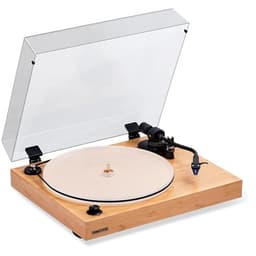
Fluance RT85
The most cartridge and platter per dollar under $600
Price as of October 22, 2026. #ad How we’re funded
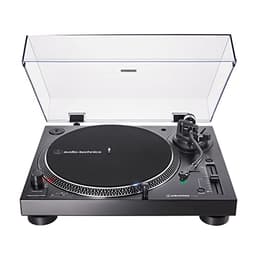
Audio-Technica AT-LP120XUSB
Digitizing records and learning proper setup
Frequently asked questions
Is the Fluance RT85 better than the AT-LP120XUSB?
For playing albums through a system that already has a phono stage, yes — the RT85 puts its whole budget into the analog chain and ships an Ortofon 2M Blue with a nude elliptical stylus on a 1.56 kg acrylic platter. For anything else, no. The AT-LP120XUSB digitizes records over USB, plays 78s, has a pitch control and brings its own switchable phono preamp, and the RT85 does none of those things.
Which one has the better cartridge?
The RT85's, on the published numbers. Ortofon's 2M Blue has a nude elliptical stylus — the diamond is the whole tip — with 5.5 mV output and 25 dB channel separation. Audio-Technica's AT-VM95E is an elliptical at 4.0 mV. The AT wins on upgrade path, though: the VM95 body accepts the whole VM95 stylus range, conical to Shibata, as snap-on swaps with no realignment.
Do I need a phono preamp for the Fluance RT85?
Yes. Fluance's own table says 'No - Separate Phono Preamp Required'. The AT-LP120XUSB has a switchable one built in, so it plugs into powered speakers or a line input as it comes. That difference is worth real money — add the price of a phono stage to the RT85 before you compare the two.
Is direct drive better than belt drive here?
It is better at two specific things: reaching speed instantly and holding it across a long side, and providing torque. Neither is a general sound-quality claim at this level, where setup and cartridge dominate. Speed stability matters most on sustained piano and strings, and when digitizing — a drift becomes a permanent property of the file. The RT85's answer is a 1.56 kg acrylic platter whose inertia does much of the same job, and a published 0.07% wow and flutter to show for it.
Which is better for recording vinyl to a computer?
The AT-LP120XUSB, decisively. It has a class-compliant USB output that a computer sees as an audio input with no drivers, plus direct-drive speed stability. The RT85 has no digital output at all, so digitizing from it means running its analog output through a phono stage into a separate audio interface.
Why does the comparison table have blank cells for the AT-LP120XUSB?
Because we will not invent numbers. Audio-Technica publishes wow and flutter and signal-to-noise figures for this deck in its printed manual, but its website returns a 403 to any automated request and the live Amazon listing does not state platter material, wow and flutter or signal-to-noise. Fluance publishes all three. That asymmetry is worth knowing on its own — one maker puts its measurements where a buyer can read them and the other does not.
Which is the better first serious turntable?
The AT-LP120XUSB, for most people. It plugs into powered speakers on day one with no extra box, it survives being repurposed later, and its cartridge upgrade path is the cheapest in budget vinyl. The RT85 is the better answer once you know you are a listener rather than a tinkerer, and once you own the phono stage it assumes.
Sources
- Fluance — RT85 Reference turntable, published specifications — Manufacturer specification table: 0.07% wow and flutter, 69 dB weighted S/N, acrylic platter 1.56 kg / 16 mm, static balanced S-type aluminum arm 224 mm / 27.5 g, H-4 bayonet headshell, Ortofon 2M Blue 0.3 x 0.7 mil nude elliptical, no built-in preamp, 7.6 kg (accessed September 3, 2026)
- Ortofon — 2M Blue — Manufacturer page for the nude elliptical 2M Blue and its stylus interchangeability (accessed August 11, 2026)
- Audio-Technica — AT-VM95E cartridge — Manufacturer specs: 0.3 x 0.7 mil elliptical stylus on an aluminum cantilever, 4.0 mV output at 1 kHz / 5 cm/sec, 1.8-2.2 g tracking force (2.0 g standard), 20-22,000 Hz, 20 dB channel separation at 1 kHz, half-inch mount, AT-VMN95E replacement stylus, and the maker's own statement that "all VM95 Series share the same body" so the stylus "can be replaced with any of the six interchangeable AT-VMN95 replacement styli". Re-read on the access date below, which corrected a tracking-force range previously noted here as 1.8-2.3 g (accessed September 26, 2026)
- Audio-Technica — VM95 Series cartridges — The shared-body VM95 range and its interchangeable stylus upgrade path (accessed July 24, 2026)
- Audio-Technica — Identifying the correct headshell for your turntable — Manufacturer guidance on headshell mounts, fitment and which tonearms accept a removable headshell (accessed August 19, 2026)
- Audio-Technica — Balancing the tonearm and setting tracking force — Manufacturer procedure for zero-balancing an arm, then dialing tracking force and anti-skate (accessed August 19, 2026)
- Crutchfield — How to choose a phono preamp — On why a phono signal needs a preamp and never running two at once (accessed July 24, 2026)
Keep reading
AT-LP120XUSB vs Fluance RT82
The same argument one rung down, where the two decks cost almost exactly the same.
Compare themFluance RT85 Review
The acrylic platter and the 2M Blue examined on their own terms.
Read the reviewAudio-Technica AT-LP120XUSB Review
The full case for the versatile deck, including where it stops.
Read the reviewBelt Drive vs Direct Drive
The mechanical trade-off underneath this whole comparison, generalized.
Read the guide