How these were ranked
- Published gain, first.A phono stage’s gain in dB is what decides whether a 2.5 mV cartridge arrives at a usable level or has you running the volume knob at three-quarters all night. Only the Fosi Box X2 publishes one — 39, 42 or 45 dB, switchable. The Douk T9 publishes an input sensitivity and an output voltage instead, which is a partial answer. The T4 PRO publishes “multi-level” control with no figures, and the Box X4 publishes nothing on the subject. The table says so rather than carrying a number we calculated for a maker who did not print it.
- Which cartridges it is specified for. Three of these four are moving-magnet only. The T9 is the one with a printed moving-coil specification, and that is a real distinction rather than a marketing one: a moving-coil cartridge puts out roughly a tenth of the voltage and needs around 20 dB more gain, which our MM vs MC page explains. Our moving-coil phono preamp roundup covers the solid-state alternatives if MC is the reason you are here.
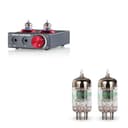
- The tube types, named. A tube stage whose maker will not say what is in the socket cannot be re-tubed with confidence, and a valve is a consumable. All four name their tubes. Two go further and publish compatible replacement families, which is the difference between tube rolling as a hobby and tube rolling as a guess.
- Whether it drives headphones, and how hard.Three of the four have a headphone jack, but only two publish a load rating. That matters more than it sounds: a 250 Ω pair of studio headphones is a very different load from a 32 Ω pair, and “has a headphone socket” is not a specification.
- Live and in stock, checked the day this page was written. Every unit here was confirmed as a live, purchasable listing before it was written about, and prices render from the live price feed with their own as-of stamp rather than from a number typed into this page.
- No claims about sound. We own none of these units. Where this page says a stage is better, it means its maker publishes more, or publishes something the others do not.
The one thing to understand before you buy a tube phono stage
At this price, a tube is a flavor, not a fidelity upgrade. That is not a criticism of the products; it is what the published figures say. The Douk T9 prints a phono THD of 0.1% or less and an 80 dB signal-to-noise ratio — respectable numbers, and nowhere near what a good solid-state stage at the same money measures. Schiit, for one, is explicit that it rates its tube and tube-hybrid gear on a looser distortion test than its solid-state gear. If your goal is the lowest noise floor and the flattest curve per dollar, a solid-state box wins and our phono preamps under $100 roundup is the better page to read.
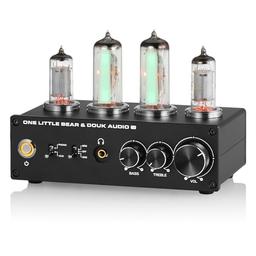
Buy a tube stage because you want the thing a tube does, or because you want the features these particular boxes bundle — tone controls, a headphone output, an aux input — which solid-state stages at the same price mostly do not. Those features are the honest reason three of the four picks below are here.
Match the stage to your setup
You run, or plan to run, a moving-coil cartridge.The Douk T9 is the only pick on this page specified for one: 0.5 mV sensitivity into a 330 Ω load, alongside the usual 5 mV into 47 kΩ for a moving magnet. The condition attached is that the 330 Ω figure is fixed, so a cartridge that asks for a particular loading is a compromise rather than a match. Worth knowing before you commit: this site currently ranks no moving-coil cartridge at all — every pick in our cartridge roundup is high-output moving magnet or moving iron, because those work with any normal MM input.
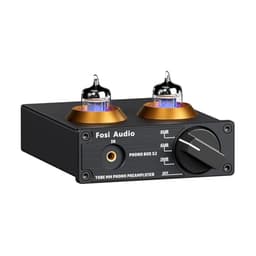
Your cartridge is quiet and your system sounds thin.Buy on gain, which means the Fosi Box X2. Its three settings — 39, 42 and 45 dB — let you match a low-output moving-magnet pickup properly instead of compensating with the volume control. It is also the cheapest pick here. What it gives up is the headphone output the other three have.
You listen on headphones.The T4 PRO publishes a 32–300 Ω rating for its headphone stage, which is the useful range: it covers both a 32 Ω consumer pair and a 250 Ω studio pair like the beyerdynamic DT 990 PRO. The T9 publishes real power figures instead — 250 mW into 32 Ω, 100 mW into 64 Ω, 60 mW into 128 Ω — which is more information but stops short of the high-impedance end. The Box X4 has a socket and publishes no load range for it. Our page on listening to vinyl with headphones covers the rest of that chain.
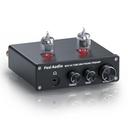
You want to roll tubes.The Box X4 is the platform, because its published listing names the families its sockets accept: 6AK5, 6AK5W, 6Zh1P and 6J1 alongside the two 5654W valves it ships with. The Box X2 is nearly as good on this count — its listing names 6K4, 6J1, 6J4, GE5654 and 6AK5 types. A warning that applies to both: the stock tubes are the cheap part of the build, and nobody publishes a measurement of what swapping them does.
You want tone controls.The T9 publishes ±10 dB of bass and treble adjustment, and the T4 PRO and Box X4 both have controls without a published range. Tone controls are unfashionable and genuinely useful on a format where pressings vary as much as vinyl does — see how to spot a bad pressing. None of them fixes a mistracking stylus, which is a setup problem, not an EQ problem.
What a tube stage does not fix
It does not fix hum. If your system buzzes, that is a grounding problem and no phono stage cures it — our turntable hum and grounding guide has the sequence to work through, and note that adding a box to the chain adds another ground path to get wrong. Every unit here takes a wall adapter rather than an internal linear supply, which is normal at this money and is one more thing to keep away from your tonearm cable.
It does not fix a worn stylus or a badly set arm either. A valve in the output cannot recover groove information a tip is no longer reading, and the money is better spent on a replacement stylus or on an hour with our turntable setup guide if either of those is in doubt.
And it does not replace a stage you already own. If your turntable has a switchable built-in preamp — most Fluance and Audio-Technica decks do — you already have a working phono stage, and these boxes are an alternative to it rather than an addition. Switch the deck’s output to LINE off and feed the tube box from the PHONO position, never both; what is a built-in phono preamp explains how to tell which you have.
One more place the money could go instead. Every box here exists to turn a cartridge signal into a line-level one, and some speakers do that job inside the cabinet — which means a tube stage is one of two ways to solve the same problem. If you are buying speakers at the same time, our alternatives to the Edifier R1280T page covers the powered pairs that include a phono input, and buying one of those removes the need for any separate stage at all. A tube box only makes sense if you want what the tube brings on top of the gain.
Two of the four stages above are Fosi boxes, and Fosi makes a third that is solid state and goes considerably further on gain — 38 to 66 dB switchable, with moving coil support. If the brand rather than the valve is what brought you here, our best Fosi Audio phono preamps page ranks all three on what Fosi publishes.